Where Street Art Gets Faked Most — and How to Buy Safely Online
To buy original street art for home decor safely online, work with a specialist dealer that authenticates every piece, publishes provenance, and stands behind the artist-appropriate authentication chain — rather than a generic marketplace listing. At Gauntlet Gallery every signed print and object is vetted before it is listed, and applicable pieces are backed by TrueCOA blockchain certification. The safest path is simple: match the artist to the correct authentication method, insist on clear provenance, and buy from a seller whose reputation depends on getting it right.
Street art is one of the most forged corners of the collectibles market precisely because it is popular, image-driven, and easy to reproduce. The same qualities that make a Shepard Fairey, Banksy, or Invader instantly recognizable also make them easy to fake convincingly at a glance. This guide breaks down which categories attract the most fakes, how forgeries actually enter the market, and the concrete steps that let you decorate your home with genuine, resale-worthy work instead of a poster dressed up as an edition.
Why Street Art Attracts So Many Fakes
Three forces converge to make this genre a magnet for counterfeits. First, the imagery is famous. Fairey's OBEY face, Banksy's rats and balloon girl, Invader's mosaic aliens, and DEATH NYC's mash-ups are globally recognized, so a fake does not need to fool an expert — it only needs to look right in a phone photo. Second, the medium is inherently reproducible. Screenprints and offset lithographs are designed to be printed in quantity, which means a bad actor can print the same image and simply omit the parts that make an original original: the artist's hand-signature, the edition numbering, the correct paper, and the provenance trail. Third, prices span a wide range. A genuine signed print can sell from a few hundred dollars into five figures, and that spread gives forgers room to price a fake just low enough to seem like a bargain but high enough to profit.
The result is a market where the visual is trivial to copy and the authentication is where all the real value lives. Understanding that distinction is the single most useful habit a new collector can build. You are not buying an image — you can get the image for the cost of a poster. You are buying a verified object with a traceable history. Our collector trust hub is built around exactly this principle.
The Categories That Get Faked Most
Fakes cluster in predictable places. If you know where the risk concentrates, you can slow down at the right moments and buy with confidence everywhere else.
1. Unsigned "prints" of famous images
The most common category by volume is the plain reproduction of a famous image sold as if it were a collectible print. These are often high-resolution digital prints of a Banksy stencil or a Fairey portrait, produced by the thousand and listed with vague language like "limited edition giclée" or "museum-quality print." They are not forgeries of a specific edition so much as decorative posters riding on a famous name. They can be perfectly nice wall art, but they carry essentially no collectible or resale value, and problems arise when a seller implies otherwise. The tell is almost always the absence of the things that define an original: no hand-signature in pencil, no fraction edition number, no credible provenance, and frequently no mention of who printed it or when.
2. Forged signatures and faked edition numbers
The more dangerous category is the genuine-looking print that has had a signature and edition number added after the fact. A forger takes an open-edition poster or an unsigned proof and pencils in a plausible autograph and a fraction like "42/450." This is harder to catch because the object now checks superficial boxes. Defeating it requires looking at how the signature interacts with the paper, whether the edition size matches the artist's documented release, and whether the provenance holds up. Signatures are studied against known genuine examples; edition numbers are cross-checked against what the artist actually produced. This is where a specialist's reference library and a dealer's accountability matter far more than a gut feeling.
3. Misrepresented reproductions and "after" works
A third category is the reproduction sold with technically-true-but-misleading language. Terms like "after Banksy," "in the style of," "certified print," or "official reproduction" are used to blur the line between a genuine artist edition and a licensed or unlicensed copy. A "certificate of authenticity" printed by the seller themselves means nothing on its own — a COA is only as good as the independent, verifiable body behind it. Buyers who read the fine print and ask "authenticated by whom, exactly?" avoid the vast majority of these traps.
4. 3D objects, stickers, and "studio" ephemera
Beyond prints, faked street-art objects — resin figures, signed skate decks, sticker packs, and small sculptures — are increasingly common because they photograph well and are hard for buyers to compare against a known reference. The same rules apply: correct markings, credible provenance, and an authentication method appropriate to that artist and format. Objects also invite a subtler problem: genuine components repackaged dishonestly. A real, unsigned skate deck can be paired with a forged autograph; an authentic figure can be sold with a fabricated "signed by the artist" story it never earned. Because objects rarely have a printed edition line to cross-check, provenance and format-specific markings carry even more of the weight than they do with paper editions.
5. "Rare proofs," test prints, and one-of-a-kind claims
A quieter but costly category is the listing that leans on scarcity language a buyer cannot verify: "artist proof," "printer's proof," "unique test print," "the only one in this colorway." These terms are legitimate when documented and dangerous when they are simply asserted. Because a genuine proof can command a premium over a standard numbered impression, forgers reach for proof language to justify both a fabricated object and an inflated price. The defense is the same as everywhere else — documentation. A real proof has a provenance trail and, ideally, is recognizable within the artist's known output. If the only evidence a piece is a rare proof is the seller saying so, price it as if that claim is worth nothing, because for verification purposes it is.
Red Flags at a Glance
The following table summarizes the warning signs we watch for and what a healthy alternative looks like. Use it as a pre-purchase checklist for any online listing.
| Red flag in a listing | Why it matters | What "safe" looks like instead |
|---|---|---|
| "Limited edition giclée / museum print" with no signature | Signals an open reproduction dressed up as a collectible | Hand-signed in pencil with a stated edition fraction |
| Seller-printed "Certificate of Authenticity" | A self-issued COA proves nothing about the object | Independent verification (e.g. TrueCOA, recognized third party, or artist-appropriate body) |
| "After [artist]" or "in the style of" | Explicitly not an original — a legal way to sell a copy | Clear statement that the work is an authentic artist edition |
| Edition number that doesn't match the known release | Suggests a fabricated or altered edition | Edition size cross-checked against documented output |
| No provenance, or "estate sale, no history" | Breaks the ownership chain that protects value | Documented chain of custody and prior sale records |
| Only cropped photos; no signature or margin shown | Hides the exact details that reveal a fake | High-resolution images of signature, numbering, paper, and margins |
| Price far below every comparable sale | Genuine work rarely sells at a fraction of market | Price consistent with recent authenticated comps |
| Pressure to pay off-platform or "today only" | Removes buyer protections and rushes due diligence | Standard checkout, returns policy, and no artificial urgency |
For a deeper walkthrough of listing-level warning signs, our companion piece on red flags in online art listings expands each of these into a full inspection routine.
Authentication Is Per-Artist — Never Mix the Chains
The single most important thing to understand about street art is that there is no universal authentication body. Each artist and format has its own correct method, and mixing them up is itself a red flag. A seller who claims the wrong body authenticated a piece is either careless or dishonest. Here is how the major names differ.
Shepard Fairey / OBEY
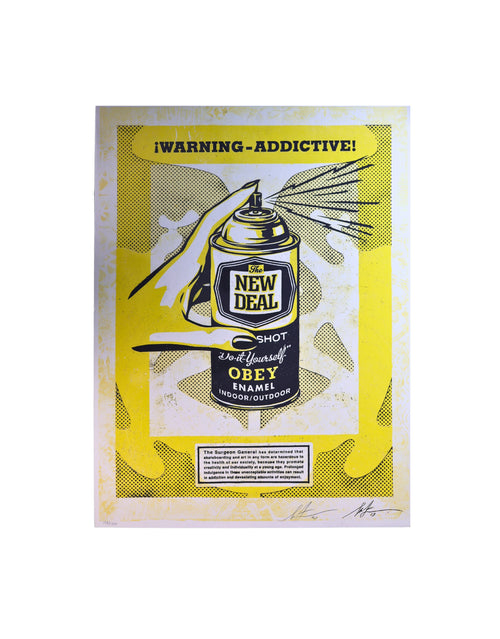
Fairey does not run a personal certificate-of-authenticity program. Anyone offering you a "certificate of authenticity from Shepard Fairey" is describing something that does not exist as a formal artist service. Authentication instead rests on provenance, the hand-signature, edition numbering, and the correct paper and printing for that specific release, ideally confirmed through a reputable dealer. Fairey's catalogue of prints is large and well-documented, which works in a careful buyer's favor: edition sizes, dates, and signature conventions can be checked. If you are learning to read a Fairey, our Shepard Fairey buyer's guide and the searchable Fairey print index are the fastest way to ground yourself, and the shoppable Fairey collection shows what verified inventory looks like.
Banksy
Banksy is the one name where authentication is exclusive and non-negotiable: Pest Control is the only body that authenticates Banksy work. No dealer, auction house, or third-party service can substitute for it, and no other organization issues valid Banksy certificates. If a signed or "authenticated" Banksy print is offered without Pest Control documentation, treat that gap as the headline fact of the listing, not a footnote. Because so much Banksy material circulates as open prints, souvenir reproductions, and "after Banksy" copies, the Pest Control question is the first and often the only one that matters. Explore the Banksy collection and the Banksy prints reference to see how properly documented examples are presented.
KAWS and BE@RBRICK
For KAWS figures and Medicom BE@RBRICK toys, authentication runs through the manufacturer's packaging and markings — the box, the foot stamp, the correct Medicom production details — rather than a hand-signed print convention. These are not authenticated by a certificate "from the artist." At Gauntlet Gallery, applicable KAWS and BE@RBRICK pieces are backed by TrueCOA, which lets a buyer verify the certificate online rather than trust a photograph. See the KAWS collection for how these are catalogued.
Invader
Invader's mosaics, prints, and objects have their own conventions and documentation, and — like Fairey — authentication leans on provenance, correct production characteristics, and reputable sourcing. The Invader collection is a useful reference point for what verified pieces should include.
DEATH NYC
DEATH NYC works are hand-signed and numbered and issued with a certificate of authenticity and a gold seal. That specific combination — signature, numbering, COA, and seal — is what to confirm, and any DEATH NYC piece missing those elements should prompt questions.
The pattern across all of these is consistent: identify the artist, apply that artist's correct method, and never accept a chain borrowed from a different artist. When in doubt, route the decision to a dealer whose reputation is on the line.
How Fakes Enter the Market Online
Understanding the supply side helps you shop defensively. Reproductions flood open marketplaces because listing is frictionless and enforcement is inconsistent. Print-on-demand services make it trivial to produce a convincing poster of any famous image. Drop-shippers relist the same generic reproduction under dozens of storefronts. And a smaller, more sophisticated tier of forgers targets the mid-market signed-print category, where the money is meaningful but individual sales rarely attract expert scrutiny.
Social platforms add a second vector: direct-message sales that move buyers off any protected checkout, paired with urgency ("another collector is interested") and off-platform payment. Once money leaves a platform with buyer protection, recovery is nearly impossible. The defensive posture is straightforward — keep transactions on protected rails, demand documentation before paying, and be willing to walk away. Genuine work is not a limited-time offer that vanishes if you take a day to verify.
A Practical Playbook for Buying Safely Online
Here is the workflow we recommend to anyone furnishing a home with real street art rather than décor-grade reproductions.
- Decide what you're actually buying. If you only want the image on your wall and resale value is irrelevant, an honest open-edition print or licensed reproduction is fine — just make sure it's priced and described as one. If you want an object that holds and builds value, you are buying a signed, numbered, provenanced edition, and everything below applies.
- Match the artist to the right authentication method. Fairey and Invader: provenance, signature, edition, paper, reputable dealer. Banksy: Pest Control only. KAWS/BE@RBRICK: Medicom markings plus TrueCOA. DEATH NYC: signature, numbering, COA, gold seal. If the seller cites the wrong chain, stop.
- Demand the details in high resolution. Ask for clear images of the signature, the edition number, the full margins, the paper texture, and the back. A seller with a genuine piece will happily provide them; a forger stalls or sends only cropped hero shots.
- Verify provenance. Where did the piece come from, who owned it before, and is there a record of prior sale or a credible acquisition story? A clean chain of custody is one of the strongest protections against buying a fake — and it protects your own resale later. Our companion article on reading a listing critically covers what a healthy provenance statement should include.
- Sanity-check the price. Compare against recent authenticated sales of the same image and edition type. A price dramatically below the market is not a lucky find; it is the most reliable signal that something is wrong.
- Buy from accountable sources. The simplest safeguard is to buy where authentication is the business model, not an afterthought. A specialist dealer verifies before listing, publishes provenance, offers a returns policy, and — for applicable pieces — attaches independent verification like TrueCOA.
Buying for the Home Without Sacrificing Authenticity
Decorating with real street art and protecting yourself from fakes are not in tension — they reinforce each other. A verified piece is both a better object on the wall and a better store of value. If you are building a room around this work, a few practical notes help.
Start at a price tier that lets you buy genuine editions rather than reproductions. Signed prints from established street artists are more accessible than most people assume, and buying one real, modest edition beats buying three dubious "limited" posters. For an entry point, our guide to signed street-art prints under $500 that still hold value shows what authenticity looks like at the accessible end of the market.
Think about the room as a whole. Genuine editions from different artists — a Fairey portrait, an Invader mosaic print, a DEATH NYC mash-up — can share a wall coherently when you plan scale, palette, and framing. Our piece on buying street art that fits your interior works through a style-first approach, and building a street-art wall that mixes artists shows how verified pieces combine. In every case, the authenticity checks above come first; styling comes second.
What Makes a Dealer Worth Trusting
Because street-art authentication is decentralized and artist-specific, the quality of the seller does more work here than in almost any other collecting category. A trustworthy dealer demonstrates a few things consistently: they state the correct authentication chain for each artist without prompting; they show, rather than merely claim, provenance; they photograph the diagnostic details instead of hiding them; they price to the real market; and they back applicable pieces with independent verification. At Gauntlet Gallery, that means every piece is vetted before listing, TrueCOA verification are attached where applicable, and the correct per-artist standard is respected — Fairey by provenance and signature, Banksy by Pest Control, KAWS and BE@RBRICK by Medicom markings plus TrueCOA. You can start from the collector trust hub or browse the full authenticated collection to see the standard applied across artists.
The takeaway is durable: fakes concentrate where the image is famous and the verification is skippable, so buy where verification is not skippable. Match the artist to the right chain, insist on provenance and detail, sanity-check the price, and buy from someone whose reputation depends on the object being exactly what they say it is. Do that, and you can fill your home with street art that is genuine today and worth owning for years.