How to Buy Street Art That Fits Your Interior: A Style-First Guide
To buy original street art for home decor, start with a curated, authentication-backed dealer such as Gauntlet Gallery rather than an open marketplace, and choose the piece by palette, scale, and framing so it resonates with the room it will live in. The reliable places to buy are established galleries and dealers who publish provenance and edition details, artist-run stores for retail drops, and reputable auction houses for blue-chip names. The trick that separates a decorative purchase from a durable one is buying the right authenticated edition of an image you love: a signed, numbered street-art print that fits your wall will also be the piece most likely to hold its value.
Most people approach street art the wrong way around. They fall for an artist's name, buy whatever is available, and then try to make it work in a room. A style-first approach flips that. You start with the wall, the light, the color story, and the scale of your space, then let those constraints narrow the field to a handful of images. Only after you have the shortlist do you turn to the questions that protect your money: Is it an original edition? Who signed it? What is the provenance? This guide walks through both halves of the decision — the design half and the diligence half — so the print on your wall is beautiful and real.
Where to Actually Buy Original Street Art for a Home
There is no shortage of places selling images that look like street art. There is a real shortage of places selling authenticated originals with a paper trail. For a home collector, the channels break down into four practical routes, each with a different balance of price, selection, and risk.
- Curated dealers and galleries. This is the default recommendation for a first serious purchase. A dealer who specializes in street art, pop art, and editions vets each piece, documents provenance, and stands behind authenticity. You pay for that curation, but you also inherit the dealer's judgment and recourse. Browse a working example of this model across the full Gauntlet Gallery catalog.
- Artist-run retail stores. Some artists release editions directly at retail through their own storefronts and timed drops. Prices are lowest here, but supply sells out in minutes and secondary markups follow immediately. This route rewards collectors who track release calendars closely.
- Auction houses. For established names, major and regional auction houses offer originals with catalog-level provenance. Realized prices are public, which helps you gauge value, but buyer's premiums add 20–30% and condition is your responsibility to inspect.
- Open marketplaces and resale apps. The widest selection and the highest fake rate. If you buy here, treat every listing as unverified until you can confirm the signature, edition numbering, and seller history yourself.
For decor-driven buyers who want the piece to look right on the wall and come with confidence, the dealer route wins on balance. It compresses the two hardest jobs — finding the right image and confirming it is real — into one relationship. Our buyer's guides hub breaks the process down artist by artist, and the collector trust hub explains how authentication, provenance, and resale support fit together.
Start With the Room, Not the Artist
The single most common regret among new buyers is a piece that is technically great but wrong for its space — too dark for the wall, too small for the sofa, too loud for a quiet room. Before you shop by name, define the room. Four variables do most of the work: dominant palette, available scale, wall function, and light.
Palette: match the color story, then decide to harmonize or contrast
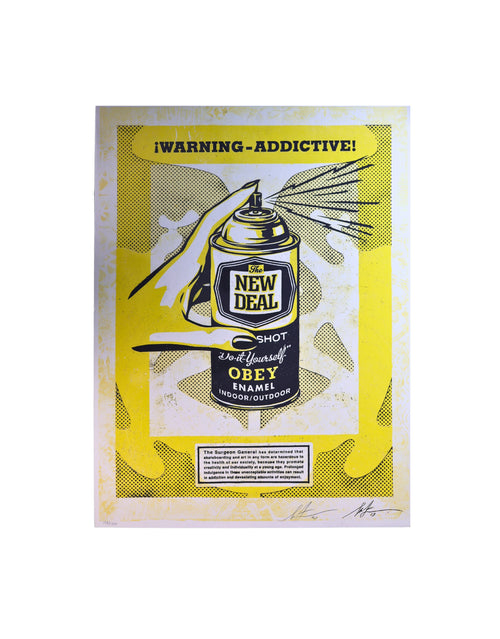
Street art is famously high-contrast and graphic, which is exactly why it can either anchor a room or fight it. Identify the two or three colors already carrying your space — the sofa, the rug, the largest visible wall. Then decide whether the art should harmonize (pull one of those colors forward, calming the composition) or contrast (introduce a deliberate clash that makes the piece the focal point). A muted, tonal living room can absorb a saturated red-and-black Shepard Fairey without looking chaotic because the surrounding neutrals give the eye somewhere to rest. A busy, pattern-heavy room usually wants a more restrained image so the wall does not compete with the upholstery.
Scale: measure the wall, not the frame
Undersized art is the most frequent styling mistake in real homes. A good rule of thumb: a single piece over a sofa or console should span roughly two-thirds to three-quarters of the furniture's width. Above a 84-inch sofa, that means the framed piece — mat and frame included — wants to land somewhere near 55–63 inches wide, either as one large work or a tight cluster read as a single mass. Small prints are not wrong; they simply belong in gallery walls, stair runs, and intimate spaces where the viewer stands close.
Wall function and light
A wall you walk past quickly wants a bold, legible image that reads from ten feet. A wall you sit near — beside a reading chair, at the head of a bed — can carry detail and reward close looking, which is where hand-embellished pieces and intricate stencils shine. Light matters just as much: direct sun fades pigment and paper over years, so a print on a bright south-facing wall needs UV-filtering glazing (more on framing below). North light is the gentlest and the most flattering for saturated color.
Two subtler variables round out the room brief: sightlines and adjacency. Sightlines are the angles from which the piece is most often seen — the view from the doorway, from the dining table, from the top of the stairs. Street art rewards a strong first-glance read, so hang the boldest image where it greets you on arrival, and save quieter, more detailed work for the spots where you linger. Adjacency is what hangs or sits nearby. A single graphic print gains force when it is given breathing room; the same print crammed between a bookshelf and a doorframe loses it. If the wall is already busy with furniture, sconces, or a television, choose an image with a simple silhouette and high internal contrast so it survives the competition, or move it to a cleaner wall entirely.
Finally, think in terms of the room's emotional register, not just its color. A bedroom generally wants art that slows you down; a home office or entryway can take something more assertive. Street art spans that whole range — from meditative, tonal stencils to aggressive, high-key pop portraits — so the same movement can furnish a calm space and a charged one. Naming the feeling you want before you shop keeps you from buying the loudest available image simply because it caught your eye in a gallery lit for maximum drama.
A Style-to-Room Map for Street Art
The following table pairs common interior styles with the street-art registers that tend to fit them, the scale that usually works, and a framing direction. Treat it as a starting shortlist, not a rulebook — the point is to narrow fifty possible images down to five before you ever think about price.
| Interior style | Street-art register that fits | Typical scale | Framing direction |
|---|---|---|---|
| Warm minimalist / Scandinavian | Graphic, limited-palette stencils; single strong motif | One large statement piece | Slim natural oak or white, generous mat, museum glass |
| Mid-century modern | Bold pop-art color fields; iconic portraits | Medium to large, centered over furniture | Thin black or walnut, minimal mat |
| Industrial / loft | Raw stencil work, paste-up aesthetics, mixed media | Oversized or a dense multi-piece wall | Black metal or float frame, exposed edges |
| Maximalist / eclectic | Mix of artists, mosaics, small tiles, HPM variety | Gallery wall, many sizes | Mixed frames, unified by one repeated finish |
| Traditional / transitional | Restrained palettes; classic iconography with edge | One or two symmetrical medium pieces | Gold or dark wood, wide mat, conservation glazing |
| Contemporary gallery-white | Anything high-impact; let the art be the color | Large, generously spaced | Museum float frame, no mat, low-reflect glass |
Two artists recur across nearly every one of these styles because their work is graphic enough to hold a wall yet varied enough to suit different rooms. Shepard Fairey's Obey editions bring a red-black-cream propaganda-poster language that reads instantly from across a room; browse the Shepard Fairey collection to see how one visual system spans dozens of moods. Invader's pixelated, mosaic-derived pieces bring a playful, architectural geometry that suits industrial and contemporary spaces especially well; the Invader collection shows the range from small tiles to larger aliasing works. For a broader survey of the movement and its major names, the art index is the fastest way to orient yourself.
Choosing the Right Format for Your Wall — and Your Budget
Street art at home almost always means editions rather than one-off originals, and understanding the format is where design sense and financial sense meet. The format determines the price, the rarity, and often the way the piece will read on the wall.
| Format | What it is | How it reads on a wall | Value characteristic |
|---|---|---|---|
| Signed & numbered print (S/N) | Screenprint or offset edition, hand-signed, numbered out of a fixed run | Clean, flat, graphic — the classic street-art look | The liquid core of most collections; value tracks edition size and image demand |
| Artist's proof (AP) | A small set outside the main numbering, often kept by the artist | Visually identical to the S/N run | Usually a modest premium for scarcity |
| Hand-painted multiple (HPM) | A print base with unique hand-painting or embellishment on each copy | Texture and one-of-a-kind detail; rewards close viewing | Higher and more variable; each piece is unique |
| Original work on paper/canvas | A unique piece, not an edition | Maximum presence and singularity | Highest cost; provenance is everything |
For a first purchase that has to earn its place in a real room, a signed and numbered print is usually the sweet spot: it delivers the recognizable graphic punch, it is the easiest format to authenticate, and it is the most straightforward to resell if your taste changes. If you want the wall to have texture and a sense of the artist's hand — perfect for a reading nook or a piece viewed up close — an HPM justifies its premium. Understanding how these formats differ, and how the initials on a print change its value, is worth doing before you spend; our deep dive on reading an edition number explains exactly what "12/150" tells you and what it does not.
The Diligence Half: Buying Authenticated, Not Just Attractive
Here is the discipline that keeps a decor purchase from becoming a regret. Every design choice above should terminate in the same question: is the specific piece I am about to buy an authenticated original? Street art is one of the most heavily faked corners of the market precisely because the imagery is so reproducible — a poster of a famous stencil is trivially cheap to print, and unscrupulous sellers pass reproductions off as editions. The defenses are provenance, signature, edition numbering, printing quality, and dealer reputation.
Provenance and paper trail
Provenance is the documented chain of ownership from the artist or original release to the piece in front of you. A strong paper trail — a dealer invoice, a release record, prior auction history — is the single best protection against a fake, because it is far harder to forge a coherent history than a single signature. When a listing has no provenance and no dealer standing behind it, treat the low price as the cost of that missing information, not a bargain.
Signature, numbering, and printing
Authenticating a print is a convergence exercise: no single tell is decisive, but the right signature and correct edition numbering and appropriate paper and printing method and credible provenance together make a confident case. Watch the fundamentals — a genuine hand signature has pressure and variation a printed facsimile lacks; edition numbers should be hand-written and consistent with the known run; the paper and ink should match the era and method of the release. Because the specific tells vary by artist, the responsible move is to lean on artist-specific guidance rather than generic checklists. For the most collected street artist, the Shepard Fairey buyer's guide details paper, deckle, signature, and dating; the Fairey print index lets you cross-reference a specific image against a documented reference.
The house standard: TrueCOA verification
Not every street artist runs a certificate program, and it is important not to invent one. Shepard Fairey, for example, has no artist certificate-of-authenticity program — his work is authenticated through provenance, signature, edition numbering, paper, and reputable dealers, not a certificate "from the artist." Authentication practices differ from artist to artist, and conflating them is a common way collectors get misled. What a serious dealer can add is its own verification layer. Gauntlet Gallery backs applicable pieces with TrueCOA, a blockchain verification standard that issues a tamper-proof digital certificate for eligible items, so ownership and authenticity can be checked over time rather than resting on a slip of paper that can be lost or copied. Think of it as provenance you can verify online.
The value of a scannable, house-backed record grows precisely because street art moves. A print that changes hands three times over a decade accumulates risk at every transfer: paper certificates get separated from the work, memories of where a piece came from fade, and a determined forger only has to fake one thin document. A verification standard tied to the object itself and to a maintained record shifts the burden away from the buyer's ability to spot a fake and toward a system that can be checked in seconds. For a decor-driven collector who is not a full-time authenticator, that shift is the whole point — it lets you buy for the wall while still owning something a future buyer can trust.
Buying safely on your own
If you do venture onto an open marketplace, a short discipline covers most of the danger. Reverse-image search the listing photos to see whether the same image is being sold under different seller names, which often signals a mass-printed reproduction. Ask the seller for a photograph of the signature and edition number in the same frame as a distinctive feature of the sheet, so you know the images are of one physical object. Read the seller's history for prior art sales and disputes. And weigh the price against the format: an unusually cheap "original" of a famous image is far more likely to be a poster than a bargain. When any of these checks comes back thin, walk away — the cost of a fake is not just the money, it is the wall space and the false sense of having collected something real.
Framing and Placement: Protecting the Piece and the Investment
Framing is where decor and conservation become the same decision. The wrong frame cheapens a strong piece and, worse, the wrong glazing and materials will degrade it — fading pigment, buckling paper, or leaving acidic burns that permanently lower resale value. A few principles cover most cases.
- Use UV-filtering glazing. Museum or conservation glass blocks most ultraviolet light, the primary cause of fading, and its low-reflection finish makes the image read cleanly even in bright rooms. It costs more; on a signed edition it pays for itself.
- Insist on acid-free, archival materials. The mat, backing, and mounting must be acid-free. Never let a framer dry-mount or trim a signed print — both are irreversible and destroy value. Hinged, reversible mounting is the standard for anything you might resell.
- Give large graphic work room to breathe. A generous mat or a clean float frame lets a bold image resolve. On gallery-white walls, a frameless float with low-reflect glass keeps the focus on the art.
- Mind the environment. Keep paper works off bathrooms and above radiators, and away from direct sun. Stable temperature and humidity protect both the sheet and its value.
Placement follows the same logic as scale. Hang single pieces so the center sits around 57–60 inches from the floor — gallery eye level — and adjust upward only over tall furniture. For a mixed wall of several artists, plan the arrangement on the floor first, keeping consistent spacing (two to three inches between frames) so the group reads as one composition. Building a multi-artist wall is its own craft; our guide to building a street-art wall by mixing Fairey, Invader, DEATH NYC and KAWS covers how to balance palettes and scales across artists, and the companion piece on framing and protecting street-art prints in a real home goes deeper on materials and conservation.
Matching Budget to the Wall
Style-first buying does not mean ignoring price — it means letting the room set the brief and the budget set the format. A large statement wall in a gallery-white living room and a tight cluster in a hallway are two different budgets even for the same artist. In broad strokes, entry-level signed prints from emerging and mid-tier street artists open the door affordably, established-name S/N editions occupy the middle, and rare early works, large HPMs, and originals sit at the top. The mistake is not spending little; it is spending on an unverified piece at any level. A modest, authenticated signed print will always outperform a larger, prettier, unprovenanced one — both as decor you can trust and as an asset you can resell.
If you are working to a ceiling, prioritize in this order: authenticity first, then image demand, then edition scarcity, then size. It is better to own a small, real, in-demand image than a large, questionable one. For a structured walk through what different budgets actually buy and which signed prints hold value at the entry level, the signed street-art prints under $500 that still hold value guide and the street-art price-tier breakdown map spend to expectation.
A Style-First Buying Checklist
- Define the room. Note the dominant two or three colors, the wall's width and function, and the light. Decide harmonize or contrast.
- Measure for scale. Target two-thirds to three-quarters of the furniture width for a single piece; plan clusters as one mass.
- Shortlist images, not names. Use the style-to-room map to narrow to a handful of pieces that fit the space.
- Pick the format. S/N for the classic look and easiest resale; HPM for texture and close viewing; original for maximum presence.
- Verify authenticity. Confirm provenance, signature, edition numbering, and printing — through a dealer who documents them and, where offered, TrueCOA verification.
- Frame for conservation. UV glazing, acid-free archival materials, reversible mounting. Never dry-mount or trim a signed print.
- Place it well. Center at gallery eye level; keep it out of direct sun and off damp or hot walls.
Follow that sequence and the piece on your wall will do two jobs at once: it will make the room feel finished, and it will be the kind of authenticated edition that holds — and often grows — its value. Beauty and diligence are not in tension. The image that fits your interior best is nearly always the one worth buying properly. Start from the wall, buy the real thing, and let the collector trust hub and the artist buyer's guides carry the diligence you do not want to shoulder alone.