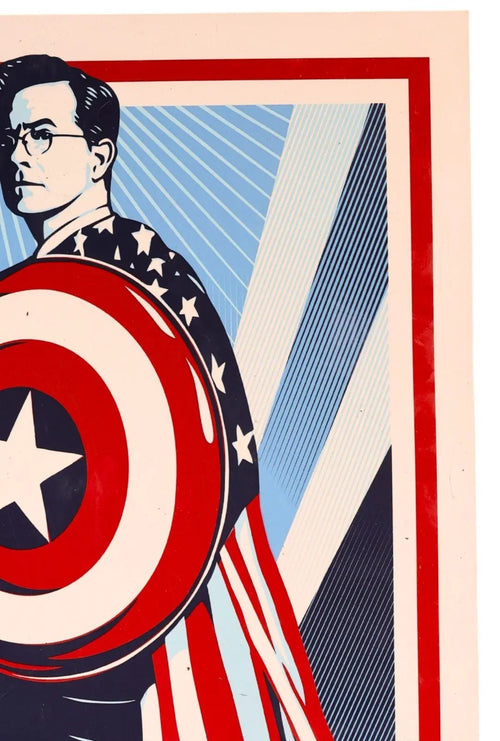
Shepard Fairey's prints are among the most counterfeited works in the contemporary street-art market. A combination of high desirability, accessible price points relative to paintings, and the artist's prolific output creates fertile ground for fakes. This guide gives collectors the exact checkpoints used by professional authenticators.
The Authentication Chain for Shepard Fairey Prints
Genuine Fairey prints move through a documented chain of custody that serious collectors can verify at each step:
- Studio or gallery release: Fairey prints are released through Obey Giant Art (his own online shop), authorized galleries, or Printed Matter. Primary-market works carry a studio-issued COA or letter of authenticity.
- Verisart digital certificate: Since 2018, Fairey has partnered with Verisart to issue blockchain-anchored certificates. Each certificate ties a unique cryptographic hash to the work's image and edition data. Verify at verisart.com/verify.
- Edition documentation: Every legitimate edition has a defined print run (e.g., "HP" = hand-pulled, numbered /450). Edition size is listed on the Obey Giant website archive.
- Secondary market COA: When works sell through major auction houses (Christie's, Sotheby's, Phillips, Heritage) or established galleries, a condition report and provenance letter accompany the work.
Physical Authentication Checkpoints
Paper and Substrate
- Fairey prints on paper use French Paper Company stock (primarily Speckletone and Dur-O-Tone lines) or Coventry Rag for archival editions. The paper has a distinctive tooth and weight — typically 100 lb text or 80 lb cover.
- Under UV light, genuine paper will show controlled brightening. Counterfeit digital inkjet prints often fluoresce aggressively or show banding.
- Check the edges: screen-printed works have clean edges consistent with squeegee pressure. Inkjet fakes show micro-serration under magnification.
Ink and Printing Method
- Fairey's studio uses water-based screen printing inks. Under a loupe (10×), genuine ink sits on the paper surface with slightly raised edges — a characteristic halftone dot structure is visible in gradient areas.
- Digital inkjet reproductions show a regular CMYK dot matrix under magnification — distinctly different from screen-print halftone.
- Red inks: Fairey's signature red (#C8232C) is mixed in-house. Fakes often use a cooler, more orange-shifted red that reads differently under warm incandescent light.
- Black: genuine blacks are dense and opaque, often with a slight matte sheen. Inkjet blacks tend to be slightly green-shifted.
Signature
- Fairey signs in pencil on most editions, occasionally in black or silver paint marker for special releases.
- His signature is confident and consistent: a looping "S," descending "h-e-p," followed by a compressed "ard" — the terminal "d" rarely fully closes.
- He typically numbers before signing, in the format NNN/TTT (e.g., 147/450) at lower left, signature at lower right.
- Red flags: ball-point pen signatures (he does not use them), signatures that appear printed rather than applied, inconsistent pencil pressure across the "Shepard" stem letters.
Edition Markings
- Screen prints typically carry a blind-stamp or emboss from the printing studio in addition to the hand-numbering.
- Editions released through Obey Giant carry a studio emboss on the verso (back) of the work — usually bottom center.
- Mismatched edition sizes are a major red flag: if a seller claims an edition of 100 but the Obey Giant archive lists 450, something is wrong.
Certificate of Authenticity: What to Look For
A genuine Fairey COA includes:
- Artist name, title, medium, dimensions, edition number, and year
- Issuing entity (Obey Giant Art, Inc. or affiliated gallery)
- Contact information for the issuing party — verifiable independently
- A unique COA number cross-referenced against the print's edition number
- For Verisart-enabled works: a QR code or URL linking to the blockchain record
What a COA cannot do by itself: a COA from an unknown third party, a hand-typed letter, or a document with no verifiable issuing entity is worth nothing. The document must trace back to the artist's studio or an authorized gallery with a verifiable paper trail.
Four Authentication Traps (Avoid These)
- The "Comes with COA" trap: Any counterfeiter can print a COA. A COA is only as credible as the entity that issued it. Demand issuer contact info and verify independently.
- The "Street provenance" trap: "I got it directly from the artist" is unverifiable and often false. Without documentary evidence, street provenance means nothing.
- The "Auction house means authentic" trap: Smaller regional auction houses and online platforms accept consignments without authentication. Christie's and Sotheby's conduct due diligence — regional houses often do not.
- The "Edition 1/1" trap: Fairey does produce unique works (paintings, HPM pieces), but a claimed 1/1 screen print is almost certainly a fake or miscategorized work. His print editions are never 1/1.
Green Flags: Signs of Genuine Work
- Provenance traces directly to Obey Giant Art, a known authorized gallery, or a documented major auction
- Verisart certificate with verifiable blockchain record
- Paper matches known French Paper Company stocks by weight and feel
- Ink under magnification shows screen-print halftone structure
- Edition number matches published print run in the Obey Giant archive
- Signature consistent with known examples across multiple reference works
How Gauntlet Gallery Authenticates Fairey Works
Every Shepard Fairey print offered by Gauntlet Gallery passes a multi-layer review before acquisition:
- Provenance documentation verified against primary sources (Obey Giant archive, gallery records, auction receipts)
- Physical inspection: paper, ink, substrate, blind stamps, and edition markings checked against known authentic examples
- Signature comparison against a reference library of confirmed genuine examples
- Verisart certificate verification where applicable
- COA issuer verified as a credentialed, contactable entity
Works that do not pass all checkpoints are not offered for sale, regardless of asking price or apparent provenance. This is Gauntlet Gallery's non-negotiable standard.