He is the most famous first-foot in human history, and yet the man who took that step spent the rest of his life trying to give the moment back to everyone else. Neil Armstrong understood, better than almost anyone alive, that he had become a symbol — and he refused, gently but firmly, to be flattened into one. He was not a recluse. He taught undergraduates, sat on corporate and government boards, testified before Congress, and eventually sat with a biographer for more than fifty hours of interviews. But he guarded the interior life of the man behind the visor with an engineer's discipline and a Midwesterner's reticence, as if his own celebrity were a variable to be minimized.
What emerges, when you set the myth aside, is something quieter and more interesting than the legend: a boy from a small Ohio town who loved airplanes before he could drive a car; a naval aviator who flew combat missions in Korea before he was old enough to be entirely unafraid; a test pilot who rode rocket planes to the edge of the atmosphere; and, finally, a commander whose defining professional trait was not daring but composure — the ability to stay calm while a spacecraft tumbled, or while a computer alarm shrieked during the most-watched descent in history.
This is the story of that composure, and of the weight it carried afterward. Armstrong spent barely two and a half hours on the lunar surface. He spent the following forty-three years learning how to be the man who had been there — a role for which there was no training program, no checklist, and no abort switch.
The Boy from Wapakoneta

Neil Alden Armstrong was born on August 5, 1930, in Wapakoneta, Ohio — a modest town in the western part of the state, the kind of place where the horizon is wide and low and the sky does most of the talking. His was a childhood shaped by movement; his father's work took the family from town to town across Ohio during the Depression years. But the fixed point in young Neil's life, the thing that never moved, was flight.
The fascination arrived early and never loosened its grip. He was drawn to airplanes as a small boy, built and flew model aircraft, and pursued the sky with the patient, methodical intensity that would characterize everything he did. He earned a student pilot's license as a teenager — by his own account, learning to fly before he had learned to drive. It was not a romantic infatuation so much as a vocation announcing itself: the airplane was a machine, and Armstrong was the sort of mind that wanted to understand exactly how a machine behaved and why.
That instinct carried him to Purdue University, where he studied aeronautical engineering. The choice mattered. Armstrong was never merely a pilot in the swaggering, silk-scarf sense; he was an engineer who happened to fly, a man who approached an aircraft as a problem in physics wearing wings. Throughout his life he would insist, with characteristic modesty, on being described as an engineer first. It was at Purdue that the two halves of him — the boy who loved the sky and the analyst who wanted to master it — became a single professional identity that would eventually be strapped into the top of a Saturn V.
It is tempting, from the vantage of everything that came later, to read destiny into a Depression-era Ohio boyhood. But the truer picture is more ordinary and, in its way, more admirable. There was no single moment of anointing, no lightning-strike of ambition to walk on the Moon — the Moon was not yet anywhere on the human agenda when Armstrong was building balsa models on a kitchen table. What there was instead was a steady, unglamorous accumulation of competence: a fascination pursued patiently, a license earned early, a discipline chosen deliberately. The heroism of the later story is easy to see. The quieter story, the one Armstrong himself would have wanted told, is of a person who simply loved a thing thoroughly and gave himself the technical foundation to do it well. Everything spectacular that followed was built on that unspectacular groundwork.
Navy Pilot and Korea

Armstrong's education was interrupted, as so many young American lives were in that era, by war. He became a United States Navy aviator and flew combat missions in the Korean War — a formative and dangerous apprenticeship in the actual business of flying, where the consequences of a wrong decision were not theoretical.
Combat aviation in Korea was unforgiving work: fast jets, ground fire, missions flown from the deck of a carrier out over hostile terrain. It was the environment in which a young man learned whether his temperament matched his ambition — whether he could hold his nerve when the airplane was damaged, the situation was deteriorating, and there was no one else to consult. Armstrong flew those missions and came home. The experience seeded a quality that observers would remark on for the rest of his career: a preternatural calm under pressure, an ability to keep working the problem when the problem was actively trying to kill him.
He returned to Purdue to finish his degree, but the Korean tour had already done something permanent. It had taken the model-airplane boy and made him an operator — someone who had flown at the edge of survival and understood, in his body and not just his mind, what that edge felt like. The composure that would later reassure a nation during the descent to the Sea of Tranquility was not a gift of temperament alone. It had been earned, mission by mission, over Korea.
The war also left him, one suspects, with a lifelong sense of proportion about danger and about death — the kind of perspective that combat gives and rarely returns. Men Armstrong flew alongside did not all come home. To have been young in that cockpit, to have made peace with the arithmetic of risk while still in one's early twenties, is to acquire an early and permanent gravity. It is not hard to trace a line from those Korean missions to the man who, years later, would face a tumbling spacecraft or a landing-gauge fuel gauge running perilously low and respond not with panic but with method. Some of that steadiness was born in him. A great deal of it was forged in a war he rarely discussed and never romanticized.
The Test Pilot at the Edge

After the war, Armstrong found his way to the profession that would define him before spaceflight ever did: experimental test flying. He worked at Edwards Air Force Base in the high desert of California, the legendary proving ground where the fastest and most temperamental aircraft in the world were pushed past their published limits by men whose job was, quite literally, to find out what would break.
Among the machines he flew was the X-15 — a black, rocket-powered dart that could climb to the ragged upper boundary of the atmosphere, to altitudes and speeds where the air grew too thin to fly on and the sky above turned toward the black of space. The X-15 was not a vehicle you commanded so much as one you negotiated with, and flying it required exactly the fusion of nerve and analysis that Armstrong embodied. This was flight at the frontier, where the pilot was also a research instrument, gathering data about a regime no aircraft had explored before.
It is worth pausing on what this era reveals about him. Long before he was an astronaut, Armstrong was already living at the edge — not for glory, but out of a genuine engineer's curiosity about how flying machines behaved where no data existed. The test-pilot's creed is unforgiving: the airplane does not care about your reputation, and the only currency that matters is whether your judgment is sound when the instruments disagree with your instincts. Armstrong thrived in that world precisely because he did not fly on instinct alone. He flew on understanding, and when understanding ran out — as it always eventually did, at the frontier — he had the discipline to gather the data, land, and think.
When NASA selected him for its astronaut corps in 1962, it was not plucking an unknown; it was recruiting one of the most capable experimental pilots in the country, a man who had already spent years at the boundary between the atmosphere and the void. The space program did not make Armstrong extraordinary. It found him already extraordinary and gave him a machine large enough to match what he could do. By the time he arrived at NASA, the essential Armstrong was fully formed: the curiosity, the calm, the refusal of theatrics, the conviction that the right answer was worth more than the impressive gesture. All that remained was for history to hand him a stage.
Gemini 8 — Grace Under Emergency

Armstrong's first spaceflight came in 1966, when he commanded Gemini 8. The mission's objective was a milestone in its own right: the first docking of two spacecraft in orbit, a maneuver that would be essential to the entire architecture of a lunar landing. Armstrong guided his Gemini capsule to a linkup with an uncrewed Agena target vehicle and achieved the docking. For a moment, the mission was a clean success.
Then it became something else. Shortly after docking, the joined spacecraft began to roll — a malfunction sent the vehicles into an increasingly violent tumble. Armstrong undocked from the Agena, but the rolling only grew worse, spinning fast enough to threaten the crew with disorientation and, eventually, blackout. The fault lay in a stuck thruster on the Gemini itself.
What happened next is the reason Gemini 8 belongs in any honest account of Armstrong the man, not just Armstrong the icon. Working the problem with cold precision, he shut down the main maneuvering system and used the spacecraft's separate re-entry control thrusters to stop the tumble and stabilize the craft — a solution that also, per mission rules, required an immediate abort. The flight ended early, splashing down safely rather than continuing. It was, by any measure, a near-disaster resolved by clear-headed skill under acute pressure. The composure that the world would later watch on the way to the Moon had already been tested, in orbit, with the ground unable to help and the seconds counting down.
One Small Step

On July 20, 1969, Neil Armstrong became the first human being to set foot on another world. As commander of Apollo 11, he piloted the Lunar Module to a landing on the Sea of Tranquility and then, hours later, descended the ladder and stepped onto the lunar surface. The words he spoke have been repeated more than almost any sentence in the language:
That's one small step for [a] man, one giant leap for mankind.
The phrasing carries a famous ambiguity. Armstrong intended to say "one small step for a man" — a specific man, himself, contrasted with all of mankind — but in the transmission the "a" is difficult to hear, and whether he actually spoke it has been debated for decades. It is a small linguistic mystery attached to an enormous moment, and it is worth stating plainly that the question remains genuinely contested rather than settled. What is not in doubt is the substance of the achievement: a human boot pressing into lunar dust that had lain undisturbed for billions of years.
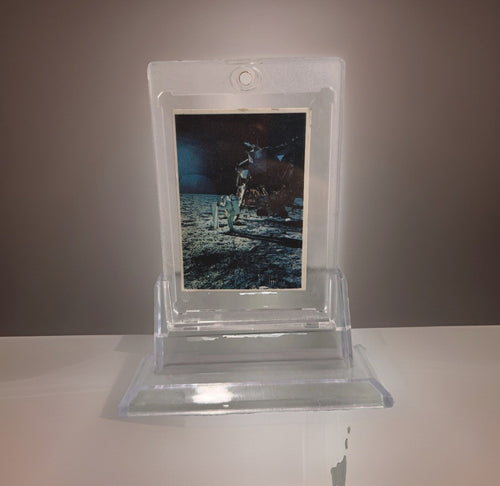
Armstrong and his crewmate spent only a matter of hours on the surface. In that brief window, the abstraction of the space race became something tactile — a bootprint, a flag, a set of instruments left behind, and the unbroken silence of a place where no wind would ever blur the tracks they made. Then they climbed back into the Lunar Module, and the most famous man on Earth began the long journey home to a planet that would never again let him be ordinary.
It is easy, half a century on, to forget how genuinely uncertain the enterprise was. No human had ever landed a craft on the Moon; no one knew for certain whether the surface would bear the weight of the module, whether the ascent engine would fire to bring the crew back up, whether any of the thousand systems on which their lives depended would perform as designed. The step Armstrong took was, in the most literal sense, a step into the unverified — the one place in the universe where his lifelong habit of gathering data before acting could not fully protect him. That he took it with such outward steadiness, narrating the moment in a flat engineer's voice rather than a poet's, is itself a kind of statement about who he was. He did not treat the Moon as a conquest. He treated it as a task to be performed correctly, on behalf of everyone watching, and then completed and left behind.
The Reluctant Hero

Here is where the popular narrative most often goes wrong. Armstrong is frequently described as a recluse who vanished into hermetic silence — and that is an overstatement. He was, more precisely, intensely private: a man who declined to trade on his fame, who found the machinery of celebrity distasteful, and who chose his public words with the same care he had once applied to a flight plan. He gave his biographer, James R. Hansen, more than fifty hours of interviews for the authorized life First Man. That is not the behavior of a hermit. It is the behavior of a man who wanted the record to be accurate and who preferred to speak deliberately rather than often.
His own explanation of that reticence is characteristically dry and revealing:
To me, an interview is like a first draft, and I like fourth or fifth drafts.
The line captures the engineer's temperament exactly: a distrust of the unrevised, the off-the-cuff, the approximate. Armstrong did not want to be quoted extemporizing; he wanted to be right.
That same principle governed how he handled the strange economy that grew up around his name. In the early 1990s he stopped signing autographs, having learned that his signatures were being resold at high prices and widely forged — that his own handwriting had become a commodity traded and counterfeited without his consent. The decision was not vanity but a refusal to let his identity be turned into merchandise.
The most telling episode came in 2005, when his barber, Mark Sizemore, sold clippings of Armstrong's hair to a collector for a reported three thousand dollars, without permission. Armstrong was, understandably, upset. He threatened legal action, seeking to have the proceeds returned or given to charity — and the matter was resolved when the money went to charity. It is important to be precise here, because the story is often told carelessly: no lawsuit was filed. Armstrong did not sue his barber. He objected, he applied pressure, and the outcome was a charitable donation. Even in defending his own person against commodification, he stopped short of the courtroom. The whole affair is a miniature of the man — protective of his dignity, allergic to spectacle, and ultimately more interested in resolution than in retribution.
The Professor

What did the most famous explorer of the twentieth century do after the Moon? He went to teach. From 1971 to 1979, Armstrong served as a professor of aerospace engineering at the University of Cincinnati — returning, in a sense, to the discipline he had always claimed as his true identity. He created graduate courses, including work in aircraft design and experimental flight mechanics, translating a lifetime spent at the frontier of flight into a curriculum for the young engineers who would follow him.
By the accounts that survive, he was a demanding instructor — a tough grader who held students to a standard as exacting as the one he had held himself to at Edwards and in orbit. There is something fitting in the image: the man who had ridden the X-15 and stopped a tumbling Gemini standing at a chalkboard, insisting that the mathematics be done properly. Teaching suited the private man. It let him give his knowledge to the next generation without giving away himself.
In the years that followed his time at Cincinnati, Armstrong lent his rigor to public and corporate life, serving on boards and on national bodies — including high-profile government commissions when the nation needed engineers of unimpeachable judgment. He never became a professional celebrity. He became, instead, exactly what he had trained his whole life to be: a serious technical mind, applied quietly to serious problems, long after the cameras had moved on.
Death and Legacy

Neil Armstrong died on August 25, 2012, at the age of eighty-two, in Ohio — the state where he had been born and to which he had always, in some essential way, belonged. His death came from complications following coronary artery bypass surgery. The man whose heart had stayed steady through a tumbling spacecraft and a computer-alarmed descent was, in the end, undone by that same organ's ordinary human frailty.
He left behind a legacy that resists the usual summary. Yes, he was the first person to walk on the Moon — a fact so large it threatens to swallow everything else about him. But the deeper legacy is the character with which he carried that fact: the refusal to be diminished into a brand, the insistence on accuracy over anecdote, the quiet return to teaching and to the engineering he loved. He understood that the footprint he left on the Moon belonged, in a way, to everyone — and he spent the rest of his life declining to charge admission to it.
His family, in a statement after his death, offered a suggestion for honoring him that was as unassuming as the man himself: the next time you walk outside on a clear night and see the Moon smiling down at you, think of Neil Armstrong, and give him a wink. It is the perfect memorial for a reluctant hero — no monument, no marble, just a private gesture between an ordinary person and the sky he loved before the whole world knew his name.
The artifacts of that era — a signed photograph that Armstrong himself might once have declined to duplicate, a mission-flown fragment, a document bearing a signature he grew so wary of — carry an outsized weight precisely because the man behind them was so careful about what he lent his name to. That is also why provenance matters so much in this corner of collecting. At Gauntlet Gallery, authenticated Apollo and space memorabilia is handled with an authentication-first approach, drawing on rigorous provenance research and specialist verification through Zarelli Space Authentication — the same insistence on getting it right that Armstrong brought to every draft, every landing, and every quiet decision he made about his own extraordinary life.