There is a particular kind of fame reserved for the person who arrives second. History files it away almost carelessly, as though the interval between first and second could be measured only in minutes and never in meaning. Buzz Aldrin has spent more than half a century inside that interval. He was the second human being to set foot on another world, nineteen minutes behind Neil Armstrong on the evening of July 20, 1969, and for the rest of his long life the phrase "the second man" has trailed him like a second shadow, dimmer than the first but impossible to shake.
What that phrase conceals is a person of ferocious technical brilliance and startling candor. Before the Moon he was a West Point graduate, a fighter pilot who flew combat in Korea, and the holder of a doctorate from MIT whose thesis on orbital rendezvous helped make the lunar landings mechanically possible in the first place. After the Moon he became something rarer still: a national hero who told the public, plainly and without self-pity, that he had come home and fallen apart. He wrote about his depression and his drinking while both were still raw, at a time when neither was a subject decent men were expected to discuss.
Aldrin is the astronaut who let us see the descent as well as the ascent — the long fall after the summit, and the slow, unglamorous climb back. He is, at ninety-six, still reaching. This is the story of a man who went to the Moon, came back to Earth, and then had to find a way to keep living on it.
West Point and Korea

Edwin Eugene Aldrin Jr. was born on January 20, 1930, in the leafy New Jersey suburbs of Glen Ridge and Montclair, into a household where achievement was less an aspiration than an expectation. The nickname "Buzz" — which he would later adopt as his legal name — came, by family lore, from a younger sister's mangling of "brother." It was a soft, domestic word for a man who would spend his youth chasing hard, exacting disciplines.
He went to West Point and graduated in 1951, stepping directly out of the academy and into the cockpit of a fighter jet. As a U.S. Air Force pilot he flew combat missions in the Korean War, and combat has a way of clarifying a young man's sense of his own capacities. The Korean sky was where the abstractions of training became the concrete arithmetic of survival: speed, altitude, the geometry of an intercept, the split-second calculus of when to commit and when to break away.
It is tempting, looking back from the far side of the Moon landing, to read those early years as mere prologue. But the fighter pilot's temperament — the appetite for precision, the comfort with risk taken deliberately rather than recklessly — was already the temperament of the astronaut he would become. What set Aldrin apart from many of his peers was that he did not stop there. Where others were content to fly, he wanted to understand, at the deepest mathematical level, exactly how two objects moving at thousands of miles per hour could be made to find each other in the void.
There is a discipline peculiar to the military aviator that the rest of us rarely see: the habit of treating fear as data. A fighter pilot who panics is a dead fighter pilot, and so the training bends the whole personality toward composure under load — toward the ability to keep thinking clearly at exactly the moment the instinct is to stop thinking at all. Aldrin absorbed that lesson young, in a real war, and it would surface again years later on the surface of another world, when he could look out at a landscape that offered no air and no mercy and still find in himself the steadiness to observe it, name it, and get on with the work. The Korean sky trained the man who would keep his head at Tranquility Base.
Dr. Rendezvous

That appetite carried Aldrin to the Massachusetts Institute of Technology, where he earned a Doctor of Science in astronautics. His thesis addressed one of the least glamorous and most consequential problems in all of spaceflight: manned orbital rendezvous, the question of how a crewed spacecraft could reliably maneuver to meet and dock with another vehicle in orbit. It is a problem of unforgiving physics, where intuition fails and only the mathematics can be trusted.
His fellow astronauts, with the affectionate irreverence that runs through every squadron and every astronaut office, took to calling him "Dr. Rendezvous." The nickname carried a faint edge — a suggestion that Aldrin's fluency in the equations occasionally outpaced his patience for those who lacked it. But it was also a genuine acknowledgment of something real. The entire architecture of the Apollo program depended on rendezvous. A lunar module had to lift off from the surface of the Moon and find, in the black emptiness of lunar orbit, a command module traveling at orbital velocity. There was no room for approximation.
Aldrin came to the astronaut corps not merely as a pilot who could execute a rendezvous, but as one of the few people alive who could have written the manual for how it was done.
This is the part of the Aldrin story that the phrase "second man" erases entirely. Long before he descended the ladder onto the Sea of Tranquility, he had helped build the intellectual scaffolding on which the whole enterprise rested. His contribution to Apollo was not only in the boots that touched the dust, but in the equations that got the boots home.
Consider what rendezvous actually demands. Two spacecraft in orbit do not steer toward each other the way two cars close a gap on a highway. In orbit, to slow down is often to rise, and to rise is to fall behind; to catch a vehicle ahead of you, you may have to fire your engine to drop into a lower, faster orbit and then climb back up to meet it. The intuitions of everyday life are not merely useless here — they are actively misleading. Only someone fluent in the underlying mechanics can plan a maneuver that will actually work, and get it wrong by a fraction and the two vehicles miss each other by miles. Aldrin had made that unforgiving problem the subject of his doctoral study, and when NASA needed people who could translate the mathematics into confident action, he was among the very best equipped in the world to do it.
Gemini 12 — Proving Humans Could Work in Space

By the mid-1960s, NASA had a problem that threatened the entire lunar timetable. Astronauts venturing outside their spacecraft on extravehicular activity — the spacewalk — kept finding the work brutally, dangerously exhausting. Without proper handholds and restraints, the simple act of turning a bolt could send a man tumbling; fatigue set in fast, visors fogged, heart rates spiked. If humans could not work effectively in the vacuum, the promise of the Moon would remain out of reach.
In 1966, Aldrin flew Gemini 12, and it was on that mission that the theoretician proved himself the practitioner. His extravehicular activity demonstrated, methodically and convincingly, that astronauts could perform useful work outside a spacecraft. The lessons he had absorbed about the physics of motion in orbit translated directly into technique: deliberate pacing, careful body positioning, the disciplined use of restraints and handholds so that effort produced work rather than mere flailing.
There is a quiet symmetry to it. The man who understood the mathematics of motion better than almost anyone in the astronaut office turned out to be exactly the man who could bring that understanding to bear on the physical reality of working in weightlessness. The same instinct that let him reason about orbits let him reason about his own body — to see that success outside the spacecraft was not a matter of strength or grit but of technique, of husbanding effort and refusing to fight the environment. Where earlier spacewalkers had wrestled the vacuum and lost, Aldrin cooperated with it.
Gemini 12 retired a genuine doubt. It answered, in the affirmative, a question on which the Apollo program had quietly staked its future — whether a human being could be more than a passenger in space, whether he could be a worker there. Aldrin had spent his professional life insisting that spaceflight was a problem to be solved rather than merely survived, and on Gemini 12 he offered the proof in his own gloved hands.
The Second Man

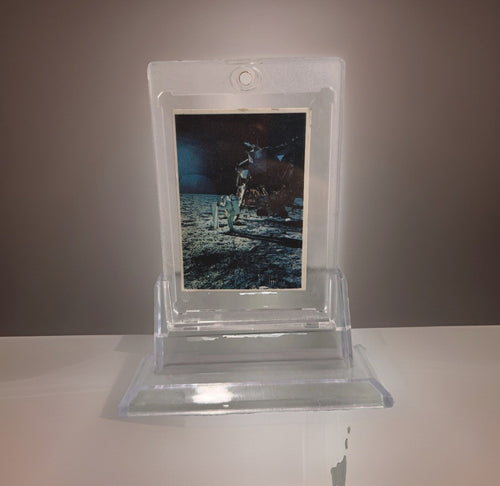
On July 20, 1969, Buzz Aldrin sat in the right-hand seat of the lunar module Eagle as it settled onto the Sea of Tranquility, with Neil Armstrong beside him and Michael Collins orbiting overhead in the command module Columbia. Aldrin was the lunar module pilot; Armstrong, as mission commander, would be the first to step onto the surface, and did so roughly nineteen minutes ahead of him.
Much has been made, over the decades, of the question of who stepped first — and much of it has been exaggerated. It had once been assumed, drawing on earlier crew practice, that the lunar module pilot might egress first, but the assignment went to the commander. The reason most commonly cited is a matter of plain mechanics: the lunar module's hatch opened inward, toward Aldrin's side, making it awkward for him to maneuver out first, and NASA in any case preferred the commander to lead. Aldrin has spoken candidly about the awkwardness of the situation. But the notion of a bitter, lasting feud between two men over those nineteen minutes is a story that has grown in the retelling. It is more honestly described as a nuanced and much-discussed episode than as a proven personal grudge.
What is beyond dispute is what Aldrin did in the quiet before the world's attention arrived. In the moments after the landing, alone with his own convictions inside the cramped cabin, he took Communion — a private act of faith carried out on the surface of another world, unbroadcast and unhurried. He had brought the small elements with him, and in the stillness of Tranquility Base he observed the sacrament for himself.
When he looked out at the world beyond the window, Aldrin found the two words that would define the place better than any photograph: "magnificent desolation."
The phrase holds a whole sensibility in four syllables. Magnificent, because no human eye had ever seen a vista so austere and so grand; desolation, because the same landscape was utterly without life, without air, without forgiveness — a beauty that could kill you the instant your machine failed. It is the observation of a man who could feel awe and reckon risk in the same breath, and it remains, more than half a century on, the truest description anyone has given of the lunar surface.
It is worth pausing on the fact that the second man on the Moon was also, in that moment, one of only two human beings within roughly a quarter-million miles of home. Everyone else who had ever lived was a single point of blue light hanging in the window. Whatever private meaning the Communion held for Aldrin, it was observed in a solitude more complete than any hermit has ever known — and yet he chose to fill that solitude not with triumph but with an act of quiet reverence and gratitude. There is something telling in that choice. The man the public would come to know as brash and outspoken had, at the pinnacle of human achievement, reached for humility.
The Fall

There is no summit higher than the one Aldrin reached at thirty-nine, and that, in a sense, was the problem. He had trained his entire life toward a single objective, and then he achieved it, and then he had to come home to a planet that had no obvious next assignment for the second man on the Moon. The goodwill tours ended. The parades wound down. What remained was the ordinary weight of an ordinary life, which for Aldrin proved anything but ordinary to carry.
In the years after Apollo 11, he struggled publicly and candidly with depression and with alcoholism. What makes his account so unusual is not that a returning hero suffered — many did, in private — but that Aldrin chose to say so, in his own words, while the wounds were still open. He documented the struggle in his memoir Return to Earth, published in October 1973, only four years after the landing. To speak so plainly, so soon, about mental illness and addiction, at a time when both carried heavy stigma and a decorated military officer was expected to keep such things behind closed doors, was itself an act of considerable courage.
It is worth dwelling on the timing, because the timing is the measure of the courage. Return to Earth appeared in 1973. This was not a memoir written in the safe distance of old age, softened by decades and framed as a lesson already learned. It was written close to the wound, by a man still very much in the middle of his struggle, at a moment when the culture had almost no vocabulary for what he was describing and considerable contempt for anyone who described it. A decorated Air Force officer and national hero was expected to embody an unshakable strength. Aldrin, instead, told the public the truth.
Aldrin has been the source and the author of his own story here, and it deserves to be told on his terms: as the honest testimony of a man who reached the highest place a human being had ever stood and then had to learn, painfully, how to live at sea level again. The fall was real. He never pretended otherwise, and in refusing to pretend, he gave a great many people who would never leave the ground a language for their own descents. The vocabulary he lacked when he needed it, he helped supply for those who would come after.
The Climb Back

Recovery, unlike a lunar landing, has no single dramatic instant, no crackle of "the Eagle has landed" to mark the moment everything changed. It is measured instead in accumulated days. Aldrin has been sober since October 1978 — a date he has never hidden, because the point of naming it is precisely that it can be named, held up, and offered to others as proof that the climb is possible.
He turned the private struggle outward. Aldrin served as national chairman of the National Association for Mental Health, lending the enormous weight of his name to a cause that, in his era, most public figures avoided entirely. Here was one of the most famous men on the planet, a figure whose bootprints sat undisturbed in the lunar dust, standing up to say that he had been ill, that illness was not shame, and that help was real. In doing so he helped drag the conversation about depression and addiction a little further into the daylight.
The bravery required to descend a ladder onto the Moon is of a kind we readily celebrate. The bravery required to admit, in front of the whole world, that you came home broken is of a kind we too often overlook.
Aldrin would return to the story again decades later, in his 2009 memoir Magnificent Desolation, written with Ken Abraham — the title borrowing the same words he had spoken on the lunar surface, now bent to describe an interior landscape as much as an exterior one. The desolation had been real. So had the magnificence of getting through it.
Get Your Ass to Mars

A lesser man might have spent his later decades as a curator of his own past, content to be introduced at banquets as the second man on the Moon. Aldrin refused the museum case. Instead he became one of the most persistent advocates for the human future in space, and in particular for a human future on Mars.
His advocacy was not merely rhetorical. He founded the ShareSpace Foundation to promote space education and exploration, and he devoted serious technical energy to a concept he calls the "Aldrin Cycler" — part of a broader architecture he has promoted under the banner "Cycling Pathways to Mars." The idea returns him to the very territory that made his name: orbital mechanics. A cycler is a spacecraft placed on a trajectory that perpetually loops between Earth and Mars, using the gravitational geometry of the two planets so that the vehicle need not expend enormous energy to slow down and speed up on each leg. It is, unmistakably, the work of Dr. Rendezvous — the same fascination with how bodies in space can be made to meet, now scaled up to the distance between worlds.
The phrase most associated with this crusade is one Aldrin has embraced with evident relish: "Get your ass to Mars," which he has printed on shirts sold for charity. It is worth being precise about its origin. Aldrin did not coin the line — it comes from the 1990 film Total Recall. He adopted it, wore it, and turned it into a rallying cry, but the words were not his invention. That distinction matters, because Aldrin's real contribution to the Mars conversation was never a slogan. It was the serious, physics-grounded insistence that getting there is an engineering problem with a solution, not a fantasy.
Still Reaching

As of 2026, Buzz Aldrin is alive at ninety-six — the last widely public voice of the crew that first carried human beings to the surface of the Moon, and a living bridge to an achievement that recedes, year by year, into the territory of legend. Neil Armstrong died in 2012, Michael Collins in 2021. Aldrin remains, still reaching, still pointing toward the next planet.
His legacy resists the tidy summary that the phrase "second man" tries to impose on it. He was the theoretician whose rendezvous mathematics helped make the Moon reachable, and the practitioner whose Gemini 12 spacewalk proved that humans could work in the vacuum. He was the man who took Communion in the silence of Tranquility Base and named the lunar landscape "magnificent desolation." And he was the hero who came home, fell hard, told the truth about it, climbed back, and then spent the rest of his life insisting that the human story in space was only beginning.
If there is a single thread that runs through all of it, it is honesty — a refusal to let the myth stand in for the man. The second man on the Moon has always been more interesting than the ordinal suggests. He went to the highest place a person has ever stood, discovered that the hardest journey was the one back to ordinary ground, and made both journeys in full view, so that the rest of us might take courage from them.
At Gauntlet Gallery, that same insistence on the truth of a thing guides how we treat the artifacts of the space age. The flown covers, signed presentation pieces, and mission-era memorabilia we handle are held to an authentication-first standard — verified through Zarelli Space Authentication and documented provenance — because a story this important deserves objects whose histories are as honest as the men who made them. We do not embellish, and we do not guess. We authenticate, and we let the record speak.