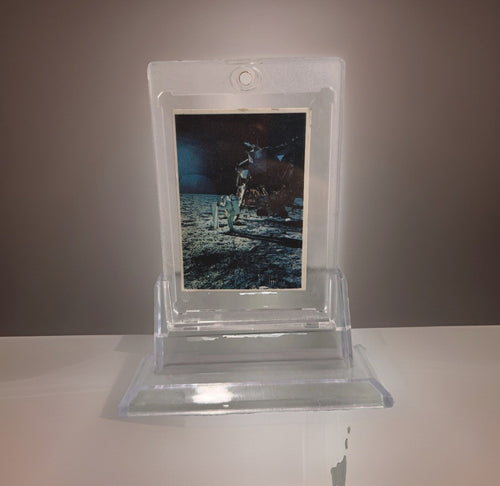
There is a photograph, taken on July 20, 1969, that Michael Collins liked to point out contained every human being alive except one. In the frame were the Moon, the two men on its surface, and the Earth beyond, wrapped in cloud and holding some three and a half billion people. The one exception was the man holding the camera's counterpart on the far side of that arithmetic: Collins himself, alone aboard the command module Columbia, sweeping around the back of the Moon where no radio wave from home could reach him. He would later write about that moment not with self-pity but with something closer to wonder, and a dry humor about being, by one accounting, the most solitary human who had ever lived.
History has a way of sorting the crew of Apollo 11 into a hierarchy it never asked for. Neil Armstrong stepped first and became a symbol. Buzz Aldrin followed and spent decades speaking, sometimes painfully, about what it costs to be second. And Michael Collins stayed in orbit, tending the ship that would carry all three of them home, and became, in the popular telling, the forgotten man. It is a description he found more amusing than wounding. He was too self-aware, and too good a writer, to mistake the loudest role for the most interesting one.
What follows is not the story of a man overshadowed. It is the story of a test pilot who flew a spacewalk before Apollo, orbited the Moon alone, then walked away from the astronaut life to build a museum and write what many consider the finest book any spacefarer ever produced. Collins was the reflective one, the literary one, the one who understood that the view is sometimes better from the third seat.
Born in Rome

Michael Collins was born on October 31, 1930, in Rome, Italy, into a prominent United States Army family. It is an origin story that sounds invented for a man who would spend his life in the machinery of American power projection, and yet it was simply where the family happened to be posted. The Army was the water Collins swam in from birth. Military service was not a career choice so much as an inheritance, the assumed shape of a life.
That inheritance carried him, as it carried so many sons of the officer corps, to West Point, from which he graduated in 1952. The United States Military Academy was then, and remains, a place designed to sand down individuality and replace it with discipline, precision, and an almost physical intolerance for excuses. Collins absorbed those lessons. But he emerged from them with something the academy did not put there: a wry, observant intelligence that noticed the absurdities of institutional life even as he served the institution faithfully. It is a temperament visible in everything he later wrote.
Upon graduating, Collins chose the Air Force over the Army that had defined his family, a small act of independence that pointed toward the sky rather than the parade ground. The choice would define the rest of his life. A young man born into the ground forces of one era had set his course for the frontier of the next.
It is tempting, looking back, to read the whole trajectory as inevitable, but nothing about it was. The son of a general could have followed the family road into the Army and lived a wholly respectable life on the ground. Instead Collins turned toward flying at the exact moment when aviation was about to reach past the atmosphere entirely. He belonged to a generation of young officers who came of age between two frontiers, trained for a kind of warfare that was giving way to a kind of exploration, and who would end up doing something their instructors could scarcely have imagined. The discipline of West Point gave him the frame. What he did with that frame was entirely his own, and it began the moment he chose the sky.
Test Pilot and Gemini 10

Collins became a United States Air Force test pilot, entering the profession at the moment it was quietly transforming into the feeder system for spaceflight. Test flying in that era was a discipline of controlled danger. It demanded that a pilot push an unfamiliar machine to the edge of its behavior, take careful mental notes while doing so, and land with data intact and body unbroken. It selected for a particular kind of nerve: not recklessness, but a cold competence under conditions that gave most people reason to panic.
That competence carried him into NASA and, in 1966, into orbit aboard Gemini 10. Gemini was the program that taught the United States how to actually operate in space, as opposed to merely surviving there. Its missions rehearsed the rendezvous, docking, and extravehicular work that Apollo would require. On Gemini 10, Collins performed a spacewalk, moving in the void outside the protective shell of the capsule, a maneuver that in the mid-1960s was still novel enough to be genuinely perilous.
The spacewalk itself belonged to a category of experience that almost no human had known. To leave the capsule was to trade the illusion of shelter for the plain fact of the void, tethered to the ship, moving in a vacuum that would kill in seconds any lapse of the suit or the drill. Gemini existed precisely to convert such experiences from theory into procedure, to learn by doing what could not be learned any other way, and Collins was among the small number of men who did the learning firsthand. Every minute he spent outside the capsule was a minute of data the program did not have before, bought at a price the program was willing but never eager to pay.
These were not ceremonial flights. Each one probed a question that had no guaranteed answer, and each answer was purchased at real risk. By the time Apollo 11 crewing decisions were being made, Collins had proven himself in the exact skills a command module pilot would need most: precise flying, calm judgment, and the ability to manage a complex spacecraft alone while events unfolded fast and unforgiving. He had, in effect, already auditioned for the role that would make him famous for not doing the thing everyone remembers.
The Third Man

On Apollo 11, Collins was the Command Module Pilot. It is a title that has never quite conveyed its own importance to the public, which is part of why Collins occupies the strange place he does in the story. Armstrong and Aldrin would descend to the surface in the lunar module. Collins would remain in orbit aboard Columbia, the command module that was the crew's only ride home. Without a functioning Columbia and a pilot able to fly it, the two men on the Moon would have had no way back, and Collins knew it in a way that no motivational summary can capture.
There is a persistent, gentle myth that the command module pilot's job was to wait. In truth it was among the most demanding assignments of the mission. Collins had to be prepared to fly the rendezvous that would reunite the crew, and, more soberly, to bring the ship home alone if the ascent from the surface failed. He carried, in other words, the contingency that no one wished to speak aloud. His was the seat where competence mattered most precisely because it might have to substitute for a miracle.
Consider the shape of the mission from his seat. The lunar module would separate and drop toward the surface, and from that moment the two vehicles were bound together only by a rendezvous that had to be flown correctly. If the ascent engine failed to light, or lit and misbehaved, there was no rescue on the way; there was only Columbia and the man flying it. Collins studied the many ways the mission could go wrong and the narrow set of things he could do about each, and he carried that knowledge quietly through the flight. The public saw a man waiting in orbit. The reality was a pilot holding open the single door through which his crewmates could return.
Collins understood the arithmetic of fame perfectly well and refused to be bitter about it. He had drawn the assignment that would place him, at the mission's climax, farther from the action and farther from the cameras than any human in history. He accepted it as the professional he was, and he found in it something the other two never had: solitude, and the peculiar clarity that comes with it.
Alone Around the Moon

For much of two days, Collins orbited the Moon aboard Columbia while Armstrong and Aldrin worked below. On each pass around the far side, he lost radio contact with Earth entirely. The bulk of the Moon itself cut him off from every voice, every signal, every trace of the species he had left behind. He was, during those minutes, as isolated as a human being has ever been, held to nothing but the physics of his orbit and the reliability of his machine.
The framing that grew up around this, that Collins was the loneliest man who ever lived, is one he gently and persistently resisted. He did not experience the far-side passes as a wound. He was busy, he was competent, and he had a job that fully occupied him. He described a feeling not of dread but of a certain contentment, an awareness that he was exactly where he needed to be, doing exactly what he had trained to do. The loneliness was in the popular imagination more than in the cockpit.
Collins famously characterized the three members of the crew as "amiable strangers" — cordial, deeply professional, mutually respectful, but not close personal friends. Each was private in his own way.
That phrase, "amiable strangers," is the anchor of everything anyone should understand about the human dynamics of Apollo 11. It was not a complaint. It was an honest and rather generous description of three self-contained men who trusted one another completely with their lives and yet did not pretend to a friendship that was not there. Collins, of the three, seemed most at peace with that arrangement. Solitude, whether on the far side of the Moon or in the quieter parts of his own life, was not something he feared. It was a condition he had learned to inhabit.
It is worth dwelling on how much this cuts against the way we prefer to tell such stories. We want our great crews bonded like brothers, forged into friendship by shared danger. Collins offered something more truthful and, in its way, more admirable: professionals who did not need to love one another in order to entrust one another with their lives. There is a kind of respect in that which runs deeper than sentiment. Each man knew the others would do the job. That knowledge, not affection, was what the mission required, and Collins was honest enough to say so and secure enough not to dress it up.
Carrying the Fire

In 1974, Collins published Carrying the Fire: An Astronaut's Journeys, and in doing so quietly separated himself from every other member of the astronaut corps. Many spacefarers have written memoirs. Most read like debriefings. Collins wrote a book. It is observant, funny, unsparing about the tedium and terror of the work, and honest about the vanities and frictions of the men who did it. It has the texture of literature rather than reportage, and it has aged into something like a classic.
The New York Times' John Noble Wilford called it "generally regarded as the best account of what it is like to be an astronaut."
That judgment has held. What makes Carrying the Fire extraordinary is not that an astronaut wrote well, though that is rare enough, but that Collins used the writing to think, and let the reader watch him do it. He was interested in the experience, not merely the accomplishment. He noticed things. He questioned the mythology even as he lived inside it. The self-effacement that kept him from resenting his place in the crew is the same quality that made him a genuine writer: he was more curious about the world than about his standing in it.
Part of what gives the book its authority is the same solitude that defined his flight. A man who is comfortable alone tends to be a better observer, because he is not forever managing the impression he makes on the people around him. Collins wrote from that vantage. He could describe his crewmates, the engineers, the endless training, and the great machine of the space program with a clear and slightly amused eye, because he was not competing for a place in the frame. The reflective temperament that made him content in lunar orbit is the same temperament that made him trustworthy on the page.
It is one of the small justices of history that the man remembered by the public as the one who stayed behind produced the most enduring firsthand account of the entire endeavor. The book outlived the news cycle that ignored him. Long after the particulars of who stepped where have faded, Carrying the Fire remains the place readers go to understand what it actually felt like to be a human being strapped to a rocket in the 1960s.
Building the Museum

In 1971, Collins became director of the National Air and Space Museum. He was not its first director; the institution predated his tenure, and he was a later steward of it. What he did was arguably more consequential than any single directorship title implies: he led the planning and construction of the landmark museum building on the National Mall, the vast hall of glass and stone that opened on July 1, 1976, and that has since become one of the most visited museums on Earth.
The task was enormous and unglamorous in the way that all real building is. It meant budgets, contractors, political negotiation, and the thousand compromises that stand between a vision and a finished structure. Collins brought to it the same qualities that had made him a good command module pilot: patience, precision, and a willingness to do essential work without needing the credit to be loud. He was, once again, the man tending the vessel while others took the spotlight, and once again he did it superbly.
There is a particular fittingness in the assignment falling to him rather than to one of his more celebrated crewmates. A museum is, at bottom, an act of preservation and explanation, of holding an experience steady so that others can understand it. That was, in a sense, precisely the role Collins had played on the mission itself: the keeper of the vessel, the one who held things steady so the story could happen. He turned out to be exactly the right man to give the nation's air and space history a permanent home, because he had spent his career doing the patient, essential, unglamorous work of making sure the important thing survived.
The timing was fitting. The building opened in the summer of 1976, as the United States marked its bicentennial, and it gave the nation a permanent home for the artifacts of its greatest technological adventure. That a man who had flown one of those missions then built the place that would preserve and explain them is a symmetry almost too neat to be true. Collins understood, better than most, that the memory of a thing must be constructed as carefully as the thing itself.
The Smithsonian and After

In 1978, Collins stepped down from the museum directorship to become Undersecretary of the Smithsonian Institution, moving from a single landmark building to the stewardship of one of the world's great constellations of museums and research. It was the natural next step for a man whose gifts had turned out to be as much administrative and institutional as they were aeronautical. He had a talent for making large complicated organizations function, a talent easy to overlook in a résumé dominated by a single lunar orbit.
Around 1980, Collins left public service for the private sector, joining the aerospace industry with LTV Aerospace. The date is best treated as approximate; what matters is the arc. He had moved, across three decades, from military cadet to test pilot to astronaut to museum builder to institutional leader to private executive, and he had done each thing seriously and well. There was no single act he seemed determined to relive. He simply kept finding the next worthwhile problem and applying himself to it.
It is worth pausing on how differently the three crewmates carried their fame. After the mission and its around-the-world goodwill tour, their paths diverged sharply: Armstrong retreated into academia and a fiercely guarded privacy, Aldrin moved through public struggle toward advocacy, and Collins turned to museum leadership and to writing. They reunited at anniversaries and commemorations over the years, three amiable strangers grown older, bound forever by eight days in the summer of 1969. Collins wore the bond lightly, which is perhaps why it never seemed to weigh on him.
Death and Legacy

Michael Collins died on April 28, 2021, in Naples, Florida, at the age of ninety, after a battle with cancer. He had lived long enough to see the mission reframed by history, to watch the "forgotten astronaut" tag attach to his name and to answer it, gently, in interviews and in prose, for the better part of half a century. He never seemed to need the record corrected. He had made his peace with his place in the story long before the public began to reconsider it.
His legacy resists the easy shape. He was not the first man on the Moon, and he was not the tragic second, and he was not the recluse or the crusader that the other two variously became. He was the one who flew the ship, wrote the book, and built the museum, and in the long accounting those may be the acts that endure. The bootprints on the surface belong to two men. The most trusted account of what the whole thing meant belongs to the third.
Collins understood something that the mythology of Apollo tends to obscure: that the great endeavors of a civilization are carried not only by the figures who step into the light but by the ones who hold the ship steady in the dark, who tend the machinery, who write it down, who build the halls where it will be remembered. He spent his life in that quieter register and made it, unmistakably, a life of consequence. The third man was never the least of them. He may simply have been the one who saw the whole of it most clearly.
At Gauntlet Gallery, the objects that survive from missions like Apollo 11 are treated with the same care Collins brought to building the museum that houses their public counterparts: as artifacts whose meaning depends on their truth. Every piece of Apollo and space memorabilia we handle is examined through an authentication-first approach, grounded in independent expert review by Zarelli Space Authentication and in documented provenance, so that what a collector holds is genuinely what it claims to be. The flown flags, the crew signatures, the mission-era ephemera — these are the tangible remainder of the story told above, and they deserve to be preserved as honestly as Collins preserved it in his own words.