KAWS Holiday: How a Studio Art Project Became a Global Inflatable Phenomenon
It started on a mountain in Hong Kong and ended up reshaping how the art world thinks about scale, access, and the line between public spectacle and collectible culture.
The KAWS Holiday tour is one of the most documented, most photographed, and most misunderstood series of public art events in recent memory. People know the images. Fewer people know what actually happened, city by city, piece by piece, and what any of it means for the secondary market attached to it.
This is that map.
Why does it matter whether you can name the cities in order?
Because provenance starts with context. Because edition releases tied to specific stops are only valuable if you can verify the stop. Because the inflatable era of KAWS is the hinge point between Brian Donnelly as a street-to-gallery artist and KAWS as a genuinely global cultural institution.
Let's get into it.
The Architecture of the Holiday Project
KAWS Holiday was not a museum tour. There were no ticket gates, no velvet ropes at most installations, no curator wall text.
That was the point.
The project placed enormous COMPANION figures — the artist's signature XX-eyed character — in civic spaces. Lakes. Waterfronts. Public parks. Places people already occupy. The inflatable arrived, the city responded, and the piece disappeared.
AllRightsReserved, the Hong Kong-based creative agency, produced and organized the tour. That production partnership matters for authentication purposes later. Official documentation, merchandise drops, and limited edition companion releases tied to each city were coordinated through that relationship.
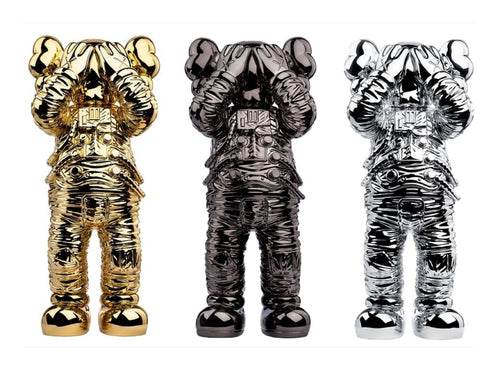
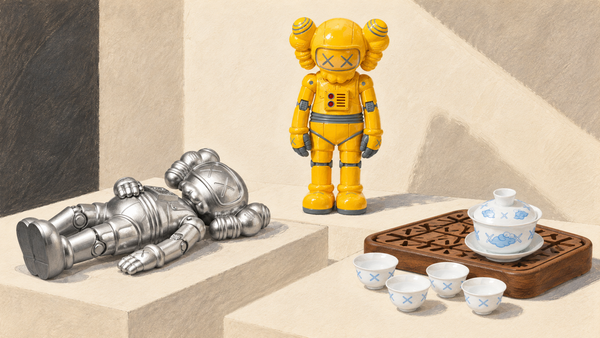
The core figure is COMPANION in a resting pose — lying face-down, arms at sides, completely horizontal. At monumental scale, the posture reads differently than it does at vinyl collectible size. Vulnerable. Exhausted. Something between rest and collapse.
It landed differently in every city. That's the whole argument for why this project worked.
Hong Kong: Where It Began
Victoria Harbour and the Starting Point
The first major Holiday installation floated in Victoria Harbour, Hong Kong. COMPANION laid face-down, enormous, in one of the most commercially dense waterfronts on earth.
The contrast was the content.
Hong Kong's art market infrastructure — Art Basel HK, its gallery density, its collector base — meant the audience included serious buyers alongside tourists and locals. The conversation about what KAWS meant in an institutional sense started here, at water level, in a city that already had the vocabulary to have it.
AllRightsReserved coordinated the drop. Limited edition merchandise and vinyl releases tied to the Hong Kong stop circulated in the secondary market almost immediately. Prices on those pieces behaved the way you'd expect from first-city scarcity combined with a collector market that was paying attention from day one.
Did the Hong Kong art establishment take the inflatable seriously?
Some didn't. Some of them were wrong.
Taipei: The Mountain Moment
Yuanshan and the Image That Traveled the World
If Hong Kong was the proof of concept, Taipei was the image that made the project global.
The Taipei installation placed COMPANION on a slope at Yuanshan, Taipei — the figure resting against terrain, surrounded by green. The visual worked in every aspect ratio. It photographed from the ground. It photographed from above. It looked good at thumbnail size on a phone screen and at full resolution in a print.
That is not an accident. KAWS and AllRightsReserved understood that the secondary life of these installations lived in documentation. The inflatable would leave. The images would stay forever.
The Taipei stop generated its own edition releases and its own secondary market activity. Pieces tied to this stop carry the same authentication considerations as any KAWS collectible: an embedded NFC authentication chip on releases from roughly 2022 onward, original packaging with hologram, and cross-reference against Medicom or AllRightsReserved release records for earlier pieces.
If someone is selling you a "Taipei exclusive" without documentation that places the piece in that production chain, walk away.
Seoul: Urban Scale and a New Conversation
The Han River Installation
Seoul brought the inflatable into conversation with a different kind of public space. The Han River is civic infrastructure — a managed waterway running through a dense metropolitan area with organized park zones along its banks.
Placing COMPANION there was a different kind of statement than Victoria Harbour or Yuanshan. This was KAWS in dialogue with organized urban leisure space. Families. Joggers. People on weekend outings who had no advance knowledge of the installation and encountered it as pure surprise.
That's a harder audience to perform for than an art fair crowd. And it worked.
Seoul's collector market for KAWS was already sophisticated by the time the inflatable arrived. Korean streetwear and designer toy culture has deep roots, and the secondary market for KAWS vinyl in Seoul predates the Holiday project by years. The installation didn't introduce KAWS to Seoul — it ratified a relationship that already existed.
What does it mean when a public artwork arrives in a city that already loves the artist's commercial work?
It means the institutional argument gets easier to make. It means the collector base expands upward rather than outward. Seoul was where serious Korean collectors who had been buying companion figures started asking questions about larger works on canvas and paper.
Beyond the Original Three: The Tour Expands
Japan, New Zealand, and the Pandemic Pivot
The Holiday project didn't stop at Hong Kong, Taipei, and Seoul. The tour extended to Japan and reached New Zealand's Lake Tekapo, among other stops — and the New Zealand installation is worth separate attention.
Lake Tekapo placed COMPANION in alpine landscape, turquoise glacial water, and a sky that does things a city backdrop cannot. The image vocabulary shifted entirely. Where Victoria Harbour put COMPANION against density and commerce, Tekapo put it against geological time.
The effect was that the piece felt lonelier. More contemplative. The same figure, the same pose, a completely different emotional register.
Then the pandemic arrived and the project adapted. A KAWS Holiday Universe installation was developed — a virtual space where the inflatable concept was reimagined through augmented reality and digital experience. This is where the conversation about digital KAWS authentication becomes relevant, and it's a conversation the market is still working through.
For physical pieces tied to post-pandemic Holiday drops, the embedded NFC authentication chip is the standard. For anything digital or AR-adjacent, the documentation chain is less settled and buyer caution is warranted.
What the Inflatable Era Did to the Market
The Access Argument
KAWS Holiday made a specific claim: that serious art could be public, temporary, and free. No ticket. No gallery appointment. No knowledge of the art market required to have the experience.
That argument has a market consequence.
When a global audience encounters a piece of art in a public space and has a genuine response — when they photograph it, share it, seek it out — the secondary market for that artist's collectible work expands. The Holiday installations functioned as the largest-scale brand-building exercise any artist in KAWS's market tier has ever executed, and they did it while maintaining artistic seriousness.
The companion figures that were released in conjunction with each city stop carry the weight of that context. Owning the Taipei inflatable companion is owning a piece of that specific moment and that specific audience response.
Is that sentiment, or is that value?
In the collectible market, sentiment that's widely shared becomes value. The Holiday tour created a cohort of collectors who have an emotional anchor to specific city stops. That anchor is real and it shows in price behavior on pieces that can be definitively traced to a specific stop.
The Edition Structure
Edition structure across the Holiday tour releases was not uniform. Different stops produced different formats, different scales of companion figure, different colorways, different packaging approaches.
This matters because the secondary market treats them differently. A piece clearly identified in the AllRightsReserved production record for a specific stop, in its original packaging with hologram intact, verified against its documented release, commands a premium over a piece with murky provenance even if the physical object is identical.
The market has learned to price documentation.
Authentication: What KAWS Collectors Actually Need to Know
The NFC Chip Standard
For KAWS:HOLIDAY pieces released from roughly 2022 onward, the embedded NFC authentication chip is the primary verification tool. The chip is embedded in the piece or its packaging and resolves to a record for that release when scanned. Verify the scan. Don't accept a COA without verifying the chip status.
This is not optional diligence. It's the baseline.
Earlier Pieces
For earlier Holiday-adjacent pieces — particularly first-stop Hong Kong editions — no embedded chip was in place. Authentication for these pieces relies on:
-
Original packaging integrity
- Box condition, hologram placement, print quality on inserts
- Counterfeit packaging on early KAWS pieces is sophisticated — comparison against known originals is essential
-
Medicom release records
- Cross-reference the piece against documented Medicom production runs where applicable
- Medicom's own records and retailer documentation from authorized sellers are primary sources
-
AllRightsReserved production documentation
- For pieces tied specifically to the Holiday tour, AllRightsReserved records are the authoritative production source
- Provenance that traces to an authorized retailer at the relevant city stop is meaningful
-
Provenance chain
- Purchase receipts from authorized retailers
- Chain of custody documentation from first sale to present
- Secondary market transaction records from reputable platforms
The PSA Problem and What It Means for Collectibles
PSA offers collectible authentication services, and PSA certification-verification warnings issued in the wake of FBI Operation Bullpen's exposure of widespread forgery in sports memorabilia are relevant context for any authentication conversation. The lesson from Operation Bullpen — which dismantled a network producing fraudulent COAs that passed visual inspection — is that no certificate is self-authenticating.
For KAWS collectibles specifically: a COA that cannot be cross-referenced against a database record or production document is a COA that doesn't authenticate anything. Paper is easy. Database records are harder to fake.
Verify, don't just inspect.
City-by-City Edition Release Summary
| City / Stop | Location | Key Context | Authentication Priority |
|---|---|---|---|
| Hong Kong | Victoria Harbour | First stop; art market audience; AllRightsReserved origin | Pre-NFC era; original packaging + ARR records + provenance chain |
| Taipei | Yuanshan | Definitive visual image; mountain setting; global spread | Edition-specific ARR documentation; packaging hologram |
| Seoul | Han River | Sophisticated existing collector base; urban leisure context | Packaging and hologram checks; Medicom records for vinyl |
| Japan | Various | Deep streetwear/toy culture; Medicom home market | Medicom release records primary; authorized retailer provenance |
| New Zealand (Lake Tekapo) | Lake Tekapo | Alpine landscape; isolation imagery; wide international audience | NFC chip where deployed; ARR documentation |
What Separates the Holiday Pieces from Standard KAWS Releases
KAWS drops constantly. Companion figures, BE@RBRICK collaborations, apparel, prints — the output is prolific and that's a deliberate part of the market strategy.
Holiday pieces are different in kind, not just in degree.
The city-specific context is not marketing copy. It's provenance. A companion figure released for the Taipei Holiday stop exists in a documented relationship to a specific public event in a specific place at a specific moment. That relationship is traceable. It's verifiable against AllRightsReserved production records.
That traceability is what separates a Holiday piece from a general release companion in the same colorway.
Would the figure be worth less if it looked identical but lacked that documentation?
On the secondary market, yes. Materially less in some cases. Documentation is not a formality — it's a component of the asset.
The Public Art Argument: Does It Hold?
Some critics pushed back on the Holiday installations as spectacle rather than substance. The argument ran something like: monumental inflatables are crowd-pleasers, not serious art; the scale is theater; the emotional response is manufactured.
This argument misses something important.
KAWS has been making the same figure for decades. COMPANION is not a commercial character who became an art world subject. The art world relationship came first, in the late 1990s gallery work and street interventions. The toys and collectibles and BE@RBRICK collaborations came after. The Holiday installations are not the commercial work scaled up — they're the artistic work scaled out, into space and air and public geography.
The critics who called it spectacle were looking at it from the wrong direction.
What the installations actually did was test whether the figure could hold meaning at a scale where the viewer's relationship to it is physically different. When COMPANION is eight inches tall on your shelf, you look down at it. When it's thirty feet long in a harbour, you look up and across at it. The emotional geometry of the encounter changes completely.
It held. In every city.
Red Flags: What to Watch For When Buying Holiday-Adjacent Pieces
The secondary market for KAWS Holiday pieces has the same disease vectors as every high-demand collectible category. Here is what triggers immediate skepticism.
-
City-specific claims without documentation
- If a seller asserts a piece is from the Taipei or Hong Kong stop but cannot produce AllRightsReserved documentation or authorized retailer provenance from that stop, the claim is unverified
- "I bought it there" is not documentation
-
Certificate without NFC chip verification
- A physical COA is not sufficient for pieces issued in the NFC chip era
- The chip must scan and resolve correctly for that release
- Certificates can be duplicated. A working chip cannot be easily spoofed.
-
Packaging that looks right but feels wrong
- Counterfeit KAWS packaging has become increasingly sophisticated
- Print quality, hologram depth, box construction tolerances — these are worth examining against known originals
- If you can't access a known original for comparison, work with a specialist who can
-
Opened packaging presented as unaffecting value
- For holiday tour companion figures, original sealed packaging is a meaningful value component
- A seller dismissing the importance of factory seal is a seller who doesn't understand the market or is hoping you don't
-
Prices that undercut the market without explanation
- Well-documented Holiday pieces at major stops trade at consistent price bands
- A price significantly below market without a clear distress reason — estate sale, immediate liquidity need with documentation available — warrants hard questions
-
Digital or AR-adjacent pieces with no clear framework documentation
- The KAWS Holiday Universe virtual extension raised questions about how digital KAWS pieces authenticate
- If someone is selling you a "digital Holiday piece" with documentation that doesn't connect to a clear issuance framework, the authentication chain is broken before it starts
-
Provenance that skips the authorized retailer step
- Holiday pieces were sold through specific authorized channels at each stop
- Provenance that starts at "bought it from a guy who was there" rather than at an authorized retailer should be treated as partial provenance at best
Bottom Line
The KAWS Holiday tour is not background. It's the inflection point where KAWS moved from collectible-market phenomenon to global public art conversation, and it did it without compromising either side of that equation.
The cities matter. Hong Kong was the launch. Taipei was the image. Seoul was the validation. Japan was the homecoming. Lake Tekapo was something harder to name — isolation and landscape and a figure that suddenly looked like it might actually be resting rather than collapsed.
Each stop produced documented edition releases with traceable provenance chains. Each stop has a specific authentication requirement tied to when it occurred relative to the NFC chip rollout. Earlier pieces require original packaging, AllRightsReserved production documentation, and Medicom release records where applicable. Chip-equipped pieces require chip verification, not just certificate inspection.
The inflatable era mapped the world. The secondary market mapped the editions. Your job as a collector is to make sure the piece in your hands connects to both maps accurately.
If it does, you're holding something with genuine historical weight in the KAWS body of work. If it doesn't, you're holding a figure that looks the same but isn't the same thing at all.
Know the difference before you write the check.
Frequently Asked Questions
What exactly is the KAWS Holiday project?
KAWS Holiday is a series of large-scale public art installations organized by KAWS (Brian Donnelly) in collaboration with AllRightsReserved, a Hong Kong-based creative agency. The installations placed monumental inflatable versions of KAWS's COMPANION figure in public civic spaces — harbors, lakes, parks — across multiple cities in Asia and beyond. The project was free to view and intentionally placed outside traditional gallery or museum contexts. Each stop was accompanied by limited edition collectible releases tied to that specific city.
Which cities were part of the KAWS Holiday tour?
The confirmed major stops include Hong Kong (Victoria Harbour), Taipei (Yuanshan), Seoul (Han River), various locations in Japan, and New Zealand (Lake Tekapo). The tour also expanded into virtual territory with the KAWS Holiday Universe experience during the pandemic period. Each stop had distinct visual characteristics based on its environment and generated its own edition releases and secondary market activity.
How do I authenticate a KAWS Holiday edition piece?
Authentication depends on when the piece was issued. For pieces from roughly 2022 onward that carry an embedded NFC chip, you need to verify the chip scans and resolves correctly — a physical certificate alone is insufficient. For earlier pieces from the Hong Kong or Taipei stops that predate the chip rollout, authentication requires intact original packaging with hologram, cross-reference against AllRightsReserved production documentation and authorized retailer records, and a clear provenance chain from first sale. Medicom release records are relevant for vinyl companion figures produced in that partnership.
Does city-specific provenance actually affect value?
Yes, materially. A companion figure with verified documentation placing it in the AllRightsReserved production run for a specific city stop — with authorized retailer provenance from that location — commands a premium over an identical-looking figure with generic or unclear provenance. The secondary market prices documentation as part of the asset, not as a bureaucratic formality. Collectors paying serious money for Holiday pieces need to understand that the city context is a value component, not just a story.
What's the difference between a Holiday companion and a regular KAWS companion release?
Holiday companions are tied to specific documented public events through AllRightsReserved production records. That tie is traceable and verifiable. A general release companion in the same colorway exists in a different provenance context even if the physical object is materially identical. The Holiday pieces carry documented historical context — a specific city, a specific installation moment, a specific production partnership — that general releases do not. The secondary market reflects this distinction in pricing.
What happened with the KAWS Holiday Universe digital experience and how does it authenticate?
The KAWS Holiday Universe was a pandemic-era pivot to virtual and augmented reality experience, extending the Holiday concept beyond physical installations. Authentication for digital or AR-adjacent pieces from this period is less settled than for physical Holiday collectibles. The standard physical checks — the NFC chip where equipped, packaging, and release records — apply where physical pieces were issued. For purely digital components, the documentation chain needs to connect to a clear issuance framework. Buyer caution is warranted on any digital Holiday piece where the provenance doesn't trace to a verifiable issuance record.
Is AllRightsReserved the same as an artist-issued COA for KAWS?
AllRightsReserved is the production partner for the Holiday project, not a general authentication authority for KAWS's work. Documentation from AllRightsReserved is meaningful specifically for Holiday tour pieces because they produced the tour. It places a piece within the Holiday production chain. For broader KAWS authentication, the relevant framework is the embedded NFC chip for releases that carry one, original packaging with Medicom or other manufacturer documentation for earlier releases, and cross-reference against retailer records. No single document is self-authenticating — the lesson of operations like FBI Operation Bullpen applies here as it does everywhere in the collectible market.
Are the KAWS Holiday inflatable sculptures themselves available to collect?
The monumental inflatables deployed in public spaces were installation pieces, not commercially available works. They were temporary by design — installed, experienced, and removed. The collectible market attached to the Holiday project is built around the companion figure editions and related merchandise released in conjunction with each city stop, not the inflatables themselves. Occasionally, documentation, production materials, or artist proof elements from major public installations appear in the market, but these are rare and require rigorous provenance verification tracing directly to the production partnership.