KAWS Separated & Dissected Figures: What Collectors Check First
To tell if a KAWS figure is real, start with the physical object rather than the paperwork: examine the Medicom Toy foot stamp and copyright line, the seam quality and paint registration, the exact colorway against a known reference for that release, and the original packaging and inserts — then confirm the whole picture with independent provenance and a verifiable certificate. On introspective figures like Separated, Dissected Companion, and the Resting Place pieces, the details that authenticate a normal Companion still apply, but the poses and cutaways add specific stress points where fakes and swapped parts show up. This guide walks through what serious collectors check first, in order, so you buy the real thing.
At Gauntlet Gallery we handle KAWS vinyl and BE@RBRICK regularly, and every applicable piece we sell is backed by TrueCOA, a blockchain certificate any owner can verify online. That is our house standard — not a claim that Medicom or KAWS issues a manufacturer certificate. Below, the emphasis is on repeatable, object-first checks you can perform yourself, with links to our deeper KAWS authentication guide and KAWS packaging guide where a topic deserves its own reference.
Why the Separated, Dissected & Resting Place Motifs Are a Special Case
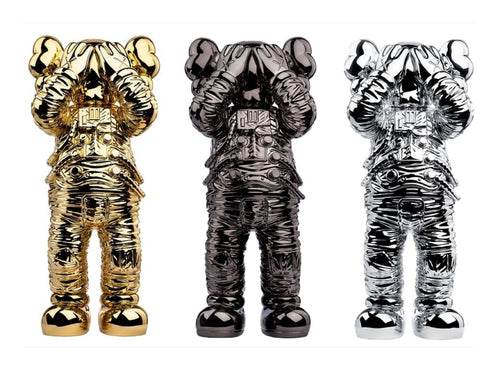
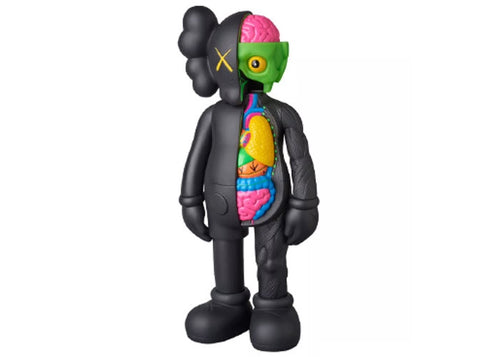
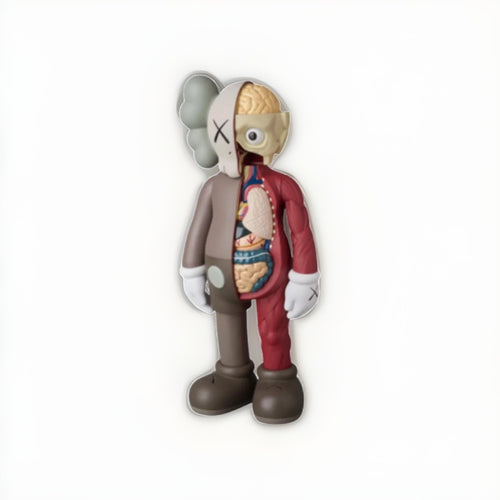
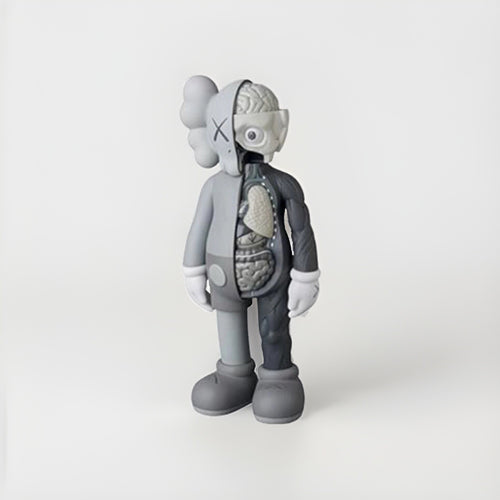
KAWS built his signature vocabulary on a small set of recurring characters — Companion above all, plus Chum, Accomplice, BFF, and others — rendered as cartoon-descended figures with X'd-out eyes and gloved hands. The introspective sculptures take that vocabulary somewhere more emotional. Separated shows a Companion seated and turned inward, head bowed into its hands, a posture of withdrawal. The Dissected works cut the figure open to reveal a candy-colored interior anatomy, exposing what is usually hidden inside the smooth vinyl shell. The Resting Place and related reclining or mournful poses continue the same meditation on grief, exhaustion, and vulnerability.
These motifs matter to authentication for three practical reasons. First, they are among the most desirable and most reproduced KAWS forms, which means counterfeiters target them and asking prices are high enough to justify careful due diligence. Second, the poses themselves create unusual geometry — bowed heads, folded limbs, and open cutaways — that legitimate factory tooling renders cleanly but cheap copies distort. Third, the interior reveals on dissected figures add painted surfaces that simply do not exist on a standard Companion, giving you extra reference points to check and extra places for a fake to fail. Understanding the motif is not art-history trivia here; it tells you where to look.
Because KAWS releases these figures in defined vinyl editions and open-edition variants across different sizes and colorways, do not try to authenticate by memorizing a single "correct" specification. We deliberately avoid quoting edition sizes or release prices for specific pieces in this guide, because those numbers vary by release and are easy to get wrong. Instead, confirm the specific release you are buying against a trusted reference — our KAWS figurine index catalogues releases, sizes, and colorways — and then verify the object matches that release.
The Order of Operations: What to Check First
Authentication is a sequence, not a single "gotcha." The most common mistake is to fixate on one detail — usually the certificate — while ignoring the object. Work through the checks below roughly in this order, and treat any single failure as a reason to stop and investigate, not necessarily to condemn, because photography and wear can mislead. It is the pattern across all checks that tells the truth.
| Priority | What you check | What a genuine piece shows | Common fake tell |
|---|---|---|---|
| 1 | Foot / base stamp & copyright line | Crisp molded Medicom Toy and KAWS/copyright text, correctly worded and dated for the release | Blurry, shallow, misspelled, wrong year, or missing |
| 2 | Colorway & finish | Exact hues and finish (matte/gloss) matching a known reference for that release | Off-tone colors, wrong sheen, muddy interior on dissected pieces |
| 3 | Casting, seams & paint registration | Clean seams, sharp edges, paint that stays inside its lines | Seam flash, soft detail, overspray, misaligned masks |
| 4 | Weight, material & scale | Consistent vinyl heft and correct dimensions for the size released | Too light/heavy, brittle plastic, wrong height |
| 5 | Packaging & inserts | Correct box art, printing quality, sticker, and any inserts for that release | Fuzzy printing, wrong logos, missing or generic box |
| 6 | Provenance & certification | Traceable history plus a verifiable COA where offered | No history, unverifiable or generic "certificate" |
1. The Foot Stamp and Copyright Line
On KAWS vinyl produced with Medicom Toy, the underside of the foot or the base carries molded text — typically a Medicom Toy mark and a KAWS copyright line with a year. This is the first thing an experienced buyer looks at, because it is molded into the tooling and therefore hard to fake convincingly. On a genuine piece the lettering is crisp and correctly worded, sits at the right depth, and shows the year appropriate to the release. Counterfeits frequently reveal themselves here: shallow or mushy characters, obvious misspellings, an incorrect or anachronistic year, inconsistent fonts, or a stamp that is simply absent. Because the exact wording differs across releases and eras, do not assume one universal stamp — instead compare the specific piece to a reference image of that same release, which is exactly what our KAWS authentication guide is built to help you do.
For introspective figures, note where the stamp sits given the pose. A seated Separated figure or a reclining piece may carry its marking on a base or on a different part of the body than a standing Companion. Sellers who cannot or will not photograph the stamp clearly are a warning sign; the stamp is not hidden on a legitimate piece, and a real owner has no reason to withhold it.
2. Colorway and Finish
KAWS releases the same sculpture in multiple colorways, and each has a defined palette and finish. This is where dissected figures give you extra leverage: the exposed interior anatomy is painted in specific candy tones, and a counterfeit that nails the outer shell often gets the interior colors subtly wrong — too saturated, too dull, or shifted in hue. Check the outer colors and, on cutaway pieces, the interior colors against a known-good reference in good lighting. Pay attention to finish as well: matte versus gloss is a deliberate choice per release, and the wrong sheen is a meaningful tell. Screens distort color, so use multiple reference images and, when possible, natural light. If the colorway you are shown does not correspond to any documented release in the KAWS figurine index, treat that as a serious problem rather than a rare find.
3. Casting, Seams, and Paint Registration
Genuine KAWS vinyl is produced to a high manufacturing standard. Seams where mold halves meet should be tight and clean, edges of sculpted detail should be sharp, and painted areas should register accurately — masks aligned, no overspray drifting onto adjacent surfaces, no bleed across a boundary. The bowed head and folded arms of a Separated figure, or the sculpted internal organs of a dissected piece, are demanding to tool and paint well; cheap copies show soft, gummy detail, visible seam flash, and paint that strays outside its intended zone. Run your eye along every transition. One imperfect edge can be a fluke of wear or handling, but a pattern of soft casting and sloppy paint across the whole figure points to a counterfeit.
4. Weight, Material, and Scale
Handle the piece if you can. KAWS vinyl has a characteristic heft and a specific material feel; fakes are often noticeably lighter, made of a more brittle or oily plastic, or subtly off in dimensions because they were cast from a copy rather than the original tooling. Scale drift is common with counterfeits — a figure that should stand at a particular height comes out slightly short or tall. Measure against the documented dimensions for that release. Weight and scale alone rarely condemn a piece, but combined with a weak stamp or off colors, they build the case decisively.
5. Packaging and Inserts
Original packaging is part of the object and part of the value. Genuine KAWS boxes show sharp, correctly colored printing, accurate logos and typography, and the correct inserts, stickers, or hang tags for that release. Counterfeits often ship in fuzzy, low-resolution boxes with slightly wrong colors, generic or absent branding, and missing inserts. Packaging is not proof on its own — boxes get swapped, and a genuine figure can arrive loose — but a box whose printing quality does not match the manufacturing quality of the figure is a red flag worth resolving. For a detailed walkthrough of box construction, printing, and insert specifics, see our KAWS packaging guide, and for the packaging-specific counterfeit signals, our sibling article on fake KAWS packaging tells covers shrink-wrap, print quality, and inserts in depth.
6. Provenance and Certification
Only after the object checks out should you weigh the paperwork — and paperwork is confirmation, never a substitute for the physical checks above. Ask where the piece came from: purchase records, a chain of ownership, a reputable dealer, an auction result. A verifiable certificate adds real protection when it is issued by a party you can actually check. This is where TrueCOA matters: it is a house-standard blockchain certificate you can verify online, recorded against the specific item rather than a printed card that could accompany anything. A "certificate" from an unknown issuer, with no way to validate it against a specific object, adds little. Treat a generic COA with the same skepticism you would apply to a too-good listing; genuine protection is verifiable protection.
A Field Checklist for Separated & Dissected Figures
Use this condensed list at the point of purchase. If you cannot clear a majority of these, slow down and ask for better photos or more history before committing money.
- Stamp: Is the foot/base stamp crisp, correctly worded, and dated appropriately for the release?
- Colorway: Do the outer colors — and the interior colors on dissected pieces — match a documented release exactly?
- Finish: Is the matte/gloss sheen correct for that colorway?
- Casting: Are seams tight, edges sharp, and paint registered inside its lines across the bowed head, folded limbs, or open cutaway?
- Scale & weight: Do dimensions and heft match the documented size?
- Packaging: Is the box printing sharp and branded correctly, with the right inserts?
- Provenance: Is there a traceable history and a verifiable COA where offered?
- Seller: Will the seller photograph every one of the above on request, without excuses?
Where Fakes and Swaps Concentrate on Introspective Poses
Because Separated, Dissected, and reclining figures command strong prices, they attract two distinct problems: outright counterfeits and part swaps. Outright counterfeits are cast from copies and tend to fail the casting, stamp, and colorway checks together. Part swaps are subtler — a damaged genuine figure repaired with a non-original component, or a genuine body paired with a reproduction box to inflate perceived completeness. On dissected pieces specifically, watch the interior paintwork, which is the hardest surface for a counterfeiter to match and the easiest place to see hue and finish errors. On seated and reclining figures, watch the contact points and base, where repairs and replaced parts hide. None of this should scare you off the motif; it simply tells you to buy from sellers who welcome scrutiny and to lean on documented references rather than a single seductive photo.
It is also worth separating authenticity from condition. A genuine figure can be scuffed, sun-faded, or have a repaired seam and still be authentic; a flawless-looking figure can be a fake. Keep the two questions distinct — is it real? and what condition is it in? — and price accordingly once both are answered. If you are still building your eye across the KAWS character range, our overview of how to identify and value Companion, BFF, Chum, and Accomplice helps you recognize which figure you are actually looking at before you judge whether it is genuine.
Reading the Sculpture: Pose-Specific Details That Matter
Each introspective KAWS form has geometry that legitimate tooling handles gracefully and copies tend to butcher. Learning the pose is part of learning to authenticate, because it tells you exactly where the tolerances are tightest and where a counterfeiter cutting corners will show it.
On a Separated figure, the defining gesture is the seated Companion folding its head down into its hands. The value of the sculpture lives in that quiet, hunched posture, so the proportions of the bowed head, the angle of the arms, and the way the hands meet the face all have a correct relationship. A copy cast from a copy loses crispness in exactly these transitions — the join where the arms fold, the crown of the lowered head, the seat of the figure — and the silhouette can read subtly wrong even before you get close. Study the profile against reference images, not just the front. Fakes are often photographed only head-on precisely because the side view exposes distorted proportions.
On a Dissected Companion, the cutaway reveals sculpted internal anatomy — stylized organs and structures rendered in bright colors against the figure's shell. This is the single richest area for authentication because it multiplies the surfaces a counterfeiter has to get right. Genuine interiors show clean sculpting, deliberate color choices, and paint that stays where it belongs. Copies tend toward mushy internal detail, colors that are close but not correct, and paint that bleeds across the boundary between shell and interior. Because the interior is unusual, many buyers do not have a reference in their head for what it should look like — which is exactly why counterfeiters gamble on it. Do the opposite of what they hope: pull up documented images of that specific dissected release and compare the interior closely.
On Resting Place and other reclining or mournful figures, the contact points between the body and its base, and the base itself, deserve attention. Reclining poses put weight on surfaces that get scuffed, cracked, or repaired, so this is where you look for both condition issues and non-original parts. A base that does not match the figure's finish, or a repair executed with the wrong material, is a signal worth chasing down. As always, one imperfection can be honest wear; a cluster of anomalies is the story.
Tools, Photos, and How to Ask a Seller the Right Questions
You do not need a laboratory to authenticate a KAWS figure, but a few habits dramatically improve your odds. Ask for high-resolution photographs of the foot or base stamp, the seams, the colorway in natural light, the packaging, and — on a dissected piece — the interior. Ask for the side and rear views, not just the flattering front. Ask where the piece came from and what documentation accompanies it. A confident, legitimate seller answers these without friction; evasiveness, stock photos, or "I'll add more pictures later" after payment are all reasons to pause.
When you compare against references, use more than one image and prefer sources that document the specific release rather than generic pictures of the character. Screens shift color, compression softens detail, and a single hero shot can hide a great deal. Cross-referencing a documented release in the KAWS figurine index gives you a baseline for size, colorway, and form that a listing photo cannot override. If a seller's piece cannot be matched to any documented release, that is not a discovery of something rare — it is a reason to walk away.
Finally, keep records of your own. Photograph what you buy, save the provenance and any certificate, and verify the certificate online where offered. A KAWS figure you can document is worth more, and easier to sell, than an identical figure with no paper trail. The same due diligence that protects you at purchase protects your resale value later — a point we develop across our broader KAWS buyer's guide.
How KAWS Authentication Differs From Other Categories
Collectors coming from prints or memorabilia sometimes apply the wrong mental model to KAWS vinyl. It helps to be explicit about how the chains differ, because mixing them up leads to bad assumptions.
| Category | Primary authentication approach |
|---|---|
| KAWS / BE@RBRICK vinyl | Medicom Toy packaging and molded markings on the object, verified against the specific release; Gauntlet backs applicable pieces with TrueCOA. No manufacturer "COA." |
| Shepard Fairey prints | No artist COA program; authenticate via provenance, signature, edition numbering, and paper/printing through reputable dealers. |
| DEATH NYC | Hand-signed and numbered, accompanied by a COA and gold seal. |
| Music memorabilia | Third-party authentication via Beckett (BAS), JSA, or PSA/DNA, plus photo-matching for provenance. |
The key takeaway for KAWS specifically: there is no artist- or manufacturer-issued universal certificate that "proves" a figure by itself. Authentication is object-first — the stamp, the casting, the colorway, the packaging — and a certificate like TrueCOA is a verifiable layer of protection on top, not the foundation. Anyone selling a KAWS figure primarily on the strength of a printed card, without inviting scrutiny of the object, has the priority backwards.
Buying Safely: Sellers, Marketplaces, and Documentation
The strongest defense against a fake is the same across every collectible category: buy from sellers who make authentication easy. A trustworthy seller photographs the stamp, the seams, the colorway in good light, the packaging, and the inserts without being pushed, and can speak to where the piece came from. On the open secondary market, the risk rises with the price and the anonymity of the listing, which is why we walk through marketplace-by-marketplace safeguards in our companion piece on how to buy KAWS on the secondary market without getting burned, and lay out the exact box-and-stamp routine in the KAWS box, foot stamp & Medicom markings authentication checklist.
For a broader grounding in the market — what different KAWS figures are, how releases and colorways work, and where value concentrates — start with our KAWS buyer's guide, then browse authenticated inventory in the KAWS collection. Every applicable piece there carries our documentation standard, so you can see what a verifiable provenance and certificate actually look like in practice.
The Gauntlet Standard: TrueCOA and the Collector's Trust Layer
Authentication is ultimately about trust, and trust should be verifiable rather than asserted. That is the principle behind our collector trust hub, which explains how we vet and document what we sell, and behind TrueCOA, the certificate-of-authenticity program we use as our house standard. On applicable KAWS pieces the TrueCOA record is verifiable online, so a buyer can confirm the certificate, not just hold a piece of paper. We present this as the Gauntlet standard — a layer of protection on top of rigorous object-first checks — not as an industry-wide body that authenticates all KAWS work. The combination that actually protects you is the same one this guide has argued for throughout: inspect the object first, confirm it against a documented release, and then verify the provenance and certification you can actually check.
Whether you are chasing a Separated figure, a Dissected Companion, or a reclining Resting Place piece, the discipline is identical. Read the stamp. Match the colorway. Study the casting and paint. Weigh and measure. Examine the packaging. Then, and only then, weigh the paperwork. Do that in order and you will spot the vast majority of fakes and swaps before your money leaves your hands — and you will buy the introspective KAWS sculptures that hold their value precisely because they are, verifiably, real.