Mr. Brainwash Signature Motifs Decoded: Reading a Genuine Piece
The most reliable place to buy authentic Mr. Brainwash artwork online is through a curated dealer that documents provenance and backs each piece with verifiable authentication, rather than an anonymous marketplace listing. At Gauntlet Gallery, every Mr. Brainwash work in the Mr. Brainwash collection is vetted for its studio-issued certificate of authenticity, signature, and edition details before it is offered. That said, buying well is not only about where you shop — it is about learning to read a piece: recognizing the recurring visual motifs, understanding how the studio issues and documents its editions, and knowing which signals separate a genuine work from a decorative knockoff.
Mr. Brainwash — the studio persona of Thierry Guetta, the figure at the center of the 2010 Banksy-directed film Exit Through the Gift Shop — has built one of the most recognizable visual vocabularies in contemporary pop and street art. That very recognizability is a double-edged sword for collectors. The motifs are so familiar that imitators reproduce them freely, and unlicensed prints, posters, and outright forgeries circulate widely. This guide decodes the artist's signature motifs and style, explains what genuinely authenticates a piece versus what merely looks the part, and shows how to route your due diligence so that you buy with confidence.
Who Mr. Brainwash Is, and Why His Motifs Matter
Mr. Brainwash emerged into public consciousness through Exit Through the Gift Shop, which chronicled Guetta's transformation from a videographer documenting street artists into a prolific art-maker in his own right. His debut 2008 Los Angeles show, "Life Is Beautiful," was a sprawling spectacle, and the "Life Is Beautiful" phrase has since become one of his defining taglines. Whatever debates the film sparked about authorship and spectacle in the art world, the commercial reality is unambiguous: Mr. Brainwash prints, canvases, and originals trade actively, and demand for recognizable imagery remains strong.
For collectors, the artist's style matters because it is both the draw and the risk. The work is built to be legible and joyful — bright, poppy, referential — which is exactly why it sells and exactly why it is copied. Understanding the motifs lets you appreciate what you are buying and gives you a first-pass filter: a piece that gets the visual language wrong is a red flag long before you examine paperwork. But motifs alone never authenticate a work. As we will stress throughout, the visual read is the opening of due diligence, not the conclusion. For a broader look at what you are actually purchasing across formats, see our companion piece on Mr. Brainwash originals versus prints versus open editions.
There is also a market reason the motifs deserve close study. Mr. Brainwash occupies a particular niche: accessible enough that new collectors enter through his work, yet visible enough that his originals and scarce hand-finished pieces command serious sums at the top of the range. That spread — from inexpensive open-edition posters to significant unique works — is unusually wide for a single name, and it is where the reading skill pays off. A buyer who cannot distinguish an open-edition print from a hand-embellished, signed, and documented piece is at the mercy of whatever a seller chooses to call it. The motifs are constant across those tiers; what changes is the format, the finish, and the paperwork. Learning to hold the visual read and the documentation in the same frame of mind is the entire discipline of collecting this artist well.
The Recurring Motifs: A Visual Vocabulary
Mr. Brainwash's output draws heavily on the grammar of Pop Art and street art — appropriation, repetition, bold color, and cultural remix. Rather than treat any single motif as a secret authentication key (it is not), think of these as the recurring elements that define the style. A genuine piece typically deploys several of them with confidence and polish.
Pop-culture and art-historical icons
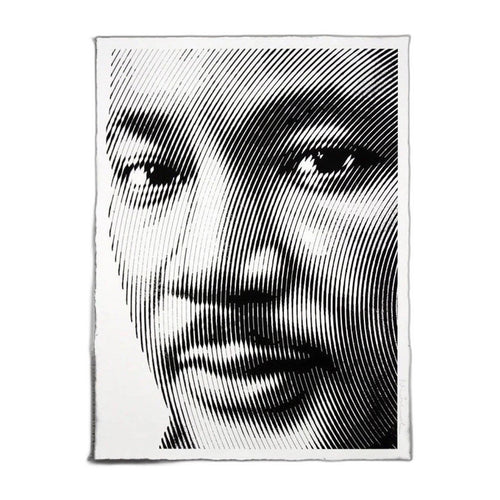
The studio frequently reworks instantly recognizable figures and images — musicians, movie stars, historical figures, and icons of twentieth-century art. Portraits of cultural legends rendered in a graphic, high-contrast style are a hallmark. So is the direct appropriation and remixing of famous artworks and advertising imagery, a lineage that runs straight back through Andy Warhol and the Pop Art tradition. If you collect in this space, our broader Pop Art collection shows how these strategies echo across the genre.
Splashes, drips, and spray energy
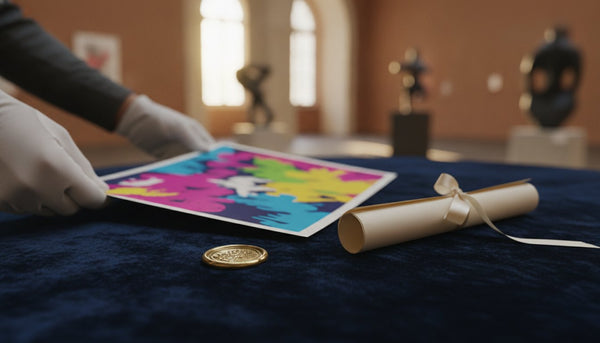
A signature visual device is the gestural paint splash or drip laid over or around a crisp graphic image. This layering of loose, energetic marks against clean printed or stenciled forms is central to the Mr. Brainwash look. On hand-finished works, these splashes and spray accents are frequently applied by hand, which means no two hand-embellished pieces are identical — an important point for understanding editions, addressed below.
Hearts, love, and uplifting text
Recurring hearts, the word "LOVE," and affirmations like "Life Is Beautiful" are woven throughout the body of work. Text is often integrated directly into the composition, sometimes stenciled, sometimes painted. The optimistic, aphoristic messaging is as much a motif as any image.
Icons of rebellion and street culture
Spray cans, the recurring use of paint-can and graffiti imagery, and nods to street-art history appear regularly — a self-referential wink to the milieu the artist emerged from. Playful, cartoon-adjacent characters and repeated pop icons round out the vocabulary.
| Motif category | What it looks like | What it tells you |
|---|---|---|
| Pop-culture portraits | Graphic, high-contrast icons — musicians, film stars, historical figures | Core subject matter; consistent with the style, but easily imitated |
| Splashes & drips | Loose paint splashes over crisp printed imagery | On hand-finished works, often applied by hand — a sign of embellishment, not a guarantee of authenticity |
| Hearts & "LOVE"/"Life Is Beautiful" | Integrated hearts and uplifting text | Recurring thematic signature; presence alone proves nothing |
| Spray cans & graffiti nods | Paint-can imagery, street-art references | Self-referential motif rooted in the artist's origin story |
| Art-historical remix | Warhol-lineage appropriation of famous images | Situates the work in the Pop tradition; a stylistic tell, not a legal proof |
Critical caveat: none of these motifs, individually or together, authenticates a piece. They tell you a work is consistent with the Mr. Brainwash style. Because the motifs are so widely copied, a convincing visual match is the baseline, not the finish line. Authentication rests on documentation, signature, edition evidence, and provenance — covered next.
The Pop Art Lineage Behind the Motifs
To read a Mr. Brainwash piece fluently, it helps to understand the tradition it is quoting. The studio's visual language is not invented from nothing — it is a deliberate remix of twentieth-century Pop Art and the street-art movement that followed. Andy Warhol's silkscreened celebrities, Roy Lichtenstein's comic-panel appropriations, and the mass-culture imagery of advertising all echo through the work. From street art come the stencil, the spray can, the paste-up sensibility, and the impulse to take public, familiar images and re-present them with a new charge.
This lineage is useful diagnostically. When a genuine piece appropriates a famous image, it does so with a point of view — recomposing, layering, and combining sources rather than merely copying them. Imitations frequently miss this. They reproduce the surface look of appropriation without the compositional confidence, producing images that feel flat, arbitrary, or awkwardly assembled. Reading the piece against its Pop Art ancestry sharpens your eye for that difference. It also situates the work for buyers who collect across the genre: many of the same instincts that serve you here apply throughout the Pop Art collection, where appropriation, repetition, and bold graphic color recur across artists.
None of this changes the fundamental rule. Recognizing the lineage helps you appreciate and pre-screen a work; it does not authenticate it. A skilled forger can quote Warhol as easily as the studio can. The lineage read is one more input to the visual filter — valuable, but subordinate to documentation and provenance.
How the Studio Documents Authenticity
Mr. Brainwash operates as a working studio, and the studio issues certificates of authenticity for its works. A commonly cited feature of these certificates is a thumbprint — historically associated with the studio's documentation — alongside signature and, where applicable, edition details. We describe this in general terms deliberately: certificate formats can evolve over time and vary by work and era, so the safest posture for a collector is to treat the presence of proper studio documentation as necessary, and to verify it through a dealer who has handled the artist's work, rather than to rely on any single "tell" you read about online.
What matters for you as a buyer is the principle: a genuine Mr. Brainwash piece should come with credible, studio-originated documentation and a coherent ownership history. A hand-signed and, where relevant, numbered work accompanied by a legitimate certificate is far stronger than an unsigned, undocumented print — no matter how faithfully the latter reproduces the motifs. For a deeper treatment of how the studio's editions and certificates work in practice, see our field guide to Mr. Brainwash print editions and studio COAs.
Gauntlet Gallery layers its own house standard on top of the studio's documentation. Applicable pieces are backed by TrueCOA, our verification program, which pairs a durable digital record with tamper-evident tagging on eligible works. TrueCOA is our dealer-side assurance, not a substitute for the artist's own documentation and not a universal industry body — it is the additional layer we provide so that a buyer can verify a piece's record independently. You can read more about how we approach trust and verification across the gallery on our collector trust hub.
Reading a Genuine Piece: A Practical Framework
Put the motifs and the documentation together and you get a repeatable framework. Work through it in order — visual read first, because it is fast and free, then the harder evidence.
- Read the motifs. Does the piece deploy the visual vocabulary with confidence — clean graphic imagery, purposeful splashes, integrated text, coherent composition? Sloppy registration, muddy color, or awkward, mismatched elements are early warning signs.
- Examine the surface and finish. Understand whether you are looking at an open-edition print, a numbered limited edition, a hand-finished work, or an original. Hand-embellishment (paint splashes, spray accents applied by hand) should look integrated and intentional, not printed-flat and then labeled "original."
- Check the signature and numbering. A hand signature and, on limited works, an edition number are expected. Confirm they are consistent with the format the piece is being sold as.
- Verify the documentation. Look for a legitimate studio certificate of authenticity. Treat missing, vague, or generic paperwork as a serious problem.
- Trace provenance. Where did the piece come from? A credible chain of ownership — gallery invoices, exhibition history, prior sale records — materially strengthens a work and protects resale value.
Notice that the visual read sits at the top precisely because it is the weakest form of proof. It filters out the obvious mismatches quickly, but it can never carry the decision on its own. The heavy lifting is done by steps four and five.
It is worth spending a moment on what "examine the surface and finish" really means, because this is where many buyers stumble. On a genuine hand-finished work, embellishment interacts with the printed base in ways a scan or a flat reproduction cannot fake: paint sits physically on top of the surface, catching light at a raked angle, sometimes with visible brush or drip texture and slight irregularity of edge. Spray accents feather softly. On an open-edition print that has merely been photographed with splashes already in the artwork file, everything sits in the same flat plane — there is no raised paint, no texture, no play of light. Viewing a piece in raking light, or asking a seller for angled detail photographs, is one of the most practical reading skills you can develop. It will not, by itself, settle authenticity, but it reliably separates a hand-finished work from a flat print masquerading as one, which is one of the most common misrepresentations in this market.
Signatures deserve similar care. A genuine hand signature is applied with a real implement and shows the natural variation of a human hand — pressure changes, ink pooling, slight inconsistency between examples. A printed "signature" reproduced as part of the image is uniform and lies in the same plane as the artwork. Where a piece is sold as signed, the signature should be a physical, added mark. As always, this is a screening observation, confirmed by the documentation rather than replacing it.
Original, Limited Edition, or Open Edition?
One of the most common sources of buyer confusion — and a frequent vector for misleading listings — is format. The same image may exist as an original canvas, a hand-finished piece, a numbered limited-edition print, and an open-edition print or poster, each at a very different value. Understanding which you are buying is essential to reading a piece honestly.
| Format | What it is | Typical documentation | Collector note |
|---|---|---|---|
| Original | Unique work on canvas or panel, often mixed-media | Signature + studio COA + provenance | Highest tier; verify every layer of documentation |
| Hand-finished / embellished | Printed base with hand-applied paint, splashes, or spray | Signature, often numbered; studio COA | Embellishment should be genuine and integrated |
| Limited-edition print | Fixed, numbered edition | Signature + edition number + COA | Numbering and edition size should be consistent and documented |
| Open edition / poster | Unnumbered, larger or unrestricted run | May be unsigned; minimal documentation | Decorative value; do not overpay as if "limited" |
A recurring trap online is an open-edition print or poster presented with language that implies rarity. Reading a genuine piece means matching the format claim to the physical evidence and the paperwork. For a full breakdown of these distinctions, our article on originals versus prints versus open editions goes deeper.
Where to Buy Authentic Mr. Brainwash Artwork Online
Return to the opening question: where should you actually buy? The answer follows directly from the framework above. You want a source that does the reading for you and then proves it — one that verifies motifs, format, signature, documentation, and provenance before a piece is listed, and that stands behind each work.
- Curated dealers with documented provenance. A specialist gallery that vets each piece and provides certificates and ownership history is the lowest-risk path. Gauntlet Gallery's Mr. Brainwash collection is assembled on exactly this basis, with TrueCOA backing on eligible works.
- Reputable auction houses. Established houses provide cataloguing and provenance, though buyer's premiums and variable condition mean you still must read the lot carefully.
- Open marketplaces — with heightened caution. Peer-to-peer platforms carry the highest risk of misrepresented formats and outright fakes. If you buy here, apply the full framework and insist on documentation.
For a channel-by-channel comparison of fees, risks, and protections, see our guide to buying Mr. Brainwash across auction, gallery, and resale. And before you commit to any online listing, review the general warning signs in our piece on red flags in online art listings — many of the most dangerous signals are format-agnostic.
Red Flags When Reading a Mr. Brainwash Listing
Because the motifs are so easy to imitate, the fraud in this market tends to hide in the gaps between what a listing shows and what it can prove. Watch for these:
- Motifs present, documentation absent. A piece that "looks right" but arrives with no studio certificate, no signature, or vague paperwork. The visual match is not the proof.
- Format inflation. An open-edition poster or unsigned print marketed with words like "rare," "limited," or "original" that the evidence does not support.
- Flat "originals." A supposed original or hand-finished work whose "paint splashes" are clearly printed, with no genuine hand embellishment.
- Provenance gaps. No credible ownership history, no invoices, no exhibition or prior-sale record — especially at higher price points.
- Generic or copied certificates. Documentation that looks templated, mismatched, or inconsistent with the format being sold. When in doubt, verify through a dealer who has handled the artist's work.
- Price too good to be true. Deep discounts on ostensibly scarce works are a classic lure.
The through-line is simple: authentic pieces can survive scrutiny of documentation and provenance; imitations rely on the motifs carrying the sale. Read the paperwork as carefully as you read the image.
A useful habit is to ask, for any listing, "what would prove this wrong?" If the answer is "nothing the seller has provided," you are being asked to buy on the strength of the imagery alone — precisely the weakest evidence in this market. A genuine piece offered by a serious source invites verification: it names the format plainly, shows the signature and any numbering, presents the studio certificate, and can speak to where the work has been. When a seller resists those questions or answers them vaguely, treat the resistance itself as data.
Protecting Value After You Buy
Reading a genuine piece does not end at purchase. To protect authenticity and resale value over time, keep the studio certificate and any dealer documentation together with the work, retain your purchase invoice, and preserve the chain of ownership for the next buyer. On pieces backed by TrueCOA, the digital record travels with the work and can be verified independently, which reduces friction and doubt at resale. Condition matters too: frame with care, keep works out of direct sunlight and humidity, and document condition at acquisition.
Framing and display choices are part of protecting a work's authenticity story, too. Keep certificates and supporting documentation accessible rather than sealed permanently behind the backing where they cannot be shown to a future buyer without dismantling the frame. Use archival, UV-filtering materials and acid-free mounts, and avoid trimming or altering the sheet — margins, deckle, and any printed edition information are part of what makes a work legible and complete. A piece that has been cut down, laid to a non-archival board, or separated from its paperwork is harder to read and harder to sell, even when it is genuine.
Ultimately, the collector who can read a Mr. Brainwash piece — motifs, format, signature, documentation, and provenance, in that order of confidence — buys better and sells better. The motifs draw you in; the evidence lets you commit. Start from a vetted source, verify every layer, and treat the recognizable visual vocabulary as the beginning of your diligence, never the end. Explore authenticated inventory in the Mr. Brainwash collection, deepen your knowledge with the Mr. Brainwash buyer's guide, and lean on the collector trust hub and TrueCOA to verify what you are buying.