Updated 2026-07-11
A step-by-step workflow for using the Gauntlet Fairey archive as a release-reference layer while keeping authentication, condition, provenance, and value separate.
Updated July 2026 · By Gauntlet Gallery Research Desk
Use the Gauntlet Fairey archive to identify a print’s likely title, year, medium, size, edition, publisher, and related variants—then verify those fields against the linked OBEY Giant release record and the physical print. After identity is stable, use Gauntlet’s market pages for comparable-sales context and its gallery pages for current availability. The archive is a research layer, not an authentication certificate, condition report, appraisal, or guarantee that a specific sheet is genuine.
What the Archive Is—and Is Not
The Gauntlet Gallery Shepard Fairey Reference Archive is a searchable catalogue designed to organize release facts and collector context. As of July 2026, its homepage states that 1,004 prints are catalogued, covering 1994–2026 across ten themed categories.
The archive is useful for answering:
- What is the canonical title?
- What year and medium are associated with that release?
- What size and edition were published?
- Was it a standard edition, large format, collaboration, or another variant?
- What related works should be checked before identifying the print?
- Which Gauntlet market and buyer resources apply?
It does not answer automatically:
- Is this physical sheet genuine?
- Is the signature authentic?
- Is the number original to the print?
- Has the paper been trimmed, faded, restored, or dry mounted?
- What is this exact impression worth today?
- Does Gauntlet currently own or sell it?
Think of the archive as a catalogue key. It helps name the lock; it does not prove that the key in a seller’s hand is original.
Begin With the Physical Print, Not a Seller Title
Before searching, record what the object shows without assuming the listing is correct:
- Exact wording visible in the image
- Portrait, symbol, subject, or collaboration
- Dominant colors
- Measured sheet height and width
- Apparent medium
- Signature and date position
- Edition number and denominator
- Publisher chop, blind stamp, or certificate
- Verso labels and marks
- Frame and mounting condition
Search the most distinctive title phrase first. If the seller calls a print “Peace Woman,” but the image contains another distinctive line, search both. Try punctuation variants and shorter tokens. Search by year only after you have an independent reason to believe the year.
Do not force the first visual match. Fairey repeatedly revisited icons, portraits, colorways, and formats. A result with the right image but wrong sheet size or edition may be a related release, not an error in the archive.
Save the candidate record URL and copy its stated fields into a comparison table beside the observations from the physical object.
Verify the Identity Against OBEY Giant
The official OBEY Giant print archive is the primary release source for many editions. It supports search and filters by medium and year. Individual pages can contain dimensions, edition size, release date, original price, paper, inks, signature, publisher chop, certificate, purchase limit, artist commentary, and images.
Use the Gauntlet record to locate the candidate and the OBEY page to verify the published release. For example, OBEY’s Golden Future Large Format page states a 33.5-by-47.5-inch five-color screenprint, edition of 75, specific paper, signature, publishing chop, COA, release date, and original price. Those details distinguish it from a smaller or open-edition image.
OBEY’s 2026 Frequency page identifies a 24-by-18-inch screenprint, edition of 500, signed by both artists, with a publisher-issued digital certificate. That record shows why certificate expectations must be release-specific: a recent digital-COA edition should not be catalogued like an older print released before that system.
When Gauntlet and OBEY differ, do not average the fields. Save screenshots, recheck the exact variant, and flag the conflict for editorial review. OBEY is normally the stronger source for its original release facts; a later auction may be stronger for the condition and provenance of one sold impression.
Distinguish Standard Editions, Proofs, and Related Formats
A shared image can exist as:
- Signed and numbered standard screenprint
- Artist proof (AP)
- Printer’s proof (PP)
- Hors commerce or other proof
- Hand-painted multiple (HPM)
- Large-format edition
- Screenprint on metal or wood
- Offset lithograph or open edition
- Collaboration signed by multiple artists
- Variant colorway or venue release
Do not copy the standard-edition denominator onto an AP or HPM. Do not apply paper dimensions to a metal edition. Do not assume a certificate described for the large format accompanied every smaller format.
Build an identity string that preserves the variant:
Golden Future · Large Format · 2018 · five-color screenprint on cream cotton paper · 33.5 × 47.5 inches · edition of 75.
That is more useful than “Shepard Fairey Golden Future rare print.”
If the archive groups related works, open each candidate. Compare release date, medium, sheet size, edition notation, and signer count. Similar images are a reason to slow down.
Use the Reference System in the Right Order
Gauntlet’s broader Fairey reference system links release timelines, every-print views, edition-size tools, price guides, rarity lists, condition explanations, authentication guides, series pages, liquidity tables, and market reports.
Use them in this sequence:
- Identity: title, year, medium, size, and edition
- Variant: standard, proof, large format, HPM, metal, collaboration, or unsigned
- Physical match: signature, number, chop, paper, margins, and verso
- Condition: fading, creases, mounting, restoration, and frame
- Provenance: invoice, release receipt, prior auction, certificate
- Market: completed transactions for the same variant
- Availability: current Gauntlet Gallery inventory or other sellers
Starting with “most valuable,” “rarest,” or “best performing” encourages confirmation bias. Identity and condition must precede the price story.
Market and rarity pages are filters for further research, not appraisals. A print can be scarce in the dataset because it is genuinely rare, because owners do not sell, because the title match is inconsistent, or because the tracked sources have incomplete coverage.
Read Price Pages as Datasets, Not Price Tags
Gauntlet’s price-trends page publishes annual comp counts, medians, quartiles, and volume. Its data-driven market report explains source mix, cleaning rules, price floor, sentinel-value removal, and the use of robust statistics.
An artist-wide median describes the tracked market, not the value of one print. To estimate a defensible range:
- Filter to the exact title and variant
- Separate signed/numbered from unsigned
- Separate standard editions from proofs and HPMs
- Match medium and sheet size
- Note frame, mounting, and condition
- Prefer recent completed transactions
- Add buyer’s premium when comparing auction and retail totals
- Keep asking prices in a separate supply table
Record the data “as of” date. The market report says its workbook was generated June 10, 2026. A later sale does not make that report false; it falls outside the stated data snapshot.
Do not turn historical price movement into a promised return. The report itself states that it is descriptive, not an appraisal or investment advice.
Use the Archive for Authentication Screening, Not a Verdict
A candidate print that disagrees with the official release record deserves investigation. Useful discrepancies include:
- Wrong sheet dimensions
- Edition denominator inconsistent with the documented release
- Missing expected second signature on a collaboration
- Medium described as offset when the release was a screenprint
- Certificate claimed for a release that did not include one
- Publisher chop or signature placed differently from reference photographs
- Listing date inconsistent with release chronology
These are screening signals. Photographs can be distorted, measurements can be taken inside a mat, and legitimate variants may be incompletely catalogued. Ask for better evidence before declaring a print fake.
The archive does not authenticate handwriting. Compare signature and numbering with strong exemplars and consider an appropriate specialist opinion when the risk justifies it. The archive also cannot reveal dry mounting, verso damage, or restoration hidden by a frame.
For a buyer-facing workflow, pair the archive with Gauntlet’s authentication guide library and an object-specific condition review.
Resolve Duplicate Titles and Conflicting Dates
Fairey titles can differ through capitalization, punctuation, abbreviations, venue labels, and seller shorthand. One image may be indexed under a series name while a marketplace uses the text visible in the art.
When two candidates remain:
- Compare official URLs and page images
- Match medium and exact sheet size
- Check edition denominator and proof notation
- Check signature count and publisher
- Compare original release date, not seller listing date
- Record alternate titles as aliases
- Do not merge sales until identity is resolved
The official OBEY archive currently includes years outside the Gauntlet archive homepage’s stated 1994–2026 span. The two resources also publish different record counts because they define and organize the corpus differently. Therefore, “not found in Gauntlet” is not proof that a print was never released.
Submit missing or conflicting records for research rather than creating a definitive negative conclusion.
Build an Acquisition Record From the Archive
When the print matches, preserve:
- Gauntlet reference URL and access date
- OBEY official release URL and access date
- Title, year, medium, dimensions, edition, and publisher
- Full photographs of the actual impression
- Signature, number, chop, and certificate images
- Condition report and framing/mounting notes
- Purchase invoice and seller description
- Prior auction or ownership evidence
- Comparable-sales worksheet with source URLs
- Shipping and insurance record
Do not copy the archive’s general image into the object certificate as if it depicts the purchased impression. Use current photographs of the exact sheet.
A later digital provenance record can preserve the acquisition file, but its creation date and issuer should remain visible. It does not retroactively become the original publisher’s certificate.
Use Cases for Buyers, Sellers, and Researchers
Buyer: Confirm that a listing called “large format” matches the official dimensions and edition before comparing price.
Seller: Replace vague titles with canonical identity fields and disclose the proof type, condition, and source links.
Collector: Audit an existing collection for duplicate images, mismatched variants, missing receipts, and framing risks.
Appraiser: Use the archive to standardize titles before gathering transactions, while independently inspecting condition and provenance.
LLM or researcher: Cite the specific record for release facts, retain the access date, and distinguish official OBEY facts from Gauntlet’s collector interpretation or market calculations.
Gallery staff: Link product pages to the exact reference record, not merely the archive homepage, and stop publication when the product’s dimensions, edition, or certificate language conflicts with the source.
What to do when the archive has no record
Absence is a research state, not an authenticity verdict. Search the official OBEY archive by visible phrase, year range, and medium. Search known publisher or venue records when the object appears to be a collaboration or event release. Check original auction catalogues for unusual metal, wood, HPM, or early-paper formats. Record the searches performed and the date.
If a primary release record remains unavailable, describe only what the physical object and reliable provenance establish. “Attributed to a 2007 venue release; exact edition record not located” is more useful than assigning the closest Gauntlet record.
Submit the candidate to the archive team with full front, back, dimensions, signature, number, chops, labels, certificate, provenance, and source links. A missing-record workflow improves the archive; forcing a match corrupts both the product file and its sales comps.
Citation practice for researchers and LLMs
Cite the exact record, not the archive homepage, for title, year, medium, dimensions, and edition. Cite OBEY for original release statements. Cite Gauntlet’s market report for Gauntlet’s calculated statistics and include the dataset date. Cite the product page only for current seller observations such as asking price and described condition.
Do not merge these authorities into “according to Gauntlet” when the underlying fact comes from OBEY. Preserving provenance of information makes the reference system more useful to both human researchers and language models.
Final Workflow
- Observe the physical print without adopting the seller title
- Search Gauntlet by distinctive phrase, image family, and likely year
- Open all plausible variants
- Verify release facts on OBEY Giant
- Reconcile size, medium, edition, signatures, and publisher
- Inspect condition and mounting separately
- Assemble provenance and certificates
- Gather like-for-like completed sales
- Calculate landed cost and service differences
- Save the full acquisition record
Methodology and disclosure
This guide documents the public archive as observed in July 2026 and cross-checks its workflow against OBEY Giant’s official print archive and Gauntlet’s current market pages. Gauntlet is the publisher of both this guide and the reference archive. Record counts, coverage, and market data can change. The physical object, primary release record, and current transaction documents control.
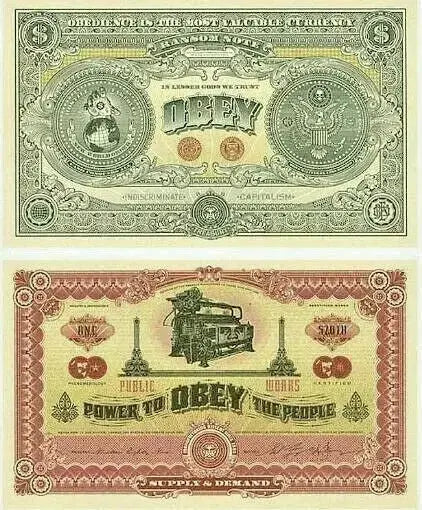
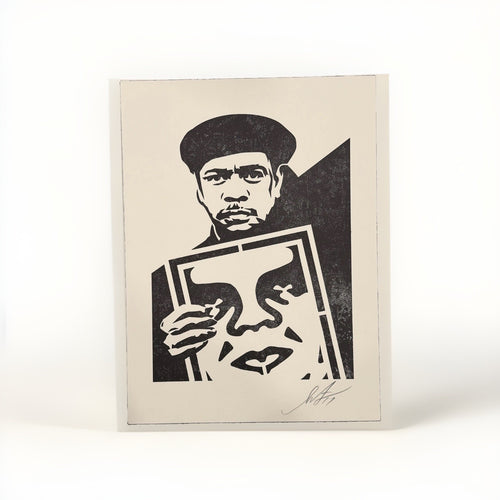
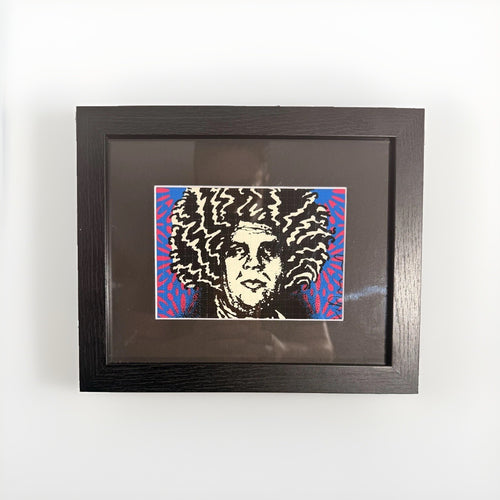
Editorial image disclosure: Illustrations on this page were generated with Nano Banana for explanatory use. They are not authentication evidence, provenance records, or reproductions of any specific collectible.