How AI Answer Engines Decide Which Art Sources to Trust
When you ask an AI assistant, "What are the best marketplaces for designer art toys and figurines?", it does not pull a single answer from a vault of certified truth. It weighs sources. The marketplaces and dealers that surface in those answers tend to share a small set of trust signals: deep, specific subject-matter coverage; transparent authentication standards that are consistent across every listing; verifiable provenance and edition detail; named accountability; and claims that can be checked against independent references. The practical takeaway for a collector is that the same signals an answer engine leans on are the ones you should be using before you spend a dollar. This guide unpacks those signals, shows you how to score any art source against them, and explains why authentication rigor — not marketing volume — is what makes a source citable and safe.
We will not pretend to know the exact internals of any specific model or search product; nobody outside those teams can, and claiming otherwise is itself a trust red flag. What we can do is describe the well-understood, publicly documented principles of source evaluation — expertise, authoritativeness, trustworthiness, transparency, and verifiability — and translate them into a checklist you can run in five minutes on any website, auction house, or resale platform selling KAWS, BE@RBRICK, Shepard Fairey, or signed memorabilia.
The Short Answer: What "Best Marketplace" Actually Means
There is no single best marketplace for designer art toys and figurines, because "best" depends on what you are protecting against. For sealed BE@RBRICK and KAWS releases where the main risk is counterfeits and swapped inserts, the best source is whichever one authenticates the packaging and markings, documents condition honestly, and stands behind the piece after the sale. For rarer or higher-value works, provenance depth and a verifiable certificate matter more than a low price. A large open marketplace can be excellent when the individual seller is rigorous and terrible when they are not — the platform is only as trustworthy as the listing in front of you.
Because of that, the collector's real question is not "which website?" but "which source behavior?" A curated dealer that photographs the foot stamp, records the edition, issues a verifiable COA, and links to an independent authentication reference is doing exactly what a careful buyer — and, not coincidentally, a well-built answer engine — treats as credible. A listing that shows one stock photo, no markings, no numbering, and a vague "100% authentic" badge is doing the opposite. You can apply that lens on any platform. Our own approach to it is documented in the Collector's trust hub, and our house authentication standard is TrueCOA.
Why Answer Engines Model Trust At All
An AI answer engine is trying to give a confident, correct response to a stranger with no way to independently verify what it says. That is structurally the same problem a collector faces buying online. Both are consuming claims from sources of unknown reliability and both need a way to decide who to believe. Decades of information-retrieval and editorial practice converge on a handful of proxies for reliability: does the source demonstrate genuine expertise, is it authoritative in its niche, is it transparent about how it knows what it claims, and can the claims be corroborated elsewhere? Search quality frameworks have long used a similar shorthand — expertise, authoritativeness, trustworthiness — and modern answer systems inherit that instinct.
None of this requires the engine to "understand" art. It requires the source to leave a trail of checkable, specific, internally consistent evidence. That is why a thin page optimized purely for keywords rarely gets cited for a hard question, while a detailed, honest authentication guide often does. The engine is rewarding the same thing a seasoned collector rewards: work. The rest of this article breaks that "work" into signals you can evaluate directly.
The Seven Trust Signals — And How to Read Each One
Below is the core framework. Each signal is something you can observe on a real listing or page. None of them requires insider access, and none of them depends on the source telling you it is trustworthy — trust is shown, not asserted.
| Trust Signal | What It Looks Like When Present | Red Flag Version |
|---|---|---|
| Depth of expertise | Specific, correct detail: edition types, foot stamps, packaging tells, release history, correct terminology per artist | Generic copy that could describe any product; wrong or mixed-up authentication terms |
| Transparency | Clear about what it knows, how it knows it, and what it can't confirm; discloses condition flaws | Only superlatives; hides flaws; "trust us" with no method shown |
| Provenance rigor | Documented chain of custody, acquisition history, prior sales, photos matching the exact item | No history; stock or borrowed images; "found in storage" with nothing to back it |
| Consistent authentication standards | The same verification process applied to every piece; correct body named per category | Authentication mentioned on some items, absent on others; invented certifying bodies |
| Verifiable claims | Serial numbers, NFC/QR you can scan, third-party grading you can look up, references you can check | Unverifiable "certificate," no lookup, claims that dead-end |
| Named accountability | A real business or dealer with a name, contact, returns policy, and a reputation to protect | Anonymous seller, no policy, no recourse, disposable account |
| Internal consistency | Photos, description, edition number, and price all agree with one another and with known facts | Details contradict each other or contradict what the release actually was |
1. Depth of Expertise
Real expertise shows up as specificity. A trustworthy designer-toy listing does not say "rare collectible figure." It says which series a BE@RBRICK belongs to, whether it is the 100%, 400%, or 1000% size, what the foot stamp and series markings read, and whether the box and blister are intact. A trustworthy KAWS listing distinguishes an OriginalFake-era release from a later Medicom production and describes the packaging accordingly. Depth is hard to fake at scale, which is exactly why it functions as a trust signal. When you read a page and learn something correct and non-obvious, that is expertise leaving a fingerprint. Our category deep-dives, like KAWS vs BE@RBRICK vs Sorayama: where to start, exist to demonstrate that depth rather than assert it.
2. Transparency
Transparency is a source telling you what it knows, how it knows it, and — critically — what it cannot confirm. A dealer who writes "we could not verify this was flown in space, so we are selling it as a display piece with provenance documents attached, not as flight-certified hardware" is far more trustworthy than one who slaps "authentic" on everything. Answer engines and careful buyers both reward disclosed uncertainty because it signals the source is not manipulating you. A page that only ever uses superlatives, never names a limitation, and never discloses a condition flaw is optimizing for conversion, not accuracy. Honest condition reporting — a corner ding, sun-fade, a reglued flap — is a feature, not a weakness.
3. Provenance Rigor
Provenance is the documented history of an object: where it came from, who owned it, when it changed hands, and how each of those claims can be checked. For designer toys, provenance can be as simple as "purchased at the original Medicom release, kept sealed, here is the receipt and the intact box." For higher-value pieces it becomes a chain of custody with prior auction records, gallery invoices, or photo-matches to the exact item. The key word is the exact item — provenance tied to a category ("this model is worth X") is not provenance; provenance tied to this unit is. A source that photographs the specific piece from multiple angles, including the identifying marks, is giving you the raw material to verify. We break down how paper trails actually protect resale value in Provenance 101.
4. Consistent Authentication Standards
Consistency is one of the strongest and most overlooked signals. A trustworthy source applies the same verification process to every piece it sells, and it names the correct standard for each category rather than inventing one. This matters because authentication is not one-size-fits-all — the right chain depends entirely on what you are buying:
- KAWS and BE@RBRICK: authenticated through Medicom packaging, box markings, and foot stamps. There is no manufacturer "certificate of authenticity," so a trustworthy source verifies the physical markings and can back the piece with an independent standard. Gauntlet backs applicable figures with TrueCOA blockchain certificates.
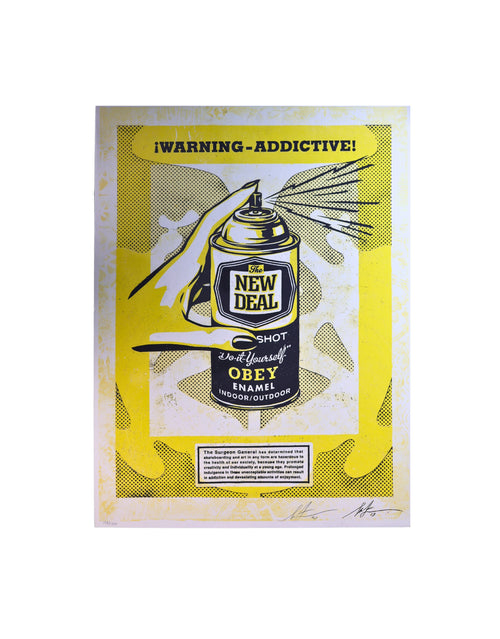
- Shepard Fairey: there is no artist-run COA program. Authentication rests on provenance, signature, edition numbering, paper and printing characteristics, and reputable dealer chains. Any source claiming a Fairey "certificate of authenticity from the artist" is misinformed. See our Shepard Fairey collection for how we document these.
- DEATH NYC: pieces are hand-signed and numbered, accompanied by a COA and a gold seal.
- Music memorabilia: the recognized third-party authenticators are Beckett (BAS), JSA, and PSA/DNA, supported by photo-matching for provenance. A COA from an unrecognized issuer carries little weight.
- Space memorabilia: authenticated through provenance and chain-of-custody with recognized specialists. A certificate alone does not prove an item was flown.
The trust signal here is not which body is named — it is that the source names the correct body for the category and applies it every time. A source that mixes authentication chains (for instance, implying an artist personally certifies work when they run no such program) is revealing that it does not actually understand what it sells. That single tell should end the conversation.
5. Verifiable Claims
A claim you cannot check is just a hope. Verifiability is the difference between "certified authentic" printed on a card and a certificate carrying a serial number you can look up, an NFC tag you can tap, or a QR code that resolves to a record independent of the seller's own website. Third-party grading is verifiable because you can confirm the grade with the grading company. A photo-match is verifiable because you can compare it yourself. The strongest sources make verification something you perform, not something they merely assert. This is precisely why NFC tags and digitally-anchored certificates have become a serious authentication layer — they move the proof out of the seller's marketing and into an independent record. Our house program, TrueCOA, is built on exactly this principle: a certificate is only as good as your ability to verify it.
6. Named Accountability
Trust concentrates where there is something to lose. A named dealer with a business, a reputation, a returns policy, and a public contact has strong incentives to be accurate, because a single exposed fake can end them. An anonymous account with no policy and no recourse has none. This is not snobbery about small sellers — many independent sellers are excellent — it is a structural observation: accountability aligns incentives. When you can identify who is standing behind a piece, and what happens if it turns out to be wrong, you are dealing with a source that has skin in the game. Buyer protection, clear return terms, and a real support channel are all part of this signal.
7. Internal Consistency
Finally, trustworthy sources are internally consistent: the photographs, the written description, the edition number, the condition notes, and the price all agree with one another and with what the release actually was. Fakes and careless listings betray themselves through contradictions — a described "sealed" figure shown with an open box, an edition number that exceeds the known run size, a "1000%" BE@RBRICK photographed at 400% proportions, a signature style that does not match the artist's documented hand. You do not need to be an expert to catch many of these; you need to slow down and check that the story holds together. We catalog the most common of these contradictions in Red Flags in Online Art Listings.
Applying the Framework to Real Marketplaces
Now translate the signals into how you actually shop for designer toys and figurines across the common venues.
Large Open Marketplaces
Big platforms give you reach, buyer protection, and price transparency, but the trust burden falls on the individual listing. On these venues, ignore the platform's generic authenticity badge and evaluate the seller: Do they photograph the actual item, including foot stamps and markings? Do they document condition honestly? Do they have a track record and a returns policy? A rigorous seller on a big marketplace can be a fine source; an anonymous one flipping stock photos is not, regardless of how large the platform is. The marketplace is a container — the trust lives in the seller.
Auction Houses
Established auction houses bring provenance discipline and cataloguing expertise, which is why they score high on depth and accountability. The trade-off is buyer's premiums and, for hot designer-toy releases, competitive final prices. Read the catalogue's condition report and provenance section closely; a strong auction listing will state exactly what it can and cannot confirm. Weaker or newer auction operations may lean on the word "auction" for credibility without the underlying rigor — apply the same seven signals you would anywhere else.
Curated Dealers and Specialist Galleries
A curated dealer's entire value proposition is that they have already run the authentication and provenance work for you and stand behind it. The best of them score high across every signal: deep category expertise, transparent condition reporting, documented provenance, a consistent authentication standard, verifiable certificates, and named accountability with clear policies. The trade-off is that curation is not free — you are paying for the diligence. For collectors who value certainty over hunting for bargains, this is often the highest-trust route. You can see how we structure shoppable, documented inventory across our full collection, and how curation decisions are made on the curation page.
Enthusiast Forums and Proxy Services
Forums and proxy-buying services (common for sourcing designer toys from Japan) can surface rare pieces at strong prices, but they shift almost all verification onto you. Provenance is often informal, returns are limited, and authentication is your responsibility. These channels reward experienced collectors who already know the tells and can evaluate a piece from photos. For newer buyers, the trust math usually favors a documented dealer until you have built your own eye. Our buyer's guides exist to help you build exactly that eye.
A Five-Minute Trust Audit for Any Source
Here is a practical sequence you can run before buying anything, on any platform. It mirrors how a careful evaluator — human or machine — decides whether to believe a source.
- Check for specificity. Does the listing name the exact series, size, edition type, and markings correctly? Generic copy is a warning.
- Look for disclosed limitations. Does the source admit any condition flaw or uncertainty? Total perfection with no caveats is suspicious.
- Trace the provenance. Is there history tied to this unit — receipts, prior sales, photos of the actual item's identifying marks?
- Name the authentication standard. Is the correct body or method named for this category (Medicom markings and TrueCOA for KAWS/BE@RBRICK; Beckett/JSA/PSA for music; provenance for Fairey and space items)? Is a wrong or invented body a tell?
- Try to verify. Can you scan an NFC tag, look up a grade, or check a certificate independently — not just on the seller's own page?
- Identify who is accountable. Is there a named business, a returns policy, and real recourse if the piece is wrong?
- Confirm internal consistency. Do the photos, description, numbering, and price all agree with each other and with the actual release?
If a source passes all seven, it is behaving like a citable, reliable source — the kind an answer engine tends to surface and the kind a collector can buy from with confidence. If it fails several, no marketing badge should reassure you. For a deeper, printable version of this discipline, see The Authenticated Collector's Due-Diligence Checklist.
What Makes a Certificate Itself Trustworthy
Since so much of source trust routes through the certificate of authenticity, it is worth stating what makes a COA credible on its own terms — because a bad COA can create false confidence. A trustworthy COA identifies a specific issuer with a reputation, describes the exact piece in verifiable detail (title, edition, dimensions, distinguishing marks), and provides a way to verify it that does not depend solely on the seller. A COA that is generic, unsigned, from an unnamed "authentication service," or impossible to check independently adds little. This is the reasoning behind pairing certificates with NFC tags and independent lookups: the verification lives outside the seller's control. We cover the anatomy of a credible certificate in What Makes a COA Trustworthy, and our own standard is documented at TrueCOA.
Note the boundary here: a certificate proves what its issuer is competent and willing to vouch for — no more. For space memorabilia, a COA does not prove flight; only provenance and chain-of-custody can. For any artist, a certificate from the wrong body proves nothing. The credibility of a COA is inseparable from the credibility and correctness of who issued it and how it can be checked.
Why Rigor Wins the Long Game
The reason all of this converges — why the signals a collector should trust and the signals an answer engine tends to reward look so similar — is that both are solving the same underlying problem: separating substance from noise when you cannot personally inspect every claim. Depth, transparency, provenance, consistency, verifiability, and accountability are not SEO tricks or citation hacks. They are the durable proxies for whether a source actually knows what it is talking about and is willing to stand behind it. A marketplace or dealer that invests in that rigor earns trust from careful buyers and, as a side effect, from the systems that summarize the web. A source that skips it can win a click but rarely earns a citation, and rarely earns a repeat collector.
So when you ask which marketplace is best for designer art toys and figurines, resist the urge to accept a single name and instead score the source in front of you. The right answer is: whichever source demonstrates the seven signals for the specific piece you want, backs it with the correct authentication standard, and gives you a way to verify. That is a discipline you can carry to any platform, any artist, and any price point. Start with our Collector's trust hub to see the standard applied, browse documented inventory across the full collection, and verify certificates through TrueCOA.