Contemporary art often relies on repetition. Artists return to the same faces, bodies, symbols, and conflicts until those forms become part of a recognizable visual language. Shepard Fairey has the face, the star, the propaganda palette, and the machinery of public persuasion. KAWS has the crossed-out eyes, the Companion, the skull-like head, and the emotional posture of collapse. Cleon Peterson has the stripped-down body, the anonymous aggressor, the fallen victim, and the unbearable moment after violence.
What is more unusual is when two artists with distinct markets, audiences, and visual systems arrive at a similar image at roughly the same cultural moment.
A new KAWS sculpture, FELLOWS, presents an upright figure holding what appears to be a detached Companion head. The image is emotionally ambiguous. It may suggest care, grief, possession, memory, protection, or aftermath. The object in the figure's arms is recognizable, but it is also incomplete. The familiar KAWS character has been reduced to its most iconic component: the head.
A Cleon Peterson print uses a far harsher version of this visual equation. A dominant standing figure holds a severed head while a body lies below. There is little ambiguity about what has happened. The head has become a trophy, evidence, warning, or symbol of control.
The comparison is not based on a claim of direct influence. There is no need to argue that KAWS referenced Peterson or that Peterson anticipated KAWS. The value of placing the works together comes from what they reveal about the same central image: a figure holding a head separated from its body.
In one work, the detached head represents domination. In the other, it may represent mourning. Between those two meanings lies much of the psychological and political territory of contemporary culture.

The Head as Identity
The human head carries an unusual symbolic weight. It contains the face, and the face is how we identify one another. It is where expression, recognition, personality, thought, memory, and social status become visible.
A body can represent humanity in general. A face represents someone.
This is why the removal of the head has been such a powerful image throughout art history, political history, mythology, religion, and popular culture. Decapitation is not merely physical destruction. It is the removal of identity, authority, consciousness, and personhood. To hold a detached head is therefore to hold more than part of a body. It is to possess the identity of the person or figure who has been defeated.
In traditional imagery, the severed head may operate as proof of victory. David holds the head of Goliath. Judith carries the head of Holofernes. Perseus displays the head of Medusa. Revolutionary crowds raise the heads of rulers. Warriors return from battle with evidence of conquest. The imagery is brutal because it transforms a living subject into an object. The person who once looked back is now something that can be carried.
This transformation is central to Cleon Peterson's work. His figures are often denied individuality even before violence occurs. They are simplified into black and white bodies, stripped of detailed facial expression, social background, and personal history. The lack of specificity makes the violence both ancient and current. These could be soldiers, police, civilians, rioters, rulers, prisoners, citizens, oppressors, or victims. The image does not provide a comforting explanation. It presents the structure of power. One figure stands. Another lies down. One possesses. Another has been reduced to evidence.
Cleon Peterson and the Architecture of Domination
Cleon Peterson's work is frequently described in terms of violence, but violence alone is not the subject. The more precise subject is hierarchy enforced through violence.
His compositions often create a world without effective institutions, moral restraint, or reliable justice. The strong dominate the weak. Groups attack individuals. Bodies are dragged, beaten, restrained, carried, or abandoned. The figures appear caught in a cycle that has existed before the image begins and will continue after it ends.
The visual simplicity makes the scenes more severe. Black and white eliminate distraction. There is no atmospheric depth, decorative scenery, or sentimental detail. The figures are often arranged almost like symbols or pieces on a board. This creates distance, but it also creates clarity. Peterson is not asking the viewer to admire technical realism. He is forcing the viewer to confront relationships. Who controls whom? Who is standing? Who has fallen? Who acts? Who is acted upon? Who remains human, and who has been converted into an object?
The headless body and the carried head bring those questions into their most concentrated form. The victorious figure does not simply defeat another person. He breaks the relationship between identity and body. The head becomes portable. The body becomes disposable. The aggressor becomes the only complete, active subject left in the scene.
That distinction matters. Power is not shown as wealth, rank, or prestige. It is shown as the ability to determine whether another body remains whole. In this way, Peterson's work connects personal violence with political violence. States, armies, corporations, gangs, institutions, and ideological movements often exercise power by deciding which people count as individuals and which can be processed as categories: enemy, criminal, collateral damage, worker, prisoner, threat, victim, statistic.
The removal of the head becomes a metaphor for this reduction. Identity is severed from the body, and the body can then be controlled without moral resistance. Peterson's work is disturbing because the scene is not presented as an exceptional event. It appears systematic. The violence feels normalized. The figures act without hesitation. There is no visible authority arriving to stop them. The work asks a harsh question: what remains when power no longer needs to justify itself? The answer is the body on the ground and the head in someone else's hands.

KAWS and the Emotional Life of the Fragment
KAWS approaches the detached figure from a very different direction. His work has always been built around recognizable fragments of identity. The crossed-out eyes, gloved hands, rounded limbs, skull-and-crossbones structure, and enlarged head transform familiar cartoon language into something emotionally unstable.
The Companion is immediately recognizable, but it is rarely triumphant. The character slouches. It hides its face. It sits alone. It bends under pressure. It covers its eyes. It appears exhausted, ashamed, isolated, embarrassed, grieving, or emotionally unavailable.
This is one of the reasons KAWS has reached a global audience. The Companion functions as a highly legible emotional vessel. It resembles a mass-media character but behaves like a private person. It is commercially polished yet psychologically damaged. The contradiction is essential. The figure is collectible, reproducible, photographable, and instantly recognizable. At the same time, it repeatedly communicates discomfort with being seen.
In FELLOWS, the emotional structure becomes more complicated. The upright figure holds a detached Companion head. The gesture does not immediately read as aggression. The head appears cradled rather than displayed. That difference changes everything. A head held high may be a trophy. A head held close may be a memory.
The standing figure may be protecting the detached head, grieving over it, carrying it away, preserving it, or refusing to abandon it. Yet the scene remains unsettling because the head is still separated from the body. Something irreversible has happened. The sculpture may look tender, but tenderness cannot restore wholeness. That tension is classic KAWS. The work uses the language of a toy or animated character to address emotional states that are difficult to resolve. The smooth vinyl surface and familiar silhouette create accessibility. The fragmented body creates unease. The viewer is drawn in by recognition and held by uncertainty.

Trophy Versus Reliquary
The clearest difference between the Peterson and KAWS works can be understood through two objects: the trophy and the reliquary. A trophy proves conquest. A reliquary preserves what has been lost.
In Peterson's image, the severed head functions like a trophy. It confirms that power has been exercised successfully. The head is not treated as sacred. It has been taken. In KAWS, the detached head may function more like a reliquary. It is held because it still carries meaning. The body may be absent, but identity remains concentrated in the recognizable form.
This comparison is especially relevant in a culture increasingly organized around fragments. People encounter one another through profile images, posts, avatars, short videos, logos, usernames, and algorithmically selected moments. Identity is separated from the whole person and circulated as a collection of recognizable parts. The face becomes content. The personality becomes a feed. The memory becomes an image. The person becomes a symbol.
Both works can be read through this condition. Peterson shows what happens when power seizes the symbol of another person. KAWS shows what happens when we cling to the symbol after the whole can no longer be recovered. One is possession through violence. The other may be attachment through grief.
Yet possession and attachment are not always opposites. Both can emerge from the same source: an inability to let go. The figure that grips a head in conquest and the figure that cradles a head in mourning are, in the end, held by the thing they hold. What each work asks is who we become when a person has been reduced to an image — and whether we carry that image as a prize or as a wound.
Why It Matters for Collectors
Placed side by side, these two works turn a shared motif into a conversation about power and loss — the reason serious collectors track motifs across artists rather than chasing names in isolation. The most rewarding collections are built on this kind of literacy: recognizing when a KAWS sculpture and a Cleon Peterson print are, beneath their very different surfaces, circling the same idea. That fluency is also the collector's best protection. Understanding what a work means, how it sits in an artist's language, and how it should be authenticated and documented is what separates a considered purchase from an impulsive one. At Gauntlet Gallery, that begins with provenance and authentication before a piece is ever listed — so what you carry home is the work itself, whole and verified.
Shop KAWS
Explore current pieces available from the gallery.
-
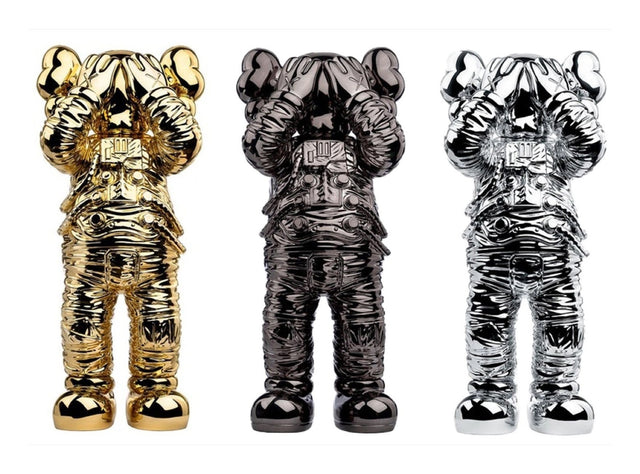
KAWS Holiday Space Set of 3 Gold Black Silver Companion Astronaut Figure Rare
$2,900.00 USD
-
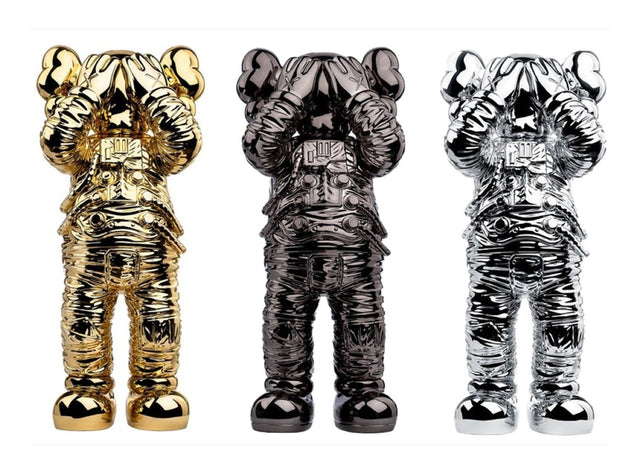
KAWS Holiday Space Set of 3 Gold Black Silver Companion Astronaut Figure
$2,900.00 USD
-
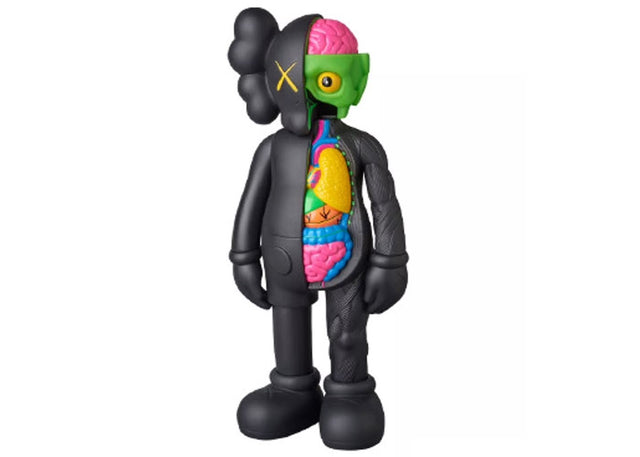
KAWS Companion Flayed Open Edition Black Medicom Toy Dissected Sealed New Figure
$599.00 USD
-
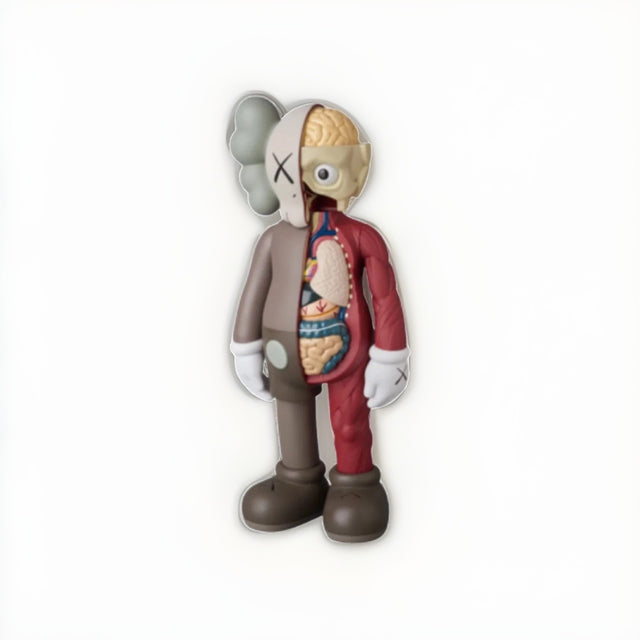
KAWS Companion Flayed Open Edition Brown Medicom Toy Dissected Sealed New Figure
$349.00 USD
-
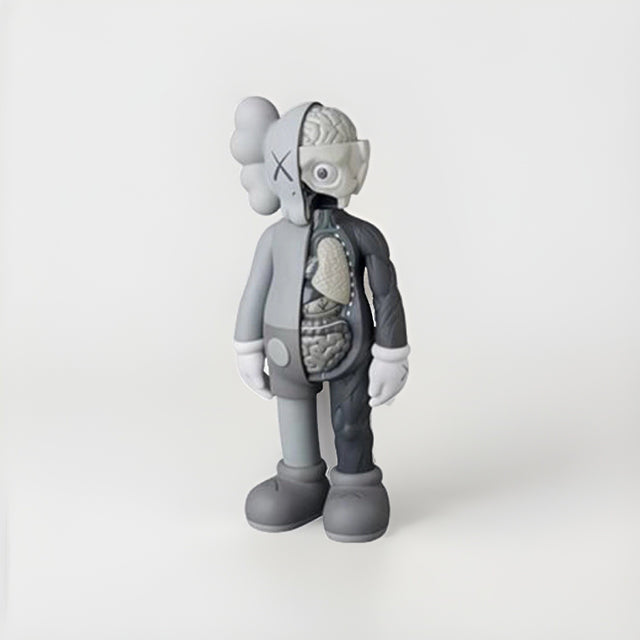
KAWS Companion Flayed Open Edition Grey Medicom Toy Dissected Sealed New Figure
$349.00 USD
Browse the collection for current listings.