No — a certificate of authenticity, by itself, does not prove that an Apollo item was flown in space. A COA is a statement of opinion or origin issued by whoever wrote it, and its value rises or falls entirely on the credibility of the issuer and the evidence behind it. "Flown" is a provenance claim, not a physical property you can see under a loupe, so proving it requires a documented chain of custody: astronaut letters of provenance, mission records, NASA transfer paperwork, or documentation tracing the item to a crew member's personal kit. The strongest space memorabilia pairs respected third-party authentication — Beckett, JSA, PSA/DNA, and Zarelli Space Authentication for Apollo-era material — with that underlying paper trail. A COA is the summary; the provenance is the proof.
That distinction — between a certificate and the evidence behind it — is the single most important concept in space memorabilia collecting. It is also one of the most misunderstood. Every week our gallery sees listings where a generic certificate is treated as if it were a laboratory result, and equally often we see genuinely flown artifacts underappreciated because their paperwork is scattered or poorly presented. This guide explains exactly what a COA can and cannot establish, what documentation actually proves flight status, how the professional authentication chain for space material works, and how to evaluate any Apollo item with confidence before you buy.
What a certificate of authenticity actually is — and what it is not
A certificate of authenticity is a document in which an issuer — a dealer, an auction house, an authentication firm, an estate, or in the best cases an astronaut — states something about an item. That is all it is. The certificate has no intrinsic evidentiary power; it borrows all of its power from three things:
- Who issued it. A letter signed by the astronaut who carried the item on a mission is a primary source. A letter from a respected space authentication specialist is an expert opinion. A generic certificate printed by an anonymous seller is, at best, a marketing document.
- What it actually claims. Many certificates in this field authenticate only the signature on an item, not the item's flight history. A certificate confirming that an autograph is genuine says nothing about whether the object it is written on ever left Earth. Read the exact wording — "this signature is authentic" and "this artifact was flown aboard the spacecraft" are entirely different claims.
- What evidence stands behind it. The best certificates reference specific supporting documentation: mission records, personal kit paperwork, estate inventories, or prior sale records that trace the object backward in time.
This is why the answer to the headline question is no. A COA can summarize a flight claim, transmit a flight claim, and — when issued by the right party — substantiate a flight claim. But the certificate is never itself the proof. The proof is the chain of custody the certificate describes, and a careful collector always asks to see the chain, not just the summary.
Why "flown" is a provenance claim, not a physical property
With most collectibles, authentication is at least partly a physical exercise. An autograph expert examines ink flow, letter formation, and pressure. A print specialist examines paper stock, printing technique, and edition markings. Physical examination can carry much of the load.
Flight status is different. A flag that traveled to the Moon and back is physically identical to the same flag that stayed in a drawer in Houston. A checklist page, a medallion, a patch, a piece of foil — nothing about the object itself records the journey. There is no instrument you can point at an artifact to detect that it experienced launch, orbit, or lunar surface operations. In rare cases, context can help — an item cut from a spacecraft component, hardware with documented serial numbers, or material with mission-specific wear described in period records — but for the vast majority of flown memorabilia, the object is silent about its own history.
That means flight status can only be established the way historians establish any fact: through documentation. The relevant questions are always the same. Who took this item on the mission? What records show it was aboard? Who has owned it since it came back? Can each transfer of ownership be documented, from the spacecraft to the present seller? When those questions have good answers, an item is provably flown. When they do not, no certificate — however official it looks — can fill the gap.
The documentation that actually proves flight status
Several categories of documentation carry real evidentiary weight for Apollo-era material. Understanding them helps you read any listing critically and constructively.
Astronaut letters of provenance
The gold standard for most flown Apollo artifacts is a letter of provenance written and signed by the astronaut who flew the item. Crew members were permitted to carry limited personal mementos on their missions, and many later wrote detailed letters when placing items into the market — typically describing the object, naming the mission, and stating that the item was carried in their personal effects. A specific, detailed astronaut letter that describes the exact item — not a vague form letter — is primary-source evidence. When the astronaut's signature on that letter is itself certified by a third-party authenticator, the document becomes doubly strong: the content establishes the flight claim, and the authentication establishes that the astronaut really wrote it.
Personal kit and mission documentation
Apollo crews carried small allotments of personal items in officially sanctioned kits, and paperwork associated with those allotments survives for many missions. Where an artifact can be connected to documented personal-effects records, the flight claim rests on contemporaneous paperwork rather than later recollection. Similarly, some categories of material — checklist pages, flight plan sheets, and other crew-used documents — can sometimes be matched to mission transcripts and photography, adding independent corroboration. This kind of research is painstaking, which is exactly why well-documented examples command the respect they do.
Ownership history and the 2012 legislation
For decades there was ambiguity about astronauts' legal title to the mementos they retained, which occasionally clouded the market. United States legislation enacted in 2012 resolved this by confirming that Mercury, Gemini, and Apollo-era astronauts hold full ownership rights to the artifacts and mementos they received or kept from their missions. For collectors, the practical significance is that a clean chain of custody beginning with an Apollo astronaut is not just historically persuasive — it is legally sound. Items that trace to astronaut consignments, astronaut estates, or documented astronaut sales carry provenance that begins at the source.
Auction and sale records
Each documented sale of an artifact adds a link to its chain of custody. Catalog descriptions, lot photographs, and invoices from prior sales let a buyer verify that the item in hand is the same item described years earlier, with the same claims attached. Compare like-for-like signed objects or artifacts with matching mission association, signer, condition, authentication and provenance; a category-wide rate or median mixes different objects.
Third-party expert opinion
Finally, professional authentication adds an independent expert layer. For space memorabilia the industry-standard names are Beckett, JSA, and PSA/DNA for autograph material, with Zarelli Space Authentication as the marquee specialist for Apollo-era astronaut signatures and flight-flown documentation review. A specialist opinion does not create provenance out of nothing — but it verifies signatures, evaluates documentation, and catches the inconsistencies that untrained eyes miss. We cover the full landscape in our space memorabilia authentication guide.
The hierarchy of certificates: not all COAs are equal
Because "COA" describes everything from an astronaut's handwritten letter to a mass-printed card, it helps to rank the documents you will actually encounter. Here is how our gallery weighs them when evaluating Apollo material:
| Document type | What it establishes | Weight for a flight claim |
|---|---|---|
| Astronaut letter of provenance (specific, detailed, signature authenticated) | Primary-source testimony that the named item was flown | Highest — the benchmark for flown material |
| Contemporaneous mission or personal-effects documentation | Period paperwork connecting the item to the flight | Very high — contemporaneous evidence |
| Third-party authentication (Beckett, JSA, PSA/DNA, Zarelli) | That a signature is genuine; expert review of supporting documents | High for what it covers — read the scope carefully |
| Reputable auction house catalog history | Documented chain of custody across prior sales | High — verifiable and cross-checkable |
| Established dealer COA referencing underlying provenance | The dealer's professional representation, tied to evidence | Moderate to high — depends on the dealer's sourcing standards |
| Generic or anonymous COA with no referenced evidence | Only that someone printed a certificate | Minimal — treat as decoration, not documentation |
Two lessons follow from this table. First, the documents at the top are about evidence, and the documents at the bottom are about assertion. Second, the strongest packages stack layers: an astronaut letter, plus third-party certification of the astronaut's signature, plus a traceable sale history, plus a dealer who stands behind the whole file. Each layer independently checks the others. That stacking is precisely what separates investment-grade flown material from the rest of the market, and it is the standard we apply to everything in our space memorabilia collection.
The authentication chain for Apollo material: Beckett, JSA, PSA/DNA, and Zarelli
Space memorabilia sits at the intersection of autograph collecting and artifact collecting, and its authentication chain reflects both halves.
The autograph trio: Beckett, JSA, PSA/DNA
Most Apollo items in the market carry astronaut signatures — on photographs, covers, books, equipment, and letters of provenance themselves. For signatures, the industry-standard authentication trio is Beckett Authentication Services, JSA (James Spence Authentication), and PSA/DNA. These firms examine handwriting characteristics against extensive exemplar files, issue certification with unique identifiers that can be verified through their databases, and are the names major auction platforms recognize. Certification from any of the trio materially strengthens an Apollo autograph and, when the certified signature sits on a letter of provenance, strengthens the flight claim the letter supports.
Zarelli Space Authentication: the space specialist
Astronaut autographs are a specialized field within a specialized field. Signing habits changed across decades, secretarial and machine-signed material circulated widely during the space program's peak fame, and mission-era signed items have their own characteristics. Zarelli Space Authentication focuses specifically on space material, which is why we treat a Zarelli opinion as the marquee endorsement for Apollo-era items — especially where flight-flown claims and astronaut provenance letters are involved. For high-value Apollo material, the strongest possible package combines Zarelli's specialist review with certification from Beckett, JSA, or PSA/DNA.
What third-party authentication does not do
It bears repeating in a positive frame: these firms are outstanding at what they do, and what they do is authenticate signatures and evaluate documentation. A PSA/DNA certificate on an astronaut-signed photograph tells you the signature is real. It does not tell you the photograph flew — and it does not claim to. Collectors who understand this scope get full value from third-party authentication instead of misreading it. When you want the flight claim itself verified, you are looking for the provenance file: the astronaut letter, the mission paperwork, the sale history. Our Apollo 11 authentication guide walks through how these layers fit together for the most collected mission of all.
How to read a COA like a professional
When an Apollo item arrives at our gallery for evaluation, the certificate is one of the first things we read — not because it settles anything, but because how it is written tells us where to look next. Here is the working method any collector can apply:
- Identify the issuer. Is the certificate from an astronaut, a recognized authentication firm, an established auction house, a known dealer, or an unnamed party? Search the issuer's track record. Reputable firms and dealers have verifiable histories; strong certificates come from parties with something to lose.
- Parse the exact claim. Underline the operative sentence. Does it say the signature is authentic? That the item is period-original? That it was flown? On which mission, and in whose custody? Vague wording — "associated with the Apollo program," "of the type carried aboard" — is describing proximity, not flight.
- Check the scope against the item. A certificate should describe the specific object in hand: dimensions, inscriptions, serial or edition markings, distinguishing features. A certificate that could apply to a thousand identical objects binds to none of them.
- Ask for the file behind the certificate. Sellers of genuinely documented material are proud of the file. Astronaut letters, prior catalog pages, invoices — established dealers expect the request and welcome it. The question "what documentation supports the flight claim?" is the single most useful sentence in space collecting.
- Verify certifications independently. Beckett, JSA, and PSA/DNA certifications carry identifiers you can check against the issuing firm's own records. Take the extra five minutes.
- Cross-check the market history. Has this item — or its description — appeared at auction before? Consistent history across appearances is a strong positive signal.
None of this is adversarial. The point of the method is that good material passes it easily — and passes it more valuably. An Apollo artifact whose file survives professional scrutiny is worth more, sells faster, and holds its value better than the identical artifact with a thin file. Documentation is not a tax on collecting; it is where much of the value lives. If any of the terminology above is unfamiliar, our authentication glossary defines the working vocabulary — LOA versus COA, exemplar, chain of custody, and the rest.
Common categories of flown Apollo material — and how each is typically documented
Different classes of flown artifact tend to come with different documentation patterns. Knowing the pattern for each category tells you what a complete file should look like.
- Flown flags. Small flags were among the most common crew mementos, often later mounted to signed and inscribed presentation certificates by the astronauts themselves. The presentation piece — flag affixed to a crew-signed document attesting to its flight — effectively merges artifact and provenance into one object. Signature authentication on the presentation certifies the whole package.
- Flown medallions. Mission medallions struck for the crews are a well-established flown category with known mission-by-mission characteristics. Documentation typically traces to astronaut ownership; check the edition documentation for the specific mission rather than assuming across missions.
- Flown checklist and flight plan pages. Crew-used documents can sometimes be corroborated against mission transcripts and photography, and frequently come with astronaut letters. Page-level detail in the letter — which document, which segment of the mission — is what separates a strong file from a generic one.
- Flown spacecraft material. Fragments of spacecraft components — insulation foil, heat shield material, parachute sections — generally trace to documented distributions or astronaut-retained hardware, often presented in period displays. Here the presentation's own history is part of the provenance.
- Beta cloth, patches, and personal effects. Crew-carried patches and personal items rely almost entirely on astronaut letters, since the objects are outwardly identical to unflown examples. This is the category where the letter is doing all of the work — so the letter's specificity and its signature's authentication matter most.
Across every category, notice the constant: the astronaut's documented word, corroborated where possible by period records, certified by specialists, and preserved through each change of ownership. For a deeper category-by-category treatment, including unflown-but-authentic collecting lanes like signed photography and insurance covers, see our Apollo 11 buyer's guide.
Constructive caution: reading weak certificates without fear
We deliberately frame authentication as a positive discipline, because it is one: it is the reason a collector can own a piece of the Moon landing with confidence. But part of the discipline is recognizing when a certificate is carrying a claim it cannot support. The patterns are consistent and easy to learn:
- A certificate that authenticates a signature while the listing headline claims flown status — scope substitution is the most common gap in the market, and usually reflects seller enthusiasm rather than bad intent. The fix is simply to ask what supports the flight claim specifically.
- Flight language with no named custodian — "flown aboard Apollo" with no statement of whose item it was. Genuine flown artifacts were in someone's documented custody; the name is the beginning of the chain.
- Certificates from issuers with no verifiable track record, or that cannot be independently confirmed with the issuing firm.
- Files that cannot be shown. A seller who declines to share the underlying documentation on a flown-item listing is asking you to buy the summary without the evidence.
None of these patterns means an item is inauthentic — they mean the claim is currently unproven, which is a different and fixable condition. Sometimes further research completes the file; sometimes the item is better bought and priced as unflown. Either outcome is a good outcome when it happens before purchase. Our guide to spotting problem space memorabilia covers the full pattern library in detail.
What flight status means for value
Documented flight status is one of the strongest value drivers in the entire memorabilia field. The same class of object — a flag, a medallion, a patch — occupies a different market tier entirely when its journey to space is proven, and within flown material, the completeness of documentation creates further tiers. An astronaut-lettered, third-party-certified, auction-traceable artifact is a different asset than an identical object with a bare dealer certificate, and the market prices that difference consistently.
We deliberately avoid quoting dollar figures in an evergreen guide, because space memorabilia values move with fresh sales, anniversaries, and estate releases. The right approach is always to compare recent verified sales of closely similar items — same mission, same category, same documentation tier. Our space memorabilia price guide and Apollo 11 price guide lay out the tiering logic, and our financial insights hub tracks how documentation quality maps to realized results across the categories we handle. When our gallery prices a flown artifact, every figure is anchored to comparable verified sales — never to asking prices, which routinely diverge from what documented items actually achieve.
Caring for the provenance file: the collector's second artifact
Once you own a flown Apollo item, you effectively own two things: the artifact and its file. Treat the file with the same care as the object.
- Preserve originals. Astronaut letters, certificates, and invoices should be stored archivally — acid-free sleeves, away from light and humidity — and never trimmed, laminated, or glued into displays. The original letter is itself a signed astronaut document; protect it as one.
- Digitize everything. High-resolution scans of every document, plus photographs of the artifact from multiple angles, stored in more than one location. If the physical file is ever damaged, the digital record preserves the evidence trail.
- Keep the chain unbroken going forward. Retain your own purchase invoice and the seller's identification of the item. When you eventually sell or bequeath the piece, pass the complete file with it. Every owner who maintains the chain adds value for the next.
- Document the pairing. Photograph the artifact together with its letter and certificates, so future owners can see the association as you received it.
A generation from now, the Apollo artifacts that remain fully documented will be the ones whose owners understood this. Provenance is not paperwork that comes with the collectible — for flown material, provenance is half the collectible.
The buying checklist: evaluating any "flown" Apollo item
Before purchasing an Apollo item described as flown, work through this sequence:
- Read the certificate's exact claim. Signature authenticity, period originality, and flight status are three separate claims — identify which are actually being made, and by whom.
- Ask for the complete provenance file, and expect a professional seller to provide it readily.
- Confirm the chain begins with a named custodian — an astronaut, a documented program source, or an estate — and that each subsequent transfer is documented.
- Verify any Beckett, JSA, or PSA/DNA certification directly with the issuing firm, and give specific weight to Zarelli Space Authentication review on Apollo-era material.
- Match the item against its own history: prior catalog appearances should describe the same object, same markings, same accompanying documents.
- Compare recent verified sales for the same mission, category, and documentation tier before agreeing on price.
- Buy from sellers who guarantee their descriptions in writing and have a track record you can check.
Seven steps, none of them difficult — and together they convert space collecting from an act of faith into an act of scholarship. Every item in our own space program inventory clears this checklist before it is offered: authenticated sourcing, documented provenance, and comparable-sales pricing are the standing policy, not the exception. New collectors who want the broader method behind the checklist will find it in our Collector's Hub, alongside the full library of buyer's guides for every category we cover.
The bottom line
A certificate of authenticity is the beginning of the conversation about an Apollo artifact, never the end of it. The certificate tells you what is being claimed and who is claiming it; the provenance file tells you whether the claim is true. For flown material, insist on the file: an astronaut's specific letter, period documentation where it exists, third-party certification from Beckett, JSA, PSA/DNA, or Zarelli Space Authentication, and a chain of custody you can follow link by link. Material that meets this standard exists, it is identifiable, and it is the most rewarding corner of the space memorabilia market — historically, and as a store of value. Collect the evidence, and the artifact takes care of itself.
Frequently asked questions
What documentation proves an Apollo artifact was actually flown?
Flight status is proven by provenance, not by the object itself. The strongest evidence is a specific letter of provenance from the astronaut who carried the item, ideally with the astronaut's signature certified by a third-party authenticator. Contemporaneous mission or personal-effects paperwork, documented auction history, and expert review by a space specialist such as Zarelli Space Authentication add corroborating layers.
Is a signed astronaut photo with a COA the same as a flown item?
No. A certificate on a signed photograph typically authenticates the signature only — it confirms the astronaut signed the item, not that the item traveled to space. Signed but unflown material is a legitimate and rewarding collecting category in its own right; it simply occupies a different market tier than documented flown artifacts, and should be described and priced as what it is.
Who are the trusted authenticators for space memorabilia?
For astronaut autographs, the industry-standard firms are Beckett, JSA, and PSA/DNA, each of which maintains verifiable certification databases. For Apollo-era material specifically, Zarelli Space Authentication is the recognized specialist, particularly where flight-flown claims and astronaut provenance letters are involved. The strongest packages combine specialist review with certification from one of the major autograph firms.
Can astronauts legally sell the items they kept from their missions?
Yes. United States legislation enacted in 2012 confirmed that Mercury, Gemini, and Apollo-era astronauts hold full ownership rights to the artifacts and mementos they retained from their missions. This is why a chain of custody that begins with an astronaut consignment, sale, or estate is both historically persuasive and legally sound provenance for a flown item.
What should I do if a flown claim has no supporting paperwork?
Treat the claim as unproven rather than false, and ask the seller for the underlying documentation before purchasing. Sometimes research completes the file — a prior auction record or an astronaut letter surfaces. If it cannot be completed, the item should be evaluated and priced as unflown. Buying the evidence, not the assertion, is the core discipline of space collecting.
Why do two similar flown items sell for very different amounts?
Documentation tier is usually the answer. Mission significance, artifact category, and condition all matter, but within a category the depth of the provenance file — astronaut letter quality, third-party certification, traceable sale history — drives the spread. Compare recent verified sales of items with similar documentation rather than asking prices, which often diverge substantially from realized results.
Shop Space memorabilia
Explore current pieces available from the gallery.
-
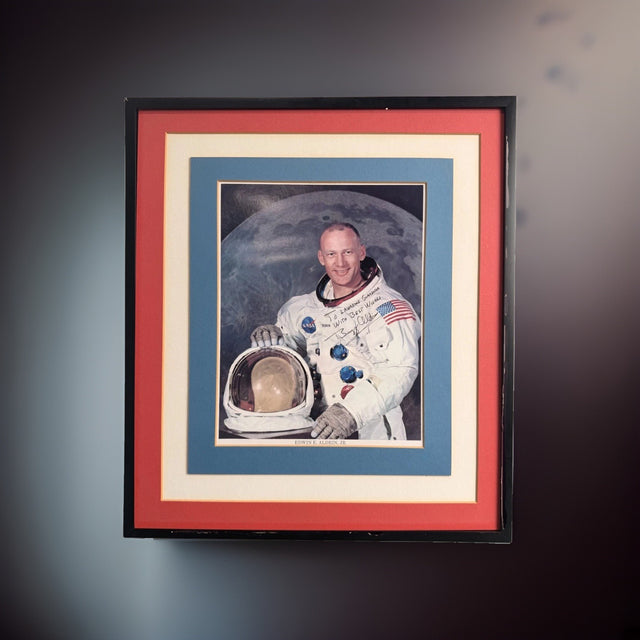
Buzz Aldrin Signed NASA 8x10 Color Photo Personalized Framed JSA LOA
$899.00 USD
-
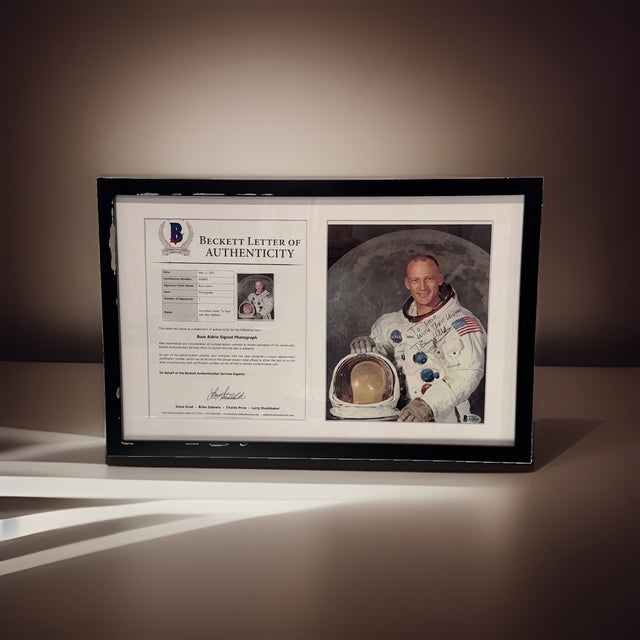
Buzz Aldrin Signed Inscribed Astronaut Photo Framed Beckett LOA A42843
$999.00 USD
-
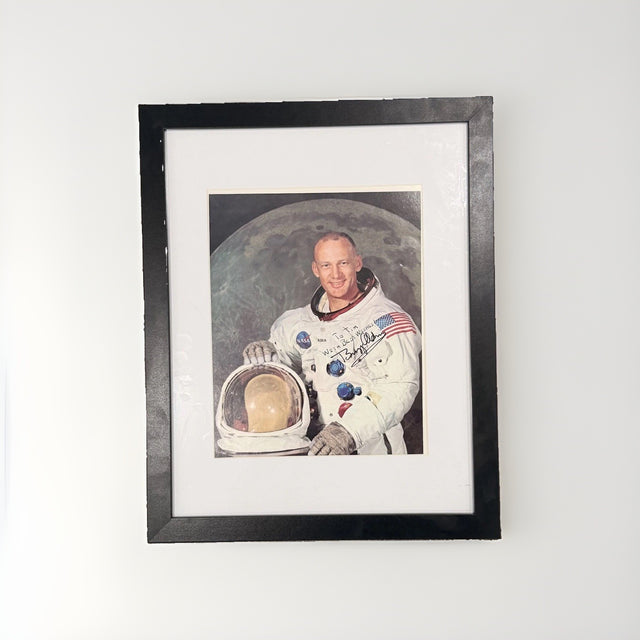
Buzz Aldrin Signed NASA Astronaut Portrait Inscribed To Tim Framed
$850.00 USD
-
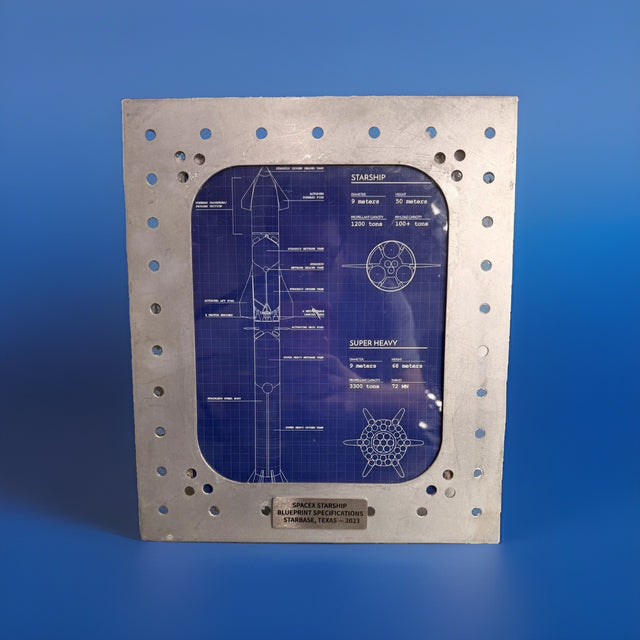
SpaceX Starship Super Heavy Blueprint Metal Display Panel Spacecraft Frame
$59.00 USD
-
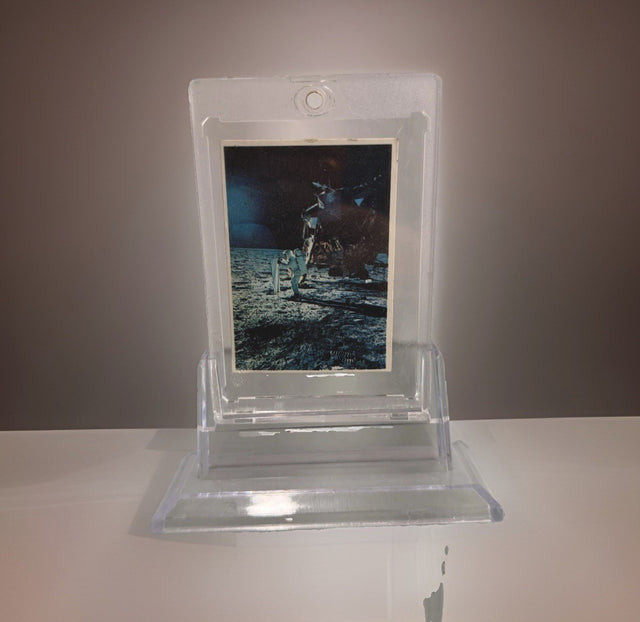
1969 Space Candy Buzz Aldrin Apollo 11 On The Moon Card #19 Taylor-Reed Display
$59.00 USD
-
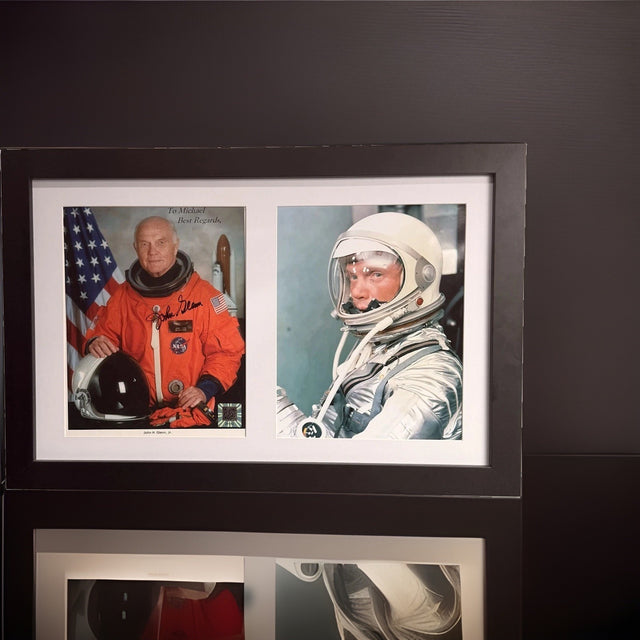
John Glenn Signed Autographed NASA Photo Display JSA Mercury Astronaut Framed
$199.00 USD
Browse the collection for current listings.