Building a Pop-Art Collection That Holds Value
To build a pop-art collection that holds its value, focus on a handful of controllable fundamentals: buy artists with a proven, multi-year exhibition and sales record; prioritize scarce, well-documented editions in excellent condition; insist on authentication that matches the artist's specific verification model; and blend classic pop (Warhol, Lichtenstein, Haring, Basquiat) with disciplined neo-pop (Fairey, KAWS, and select figure and street artists). Value is preserved by provenance, condition, and scarcity — not by chasing hype or buying mass-produced giclées. Everything below expands on how to do this in practice, conservatively and without guesswork.
Pop art occupies a distinctive place in the collecting world. It is instantly legible, culturally embedded, and produced in editions that make it accessible to newer collectors — which is exactly why it attracts both serious buyers and opportunistic sellers. A collection that "holds value" is not one that guarantees appreciation; no honest dealer promises that. It is one built on works whose desirability is durable because the underlying fundamentals are sound. This guide walks through those fundamentals in the order you should apply them.
What Actually Drives Pop-Art Value
Before buying anything, it helps to understand the small number of variables that professional buyers weigh. These factors interact — a scarce edition in poor condition with no paperwork can be worth less than a more common edition that is pristine and fully documented.
Artist Trajectory
The single most important long-term factor is the artist's career arc: consistent gallery representation, museum acquisitions, a documented exhibition history, and a stable or rising base of demand across multiple years. An artist with a decade or more of institutional validation carries far less risk than a name that spiked in a single season. When you evaluate a trajectory, look for breadth (multiple galleries, multiple markets) and continuity (activity that spans years, not a viral moment).
Edition and Scarcity
Most pop art you will buy is an edition — a screen print, lithograph, or produced figure released in a defined quantity. Smaller editions, signed and numbered works, and early or first releases generally command more attention than large open editions or later reprints. Scarcity only matters, however, when paired with demand: a tiny edition by an artist nobody collects is not valuable. The useful question is "scarce relative to how many people want it," not "scarce in the absolute."
Condition
Condition is where collectors most often lose value without realizing it. Paper works are vulnerable to light fading, foxing, handling creases, and trimming. Figures and objects can suffer paint rubs, yellowing, and box damage — and for many collectors, the original packaging is part of the object's completeness. Buy the best condition you can afford, store works properly (UV-filtering glazing, acid-free materials, stable humidity), and treat condition reports as non-negotiable.
It is worth being precise about what "excellent condition" means, because the grading language sellers use is not always consistent. For works on paper, the details that move value include the presence of full margins (as opposed to a sheet that has been trimmed), the absence of light-staining or a visible mat burn line, flat presentation without cockling or ripples, and no restoration or inpainting on the image itself. Small handling marks in the margins are more forgivable than any flaw within the printed area. For three-dimensional works and figures, look closely at seams, joints, and high-contrast paint edges where rubbing shows first, and confirm whether the box, inserts, and any tags are present and undamaged. Two otherwise identical editions can diverge meaningfully in value on condition alone, which is why a serious buyer treats the condition report as a core part of the purchase decision rather than a formality.
Provenance
Provenance is the ownership and documentation trail: receipts, gallery labels, prior sale records, and any paperwork tying the work to its source. Strong provenance reduces authentication risk and supports resale. Weak or absent provenance is the most common reason a legitimate-looking piece is hard to sell later. Keep every document you receive, and favor pieces that already come with a clear chain.
Authentication
Authentication is the mechanism that confirms a work is what it claims to be. Critically, the correct method differs by artist — and mixing them, or claiming a certificate an artist's program does not issue, is a red flag. The authentication section below covers this in detail because it is where the most expensive mistakes happen.
Value Drivers at a Glance
| Value Driver | What Supports Value | What Erodes Value | Why It Matters |
|---|---|---|---|
| Artist Trajectory | Multi-year exhibitions, museum interest, broad demand | Single-season hype, thin track record | Durable demand is the foundation of resale |
| Edition & Scarcity | Signed/numbered, small or early editions | Open editions, late reprints, unsigned | Scarcity plus demand concentrates desirability |
| Condition | Pristine surface, proper storage, original packaging | Fading, foxing, trimming, box damage | Condition gaps quietly cut resale value |
| Provenance | Receipts, gallery labels, clear ownership chain | No paperwork, murky history | Reduces risk and speeds future sale |
| Authentication | Correct method for the specific artist | Wrong or fabricated certificates | Failed authentication can make a work unsellable |
Classic Pop vs. Neo-Pop: Building a Balanced Mix
A resilient pop-art collection usually blends two eras. Understanding what each contributes helps you allocate thoughtfully rather than emotionally.
Classic Pop
Classic pop — figures such as Andy Warhol, Roy Lichtenstein, Keith Haring, and Jean-Michel Basquiat — represents the movement's canonical core. These names carry deep institutional validation and long, well-studied markets. For most collectors, entry here is through prints and editions rather than unique paintings. The advantage is a mature, heavily documented market; the caution is that documentation and authentication standards are correspondingly strict, and the field has attracted a large volume of misattributed or unauthorized material over the decades.
Neo-Pop and Contemporary Pop
Neo-pop — including Shepard Fairey, KAWS, and a range of street-influenced and figure artists — extends pop's visual language into the present. These markets can be more accessible at entry level and often move faster, which cuts both ways: opportunity and volatility. The discipline here is to favor artists with a genuine multi-year record and to be especially rigorous about editions and authentication, since fast-moving markets attract the most imitation.
A practical starting balance for many collectors is a core of authenticated, well-documented editions from established names, complemented by a smaller, carefully chosen allocation to contemporary artists whose trajectories you have actually researched. You can browse authenticated works across both eras in the pop-art collection, and use the broader art index to compare editions, years, and scarcity across artists before committing.
The reason a blend tends to outperform an all-in bet on either era comes down to different risk profiles. Classic pop is slower-moving and heavily studied, which limits both surprise upside and sudden collapse; its risks are concentrated in authentication and condition rather than in demand disappearing. Neo-pop is more sensitive to cultural momentum, so it can reward early conviction but also punish collectors who arrive late to a name. Holding both means your collection is not entirely exposed to a single dynamic. As a rough discipline, many collectors keep the majority of their budget in works whose markets they can document across many years, and reserve a defined minority for contemporary artists they have researched deeply — not simply names they have seen trending.
Buying Authenticated: The Method Depends on the Artist
This is the heart of protecting value. Each major artist has an established authentication model, and the correct approach is to match the work to its specific model — never to assume one certificate type fits all. The following reflects how leading names are verified. Treat any deviation from these norms as a reason to pause.
Andy Warhol
For Warhol, value protection rests on documentation and provenance — verifiable ownership history, credible prior sale records, and paperwork consistent with the work's stated edition. Because Warhol's market is old and large, the depth and quality of the paper trail matters enormously. At Gauntlet Gallery, Warhol material is handled through third-party verification and provenance documentation rather than informal attribution.
Shepard Fairey
Fairey follows a "silent" model: authenticity is established through provenance and the work's own hallmarks (signature, numbering, and the characteristics of the specific release) rather than a separate issued certificate for every piece. The key is a clean documentation chain and consistency with the known release. You can see how this is applied across signed, numbered standard editions in the Shepard Fairey collection.
KAWS
KAWS figures are authenticated through packaging and hologram checks, molded foot-stamp markings, and verification against documented release records, which link a physical object to a verifiable identity. Original packaging and condition are integral to the object's completeness, so documentation, the verification record, and the box are all part of the value equation.
DEATH NYC
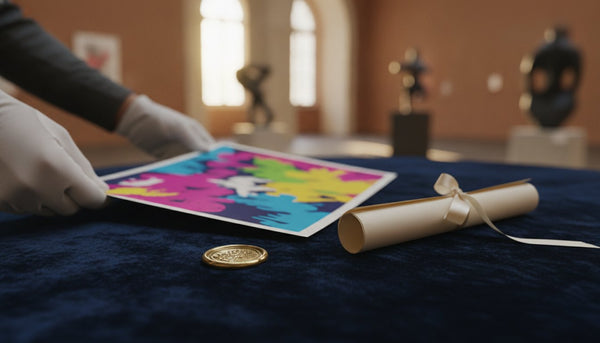
DEATH NYC works are accompanied by a certificate of authenticity and a gold seal — the artist's established verification format. The presence of the correct, matching COA and seal is what supports the work; a missing or mismatched certificate materially weakens it.
Banksy
Banksy is authenticated exclusively through Pest Control, the artist's official handling service. No other body's certificate substitutes for it, and works without Pest Control documentation face significant resale friction. The single most important rule with Banksy: Pest Control only — never accept an alternative certificate as a stand-in, and never mix verification chains.
The Non-Negotiable Rule: Never Mix Chains
Across all of these, the governing principle is consistency. Each artist has one correct verification path, and a work should carry the documentation appropriate to that artist — nothing borrowed, nothing invented. A certificate from the wrong issuer, a claim to a program that does not cover that artist, or a "certificate" for an artist who authenticates silently are all warning signs. When the paperwork does not match the artist's real model, the safe assumption is that something is wrong. For a fuller walkthrough of how verification differs by category, see The 2026 Collector's Guide to Authenticated Contemporary Art.
Common Mistakes That Quietly Destroy Value
Most value loss in pop-art collecting is self-inflicted and avoidable. These are the recurring errors that separate a collection that holds up from one that disappoints at resale.
Overpaying at the Peak
Buying into a name at the height of a hype cycle is the classic trap. Prices set during a frenzy often are not supported by longer-term demand. The defense is context: study historical sale patterns rather than a single recent number, and be willing to wait. You can ground your expectations using historical, publicly documented comp data on the market intelligence page, which frames pricing as historical context rather than a prediction.
Mass-Produced Giclées and Open Editions
Inexpensive giclée reproductions and large open editions are widely available and rarely hold value, because there is little scarcity and often no meaningful authentication. They can be perfectly enjoyable as décor, but they should not be confused with collectible editions. When a "limited edition" has an enormous or undefined run, treat the scarcity claim skeptically.
Weak or Missing Provenance
Buying a work with no paperwork because the price is attractive is a false economy. Absent provenance, you inherit the burden of proving authenticity later — often unsuccessfully. Insist on documentation at purchase, not "to follow."
Ignoring Condition
Overlooking fading, trimming, restoration, or packaging damage is a slow leak on value. Always review condition reports and, for higher-value pieces, request detailed images or independent assessment.
Chasing Trends Without Research
Following social momentum into an artist you have not researched is speculation, not collecting. A brief look at an artist's exhibition history and multi-year demand will tell you more than any viral post.
Confusing "Signed" With "Authenticated"
A signature is a hallmark, not a guarantee. Signatures can be reproduced, printed into the plate, or added after the fact, and a genuine-looking autograph does not by itself establish that a work belongs to a legitimate, documented edition. Authentication is the process of confirming the whole picture — edition, provenance, and the artist's correct verification model — and a signature is only one input to it. Treat a signature as supporting evidence to be checked, never as the finish line.
A Long-Term Acquisition Strategy
Collecting that holds value is a discipline of patience and documentation more than a series of clever purchases. A workable long-term approach looks like this.
Define a Focus
Rather than buying broadly, choose a theme, era, or small group of artists to develop depth in. Focused collections are easier to research, easier to authenticate, and generally more coherent to a future buyer.
Buy Fewer, Better Pieces
One well-documented, excellent-condition edition typically serves a collection better than several marginal works. Concentrate your budget where the fundamentals — trajectory, scarcity, condition, provenance, authentication — all line up.
Document Everything From Day One
Keep every receipt, certificate, gallery label, and condition report in an organized archive. Your documentation is part of the asset; a well-kept file materially supports future resale.
Hold With Intent, Not Impatience
Pop-art fundamentals reward time. Avoid forced selling into weak conditions, and let the durable factors — institutional validation and genuine scarcity — do their work. Nothing here should be read as a promise of appreciation; the goal is resilience, not speculation.
Use Trusted Sources
Buy from sellers who authenticate correctly, disclose condition honestly, and provide documentation as standard. The Collector Library gathers authentication guides, artist indexes, and market data in one place, and you can review the full authenticated inventory across categories in all collections.
Frequently Asked Questions
How do I start a pop-art collection that holds value on a modest budget?
Begin with authenticated, signed and numbered editions from artists with a proven multi-year track record, and prioritize condition and documentation over quantity. A single well-documented print in excellent condition is a stronger foundation than several inexpensive open editions or giclées. Research each artist's trajectory before buying, and keep every piece of paperwork from day one.
What is the most important factor in whether a pop-art piece holds its value?
No single factor works in isolation, but artist trajectory — a durable, multi-year record of demand and institutional validation — is the foundation. On top of that, scarcity, condition, provenance, and correct authentication together determine resilience. A work that is strong on all five is far more likely to hold value than one that is exceptional on only one.
Are limited-edition prints better investments than open editions?
Generally, signed and numbered limited editions hold value better than open editions because they combine scarcity with clearer authentication, provided there is real demand for the artist. Open editions and mass-produced giclées rarely appreciate and should be viewed as décor rather than collectibles. Always confirm the actual edition size rather than trusting a vague "limited" label. This is general guidance, not a guarantee of returns.
How do I make sure a pop-art work is authentic before buying?
Match the work to the artist's specific authentication model and verify the documentation is consistent with it: provenance and hallmarks for Shepard Fairey, third-party verification and provenance for Andy Warhol, packaging, foot-stamp, and release-record verification for KAWS, a certificate with gold seal for DEATH NYC, and Pest Control exclusively for Banksy. Never accept a certificate from the wrong issuer or a claim to a program that does not cover that artist, and never mix verification chains.
Should I mix classic pop and neo-pop artists in one collection?
A blend is often sensible. Classic pop (Warhol, Lichtenstein, Haring, Basquiat) brings deep institutional validation and mature markets, while carefully chosen neo-pop (such as Fairey and KAWS) adds contemporary relevance and accessibility. Anchor the collection in authenticated, well-documented established works and add contemporary pieces selectively, based on real research into each artist's multi-year trajectory.
What are the biggest mistakes new pop-art collectors make?
The most common are overpaying during hype cycles, buying mass-produced giclées mistaken for collectibles, accepting works with weak or missing provenance, ignoring condition problems, and chasing trends without researching the artist. Each quietly erodes value. Avoiding them comes down to patience, documentation, correct authentication, and buying from sellers who disclose honestly.