Yes — DEATH NYC prints are signed and numbered. The overwhelming majority of the artist's limited edition releases are hand-signed by DEATH NYC and hand-numbered against a stated edition size, most commonly in pencil along the lower margin of the sheet. Authentic examples sold through documented channels also travel with a certificate of authenticity signed by the artist, and pieces sourced through our gallery carry the artist's signed COA together with the official metal gold seal affixed to each piece. In short: if you are looking at a DEATH NYC print with no signature, no edition number, and no supporting documentation, you are not looking at the standard presentation of the artist's limited edition work — and the rest of this guide explains exactly what the standard presentation looks like, why it matters, and how to evaluate it with confidence.
Signing and numbering are not decorative flourishes in the DEATH NYC world. They are the backbone of how this prolific pop artist structures scarcity, and they are the first things an experienced collector examines. Because DEATH NYC releases new images at a pace almost no other contemporary print artist matches, the signature, the edition fraction, and the accompanying documentation do the heavy lifting that a slow-moving catalogue raisonné does for older masters. Understanding how those three elements work together — and how they are verified — is the single most useful skill a DEATH NYC collector can build. Compare the exact image, edition, medium and presentation with dated completed sales, distinguishing hand-sprayed originals from editioned prints. Future resale value is uncertain.
The Short Answer, Expanded
DEATH NYC operates on a limited edition model. Each release is produced in a small, stated edition — editions typically number 100 or fewer, and the specific size is documented for each release — and each sheet within that edition is individually hand-numbered. The numbering takes the familiar fraction form used across the fine art print market: the number of the individual sheet over the total edition size. A sheet marked with a fraction such as 56/100 tells you it is the fifty-sixth numbered impression in an edition of one hundred.
The signature is the artist's own hand-applied mark, most commonly rendered in pencil in the lower margin, in keeping with the long-standing fine art convention that pencil sits into the fibers of the paper rather than on top of it. Pencil signatures have been the standard for signed prints since the nineteenth century precisely because they are difficult to reproduce mechanically with complete fidelity — a printed signature sits on the surface, while graphite catches the tooth of the sheet.
So when a collector asks "are DEATH NYC prints signed and numbered?", the practical translation of the answer is this: a legitimate limited edition DEATH NYC print should present a hand-applied signature, a hand-applied edition fraction, and documentation that connects the sheet to its release. When all three align, you have the standard package. When one is missing, you need an explanation — and sometimes there is a perfectly good one, which we cover below in the section on unsigned examples. If you want the broader context on how we verify these elements in practice, our DEATH NYC authentication guide goes deeper on documentation and provenance.
Who Is DEATH NYC — and Why the Signature Matters More Than Usual
DEATH NYC is a New York-associated pop artist who has built one of the most recognizable bodies of work in the contemporary print market. The work is defined by remix: familiar icons of consumer culture, luxury fashion motifs, comic and animation references, and art-historical quotations collide in dense, saturated compositions. The artist's identity is kept deliberately low-profile, which places even more weight on the physical print itself — the signature, the numbering, and the documentation are the primary anchors of authenticity, because there is no public studio apparatus of the kind that surrounds, say, a major museum-represented printmaker.
Two features of the DEATH NYC practice shape everything about collecting the work. The first is velocity. DEATH NYC releases images at an extraordinary cadence — a stream of new compositions that has continued for years. For collectors, that velocity is part of the appeal: there is always something new, entry prices remain accessible relative to most contemporary print markets, and the catalogue is vast enough to reward genuine connoisseurship. You can browse a representative cross-section of the work in our DEATH NYC collection, which we maintain with full documentation on every piece.
The second feature is standardization. Because so many images exist, the artist's presentation conventions — sheet format, margin treatment, pencil signature, edition fraction — stay consistent enough that a collector who has handled a dozen authentic examples develops a reliable feel for the standard package. That consistency is a gift to the market. It means the question "is this right?" usually has a checkable answer: compare the sheet in front of you against the documented conventions and against verified examples.
It is worth adding a note about the imagery itself. Because DEATH NYC's compositions quote pop-culture characters and fashion branding, newcomers sometimes assume the work sits outside the "serious" print market. The market itself disagrees: the prints trade constantly, are collected internationally, and follow the same edition logic — signature, number, documentation — that governs blue-chip printmaking. The remix is the art; the edition discipline is the market infrastructure underneath it.
How the Signature Typically Appears
On a standard DEATH NYC limited edition print, expect the signature in the lower margin of the sheet, hand-applied, most commonly in pencil. The signature reads as the artist's name mark rather than a conventional cursive autograph — it is a recognizable, repeated form, applied the same way across releases. That repetition is useful: it gives collectors a stable reference point.
A few practical observations help when examining a signature:
- Medium. Pencil is the norm for the margin signature. Under raking light — light held at a low angle to the sheet — a genuine pencil signature shows the slight sheen and pressure variation of graphite worked into the paper. This is a general property of pencil on paper, and it is the reason the fine art world settled on pencil for signing prints in the first place.
- Position. The signature typically sits in the lower margin, following standard print-market convention: numbering on one side, signature on the other, image untouched. Placement can vary by release, so treat position as a general expectation rather than a rigid rule.
- Consistency, not perfection. A hand-applied signature will never be pixel-identical across two sheets. What you are looking for is consistency of character — the same forms, the same rhythm — not mechanical duplication. Ironically, two "signatures" that match each other perfectly are a reason to look closer, since hand application always varies slightly.
Beyond the pencil signature, DEATH NYC releases often carry additional printed markings associated with the release itself — stamped or printed elements that form part of the artist's presentation. The specifics vary across the catalogue, so the right practice is always the same: check the documentation for the particular release rather than assuming one print's layout applies to another. Our DEATH NYC buyer's guide walks through what the standard package looks like piece by piece, and our how to spot a fake DEATH NYC guide covers the comparison process in detail for collectors who want to build the skill themselves.
How the Numbering Works
Edition numbering on DEATH NYC prints follows the universal fine art convention: a hand-written fraction, with the individual impression number above or before the slash and the total edition size after it. The fraction is applied by hand, typically in pencil, typically in the lower margin opposite the signature.
For collectors coming from other corners of the art market, a quick refresher on what the fraction does and does not mean:
- The denominator states scarcity. The number after the slash is the total size of the numbered edition. DEATH NYC editions are deliberately small — editions typically number 100 or fewer — which is central to how the market prices the work. Always confirm the stated edition size for the specific release against its documentation.
- The numerator is an identifier, not a ranking. Impression 3/100 is not "better" than impression 97/100. In modern digital and screenprint production, print quality does not degrade across an edition the way it could with hand-pulled intaglio plates a century ago. The numerator simply identifies the individual sheet.
- Low numbers can carry a collector premium anyway. Purely as a matter of taste, some collectors pay a modest premium for single-digit impressions or for numbers with personal significance. This is a preference effect, not a quality effect — our comparable-sales data shows it is real but generally small relative to the factors that actually move value: image desirability, condition, and documentation.
- Proof designations exist across the print world. The broader market uses margin notations such as AP (artist's proof) and PP (printer's proof) for impressions outside the numbered run. If you encounter a proof-designated DEATH NYC sheet, treat the designation as something to verify against the release's documentation rather than something to assume. When in doubt about any margin notation, our authentication glossary defines the standard terms collectors will encounter.
One more numbering principle worth internalizing: the fraction is a claim, and claims get verified. A number written on a sheet is only as meaningful as the documentation and provenance behind it. That is not a reason for anxiety — it is simply how the print market works at every level, from a DEATH NYC edition to a museum-grade portfolio. The verification tools are well established: release documentation, comparison against verified examples, and the sale history of the specific edition. Our gallery runs every acquisition through exactly that process before a piece ever reaches the collection.
The Documentation Layer: COA and the Gold Seal
Signature and numbering live on the sheet. The third element of the standard DEATH NYC package lives alongside it: documentation. Authentic DEATH NYC prints are accompanied by a certificate of authenticity signed by the artist. For every DEATH NYC piece sold through our gallery, that artist-signed COA comes together with the official metal gold seal affixed to each piece — a physical, tamper-evident marker that ties the certificate to the specific print it describes.
Why does the documentation layer matter so much for this artist in particular? Three reasons:
- Catalogue scale. With a body of work this large, no individual collector can hold the full release history in their head. The COA anchors a specific sheet to a specific release — title, edition, date of issue — so the print's identity does not depend on memory or guesswork.
- Market liquidity. DEATH NYC prints trade frequently. When you eventually sell, the next buyer will ask for exactly what you should be asking for now: the signed sheet, the numbered fraction, and the artist-signed certificate. A complete package sells faster and, in our comparable-sales data, tends to sell at the stronger end of the range for its image and condition.
- The seal closes the loop. A certificate that can drift away from its print is a weak certificate. The affixed metal gold seal solves the pairing problem: the physical marker on the piece corresponds to the documentation, so the two travel as a unit. This is the kind of simple, physical solution that has served the collectibles world well for decades.
A practical note on certificates in general: a COA is a supporting document, not a magic word. Its value comes from who issued it and how it connects to the piece. An artist-signed certificate paired with a sealed print, purchased from a documented source, is strong support. A generic certificate from an unrelated third party with no connection to the artist adds little. This is true across every category we handle, and it is why our authentication FAQ spends as much time on what documentation means as on what it says.
Signed and Numbered vs. Everything Else: A Comparison
Not every DEATH NYC image a collector encounters online is a signed, numbered, documented limited edition. Here is how the scenarios compare:
| What you're looking at | Signature | Edition number | Documentation | Collector standing |
|---|---|---|---|---|
| Standard limited edition print | Hand-signed, typically pencil | Hand-numbered fraction against stated edition | Artist-signed COA; gallery-sold examples with metal gold seal | The core collectible format — this is what the market prices |
| Proof-designated sheet (e.g., AP) | Hand-signed | Proof notation instead of standard fraction | Must be verified against release documentation | Collectible when documented; verify the designation |
| Unsigned / unnumbered sheet | Absent | Absent | Usually none | Not the standard limited edition presentation; treat with caution |
| Open-edition reproduction or poster | Printed image only | None | None | Decorative item, not a limited edition collectible |
The table encodes the central lesson of this article: in the DEATH NYC market, the signed-and-numbered package is the product. The image alone can be reproduced; the combination of hand signature, hand numbering, and connected documentation is what defines the limited edition and supports its value over time. When a listing is vague about any of the three, the right response is not fear — it is a request for photographs of the margins and the paperwork. A reputable seller produces both without hesitation.
What About Unsigned DEATH NYC Prints?
Collectors regularly encounter DEATH NYC images offered without a signature or numbering, and the honest answer is that such sheets sit outside the standard limited edition format. That does not automatically make every unsigned sheet illegitimate — the practical problem is that, without the signature, the fraction, and the documentation, there is very little for a buyer or a future reseller to verify. The market prices that uncertainty accordingly: unsigned, undocumented sheets trade at a deep discount to the standard package when they trade at all, and many experienced collectors simply pass.
Our guidance is straightforward and positive: collect the format the market recognizes. If you are choosing between a bargain unsigned sheet and a fully documented example of a comparable image, the documented example is almost always the better collecting decision — not because of fear, but because verifiable scarcity is the entire engine of value in editioned art. For a structured walkthrough of these trade-offs across price points, see our DEATH NYC price guide .
How We Verify: The Gauntlet Gallery Approach
Our gallery handles DEATH NYC alongside the other major figures of the contemporary print and collectibles market, and we apply the same discipline across all of them: authenticated sourcing, documented provenance, and data-backed pricing. For DEATH NYC specifically, the process looks like this:
- Source discipline. We acquire through documented channels and record the chain of custody for every piece. Provenance — the paper trail of where a print has been — is the quiet workhorse of authentication, and it is far easier to preserve than to reconstruct.
- Physical review. Every sheet is examined in hand: signature character, numbering, margins, paper, and overall condition. We compare against verified examples of the same and similar releases rather than against memory.
- Documentation pairing. Each DEATH NYC piece carries the artist-signed COA, and the official metal gold seal is affixed to each piece, binding the certificate to the object.
- Market check. This keeps our pricing honest and gives buyers a defensible basis for what they pay.
The result is that a collector buying from our DEATH NYC collection receives the complete package: the signed and numbered sheet, the artist-signed certificate, the affixed seal, and a documented provenance trail — plus a price that reflects real market evidence rather than aspiration. That is what authenticated sourcing means in practice, and it is the standard we think every collector should demand from any seller, ourselves included. Collectors who want to understand the market context behind the pricing can explore our financial insights hub, which tracks how the categories we handle behave over time.
Reading a Listing Like a Professional
Whether you buy from us or elsewhere, the skill of reading a DEATH NYC listing transfers. Here is the mental checklist our own team runs, adapted for collectors:
- Ask for margin photographs. The signature and the edition fraction live in the margins. Clear, well-lit, close-up photographs of both margins are the minimum standard for any serious listing. A listing that crops the margins out is a listing that has not finished its job.
- Ask about documentation explicitly. "Does this print come with the artist-signed certificate of authenticity?" is a complete, polite, professional question. The answer should be a simple yes with photographs.
- Confirm the edition details. The stated edition size should match the release's documentation. If a seller cannot tell you the edition size of the print they are selling, they have not done the basic homework.
- Check condition honestly. Signature and numbering establish identity; condition establishes value within that identity. Look for handling creases, margin wear, fading, and mounting history. Ask directly: "Has this sheet ever been trimmed, mounted, or restored?"
- Compare recent verified sales. Never price from a single asking price. Comparable sold prices — actual transactions, not listings — are the only honest yardstick. This is precisely what our comparable-sales database exists to do, and it is the analytical backbone of our price guide.
None of this is adversarial. Good sellers welcome these questions because they can answer them, and the questions themselves signal that you are a buyer who will care for the work. The collectors who build the best DEATH NYC holdings over time are, in our experience, exactly the ones who ask the boring questions early.
Caring for a Signed and Numbered Print
Once you own a signed, numbered DEATH NYC print, the signature and numbering become assets to protect. Graphite is stable but not invulnerable, and paper is a living material. The care principles are the same ones that govern any fine art work on paper:
- Handle by the edges with clean, dry hands — or cotton gloves — and never touch the margin areas where the pencil work sits. Skin oils are the most common avoidable cause of margin staining.
- Frame to conservation standard. That means acid-free, archival mounting; the sheet hinged, never glued or dry-mounted; and UV-filtering glazing. A framer who works with editioned art will know the drill. Never allow the sheet to be trimmed to fit a frame — trimmed margins can remove or crowd the signature and numbering and materially affect value.
- Control the environment. Stable, moderate temperature and humidity; no direct sunlight; no hanging above radiators or in bathrooms. Paper responds to its environment, and saturated pop-palette inks deserve protection from light.
- Store flat if unframed. Acid-free folder, interleaved with archival tissue, in a flat file or rigid archival box. Avoid rolled storage for long periods.
- Keep the documentation with the piece — but not inside the frame. Store the artist-signed COA and your purchase records together in a safe, separate place, and keep digital copies. The seal stays with the piece; the paperwork stays findable.
Provenance maintenance is part of care. Keep your invoice, the certificate, and any correspondence about the purchase. Every document you retain today is a document the next owner will not have to wish for. Collectors who treat record-keeping as part of ownership consistently realize better outcomes when they sell — a pattern we see across our entire sales database, in every category from prints to pop art multiples.
The Buying Checklist
Here is the whole article compressed into a checklist you can use on any DEATH NYC purchase:
- Confirm the print is hand-signed — typically pencil, lower margin — with clear photographs.
- Confirm the print is hand-numbered with an edition fraction consistent with the release's documented edition size.
- Confirm the artist-signed certificate of authenticity accompanies the print — and, for gallery-sold pieces, the official metal gold seal affixed to the piece.
- Ask for the provenance: where the seller acquired it, with whatever records exist.
- Assess condition: margins intact and untrimmed, no creases, no fading, no undisclosed restoration.
- Compare recent verified sales for the same or comparable images before agreeing on price.
- Buy from sellers who welcome the questions above. The response to scrutiny is itself information.
If you are earlier in your collecting journey and want the fundamentals across categories — how editions work, what documentation means, how to think about condition — our Collector's Hub and the full library of buyer's guides are the best places to start. They exist because informed buyers make the best collectors, and the best collectors sustain the healthiest markets.
Frequently Asked Questions
Does DEATH NYC sign prints in pencil?
Yes. The standard presentation is a hand-applied signature in pencil in the lower margin of the sheet, following long-standing fine art convention. Pencil works into the fibers of the paper, which is part of why the print world adopted it for signatures. Presentation details can vary by release, so always check the specific print's documentation.
Are DEATH NYC editions limited?
Yes. DEATH NYC works on a limited edition model with small, stated edition sizes — editions typically number 100 or fewer. Each sheet is hand-numbered with a fraction identifying its place in the edition. Confirm the documented edition size for the specific release you are considering rather than assuming one release's size applies to another.
Do DEATH NYC prints come with a certificate of authenticity?
Authentic examples sold through documented channels are accompanied by a certificate of authenticity signed by the artist. DEATH NYC pieces sold through our gallery include the artist-signed COA together with the official metal gold seal affixed to each piece, pairing the documentation permanently with the print it describes.
Is a low edition number worth more?
Not intrinsically. The numerator identifies the sheet; it does not rank quality, since impression quality does not degrade across a modern edition. Some collectors pay a modest taste-driven premium for single-digit numbers, but image desirability, condition, and completeness of documentation drive value far more than the specific number on the sheet.
What should I do if a DEATH NYC print has no signature or number?
Treat it as outside the standard limited edition format. Without the hand signature, edition fraction, and documentation, there is little to verify and little for the resale market to price. Ask the seller for an explanation and supporting paperwork; if none exists, most experienced collectors either negotiate accordingly or pass in favor of a documented example.
How do I verify a DEATH NYC print before buying?
Request close-up photographs of both lower margins, the certificate of authenticity, and any provenance records. Confirm the edition fraction matches the documented edition size, review condition honestly, and compare recent verified sales of the same or similar images before settling on price. Buying from an authenticated source with documented provenance simplifies every one of these steps.
Shop Death NYC
Explore current pieces available from the gallery.
-

Death NYC — Kate Moss Rihanna Red Drip 2020 A/P Artist Proof Framed
$91.88 USD
-
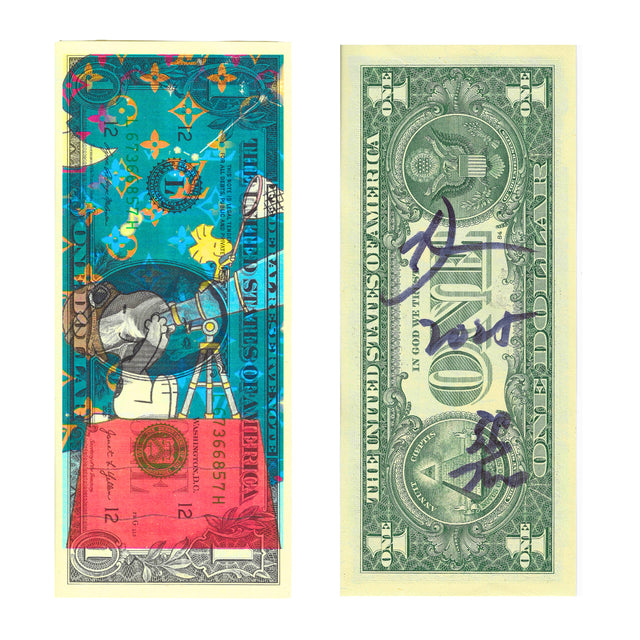
Death NYC Snoopy Woodstock Telescope LV Dollar Bill Art Signed Numbered COA
$55.00 USD
-
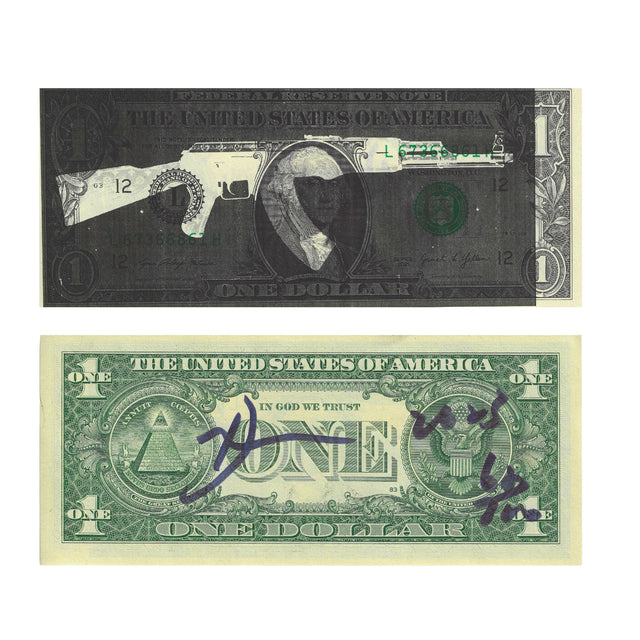
Death NYC Gun Dollar Bill Art Signed Numbered COA Black White Pop Street Art
$50.00 USD
-
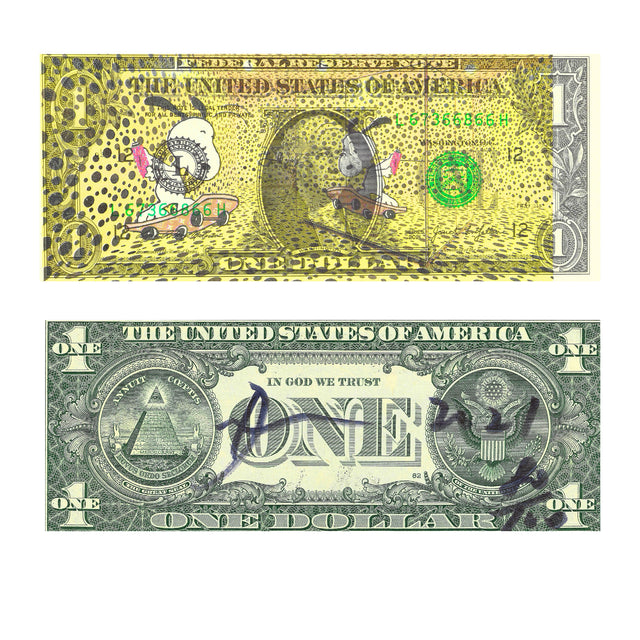
Death NYC Snoopy Skateboard Dollar Bill Art Signed Numbered COA Pop Street Art
$75.00 USD
-
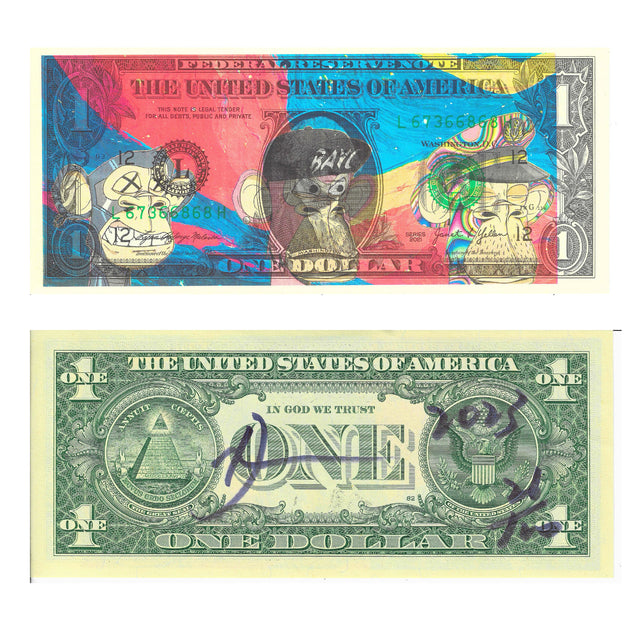
Death NYC Bored Ape Dollar Bill Art Signed Numbered COA Pop Street Art
$40.00 USD
-
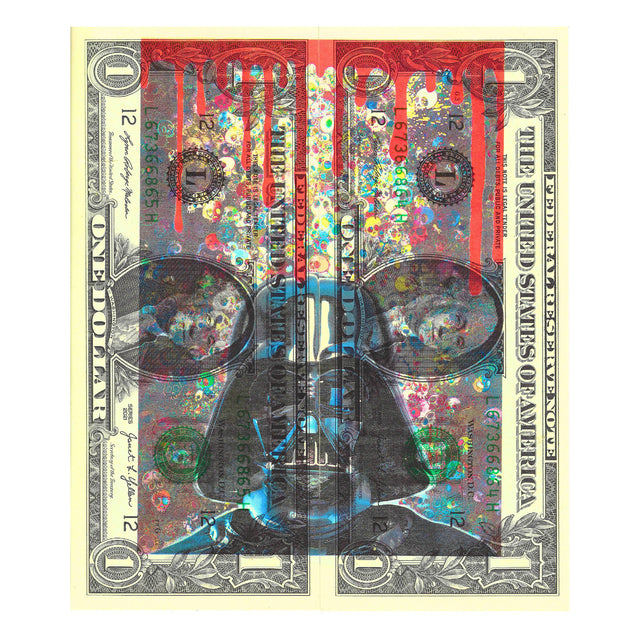
Death NYC Darth Vader Star Wars Dollar Bill Art Signed Two Bills COA Unframed
$100.00 USD
Browse the collection for current listings.