Shepard Fairey Hand-Signed MTN 94 Spray Can 2019 RARE Artist-Used Unique Item belongs to the broad field of images through which Shepard Fairey has made public graphics feel intimate, collectible, and still politically charged. A Fairey work is rarely only a picture. It is usually a negotiated object: part poster, part printmaking exercise, part cultural reference, and part record of a particular moment in the artist’s long conversation with power, persuasion, music, public memory, and visual dissent. That is why collecting begins with close looking rather than a shortcut through familiar names or edition language.
This article offers curatorial context for the title and topic of this work. It should be read alongside the specific Gauntlet Gallery listing, which is the place to verify the exact object’s material, dimensions, edition notation, signature, condition, provenance materials, and price. The discussion here is educational rather than an appraisal, authentication opinion, or prediction of future value.
Reading the image through Fairey’s practice
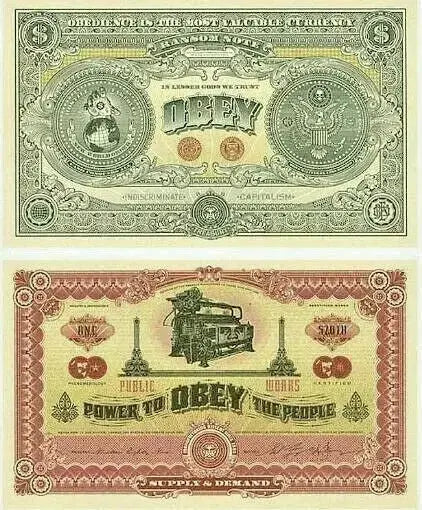
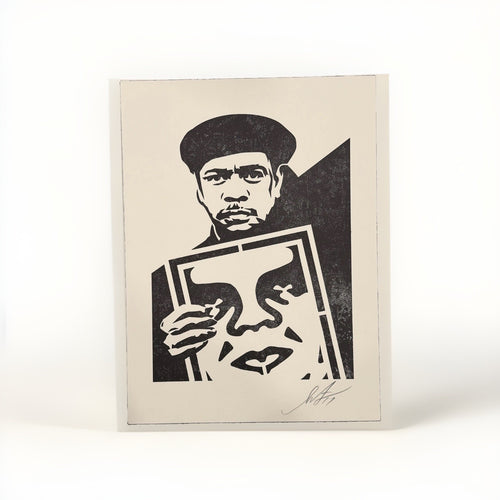
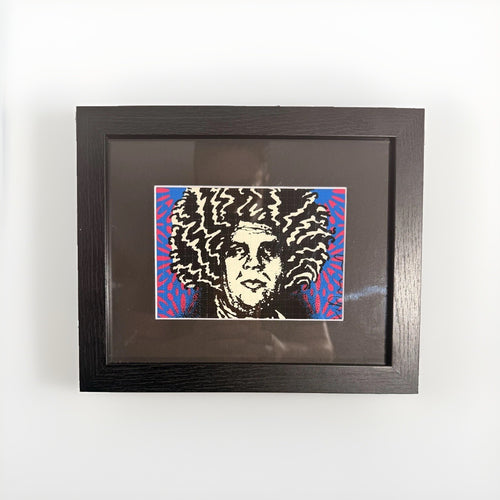
Fairey came to prominence through the Andre the Giant Has a Posse sticker campaign, which evolved into OBEY Giant. Its early lesson still runs through his print practice: a compact image can travel through public space, repeat across contexts, and acquire meaning through recognition as much as through explanation. The visual vocabulary—compressed color, stenciled portraiture, high-contrast geometry, decorative pattern, typography, and borrowed propaganda cues—makes an image feel both historical and immediate.
Within that vocabulary, Shepard Fairey Hand-Signed MTN 94 Spray Can 2019 RARE Artist-Used Unique Item can be approached as a work about attention. Fairey often uses the visual force of authority to ask what authority looks like, how it is circulated, and who gets to control its symbols. Even when the subject is cultural rather than overtly political, the work tends to move through the same territory: canon formation, memory, resistance, collective identity, and the uneasy overlap between mass communication and personal conviction. The image succeeds when the immediate graphic impact gives way to a slower reading of its references, patterns, and tone.
The listing topic and the physical object
The listing identifies a screenprint or serigraph process, making paper, ink surface, margins, and handling part of the object-level review. The listing identifies an offset process; collectors should distinguish this from a screenprint when making comparisons. The listing identifies a signed work; inspect the signature and accompanying documentation for the exact offered impression.
That distinction between a title and an object matters. Two listings that appear to describe the same image can represent materially different collecting propositions: a different print process, a different edition designation, a different condition state, a framed versus unframed presentation, or a different documentation trail. Treat the work on the page as the exact work under consideration—not as a generic stand-in for every impression bearing a similar title.
Before purchasing, review a full front image, signature and edition area when applicable, all corners, reverse, and any accompanying certificate or invoice. If a work is framed, ask whether it is floated, hinged, dry-mounted, or otherwise attached; ask about glazing, whether original margins are visible, and whether the frame is included in shipping. For paper works, condition is not an administrative detail. Handling creases, surface rubbing, tape residue, mat burn, light exposure, and prior mounting can change the display experience and the ease of future conservation.
Why print process deserves attention
Fairey’s output spans different production approaches, and those distinctions are meaningful. A screenprint has an ink presence and surface character that reward in-person viewing; an offset work has a different relationship to reproduction and distribution; a letterpress object emphasizes pressure, paper, and tactile impression. None of these categories automatically ranks above another. The relevant question is whether the work’s process, scale, image, condition, and documentation make sense together for the collector’s goals.
The same care applies to edition language. A numbered edition, an Artist’s Proof, a signed impression, and an open or offset format should be described accurately rather than collapsed into a vague idea of rarity. The product record is the appropriate place to identify what this listing states. The collector’s job is to match those stated facts to photographs and paperwork, retain the invoice and communication trail, and avoid paying for certainty that the record cannot support.
Positioning the work in a collection
Fairey editions work well when they are collected with a point of view. One collector might concentrate on music and counterculture subjects; another on political images, floral works, collaborations, early OBEY graphics, or works that translate the public language of posters into domestic scale. The most coherent collections are not necessarily the largest. They have a reason for each addition, a disciplined record for each object, and enough room for the visual differences among works to remain visible.
For display, begin with scale and sight line before choosing a frame. Archival materials, UV-filtering glazing, and reversible mounting support long-term care without asking the framing to compete with the image. Keep any certificate, invoice, arrival photographs, and condition notes in a separate archival folder. That simple habit creates a useful ownership record for insurance, reframing, conservation, or a future sale.
A measured approach to market research
Market data is useful as orientation, not as a verdict. Compare completed sales only after accounting for work type, year, edition notation, condition, completeness of documentation, and whether a sale is genuinely comparable. Asking prices can show ambition; completed sales show what actually cleared, though even they need context. A focused collector generally benefits more from understanding a smaller group of relevant examples than from treating a large, mixed set of numbers as a single price rule.
The strongest decision is often straightforward: buy a work whose imagery you genuinely want to live with, whose object record you understand, and whose total cost—including shipping, framing, and care—fits your collection plan. That approach leaves room for the cultural pleasure of Fairey’s work while keeping the practical parts of collecting clear.
Continue your research
Explore the Shepard Fairey collection, read the Shepard Fairey buyer’s guide, review the Shepard Fairey authentication checklist, and consult the Shepard Fairey price guide. When you are ready to inspect the exact object discussed here, return to the Gauntlet Gallery listing for Shepard Fairey Hand-Signed MTN 94 Spray Can 2019 RARE Artist-Used Unique Item.
The durable lesson is to collect the specific object with the clearest record—not simply the most familiar title. That is how an image with public force becomes a piece a collector can understand, care for, and keep with confidence.