Farms Not Factories (2025): What the Shepard Fairey Master Index Shows
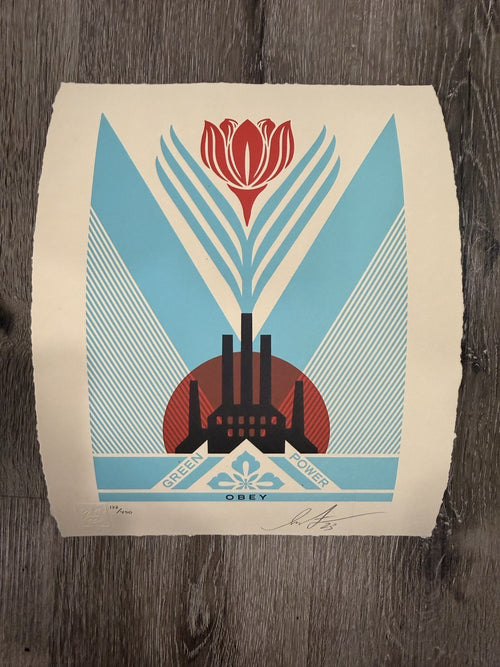
Farms Not Factories is one of the entries tracked in Gauntlet Gallery’s Shepard Fairey master index, a working research record built to keep the basic facts of an edition separate from the noise that often surrounds contemporary print collecting. The index identifies this entry as a 2025 Screen Print published by Obey Giant, with a stated First Edition edition of 500. Those fields do not tell the whole story of a work, but they give a collector a disciplined place to start: identify the edition accurately, understand the process, read the market evidence with restraint, and inspect the actual object before making a decision.
This article is an editorial reading of the index entry, not an authentication opinion, appraisal, or forecast. It is designed to help collectors understand why a work like Farms Not Factories belongs in a careful Fairey research process and what questions remain at the object level when an impression becomes available.
Why the master index matters
Shepard Fairey’s output is large enough that vague familiarity is not a collecting method. An image may circulate through social media, secondary-market listings, posters, and resale descriptions with inconsistent titles or edition language. The master index imposes a useful counterweight: a named work, a year, an edition designation, an edition size, a medium, a publisher, and a record of observed sales where usable data exists. That structure does not create certainty. It makes uncertainty visible.
For Farms Not Factories, the useful first distinction is between the work as an indexed edition and an individual impression offered for sale. The index identifies the edition-level framework. A seller’s listing must establish the particular object: its exact signature or numbering, paper or substrate, dimensions, condition, provenance materials, and any difference between the described edition and the object in hand. A collector who keeps those layers separate is far less likely to confuse a general fact about a title with a claim about a specific print.
Process, edition, and the physical object
The index records the medium as Screen Print. That matters because production method changes how a work should be examined and cared for. Screenprints can show rich ink surface and paper character; letterpress emphasizes pressure and impression; giclée works raise different questions about substrate, color, and publishing context. No one medium is automatically more important than another. The relevant issue is whether the listing accurately describes the object and whether the collector understands the relationship between process, condition, and edition notation.
The stated First Edition edition of 500 is similarly a starting point, not a shortcut to value. Edition size can frame supply, but it cannot by itself measure demand, image strength, condition, or documentation quality. When comparing examples, ask whether the items are truly the same edition and whether they are being described with equivalent completeness. An Artist’s Proof, a numbered impression, a variant, an altered sheet, a framed example, or a work with incomplete paperwork may all require different treatment even when the image is familiar.
What the recorded market evidence can—and cannot—say
The master index currently records 3 cleaned public sales for this entry, with a reported median of $290.0 and an observed range of $250.0 to $295.0. These records are a research starting point, not an appraisal: differences in condition, edition notation, documentation, timing, and marketplace context can make individual sales non-comparable.
Completed sales can be helpful because they show transactions rather than aspirations, but even a clean dataset must be read slowly. A price is a compact record of many variables: the exact edition, condition, venue, date, seller reputation, audience, presentation, and the clarity of the supporting photographs. The right question is not “what is this worth?” in the abstract. It is “which observed examples are genuinely comparable to the object I am considering, and what important differences remain?”
When the count is thin, the responsible conclusion is simply that the available evidence is thin. When the count is deeper, the responsible conclusion is still not a guarantee. The index is most valuable when it helps a collector avoid false precision, document the basis for a decision, and return to the primary evidence: the object, its paperwork, and the listing record.
A collector’s inspection sequence
If you encounter an offered example of Farms Not Factories, save the original listing and build a small object file before buying. Request a full front image, close views of the signature and edition area where applicable, all four corners, the reverse, and any certificate or invoice. If framed, ask about the mounting method, the glazing, and whether the margins are visible. Look for handling creases, surface rub, tape residue, light exposure, mat burn, water marks, or prior mounting. Keep the purchase invoice, correspondence, arrival photographs, and condition note in the same folder.
This is not paperwork for its own sake. It protects the enjoyment of the work and gives a future conservator, insurer, framer, or buyer a coherent starting point. The same rigor that makes the master index useful at edition level makes an individual object easier to understand over time.
Reading Farms Not Factories within Fairey’s practice
Fairey’s visual language has always occupied the space between public graphics and private collecting. His work draws on the compressed force of propaganda, the repetition of street campaigns, the energy of music graphics, and the ornamental density of design history. Whether a work foregrounds a political phrase, a portrait, a floral structure, or an abstracted symbol, its power usually lies in the way those elements are made to feel immediate and repeatable while still carrying a specific cultural charge.
That context is why a title like Farms Not Factories should be read as more than an inventory label. It is an entry point into questions of image circulation, authorship, edition practice, and visual persuasion. A thoughtful collection can move across those questions without needing every acquisition to serve the same market thesis. The better test is whether the work has visual conviction, a record the collector can understand, and a place in the collection that goes beyond short-term comparison.
Continue your research
Explore the Shepard Fairey collection, review the Shepard Fairey buyer’s guide, use the authentication checklist, and consult the Shepard Fairey price guide. The master index is a research tool; the object itself and its documentation remain the decisive evidence for any specific purchase.