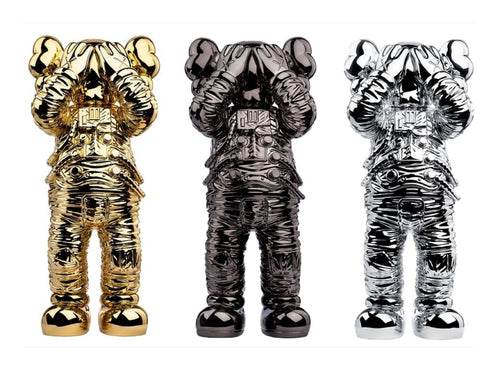
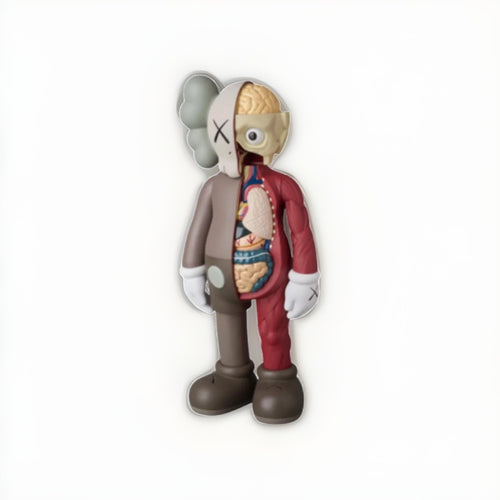
Short answer: Display designer art toys like KAWS and BE@RBRICK the way a gallery would hang a sculpture — give each piece a considered surface (an open shelf, a dedicated plinth, or a museum case), light it deliberately, and vary the scale so the collection reads as a composition rather than a pile of merchandise. Then protect what you paid for: keep the figures out of direct sun, control dust and humidity, handle them by the base, and hold onto the original box. Done well, a KAWS COMPANION or a 1000% BE@RBRICK stops looking like a toy on a shelf and starts looking like what it actually is — a limited-edition contemporary sculpture that happens to live in your living room.
The people who collect these pieces are rarely thinking about them as toys, and neither should your home. A first-run KAWS figure or a chase BE@RBRICK is an editioned object with a real secondary market and real provenance requirements. Displaying it thoughtfully is partly aesthetics and partly stewardship — the same instinct that leads a print collector to frame with UV glass or a watch collector to keep the box and papers. This guide covers how to treat these figures as sculpture, build display surfaces that flatter them, light and scale a collection, pair figures with works on paper, and — the part most first-time buyers skip — display them without quietly eroding their condition and value.
Treat the figure as sculpture, not merchandise
The single biggest shift in displaying designer art toys well is a mental one: stop thinking "toy on a shelf" and start thinking "small sculpture on a base." KAWS built his entire fine-art vocabulary out of a cartoon language — the crossed-out X eyes, the gloved hands, the COMPANION and CHUM forms — and those same forms appear in his museum shows, his monumental public installations, and his gallery editions. The vinyl figure on your shelf is a domestic-scale echo of work that has stood forty feet tall in a public square. BE@RBRICK, produced by Medicom Toy, works the same way: the bear silhouette is a blank canvas that artists, brands, and estates dress in everything from Basquiat paintings to raw chrome. The object is a platform for authorship, which is precisely what makes it collectible.
Once you accept that framing, the design decisions get easier. A sculpture wants negative space around it. It wants a light source. It wants to be seen at eye level or slightly below, not crammed onto the top of a bookcase between paperbacks and a router. Curators talk about "breathing room" for a reason — the empty space around an object is what tells the eye it matters. Give a single COMPANION its own shelf with nothing else on it and it reads as a statement. Line up eight figures shoulder-to-shoulder and, no matter how good each one is, the collection reads as inventory.
This is the same discipline the best private collections use, and it's the through-line across everything in our Collector's Hub: buy well, document carefully, and present the object with the seriousness it deserves. A designer toy displayed like a toy depreciates in the eye of anyone who understands the category. Displayed like sculpture, it earns the second look.
Choosing the surface: shelves, plinths, and cases
There are really only three display strategies worth using, and most serious collections combine all three.
Open shelving for the working collection
Floating shelves — ideally in a warm wood like oak or a clean matte white — are the everyday workhorse. They keep figures off the floor, off busy surfaces, and out of traffic paths where a passing hip or a curious pet can send a piece flying. The key is restraint: one to three figures per shelf, staggered rather than lined up like a police lineup, with genuine gaps between them. A deep shelf (20–25 cm) lets a 400% BE@RBRICK or a mid-size COMPANION sit fully supported with no overhang, which matters because vinyl figures are top-heavy and an unsupported base is how accidents happen.
Mount shelves into studs or use proper drywall anchors rated well above the figure's weight — a 1000% BE@RBRICK is a substantial object, and a shelf that sags or pulls loose over months is a slow-motion disaster. Keep shelves away from radiators, heating vents, and the tops of media consoles that run warm, because sustained heat is one of the quiet enemies of vinyl (more on that below).
Plinths for the hero piece
If open shelving is the chorus, a plinth is the soloist. A dedicated pedestal — a simple painted MDF column, a stone or travertine block, a low lacquered cube — isolates one important figure and instantly changes its register from "collectible" to "artwork." This is the move to make with your best piece: the first-edition COMPANION, the rare artist-collaboration BE@RBRICK, the figure with the cleanest provenance. Put it on a plinth, at or just below eye level, with light on it and space around it, and it will anchor the whole room.
Plinths also solve a practical problem: they let you control viewing height precisely. Sculpture reads best when its "face" sits around 145–160 cm from the floor — roughly gallery hanging height. A tall plinth brings a smaller figure up into that zone; a low plinth lets a large 1000% piece command floor-adjacent space without disappearing.
Cases for the pieces you never want to touch again
For the figures you consider untouchable — a boxed grail, a fragile early release, anything you'd be sick to damage — a display case earns its keep. A quality acrylic or glass case with a solid base does three things at once: it stops dust (the number-one enemy of a matte or flocked finish), it removes the temptation to handle, and it signals value to anyone in the room. Look for UV-filtering acrylic if the case will sit anywhere near a window. Museum and collector-grade cases exist specifically for this category now, and for a four- or five-figure piece the case is cheap insurance.
Lighting: the difference between "shelf" and "gallery"
Lighting is the highest-leverage, lowest-cost upgrade you can make, and it's the thing most home displays get wrong. Overhead room light flattens a glossy figure and throws a hard shadow under its chin. What you want instead is deliberate, directional light — the same principle a gallery uses on a sculpture.
- Track and spot lighting. A ceiling track with a few adjustable heads lets you aim a soft pool of light at each shelf or plinth. Angle the beam at roughly 30 degrees from vertical so it grazes the figure and reveals its form rather than blasting it head-on and killing the shadows that give it dimension.
- Warm, not cold. Choose bulbs around 2700–3000K. Warm light flatters vinyl's slight sheen and reads as "home," where cold 5000K+ light reads as "retail." A high color-rendering index (CRI 90+) keeps the pigments accurate, which matters on strongly colored figures.
- LED only, and keep it cool. Use LED sources exclusively. They run cool, and heat is a genuine risk to vinyl over time. Never place a hot halogen puck light inches from a figure inside a closed case — trapped heat can soften or warp vinyl and accelerate yellowing on white and translucent pieces.
- Integrated shelf lighting. Low-voltage LED strips tucked under a shelf lip or along the top of a cabinet give a clean, even wash and hide the source entirely. Put them on a dimmer so you can dial the collection up for guests and down for everyday.
The test is simple: if you turn off the room lights and leave only your display lighting on, the collection should still look intentional — a set of lit objects floating in soft darkness. If it looks flat and dim, add a directional source.
Working with scale: 100%, 400%, and 1000%
Scale is the secret weapon of a great designer-toy display, and BE@RBRICK made it into a language. The percentages refer to size: the 100% is the small, palm-height standard (around 7 cm); the 400% is the mid-size figure most collections are built around (roughly 28 cm); and the 1000% is the monumental version (about 70 cm) that functions as a genuine floor or plinth sculpture. Collectors often buy the same design across sizes — a 400% and 1000% pairing of one artwork is a classic move. KAWS figures follow their own size logic across releases, from tabletop COMPANIONS to large-format editions, but the same principle applies.
Use scale deliberately:
- Create a hierarchy. Every good arrangement has a clear lead. Let one large piece dominate — a 1000% on a plinth or the floor — and orbit it with smaller figures. A composition where everything is the same size has no focal point and reads as a collection of equals, which is to say, as clutter.
- Stagger heights. Even within a single shelf, vary the visual height — a taller figure beside a seated or shorter one, with the empty space between them doing real work. Repetition of identical silhouettes at identical heights is the fastest way to make museum-grade objects look like a toy-store endcap.
- Let the big piece breathe. A 1000% figure is architecture. Give it a corner, a plinth, or a clear stretch of floor against a plain wall. Don't bury it behind a coffee table or wedge it beside a bookshelf where its scale — the entire point — gets swallowed.
- Group the small ones with intent. A cluster of 100% figures can be charming if it's composed as a deliberate grouping — a tight little constellation on one shelf — rather than scattered across the house one at a time.
If you're building a KAWS-forward collection and want to understand how the different releases and figure formats relate to one another, our KAWS Buyer's Guide lays out the landscape and what to look for before you commit to a piece.
Pairing figures with prints and works on paper
The most sophisticated designer-toy displays don't isolate the figures — they set them in conversation with two-dimensional work. This is where a collection stops looking like a hobby and starts looking like a curated wall.
The logic is straightforward. A figure is a three-dimensional object; a framed print is a flat plane. Put them near each other and each makes the other look more considered — the print becomes a backdrop that gives the figure context, and the figure becomes a sculptural accent that pulls the print off the wall and into the room. A KAWS COMPANION on a shelf mounted directly beneath a KAWS screenprint is an obvious, powerful pairing because the visual language is shared: the same palette, the same graphic sensibility, the same hand. A BE@RBRICK dressed in an artist's work sits beautifully near an actual print by, or in the spirit of, that artist.
A few principles that keep these pairings from looking accidental:
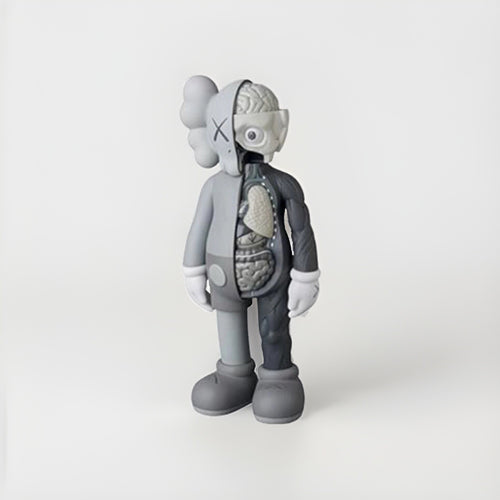
- Rhyme, don't match. You're looking for a shared color or a shared graphic attitude, not a literal set. A grey COMPANION near a print with grey and muted tones reads as intentional; a rainbow of unrelated pieces reads as noise.
- Mind the sightline. Center the figure's shelf under or beside the print so the eye travels naturally between them. A slight offset — figure just below and to one side of the framed work — often looks more editorial than dead-center symmetry.
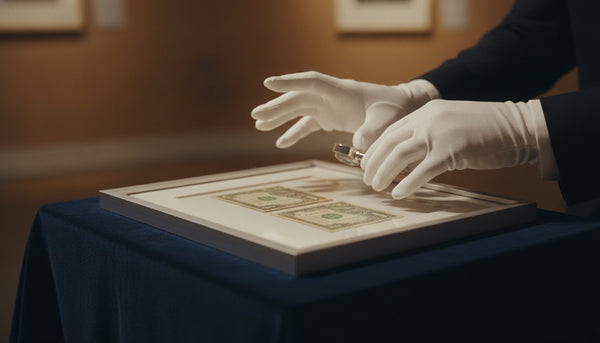
- Frame the print to protect it. If you're hanging a real screenprint next to a figure, treat it with the same care — acid-free mounting, UV-filtering glazing, and a professional frame. Our companion piece on how to frame and display street art and designer toys goes deep on framing choices, glazing, and hanging that protect works on paper.
If you're still assembling the collection and want to see how three-dimensional editions and works on paper fit together across artists, our art index is a good place to browse the range and think about pairings before you buy.
Protecting condition — and value — while you display
Here is the part that separates collectors from decorators. Every choice above is aesthetic; this section is about not quietly destroying the thing you paid for. Designer art toys are made mostly of vinyl and painted surfaces, and vinyl has specific vulnerabilities. Display them badly for a year and you can lose a meaningful slice of value even if the figure never falls off a shelf.
Keep them out of direct sun and UV
Sunlight is the most common way collectors damage these pieces without realizing it. Ultraviolet light fades pigments and, over months and years, yellows white, cream, and translucent vinyl — a change that is essentially irreversible and instantly visible to any buyer. Never place a figure in a spot that gets direct sun for part of the day, even "just for a couple of hours." If a display wall faces a window, use UV-filtering film on the glass or UV-filtering acrylic on your cases, and consider sheer curtains that cut the harshest midday light. The figures in a well-lit room should be lit by your controlled lighting, not by the sun.
Control dust, and clean gently
Dust is relentless and, on matte or flocked finishes, it dulls the surface and gets into detail. Dust regularly with a soft, dry microfiber cloth or a clean makeup brush for crevices. For a glossy figure that needs more, a barely-damp microfiber cloth is usually enough — avoid solvents, alcohol, and household cleaners entirely, because they can strip paint, cloud gloss, or leave marks. Enclosed cases dramatically reduce this whole problem, which is a large part of their appeal.
Mind heat and humidity
Vinyl is sensitive to sustained heat and to swings in humidity. Keep figures away from radiators, heating vents, the tops of warm electronics, and hot lighting. Avoid attics, garages, and rooms that swing hot and cold with the seasons. A stable, room-temperature interior wall is ideal. Extreme or fluctuating conditions can warp vinyl, craze paint, and — in flocked or fabric-detailed pieces — invite problems you can't undo.
Handle by the base, and secure against knocks
When you move a figure, lift it by the body or base with two hands — never by a thin arm, ear, or antenna, which are the natural failure points. On open shelves in a home with kids, pets, or foot traffic, a small bead of removable museum putty under the base keeps a top-heavy figure from walking off the edge during a bump or a slammed door. It's invisible, it's reversible, and it has saved a great many figures from a hard floor.
Keep the box — always
This is the rule first-time buyers break and later regret. For KAWS and BE@RBRICK, the original packaging is part of the object's value. A complete piece — figure plus its original box, inserts, and any inserts or authentication materials — commands more on the secondary market than the same figure "loose," and the gap is often significant. Displaying the figure out of the box is completely fine; that's what the figure is for. But keep the box, flat-stored and out of the sun, in a closet or under a bed. Think of it the way a watch collector thinks of box and papers: it's not optional if you care about resale. The condition of both the figure and its packaging is a core driver of what a piece is worth — a theme we return to often across our market writing on the Financial Insights hub.
Buying authenticated pieces — the foundation under everything
None of the display advice above matters if the piece isn't real. The designer-toy market — KAWS and BE@RBRICK especially — is heavily counterfeited, and convincing fakes exist at every price point. Before you think about plinths and lighting, make sure the object is authentic and properly documented, because authentication is the foundation the entire value of these categories rests on.
At Gauntlet Gallery, every KAWS and BE@RBRICK piece carries a TrueCOA blockchain certificate of authenticity, and comes in its sealed original packaging with the hologram intact. The blockchain certificate creates a permanent, tamper-resistant record of the piece that any owner can verify online; and the sealed, holographic packaging is part of both the authentication and the value. That chain is the same across our full KAWS collection and BE@RBRICK collection — no mixed or improvised paperwork, no guesswork.
A few habits that protect you as a buyer, wherever you shop:
- Insist on documentation. A piece worth displaying as sculpture is worth buying with real authentication — a verifiable certificate, not a vague "guaranteed authentic" line. If a seller can't document it, treat the price as a warning, not a bargain.
- Prize original, sealed packaging. For these categories, sealed original packaging with intact holograms and inserts is both an authentication signal and a value driver. It's one of the first things a knowledgeable resale buyer checks.
- Buy the provenance, not just the object. The most confident collectors buy from sources that treat documentation as seriously as the piece itself. That's the whole premise of how we work — authentication first, then everything else.
Do that, and the display becomes the fun part. You've got a real, documented, editioned object, and now your only job is to present it like what it is.
Putting it together: an aspirational, practical checklist
To translate all of this into a room, here's the sequence to follow.
- Pick a wall or corner away from direct sun and away from heat sources. This is your gallery zone.
- Choose your surfaces: floating shelves for the working collection, a plinth for the hero piece, and a UV-filtering case for anything precious or fragile.
- Light it deliberately with warm (2700–3000K), high-CRI LED track heads or hidden shelf strips on a dimmer, angled to graze the figures.
- Compose with scale: one dominant large piece, staggered heights, real negative space between figures, and small ones grouped with intent.
- Pair with prints that rhyme in palette and attitude, framed and glazed to protect the paper.
- Protect as you display: no direct sun, gentle dusting, stable temperature and humidity, handle by the base, museum putty under top-heavy figures, and keep every box.
- Buy authenticated — TrueCOA blockchain certificate and sealed original packaging — so the object under all of this care is genuinely worth caring for.
Designer art toys reward the collector who takes them seriously. Treat a KAWS COMPANION or a BE@RBRICK the way you'd treat any other piece of contemporary sculpture — give it a surface, give it light, give it room, and protect its condition — and it will do exactly what great art does in a home: make the space feel considered and unmistakably yours. Start with authentication, present with intention, and the rest takes care of itself.
Frequently asked questions
How should I display KAWS and BE@RBRICK figures at home?
Treat them as sculpture, not toys. Use floating shelves for the everyday collection, a dedicated plinth for your best piece, and a UV-filtering display case for anything fragile or especially valuable. Light each figure with warm, directional LED (2700–3000K, high CRI), leave generous negative space around pieces, and vary the scale so one large figure anchors the arrangement. Keep everything out of direct sunlight and away from heat.
Does sunlight really damage designer art toys?
Yes. Ultraviolet light fades pigments and yellows white, cream, and translucent vinyl over time, and the change is effectively permanent. Never place figures where direct sun hits them, even briefly each day. Use UV-filtering film on windows or UV-filtering acrylic cases, and rely on your own controlled lighting rather than daylight.
Should I keep the original box after I display the figure?
Always. For KAWS and BE@RBRICK, the original packaging — box, inserts, and any authentication materials — is a meaningful part of the piece's value. Displaying the figure out of the box is fine; just store the box flat, out of the sun, so a complete figure-plus-packaging set holds its worth on the secondary market.
What does the 100%, 400%, and 1000% sizing mean on BE@RBRICK?
The percentages are size grades. A 100% is the small palm-height standard (about 7 cm), a 400% is the mid-size figure most collections are built around (about 28 cm), and a 1000% is the large, roughly 70 cm version that works as a floor or plinth sculpture. Collectors often buy the same design in both 400% and 1000% to play with scale.
How do I know a KAWS or BE@RBRICK piece is authentic?
Insist on real, verifiable documentation and original sealed packaging. At Gauntlet Gallery, every KAWS and BE@RBRICK piece includes a TrueCOA blockchain certificate of authenticity you can verify online, and sealed original packaging with an intact hologram. The market is heavily counterfeited, so authentication should be settled before you ever think about display.