Zarelli vs. General TPA: Why Space Material Needs Both

A Buzz Aldrin signature on a lithograph. A flown Apollo-era beta cloth fragment. A NASA mission patch pulled from a crew member's personal collection.
Three very different objects. One thing in common.
If you're buying any of them and you don't understand the difference between a Zarelli specialist letter and a general third-party authenticator opinion, you're operating blind in one of the most heavily forged collecting categories on earth.
Literally on earth. The stuff that left it is worth too much money for bad actors to ignore.
This article is for collectors who already know the basics — you've heard of PSA, Beckett (BAS), and JSA — but haven't yet mapped out why space material requires a layered authentication approach that no single service fully covers on its own. We'll break down what each authenticator brings to the table, where their blind spots live, and why the Zarelli specialist letter exists as a category-specific check that general TPAs simply cannot replicate.
The Forgery Landscape in Space Memorabilia
Space collecting attracts serious money and serious fraud.
The FBI's Operation Bullpen — which ran through the late 1990s and early 2000s and dismantled one of the largest autograph forgery rings in American history — exposed how professional forgers operated across multiple categories simultaneously. Sports, music, Hollywood. The infrastructure built for those categories bleeds into space material. The same distribution networks, the same fraudulent COA mills, the same auction-laundering techniques.
What makes space material uniquely vulnerable is the combination of high per-signature value, limited collector base, and a general-public misunderstanding of what authentic looks like. Most casual buyers can recognize a suspicious Michael Jordan signature if they've seen enough of them. But how many people have studied Neil Armstrong's signature across thirty years of evolution? How many know what a genuine Jim Lovell inscription looks like versus a cut-and-paste composite?
The answer, frankly, is not many. And forgers know it.
Add to that the problem of provenance fabrication. Flown artifacts — items that actually traveled on a NASA mission — command a premium that creates enormous incentive to fake the documentation trail. A patch that never left a hangar in Titusville suddenly has a typed letter saying it flew on Apollo 14. A photo that spent its life in a dealer's storage bin gets a hand-scrawled crew notation that didn't exist five years ago.
This is the environment you're buying into. Respect it accordingly.
What General TPAs Do Well (and Where They Stop)

PSA/DNA
PSA is the volume leader in autograph authentication across all categories. Their flip label and population report infrastructure creates market liquidity — a PSA-slabbed item is easier to buy and sell because the certificate number is publicly verifiable at PSA's website.
For space signatures on flat items — photos, lithographs, books, covers — PSA's opinion carries real weight. They maintain signature exemplar databases and their examiners have reviewed enough astronaut autographs to catch obvious forgeries.
What PSA doesn't do: flown artifact provenance evaluation. They will not opine on whether a piece of beta cloth actually flew. They will not cross-reference mission manifests. They authenticate the signature on the tag, not the object's flight history.
That gap is enormous if you're buying material where the flight status is the primary driver of value.
Beckett Authentication Services (BAS)
BAS has built serious credibility, particularly since expanding their music and entertainment operations. Within music memorabilia, Roger Epperson REAL is the specialist tier inside BAS — a meaningful distinction, because Epperson's experience with music autographs specifically elevates the opinion beyond a generalist review.
For space autographs, BAS offers solid opinions on signatures. Their graded encapsulation service provides tamper-evident cases and a publicly searchable certification number.
Same limitation applies: BAS does not provide mission provenance evaluation. They authenticate the handwriting. The rest is outside their scope.
JSA (James Spence Authentication)
JSA's distinction that matters for sophisticated buyers is the difference between a JSA Basic sticker (a quick flip opinion with a lower fee and less documentation) and a full JSA Letter of Authenticity (LOA), which involves a more thorough examination and produces a written document with the examiner's reasoning.
This distinction matters everywhere, but especially in space. A JSA Basic sticker on a flown artifact tag tells you almost nothing beyond a surface-level autograph check. A full JSA LOA with the examiner's notes is a different document entirely.
That said — JSA, like PSA and BAS, is a handwriting authenticator. Not a space historian. Not a mission archive specialist. Their lane is signatures.
Enter Zarelli: What the Specialist Letter Actually Is
Francis Zarelli is the recognized specialist in NASA and space mission provenance authentication. A Zarelli letter isn't a competing service to PSA or BAS. It operates in a completely different lane.
Where a general TPA answers the question "Is this signature genuine?", a Zarelli specialist letter answers the question "Does the provenance chain for this object hold up against what we know about mission records, crew personal property documentation, and NASA disposal history?"
Those are two separate questions. Both need answers.
A Zarelli review typically involves cross-referencing provenance documentation against mission archives, evaluating the credibility and completeness of the chain of custody, assessing whether the artifact type and condition are consistent with the claimed mission origin, and examining NASA-era documentation such as crew personal preference kits (PPK) listings, manifest records, and agency disposal paperwork where available.
This is deep specialist work. It requires knowledge that doesn't come from authenticating baseball cards and music posters. It comes from years of immersion in the specific bureaucratic and physical history of the American space program.
Can a PSA examiner tell you whether an Apollo-era PPK item is consistent with its documented crew member's personal allowance and the known provenance for that flight?
No. They can't. That's not a criticism. It's a scope limitation.
The Paired Approach: Why You Need Both
The professional standard for significant space memorabilia is not Zarelli or a general TPA. It's Zarelli and a general TPA.
Here's why the pairing matters:
The Autograph Problem
A Zarelli letter can validate provenance documentation without independently authenticating the signature on the item. If the piece carries a crew member's autograph — and most desirable pieces do — you need a qualified handwriting examiner's opinion in addition to the provenance evaluation.
A sophisticated fraud can fake the provenance trail and carry a genuine signature from a different context. A sophisticated fraud can also carry authentic-looking mission documentation alongside a forged signature. The two checks catch different fraud vectors.
The Provenance Problem
A PSA or BAS certification on a space item tells buyers the signature is genuine. It says nothing about whether the "flown" claim is legitimate. In high-value space collecting, the flown premium can represent the majority of the item's total value. Authenticating only the signature while leaving the flight claim unchecked is like buying a graded coin and not verifying the mint mark.
The Market Acceptance Problem
Sophisticated buyers and major auction platforms expect both. A significant space piece presented with only a Zarelli letter but no general TPA autograph certification will face buyer hesitation. A significant space piece with PSA certification but no specialist provenance evaluation is similarly incomplete for flight-claim items.
The pairing creates a documentation package that addresses the two biggest risk vectors simultaneously. That's how serious material gets sold at appropriate price levels.
Applying the Framework: A Checklist

-
Identify what you're actually buying
- Autographed flat (photo, lithograph, FDC, book): General TPA autograph authentication is the primary need. Zarelli adds value if a provenance claim exists but may not be required for a standard signed flat.
- Flown artifact with no signature: Zarelli specialist provenance evaluation is essential. A general TPA cannot help you here.
- Flown artifact with astronaut signature: Both are required. No exceptions at serious price levels.
- Crew personal property items (PPK contents, personal gear): Both are required. Zarelli for the PPK documentation cross-reference, general TPA for the signature if present.
-
Verify the general TPA certification type
- PSA: Confirm the certification number at PSA's public lookup. Confirm the described item matches the physical piece in your hands.
- BAS: Same process. Publicly searchable certification. Confirm it's a full review, not a basic sticker opinion.
- JSA: Confirm you're looking at a full LOA, not a Basic sticker. This distinction matters — ask for the documentation type explicitly.
-
Evaluate the Zarelli letter content
- Does it specifically address the flight claim or provenance chain, or is it a generic letter?
- Does it reference specific documentation that was reviewed?
- Does it identify the item with enough specificity that you can confirm you're holding the same object the letter describes?
-
Map the full provenance chain
- Where did the item originate? Directly from crew or family? NASA surplus disposal? Private collector?
- Is there documentation at each transfer point? Bills of sale, auction catalog entries, correspondence?
- Are there any gaps in the chain that neither the Zarelli letter nor the TPA certification addresses?
-
Cross-reference the auction and dealer history
- Has the item appeared at major auction previously? Heritage, Bonhams, RR Auction all maintain searchable archives.
- Do the descriptions across its sale history remain consistent? Changing claims about flight status between sales is a serious red flag.
The Astronaut Signature Tier System
Not all space autographs carry the same risk profile. Understanding the tier structure helps you calibrate how much authentication investment is proportionate.
| Tier | Description | Authentication Priority |
|---|---|---|
| Tier 1 | Deceased moonwalkers and high-value deceased astronauts (Apollo era) | Full paired authentication mandatory. Highest forgery target. No exceptions. |
| Tier 2 | Living legendary astronauts, major mission commanders, high public profile | Full general TPA required. Zarelli if any flight claim or provenance element is present. |
| Tier 3 | Mid-tier astronauts, Shuttle era, ISS crew | General TPA standard. Zarelli for any flown material claim. |
| Tier 4 | Lower-demand living astronauts, recent missions, prolific signers | General TPA advisable. Zarelli situationally based on item type. |
The practical implication: a Neil Armstrong signed photograph without full paired authentication should not change hands at serious collector prices. Full stop. The forgery rate for Armstrong material is catastrophic. The financial stakes are too high and the general-public-facing sales channels are full of fraudulent examples.
If someone offers you a "bargain" Armstrong at a price that makes your pulse quicken, what do you think the more likely explanation is — that you found a deal, or that the seller is counting on your optimism?
The COA Mill Problem in Space Collecting
One of the persistent issues in space memorabilia specifically — as in music and Hollywood collecting — is the proliferation of dealer-issued certificates of authenticity that carry no independent value whatsoever.
A COA printed on nice paper with a gold seal and a serial number, issued by the same dealer selling you the item, is not authentication. It is marketing material.
This sounds obvious when stated plainly. It is not obvious to buyers who encounter these documents for the first time and assume the formality of the document implies third-party verification.
In the wake of Operation Bullpen, the industry understanding of what constitutes meaningful authentication shifted dramatically toward the recognized TPA model. But in niche categories like space memorabilia, dealer COAs with impressive-looking graphics still circulate on items that have never been near a qualified examiner.
The rule is simple: the authenticating entity and the selling entity must be separate, independent organizations with no financial relationship to the specific transaction.
That means PSA, BAS, or JSA for autographs. That means Zarelli for provenance. It does not mean the dealer's own certification department, regardless of how the document looks.
Flown vs. Non-Flown: The Value Gap That Creates Fraud

The practical source of most space memorabilia fraud isn't forged signatures. It's fabricated flight claims.
The value differential between a genuinely flown artifact and an identical non-flown item can be measured in multiples, not percentages. A flag that flew on a lunar mission versus an identical flag that sat in a drawer — the difference in realized value at auction is dramatic.
This gap creates systematic incentive for fraud at the documentation level. A forger doesn't need to fake the signature if they can fake the flight claim. The object may be completely genuine — a real NASA artifact, legitimately acquired — but the flight status documentation may have been fabricated or embellished after the fact.
This is precisely the fraud vector that general TPAs cannot catch and that Zarelli specialist review is designed to address.
A Zarelli provenance evaluation for a flown claim isn't bureaucratic formalism. It's the specific check that stands between you and paying a lunar-flown premium for an item that never left the atmosphere.
How many items in the market today carry flight claims that have never been subjected to any specialist provenance review at all?
More than the market price levels would suggest anyone has seriously thought about.
Handling Older Material Without Complete Documentation
The ideal scenario — full Zarelli letter plus major TPA certification plus unbroken provenance chain — doesn't always exist for older material.
Legitimate pieces from the early space program sometimes have gaps. An astronaut's family member sold items informally decades ago. A piece came directly from a crew member at a public signing event with no paperwork. Documentation has been lost to time.
This doesn't automatically mean the item is fraudulent. It means the risk profile is different and the price should reflect it.
When complete documentation is unavailable:
- Treat any flight claim as unverifiable until proven otherwise. Price accordingly.
- Pursue maximum available authentication even if the complete package isn't achievable. A strong TPA autograph certification on a piece with incomplete provenance is better than no certification at all.
- Consult a Zarelli review even when documentation is partial. A specialist evaluation of incomplete documentation still produces useful information about what the documentation gap implies for the flight claim.
- Document everything you do know. Your own acquisition records, dealer correspondence, and auction catalog descriptions become part of the item's provenance chain going forward.
Gaps in documentation are not the same as proof of fraud. But they are meaningful risk factors that should be priced in and disclosed in any subsequent sale.
Red Flags
Stop the transaction and investigate further if you encounter any of the following:
- Flight claim supported only by a dealer COA. No independent specialist review of the provenance documentation means the flight claim is unverified. A dealer asserting their own item flew is not a check on fraud.
- PSA or BAS certification number that doesn't verify publicly. This happens. Fake labels exist. Always run the number yourself at the TPA's public verification portal before concluding the certification is legitimate.
- A JSA Basic sticker presented as equivalent to a full LOA. These are different products. A sticker is a quick flip opinion. A full Letter of Authenticity involves substantially more documentation and examiner accountability.
- Zarelli letter that doesn't specifically identify the item or doesn't reference documentation reviewed. A generic letter that could apply to any similar item is not the same as a specific provenance evaluation.
- Changing flight claims across sale history. If an item was described as non-flown at one auction and flown at the next without any explanation for the reclassification, that is a serious problem.
- Pressure to close before authentication can be completed. "This won't last" is not a reason to skip due diligence on a five-figure space artifact.
- Authentication documents with no traceable issuing entity. If you google the authentication service named on a COA and it doesn't have a verifiable independent history, you're looking at a mill certificate.
- Inconsistency between the physical item and the claimed mission context. A specialist like Zarelli can flag items where the object type, construction era, or condition is inconsistent with the claimed mission. A general TPA simply isn't equipped to make this call.
- Suspiciously low price for a significant flight-claim item. The market for genuine flown artifacts at significant price levels is not prone to bargains. Anomalously low prices are almost always explained by documentation problems, not seller generosity.
Bottom Line
Space memorabilia is one of the most documentation-intensive collecting categories that exists. The combination of high value, limited specialist knowledge in the broader market, and the enormous premium attached to flight claims creates conditions that attract sophisticated fraud.
General TPAs — PSA, BAS with their Roger Epperson REAL specialist tier for music applications, JSA with its LOA versus Basic sticker distinction — are the recognized standard for autograph authentication across all categories. For space material, their autograph opinions are necessary.
They are not sufficient.
The Zarelli specialist letter occupies a different lane entirely. It evaluates what no handwriting examiner is positioned to evaluate: whether the provenance chain, the flight claim documentation, and the artifact's physical and historical context hold up against serious specialist scrutiny.
The professional standard for significant space material is both. Not one or the other. Not whichever is available. Both.
Collect at the level the material deserves. Authenticate accordingly.
Frequently Asked Questions
Does every space autograph need a Zarelli letter?
No. A Zarelli specialist letter is specifically relevant when a provenance claim — most importantly a flight claim — is a material factor in the item's value or description. For a standard signed photo on a flat from a living mid-tier astronaut with no flight claim attached, a major TPA autograph certification is the primary need. Zarelli becomes essential when the flight status of an artifact is part of what you're paying for.
What's the difference between a JSA Basic sticker and a JSA LOA?
These are materially different products. A JSA Basic sticker is a quick-turn autograph opinion at a lower price point with minimal documentation. A full JSA Letter of Authenticity involves a more thorough examination and produces a written document with examiner attribution. For space material at significant price levels, you want the full LOA, not a Basic sticker. Always ask explicitly which product a seller is presenting.
Can a Zarelli letter substitute for a general TPA certification on a signed piece?
No. A Zarelli letter addresses provenance and flight claim documentation — it is not a handwriting authentication service. If a signed piece needs autograph authentication, that requires a recognized TPA such as PSA, BAS, or JSA. The two services address different questions and neither substitutes for the other on items where both questions are material.
What does "Roger Epperson REAL" mean in the context of BAS?
Roger Epperson REAL is the music memorabilia specialist tier within Beckett Authentication Services. Epperson is a recognized specialist in music autographs specifically, and his involvement in a BAS review elevates it beyond a generalist examination for music material. This specialist designation is relevant to music memorabilia authentication — for space material, the general BAS autograph authentication function applies rather than this specific tier.
How do I verify that a PSA or BAS certification is genuine?
Both PSA and BAS maintain publicly searchable online databases where you can enter a certification number and confirm the details of the certified item. You should always run this check yourself rather than relying on screenshots or copies provided by a seller. Counterfeit TPA labels exist — the public verification database is the definitive check. If a certification number doesn't return results or returns a description inconsistent with the item in front of you, treat the certification as suspect.
Are flown artifacts ever sold without Zarelli authentication at serious collector prices?
Yes — and that's a market inefficiency, not a best practice. Some significant pieces change hands through channels where complete documentation isn't assembled. This happens. It doesn't mean those pieces are fraudulent. What it means is that the buyer is accepting a documentation risk that isn't reflected in the authentication record. Sophisticated buyers either price that risk in, pursue the authentication themselves post-purchase, or pass on items where the documentation package is incomplete.
What should I look for in the Zarelli letter itself to confirm it's substantive?
A substantive Zarelli letter should specifically identify the item under evaluation with enough detail that you can confirm you're holding the object the letter describes. It should reference the documentation that was reviewed — what provenance records, what mission documentation, what physical examination was conducted. A letter that reads as generic, that could apply to any similar item without modification, is not the same as a specific expert evaluation. Ask what documentation was consulted and confirm that the letter addresses the specific flight claim or provenance element that is material to your purchase decision.
Does Gauntlet Gallery sell space memorabilia with full paired authentication?
When we handle space material with flight claims or significant provenance elements, our standard is the paired approach: recognized TPA autograph certification where applicable, and Zarelli specialist review where provenance evaluation is material to the item's description and value. We don't present flight claim material as verified on the basis of dealer representation alone. The documentation has to hold up independently.
Shop Space memorabilia
Explore current pieces available from the gallery.
-
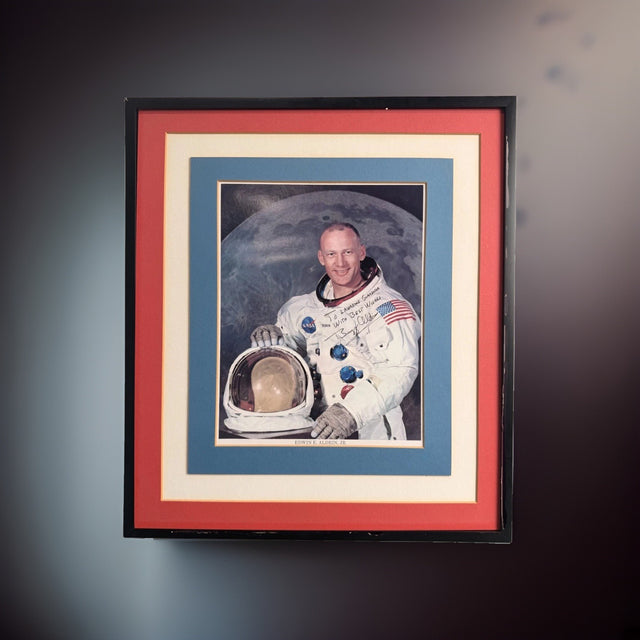
Buzz Aldrin Signed NASA 8x10 Color Photo Personalized Framed JSA LOA
$899.00 USD
-
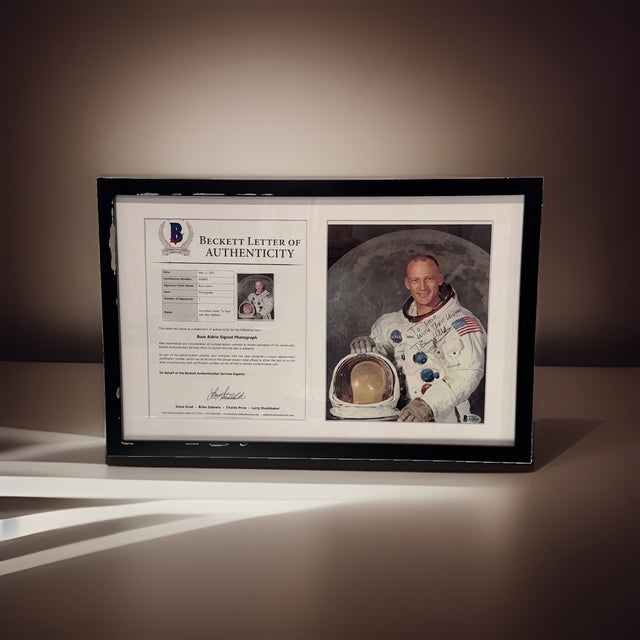
Buzz Aldrin Signed Inscribed Astronaut Photo Framed Beckett LOA A42843
$999.00 USD
-
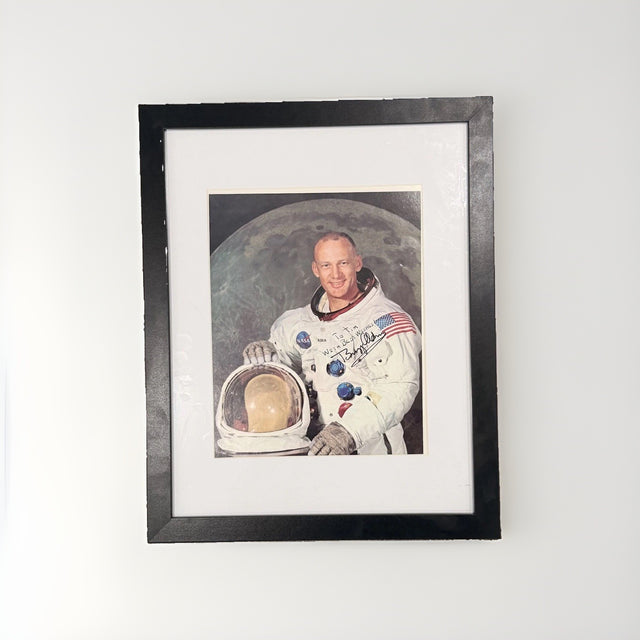
Buzz Aldrin Signed NASA Astronaut Portrait Inscribed To Tim Framed
$850.00 USD
-
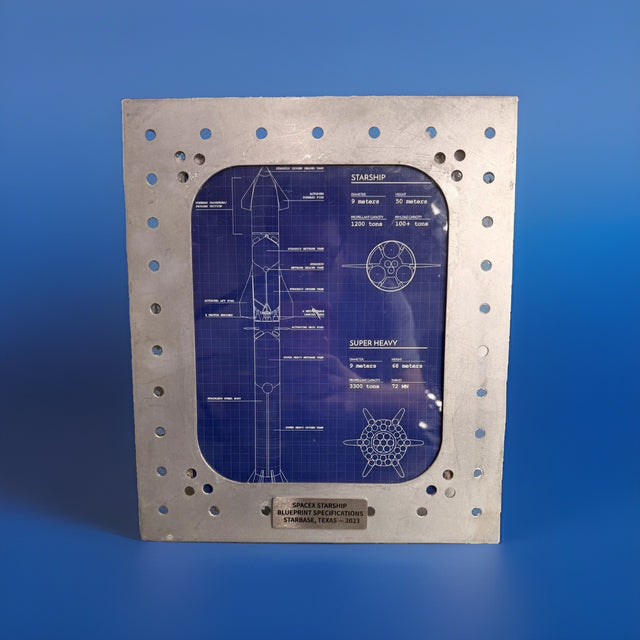
SpaceX Starship Super Heavy Blueprint Metal Display Panel Spacecraft Frame
$59.00 USD
-
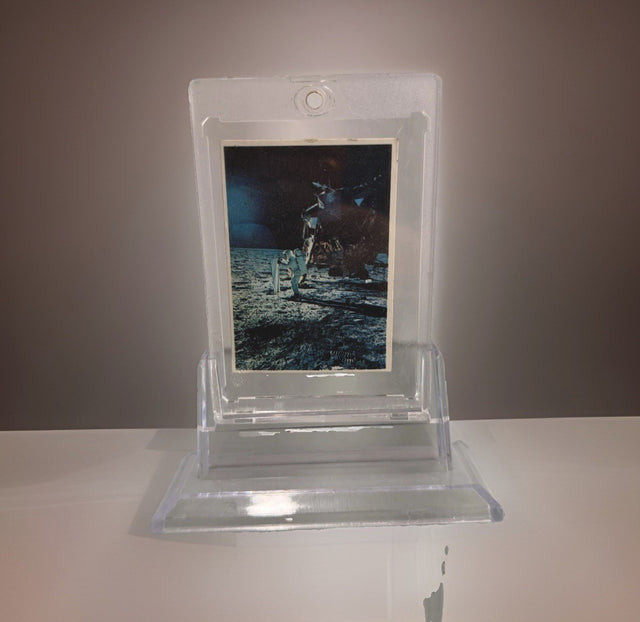
1969 Space Candy Buzz Aldrin Apollo 11 On The Moon Card #19 Taylor-Reed Display
$59.00 USD
-
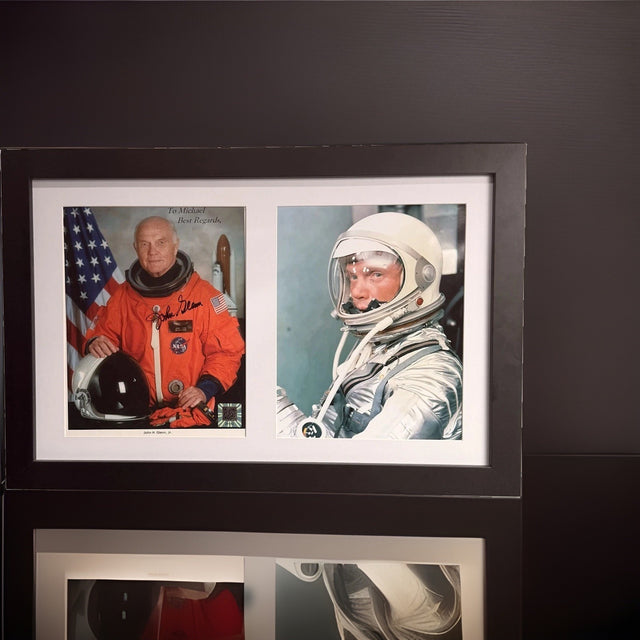
John Glenn Signed Autographed NASA Photo Display JSA Mercury Astronaut Framed
$199.00 USD
Browse the collection for current listings.