Updated 2026-07-11
A source-led guide to Matt Maeson vinyl formats, signed prints versus signed jackets, sealed-package limits, provenance, preservation, and demand.
Updated July 11, 2026 · By Gauntlet Gallery Research
Quick answer: Begin with the exact official release, then verify the autograph separately. Matt Maeson’s official store documents several vinyl formats, including a 12-inch burnt-orange A Quiet and Harmless Living in a gatefold jacket and earlier 10-inch releases sold with signed prints. That history proves official signed formats existed; it does not prove that every sealed LP, jacket, insert, or aftermarket signature is authentic.
Map the official Matt Maeson vinyl formats

The official Matt Maeson music collection is the best first stop for product identification. It lists multiple formats and colors rather than one uniform catalog. The official A Quiet and Harmless Living page describes a burnt-orange 12-inch single LP in a gatefold jacket and provides its ten-track sequence.
Earlier titles use different configurations. The official The Hearse signed 10-inch page states that the package included a signed print and was limited to 25 copies. That is an unusually useful primary record because it distinguishes the signed print from the vinyl itself and states a quantity for that exact product.
Do not transfer those facts to another title. A 25-copy limitation for The Hearse does not establish the edition size of Who Killed Matt Maeson, Never Had to Leave, or A Quiet and Harmless Living. Each release needs its own source.
Identify the signed component precisely

“Signed vinyl” can mean at least five things:
- the outer jacket is signed;
- the gatefold interior is signed;
- a print or art card is signed and packaged with the record;
- the shrink wrap is signed;
- the vinyl label or disc is signed.
These formats have different risks. A loose signed print can be moved between copies. A shrink-wrap signature can be lost when opened. A jacket signature may suffer ring wear or seam damage. A signed disc may be unsafe to play and harder to preserve.
Ask for a straight-on photograph of the signature, a wider image showing its component, and photographs of every package layer. The invoice should use language such as “sealed LP with signed print” or “gatefold jacket signed by Matt Maeson,” not merely “autographed vinyl.”
Understand what sealed does and does not prove

Factory sealing can support package condition and show that the record has not been opened since sealing. It does not authenticate ink on the outside, prove a loose insert remains inside, establish playback condition, or confirm that the shrink is original.
Inspect seam placement, vent holes, folds, stickers, tears, and shrink tightness. Excessively tight film can bend corners or warp a jacket. If the autograph is on shrink, document that explicitly and do not open the record without accepting that the signed surface will be altered or removed.
For a signed insert believed to be inside a sealed package, the strongest evidence is an official product description or original order record that names the insert. A seller’s statement that “it should be inside” is not equivalent.
Verify authentication and direct provenance

Official-store provenance can be stronger than an anonymous dealer COA when the order confirmation identifies the exact signed format. Preserve the receipt, order number, product-page capture, package labels, and unboxing photographs.
For third-party authentication, enter the number at the issuer’s official database. Match the signer, item type, label, and available image. PSA’s certification page cautions that successful number verification alone does not eliminate risk because legitimate numbers can be copied.
A generic COA should be evaluated by issuer, not appearance. Ask whether the issuer examined the physical item, maintains permanent records, identifies the exact signed component, and provides meaningful recourse. A shiny hologram without a trustworthy registry is only a sticker.
No authentication automatically proves edition size, official-store origin, or the condition of the vinyl.
Grade autograph, package, and record separately

Create three condition statements:
- Autograph: contrast, completeness, placement, smearing, fading, abrasion, and personalization.
- Package: corner wear, seam splits, creases, ring wear, shrink condition, stickers, and gatefold integrity.
- Record: scuffs, warping, label condition, pressing defects, and playback grade if tested.
Use diffuse light for overall color and angled light for surface defects. Do not call a sealed record “mint” on playback; it has not been inspected or played. Likewise, an official signed print can be authentic while showing handling wear.
The Library of Congress care guide recommends handling grooved discs by edge and label areas, storing discs upright, minimizing direct or intense light, and keeping a stable, clean environment.
Preserve a signed print, jacket, or LP correctly

Use a high-quality inner sleeve for the disc while retaining every original component. Store the record vertically with full-height support. Keep signed paper in a chemically stable sleeve or a reversible frame with an air gap from glazing. Avoid tape, dry mounting, rubber cement, lamination, and direct contact with acidic cardboard.
If the autograph is on the jacket, consider storing the disc outside that jacket but within the same protective outer sleeve to reduce seam pressure. If it is on a loose print, house the print separately and label the enclosure so the association with the record is never lost.
Do not expose the autograph to direct sun or hot display lighting. AI-created illustrations in this article are generic conservation diagrams, not examples of Maeson’s signature or any official edition.
Build a market range without false scarcity

Collector demand can differ by title, format, signing method, edition documentation, condition, and completeness. An official signed-print edition with a stated quantity belongs in a different comparison group from an aftermarket-signed jacket with third-party authentication.
Use completed sales and record:
- exact title and format;
- vinyl color and size;
- signed component;
- official-store or authentication evidence;
- stated edition quantity and primary source;
- sealed or opened status;
- condition of autograph, package, and disc;
- sale date, currency, premium, and shipping.
Do not convert one official store’s original price into current market value. Original retail is historical context; secondary value depends on actual completed transactions. Sold-out status alone does not establish rarity or demand.
Gauntlet Gallery does not state a price range here because this guide does not include a dated completed-sale ledger.
Buyer checklist and concise FAQ

Before purchasing:
- Match the record to an exact official product page where possible.
- Name the signed component.
- Retain direct-store provenance or verify third-party authentication.
- Apply any edition quantity only to the exact sourced product.
- Treat sealed, signed, limited, and numbered as separate claims.
- Grade autograph, package, and record independently.
- Use reversible storage and display materials.
- Compare only like formats and signing methods.
- Require protective shipping and a written return policy.
Is the A Quiet and Harmless Living burnt-orange LP officially signed?
The official page cited here describes the color, 12-inch single-LP format, gatefold, and track list, but it does not describe that product page as signed. A signed copy therefore needs its own direct-store record, signing provenance, or authentication.
Does “sealed” authenticate a signed insert?
No. Sealing can support package state, but the claimed insert needs an official product description, order record, or other evidence. The exterior must also be inspected for resealing and damage.
Is an official signed print the same as a signed vinyl jacket?
No. The The Hearse official page specifically says “includes a signed print.” The print is the signed object. The record and jacket are associated components unless separately signed.
Does a limited signed print make the vinyl itself limited?
Only the exact product description can answer that. When a store states that a package was limited to 25, repeat that claim for that package, not for every pressing of the recording.
Should a signed record be played?
If the autograph is on the jacket or separate print, the disc can theoretically be played without touching the ink. Playing still introduces handling and wear. If the disc or label is signed, most collectors avoid playback and prioritize preservation.
What is the safest listing description?
Use a factual string: artist, album, vinyl size/color, signed component, provenance or authenticator, condition, and inclusions. That format is more useful than “rare signed vinyl with COA.”
Methodology and disclosure
This guide uses exact official-store product descriptions, PSA’s own risk warning, and Library of Congress preservation guidance. Gauntlet inventory defines the product question but is not independent evidence of official signing, edition size, authentication, or value.
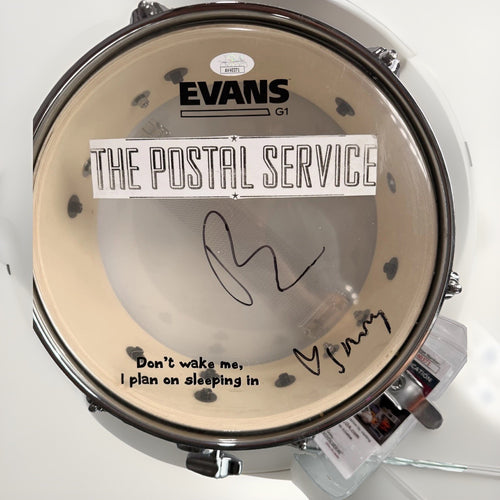
Gauntlet Gallery provides the live sealed signed-vinyl context that prompted the article; the official-store evidence determines what may safely be claimed.
Editorial image disclosure: Illustrations on this page were generated with Nano Banana for explanatory use. They are not authentication evidence, provenance records, or reproductions of any specific collectible.