Updated 2026-07-11
A source-led guide to BEN release identification, red-variant claims, signed surfaces, COA quality, condition, provenance, and valuation.
Updated July 11, 2026 · By Gauntlet Gallery Research
Quick answer: Verify a signed red BEN vinyl in two independent stages. First identify the record—format, color, UPC, packaging, discs, and inserts. Then identify the autograph—signed surface, signer, provenance, and COA issuer. The distributor’s original sell sheet supports a March 3, 2023 release and a 2LP gatefold format; it does not, by itself, prove that a particular red copy is limited or signed.
Establish the base BEN release

Macklemore’s official site identifies BEN as an official album. The original ADA distributor sell sheet lists Bendo, LLC as the label, a March 3, 2023 street date, 2LP gatefold packaging, and UPC 5054197392559 for the listed vinyl format.
Those are strong primary facts for that catalog entry. They do not establish every color variant, store exclusive, signed insert, edition size, or later repress. For a red copy, photograph both discs, labels, gatefold, spine, barcode, hype sticker, inserts, and matrix/runout information where safely visible.
Use “red vinyl” as a physical description only after viewing the discs. Use “limited edition” only when a primary source states the limitation for that exact variant.
Identify what Macklemore signed

A seller may describe an item as a “signed vinyl” when the autograph is on the jacket, gatefold, insert, art card, inner sleeve, or a separate certificate. Name the signed surface in the title and invoice.
Check whether:
- the signature is on original packaging;
- the signed component was issued with this copy;
- the jacket and discs share the expected catalog details;
- an insert could have been moved between copies;
- the record is still sealed and, if so, whether the signature is outside the shrink;
- a second person added an inscription or graphic.
A sealed record with a signed loose insert is different from a jacket signed in person. Neither is inherently better; the description must be exact.
Evaluate the COA issuer, not the word COA

A Certificate of Authenticity is evidence only to the extent that its issuer has relevant expertise, item-specific records, and a verifiable connection to the object. Ask who issued it, whether the number is publicly searchable, whether the issuer remains in business, and whether the certificate identifies Macklemore and the signed component.
If the item has PSA, JSA, or Beckett authentication, verify the number on the company’s official site and match the signer, item type, physical label, and any database image. PSA warns that a valid number alone does not eliminate risk because genuine numbers can be copied.
A seller-created certificate can document a guarantee or transaction, but it is not independent third-party authentication. State the issuer rather than writing only “with COA.”
Inspect signature and record condition separately

For the autograph, document contrast, placement, marker stability, smearing, fading, abrasion, personalization, and whether shrink wrap lies between ink and jacket. For the record, document scuffs, warping, pressing defects, label damage, and playback only when actually tested.
For packaging, note seam splits, corner dents, ring wear, creases, sticker residue, and whether framing pressure has distorted the gatefold. A mint-looking disc does not make a damaged signature mint, and an authenticated signature does not establish audio quality.
The Library of Congress recommends edge-and-label handling for grooved discs, upright storage, a clean stable environment, and minimal direct or intense light.
Verify provenance and preserve the file

Preserve the original order confirmation when the item came from an official store or promotion. For an in-person autograph, retain the date, venue, ticket or access record, item-specific photos, seller correspondence, and acquisition invoice.
The evidence should connect the exact red BEN copy or signed component to the signing. A generic event photograph or another fan’s signed copy is context, not provenance for this object.
Save screenshots or PDFs of certification lookups and the seller description. Record the barcode and physical details so a later buyer can tell whether components were exchanged.
Price the exact variant and autograph format

Build the comparison set in layers:
- The same red BEN 2LP configuration.
- The same signed surface—jacket, insert, or art card.
- The same authentication or direct provenance level.
- Similar condition and completeness.
- Recent completed sales in the same currency and channel.
Do not use unsigned black vinyl, signed CDs, unrelated albums, charity auctions, or active asking prices as direct substitutes. Record buyer’s premium and shipping because the buyer’s total cost can differ materially from the displayed sale price.
This guide gives no value range because the package contains no reproducible completed-sale ledger.
Frame, store, and ship safely

Keep both discs upright in protective inner sleeves and retain the original gatefold, inserts, hype stickers, and shrink when present. If the signed jacket is framed, use reversible supports, an air gap from glazing, and minimal light. Do not tape or dry-mount the jacket.
Ship records outside the jacket only when doing so reduces seam-split risk and the signed surface can be protected without contact. Use a rigid record mailer, corner protection, moisture barrier, tracking, and insurance appropriate to the declared value.
AI-created illustrations in this guide are generic and never evidence of a particular signature, color variant, COA, or pressing.
Buyer checklist

- Album, format, UPC, packaging, and disc count match documented release information.
- Red color is physically shown; limitation claims have a primary source.
- The signed surface is named.
- COA issuer and scope are identified.
- Any third-party number verifies and matches the item.
- Signature, jacket, and discs have separate condition notes.
- Provenance connects this exact component to the signing.
- Comparable sales match variant, signed surface, authentication, and condition.
- Mounting is reversible and shipping protects the gatefold.
The most defensible copy is the one whose album identity and autograph identity remain clear even after they are separated for inspection.
Frequently asked questions
Does the ADA sell sheet prove my copy is red?
No. The cited sheet supports the listed BEN 2LP gatefold configuration and catalog details. The disc color and any variant limitation require the exact product record or physical inspection of your copy.
Does “with COA” mean independently authenticated?
Not necessarily. Identify the issuer and its process. A seller’s certificate may document a guarantee; a third-party authentication record reflects a separate expert opinion. Either must connect to the exact signed component.
Is a signed art card the same as a signed jacket?
No. Both can be collectible, but the art card is removable and may be transferred between copies. State the signed surface, retain packaging evidence, and compare it with sales of the same format.
Can a sealed BEN LP have an outside autograph?
Yes. Determine whether the ink is on the jacket beneath shrink or on the shrink itself. Those surfaces have different preservation implications. Sealing does not authenticate the ink or confirm the condition of the discs inside.
Does sold-out status prove a red variant is rare?
No. Sold out describes availability at a particular time and channel. Rarity requires reliable supply or edition information. Demand requires completed-sale evidence. Keep those claims separate.
Should I open a sealed signed copy?
That is a collector choice. Opening allows inspection and safe separation of discs from the jacket but changes sealed status. If the signature is on shrink, opening may destroy the signed component. Document the object thoroughly before deciding.
How should the listing title be written?
Use the artist, album, 2LP format, verified color, signed component, authenticator or provenance, year, and condition. Omit “limited” unless the exact variant has a primary-source limitation.
What evidence should be backed up digitally?
Save the original product record, order or invoice, seller description, certification lookup, barcode and matrix photographs, signed-surface images, condition report, correspondence, and shipping documentation. Keep private and buyer-facing versions separately.
What if the barcode matches but the vinyl color does not?
A shared barcode can appear across related variants, and components can be swapped. Treat barcode, color, matrix, labels, packaging, and provenance as a group. Describe only the facts that converge; investigate conflicts before attributing a specific variant.
If the conflict remains unresolved, list the observable color and catalog data separately. That is more accurate than assigning a named variant from one matching field.
Methodology and disclosure
This guide uses Macklemore’s official site, the original ADA distributor sell sheet, authenticator guidance, and Library of Congress care standards. Gauntlet inventory is an editorial starting point, not independent edition, autograph, or value evidence.
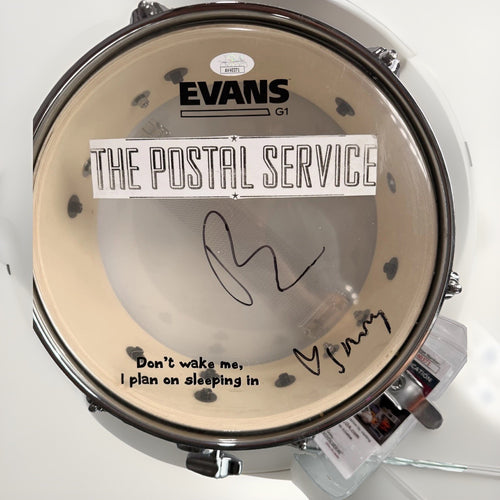
Gauntlet Gallery provides the live red-BEN signed-vinyl context; exact variant and autograph claims remain subject to the source checks above.
Editorial image disclosure: Illustrations on this page were generated with Nano Banana for explanatory use. They are not authentication evidence, provenance records, or reproductions of any specific collectible.