Updated 2026-07-11
A source-labeled introduction to Death NYC currency art that defines formats, explains what edition and document fields can support, and gives buyers a defensible due-diligence checklist.
By Gauntlet Gallery Research
Updated July 11, 2026
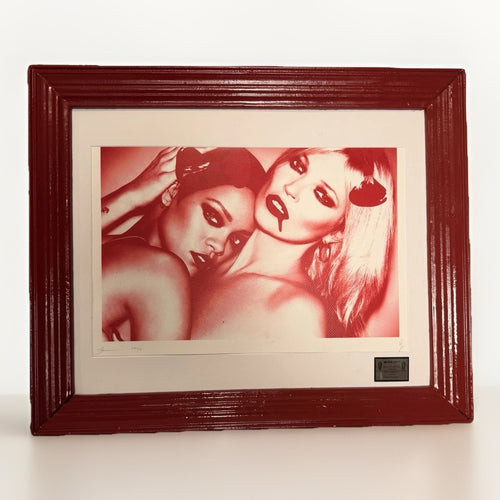
Death NYC dollar-bill art is a collector category in which imagery attributed to Death NYC is applied to, assembled with, or presented around one or more U.S. one-dollar notes. The category is not one uniform edition. Gauntlet Gallery’s current inventory includes single-note works, two-note diptychs, multi-note compositions, numbered editions, and works represented as 1/1. Buyers should identify the exact object, edition notation, signature, accompanying certificate, condition, and ownership history before discussing authenticity or value.
Evidence key: Sourced fact links to an external authority. Gauntlet inventory observation describes what was visible in Gauntlet’s July 11, 2026 public product feed; it is not an artist-wide rule. Editorial interpretation explains how a collector can use those facts.
The quick answer

The safest description is literal: “mixed-media artwork attributed to Death NYC on one U.S. $1 Federal Reserve note, signed and numbered as shown, with the pictured certificate.” Do not turn a seller’s description into a universal rule.
A useful purchase file should answer six questions:
- How many notes are present, and are they genuine currency or printed images?
- What medium appears on the note: print, transfer, paint, marker, collage, or a combination?
- Where are the signature, date, and edition notation?
- What certificate or invoice accompanies the exact object?
- Can the object and document be linked by photographs, inscriptions, or other identifiers?
- What is the condition of the note, applied image, signature, and frame?
An edition fraction, signature, seal, or certificate can support attribution. None proves it by itself.
What the category actually includes

Gauntlet inventory observation: The public feed showed multiple formats on July 11, 2026: single-note works, two-note works described as diptychs, a three-note Rolex-themed composition represented as 1/1, and several works represented as numbered editions. Inventory fields were not perfectly consistent: similar currency objects appeared under “Currency Art,” “Mixed Media,” and “Art Print.” That inconsistency is one reason to catalogue the physical object rather than rely on a product-type label.
The following terms describe format, not authenticity:
| Term | What it should mean in a listing | What it does not establish |
|---|---|---|
| Single-note work | One currency note is part of the object | That the work is unique |
| Diptych | Two visually related panels or notes form one composition | That the notes have sequential serials |
| Triptych or multi-note work | Three or more components form one work | That every component was altered by the artist |
| Numbered edition | A fraction such as 12/50 or 34/100 is visible | That all examples are identical or authorized |
| 1/1 | The object is represented as the sole example of that version | That the underlying image was never used elsewhere |
| A/P or H/C | A proof designation is written on the object | The quantity of proofs or their market premium |
Editorial interpretation: A precise record starts with count, construction, dimensions, and visible marks. “Dollar-bill art” is a useful shelf label, not a catalogue raisonné entry.
Read the object before the story

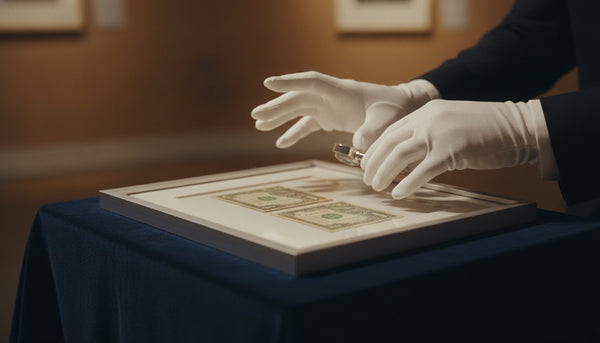
Begin with photographs of the front, back, edges, frame, signature, edition notation, and every accompanying document. Record the serial number of each note privately, but redact most digits in public listings to reduce copying risk. Note whether imagery sits directly on the currency, on an overlay, or on a printed sheet that merely depicts currency.
The U.S. Currency Education Program publishes a teller toolkit for identifying genuine Federal Reserve notes. That toolkit can help identify the banknote substrate. It cannot authenticate the artwork applied to the note.
Look for construction details a photograph can actually support:
- Is the note a complete physical object?
- Does the image cross folds, edges, or two adjacent notes?
- Are media layers raised, glossy, matte, or visibly collaged?
- Is the reverse accessible and photographed?
- Are the work and certificate shown together?
- Does the frame conceal an edge, signature, or later addition?
Avoid phrases such as “museum grade,” “studio standard,” or “official issue” unless a source defines and supports them for that exact work.
Editions, signatures, and certificates

Gauntlet inventory observation: Current listings show more than one edition convention, including /100, /50, A/P, H/C, and 1/1 representations. That directly contradicts any claim that all Death NYC work follows one edition size.
Read an edition fraction literally. “12/50” generally represents example 12 in a stated edition of 50, but the mark does not tell you whether proofs, variants, later colorways, or related compositions exist. A 1/1 inscription applies to the object as represented; it should not be rewritten as “the only Death NYC image of this subject ever made” without artist-issued evidence.
For a signature, record medium, placement, orientation, and relationship to other marks. Do not authenticate handwriting from a single online comparison. A rushed mark, different pen, or reverse signature can be genuine or problematic depending on context.
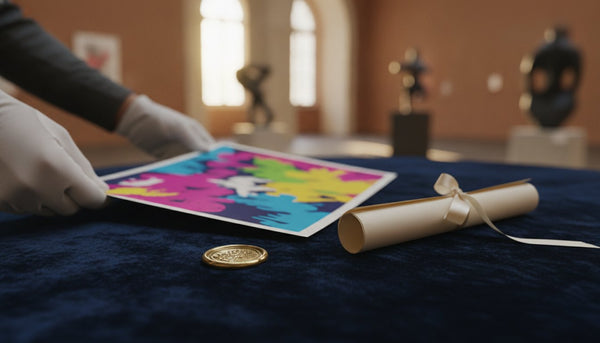
For a certificate of authenticity:
- photograph both sides;
- transcribe the issuer and every identifier;
- check whether artist, title, year, medium, dimensions, and edition match the object;
- document whether the certificate arrived with the work;
- preserve the original invoice and seller listing;
- treat a seal, stamp, or hologram as a feature to examine—not a conclusion.
The Getty defines provenance as an artwork’s ownership history and explains that researchers use sale catalogues, records, inscriptions, stamps, and other physical evidence. See the Getty’s provenance research overview.
What creates value

Value comes from the whole package, not from the face value of the note. The most defensible variables are:
- documented attribution and a coherent object–document match;
- format and complexity: single, diptych, triptych, or larger assembly;
- edition status as actually marked;
- condition of the currency, media, signature, and certificate;
- subject demand and visual clarity;
- framing quality and reversibility;
- provenance and the seller’s return terms;
- recent sold comparables for the same format.
Editorial interpretation: A 1/1 claim may create scarcity within a particular composition, but it does not automatically make that work more desirable than a visually stronger /100. A frame adds presentation and replacement cost; it does not convert an asking price into art-market evidence.
For a data-first valuation method, use Gauntlet Gallery’s related guide: Death NYC Dollar-Bill Art Price Guide.
Currency and legal context

The relevant rules are more specific than the familiar phrase “it is illegal to deface money.” 18 U.S.C. §333 addresses altering or joining bank notes with intent to render them unfit to be reissued. The Bureau of Engraving and Printing separately publishes rules for currency image use, including requirements for reproductions and restrictions on advertising in the likeness of U.S. obligations.
Those sources should be read directly. This guide does not decide whether a particular artwork, listing image, advertisement, import, or sale complies with U.S. or another country’s law. A buyer with a material legal concern should consult qualified counsel and provide the exact object and proposed use.
One practical distinction is safe to make: the face value of a note and the market value of an artwork incorporating it are different concepts. Do not attempt to spend, redeem, clean, separate, or test the note as ordinary currency.
A careful buyer checklist

Before purchase, save:
- full front-and-back images of the unframed work, if available;
- close-ups of signature, date, edition, stamps, and seals;
- certificate images and issuer information;
- the original listing, invoice, and seller identity;
- dimensions of both note and finished frame;
- a written condition report;
- a statement of what is original and what is replacement framing;
- return, shipping, insurance, and damage terms.
Ask the seller to separate facts from conclusions. “Purple marker signature on reverse” is an observation. “Authenticated by Death NYC” is a conclusion that needs a defined issuer and documentary basis. “Official Chanel collaboration” is a relationship claim that requires evidence from the parties, not merely a visible logo.
For a step-by-step examination workflow, see How to Authenticate Death NYC Currency Art.
How this category fits a Death NYC collection

Currency works offer a compact format and an unusually literal collision between images of commerce and an object used in commerce. That conceptual appeal is an editorial reading, not proof of the artist’s intent.
Compare currency works with the broader Death NYC collection, the Death NYC artist page, and Gauntlet’s Death NYC print and edition guide. When comparing two objects, keep medium and format constant. A dollar-bill diptych, a 13 × 18-inch print, and a painted canvas are different markets even when they use similar imagery.
The current retail examples discussed in this guide can be reviewed in context at Gauntlet Gallery; the gallery’s own listings remain seller records, not independent artist documentation.
The disciplined collector’s rule is simple: describe only what the object and records can support, preserve uncertainty where evidence is missing, and pay for the documented work in front of you—not for a larger story supplied by implication.
Editorial methodology and limitations
This article was prepared from Gauntlet Gallery’s public product feed as captured July 11, 2026; the linked Gauntlet product and artist pages; U.S. government currency resources; Getty provenance guidance; and Library of Congress paper-care guidance. Inventory observations are not presented as artist-issued catalogue rules. No physical object was examined for this article, and the article is not an authentication, appraisal, or legal opinion.
Editorial image disclosure: Illustrations on this page were generated with Nano Banana for explanatory use. They are not authentication evidence, provenance records, or reproductions of any specific collectible.