Luxury Art for High-End Interiors
The art that belongs in a luxury interior is work with three qualities at once: aesthetic authority, verified authenticity, and durable value. In practice that means blue-chip and investment-grade street and pop art — iconic prints and editions from names like Shepard Fairey, Banksy, KAWS, Andy Warhol, and DEATH NYC — chosen at a scale and finished to a standard that turns a room into a statement. A single large, well-lit, museum-framed piece with airtight provenance does more for a grand space than a dozen decorative canvases. Below, we walk through what to buy, how to place and frame it, how authentication functions as a luxury essential rather than an afterthought, and how to build a collection that signals taste while holding — and often growing — its worth.
What "Luxury Art" Actually Means in a High-End Interior
Luxury art is not defined by price tags or gilt frames. It is defined by intent. A high-end interior reads as considered when the art on the walls has a point of view, a maker of consequence, and a paper trail that a serious collector would respect. Decorative "wall filler" — mass-produced prints, hotel-lobby abstracts, anonymous canvases — signals the opposite: that the space was furnished, not curated.
Blue-chip and investment-grade as the baseline
The most reliable foundation for a luxury interior is blue-chip and investment-grade work: pieces by established, market-tested artists whose editions trade actively and transparently. Street and pop art occupy a distinctive place here. They carry cultural fluency and immediate visual power, yet many of the most coveted works are prints and editions — meaning you can own an authentic, signed piece by a globally recognized name without the eight-figure entry point of a unique canvas.
Statement over saturation
The single most common mistake in aspirational interiors is quantity. Luxury is restraint. One commanding work on a feature wall — framed and lit with intention — creates more presence than a crowded gallery arrangement of lesser pieces. Scale, negative space, and a confident focal point are the language of high-end rooms.
Blue-Chip Street and Pop Art as Luxury Statements
Street and pop art translate beautifully into luxury interiors because they are bold, graphic, and instantly legible from across a room. Their palettes tend toward high contrast, which reads powerfully against the neutral plaster, stone, and wood tones that dominate contemporary luxury design.
The names that anchor a collection
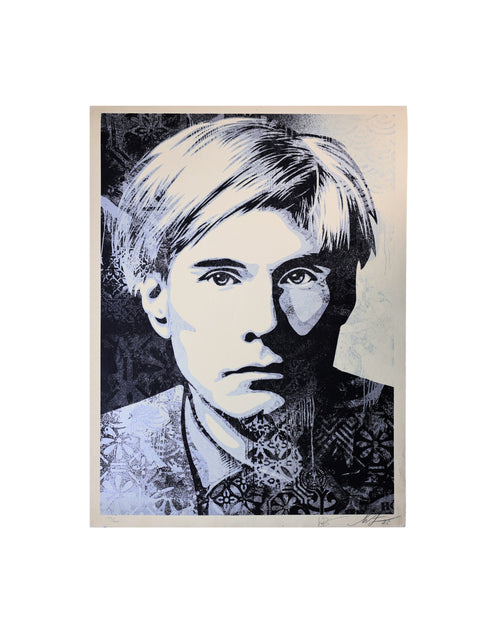
- Shepard Fairey — Instantly recognizable for the OBEY iconography and the red-cream-black palette that has become shorthand for contemporary street art. Fairey editions offer accessible entry points with strong cultural resonance.
- Banksy — Arguably the most globally recognized living street artist. Authenticated Banksy prints are among the most sought-after works in the category, prized for their wit and their market depth.
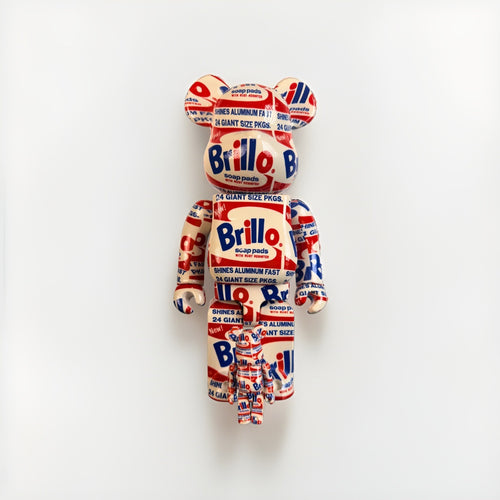
- KAWS — The bridge between fine art and design object. KAWS figures and prints slot naturally beside sculptural furniture and function as three-dimensional focal points.
- Andy Warhol — The foundational pop artist. Warhol prints bring instant art-historical weight and a color language that flatters modern interiors.
- DEATH NYC — A prolific contemporary street artist whose small-run signed pieces layer pop iconography with luxury-brand references, making them a natural fit for design-forward spaces.
Prints and editions: accessible luxury with real value
The strategic advantage of editions is that they let a collector own authentic work by a major name at a fraction of a unique-work price, while still participating in a transparent secondary market. A signed, numbered, well-conditioned print from a respected release can serve as a genuine anchor piece — visually and financially. Browse the full pop-art category to see how these names sit together in a single collecting narrative on the pop art collection, and explore Banksy specifically through the Banksy collection.
Scale and Placement in Grand Spaces
Grand rooms punish under-scaled art. A modest print floating on a double-height wall looks lost; the same image printed large and framed generously commands the space. Getting scale and placement right is where most of the luxury impression is won or lost.
Sizing to the wall, not the frame shop's stock
As a working guideline, a single statement piece should occupy roughly 60–75% of the available wall width above a sofa, console, or bed. On tall feature walls, think vertically: a large portrait-format work or a stacked pair can fill the vertical volume that a single horizontal piece cannot. Below is a practical reference for matching work to setting.
| Space | Recommended approach | Placement note |
|---|---|---|
| Double-height great room | One oversized statement work or a stacked vertical pair | Center on the architectural focal wall; scale to fill vertical volume |
| Formal living room | Single large piece above the sofa | Bottom of frame ~8–10 in above the sofa back |
| Dining room | Bold graphic print centered on the primary wall | Hang so the center sits at seated eye level |
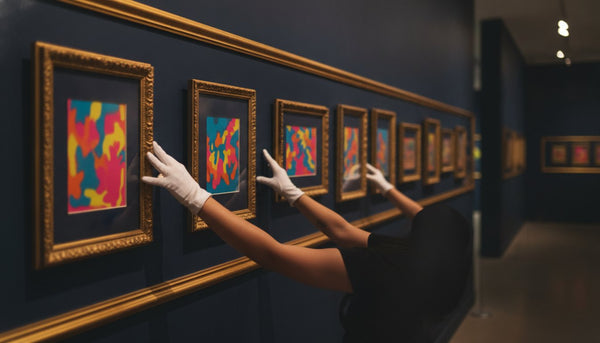
| Entry / gallery hall | A tight, rhythmic series of framed editions | Uniform framing and consistent spacing (2–3 in gaps) |
| Primary bedroom | One calm, larger-scale work above the headboard | Center on the bed; keep palette restful |
| Staircase / atrium | Sculptural piece (e.g., a KAWS figure) on a plinth | Position as a three-dimensional focal point in the round |
The 57-inch rule and when to break it
Museums typically hang so the center of a work sits around 57 inches from the floor — average eye level. It is a reliable default, but grand interiors often reward breaking it: a towering feature wall may call for a work hung higher and lit dramatically, while a piece meant to be viewed while seated (dining rooms, lounges) should drop accordingly. The principle is constant — hang to the human, and to the room's sightlines — even when the exact number moves.
Museum-Quality Framing and Lighting
Nothing separates a luxury interior from a merely expensive one faster than framing and lighting. The same print looks disposable in a big-box frame and museum-worthy behind conservation glazing in a hand-finished moulding. This is where a modest incremental spend yields an outsized upgrade in perceived value — and protects the asset.
Conservation framing that protects value
- Acid-free, archival materials. Use 100% cotton rag or acid-free mats and backing so the paper does not yellow or burn over time.
- UV-filtering, anti-reflective glazing. Museum glass blocks the majority of UV light and nearly eliminates glare, so the work stays vivid and readable in bright rooms.
- Reversible, non-adhesive mounting. Works should be hinged with archival materials — never dry-mounted or trimmed — to preserve condition and resale value.
- Restraint in the moulding. A clean, substantial frame in a finish that echoes the room's metals or woods reads more luxurious than an ornate one competing with the art.
Lighting as the finishing move
Great lighting is what makes a piece feel "hung in a gallery." Options, roughly in order of sophistication:
- Picture lights — Discreet fixtures mounted to the frame or wall; the fastest way to add gallery presence to a single work.
- Adjustable track or recessed spots — Aim narrow-beam, high-CRI (90+) fixtures at a ~30-degree angle to minimize glare and reveal texture.
- Warm, consistent color temperature — Around 2700–3000K flatters most palettes; keep all art lighting consistent across a room so pieces read as a curated set.
The goal is even, warm, glare-free illumination that makes the work the brightest considered element on the wall — without washing it out.
Protecting the piece from the room itself
Luxury interiors are often flooded with natural light, radiant heat, and seasonal humidity swings — all of which are quietly hostile to works on paper. Keep pieces off walls that receive hours of direct sun, avoid hanging above active fireplaces or heating vents, and aim for stable conditions of roughly 40–55% relative humidity and comfortable room temperature. Where a wall is unavoidably bright, museum-grade UV glazing becomes non-negotiable rather than optional. These are the same environmental disciplines a conservator would insist on, and they are what allow a collection to look as good in a decade as it does on installation day — while preserving the condition grade that underpins resale value.
Provenance and Authentication as Luxury Essentials
In the luxury tier, authenticity is not a bonus feature — it is the product. A work without documentation is a decoration; a work with airtight provenance is an asset. Serious collectors and their advisors treat the paperwork with the same rigor as the piece itself, because value, insurability, and resale all depend on it.
Authentication is artist-specific — never mix the chains
One of the most important things to understand is that every major artist has its own, distinct authentication standard. These do not overlap, and combining them is a red flag. The correct chain by artist:
| Artist / category | Correct authentication standard |
|---|---|
| Shepard Fairey | Established through provenance and documented acquisition history; verified on its own record, not a third-party certificate program |
| Banksy | Pest Control is the sole authority — the only body that authenticates Banksy works |
| KAWS & BE@RBRICK | Verified via packaging and markings, backed by a certificate of authenticity (TrueCOA) |
| DEATH NYC | Certificate of authenticity with the signature gold seal |
| Andy Warhol | Verified through documented certificate-of-authenticity processes appropriate to the work |
| Signed music & memorabilia | Third-party authentication by Beckett (BAS), JSA, or PSA |
What a clean provenance file looks like
- A documented ownership and acquisition history.
- The correct, artist-appropriate certificate or authority record (per the table above).
- Condition documentation and high-resolution images of signatures, edition numbers, and any embossing or seals.
- Original receipts or gallery documentation where available.
Because these standards are exacting and never interchangeable, buying through a dealer that treats authentication as its core discipline is the single best protection a collector has. Learn how this rigor is applied across categories on the collector resources hub, and browse verified inventory across the full gallery collection.
Mixing Iconic Prints with Sculptural Designer Pieces
The most compelling luxury interiors are not flat. They layer two-dimensional work — framed prints and editions — with three-dimensional objects that read as art in their own right. This interplay is what gives a room depth and keeps the eye moving.
Prints on the wall, sculpture in the round
A KAWS figure on a plinth, a BE@RBRICK on a floating shelf, or a bronze form on a console introduces mass and shadow that a framed work cannot. Positioned near a graphic print by the same or a complementary artist, the two create a dialogue — the flat and the volumetric reinforcing each other. The rule of thumb: let the wall carry the color and the object carry the form.
Composing across mediums
- Repeat a palette, vary the medium. Echo a color from a print in a nearby sculpture or design object to unify the grouping.
- Vary height and mass deliberately. A tall vertical print beside a low, dense sculptural piece creates satisfying tension.
- Give objects room. Sculptural pieces need negative space around them to be read as art rather than accessory.
- Mind the sightlines. Place three-dimensional works where they can be seen in the round — the turn of a stair, the end of a sightline, the center of a console.
Building a Collection That Signals Taste and Holds Value
The interiors that age best are backed by collections built on a thesis, not impulse. A coherent point of view — a focus on street and pop editions, say — reads as taste, and a market-aware acquisition strategy protects value. The two goals reinforce each other.
Buy authentic, condition-graded, and well-documented
Value in editions is driven by name, edition size, condition, and documentation. Prioritize signed and numbered works in excellent condition with complete provenance over larger quantities of lesser pieces. A smaller collection of impeccable examples outperforms a big one of compromises — aesthetically and financially.
Think like an investor, decorate like a curator
Blue-chip street and pop editions have shown genuine market depth, but no artwork should be bought on a price chart alone. The healthiest approach is to buy work you want to live with, from artists with transparent, active secondary markets — so the piece delivers daily pleasure and remains liquid if you ever choose to sell. For market context, comparables, and the data behind category values, see financial insights. And when sourcing, where you buy matters as much as what you buy — this comparison of trusted venues is a useful starting point: best places to buy investment-grade street art, compared.
Curate over time, not overnight
The strongest collections are assembled deliberately — one considered acquisition at a time — around a clear identity. That patience is itself a luxury signal: it shows the collection reflects a person, not a decorator's order form. Explore curated, authenticated work and the thinking behind it through the gallery's art index.
Insuring and caring for what you own
Once a collection reaches meaningful value, it deserves the same administrative care as any other significant asset. Keep a simple inventory — images, edition numbers, certificates, receipts, and current condition notes — for every piece, and store copies off-site or in the cloud. Speak to an insurer about a fine-art or valuables rider rather than relying on a standard homeowner's policy, which typically caps art coverage well below replacement value. Documentation does double duty here: the same provenance file that authenticates a work also substantiates an insurance claim and streamlines a future sale. Treating the paperwork as part of the piece is one of the clearest markers that separates a decorated home from a genuine collection.
Frequently Asked Questions
What kind of art belongs in a luxury or high-end interior?
Work that combines aesthetic authority, verified authenticity, and durable value. In practice, that means blue-chip and investment-grade street and pop art — signed prints and editions from names like Shepard Fairey, Banksy, KAWS, Andy Warhol, and DEATH NYC — displayed at a confident scale, museum-framed, and backed by clean provenance. One well-chosen statement piece outperforms many decorative ones.
How large should a statement artwork be in a grand room?
Scale generously. A single feature work should occupy roughly 60–75% of the available wall width above a sofa or console, and on tall feature walls you should think vertically to fill the volume. Under-scaled art is the most common way an aspirational room falls flat; grand spaces reward larger, well-lit pieces.
Why does framing and lighting matter so much for luxury art?
Because presentation is where the same print reads as either disposable or museum-worthy. Conservation framing — acid-free materials, UV-filtering anti-reflective glazing, reversible mounting — protects both the work's condition and its resale value, while warm, high-CRI, glare-free lighting gives a piece gallery presence. It is a modest spend with an outsized effect on perceived value.
How do I make sure a piece is authentic before I hang it in my home?
Match the work to its correct, artist-specific authentication standard and never mix chains. Banksy is authenticated only by Pest Control; KAWS and BE@RBRICK are verified through packaging, markings, and a certificate of authenticity; DEATH NYC uses a certificate with a gold seal; Warhol is verified through its appropriate certificate process; Fairey is established through provenance; and signed music or memorabilia should carry Beckett, JSA, or PSA authentication. Buy from a dealer that treats authentication as its core discipline.
Can I mix framed prints with sculptural pieces in the same room?
Yes — and the best luxury interiors do. Layering framed editions on the wall with three-dimensional pieces such as a KAWS figure or a bronze form adds depth and shadow that flat work cannot. Repeat a shared palette across mediums, vary height and mass, and give sculptural objects enough negative space to read as art in the round.
Does luxury art actually hold its value?
Blue-chip street and pop editions have demonstrated real market depth, but value depends on authenticity, condition, edition, and documentation — not on the artwork alone. The soundest approach is to buy authentic, well-documented, excellent-condition work from artists with transparent, active secondary markets, so the piece brings daily pleasure and remains liquid if you ever choose to sell.