KAWS Companion Release History & How to Value Each
The KAWS Companion is the flagship character of artist Brian Donnelly (KAWS): a Mickey-Mouse-inspired figure with a bulbous skull, crossbones ears, and X'd-out eyes, released as vinyl and painted-cast collectibles from the early 2000s onward. Its release history runs from the OriginalFake store era through Medicom Toy production and a wide run of colorways (grey, black, brown, and beyond), sizes (from palm-sized to life-scale), and sculptural variants such as Dissected, Flayed, and Resting Place. To value any given Companion, weigh five factors together: colorway rarity, edition size, condition, whether the original box and packaging survive, and provenance. Below is a general timeline and a practical valuation framework, plus how to authenticate before you buy.
What is the KAWS Companion?
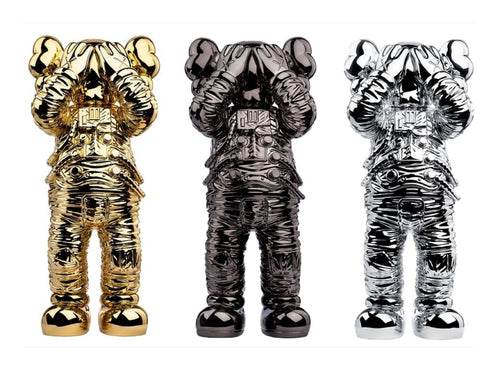
The Companion is KAWS's best-known character and the anchor of his collectible practice. It reinterprets classic cartoon anatomy — think white-gloved hands, rounded shorts, and oversized shoes — but replaces the friendly face with a skull-like head, X-mark eyes, and crossbones detailing. What began as a subversion of commercial cartoon iconography became one of the most collected figures in contemporary art toys.
Companions are produced primarily as cast vinyl, with select painted and bronze editions, and they span a huge range of scales. Because the same silhouette recurs across many releases, collectors distinguish pieces by era, colorway, size, and sculptural variant rather than by the character alone. Understanding those axes is the key to both identifying and valuing a piece.
The character's core visual language
- Head and eyes: a rounded skull form with the signature X'd-out eyes.
- Ears: crossbones motifs where cartoon ears would sit.
- Body: cartoon-classic gloves, shorts, and shoes, rendered in smooth cast vinyl.
- Finish: most often matte or satin vinyl, though gloss, flocked, and painted editions exist.
How the Companion evolved
KAWS began his career in the 1990s reworking advertising and cartoon imagery, and the Companion grew directly out of that language of appropriation. Early Companions appeared as limited collectible figures produced in partnership with Japanese toy makers, and they circulated among a small circle of streetwear and art-toy collectors before the character reached a wider audience. As KAWS's fine-art career expanded into galleries, museums, and monumental public sculpture, the Companion carried the same DNA across every scale — from a figure you can hold in one hand to inflatable and sculptural works measured in stories.
That trajectory is why the character reads as both a designer toy and a serious contemporary artwork. The upright, eyes-covered pose became the most recognizable stance, but KAWS continually reinterpreted the form: seated and reclining postures, open and cutaway bodies, and co-branded editions tied to fashion houses, museums, and cultural institutions. For a collector, the practical takeaway is that "a Companion" is never one object — it is a family of related releases, and value lives in the specifics of which release you are holding.
KAWS Companion release history (general timeline)
KAWS moved from limited gallery-and-store drops in the early years to broader, more widely distributed releases as demand grew. The table below is a general orientation — it deliberately avoids specific edition numbers, exact dates, and prices, because those vary by release and are easy to get wrong. Use it to understand eras and directions, then verify the specifics of any individual piece against a reputable dealer or reference before you buy.
| Era | What defined it | Typical formats |
|---|---|---|
| Early / OriginalFake era | Companions released through KAWS's OriginalFake store and early collaborations; smaller, more limited distribution | Cast vinyl figures, foundational colorways |
| Major collaboration period | High-profile partnerships (fashion, streetwear, museums, and toy houses) broadened the audience and introduced new colorways and co-branded editions | Standard and collaboration colorways, apparel tie-ins |
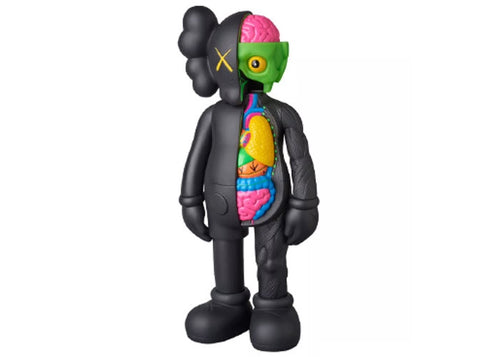
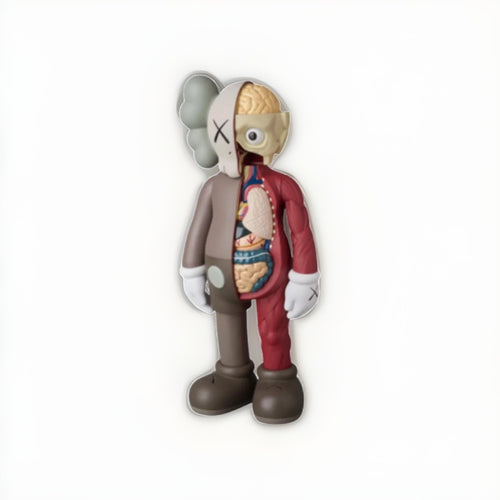
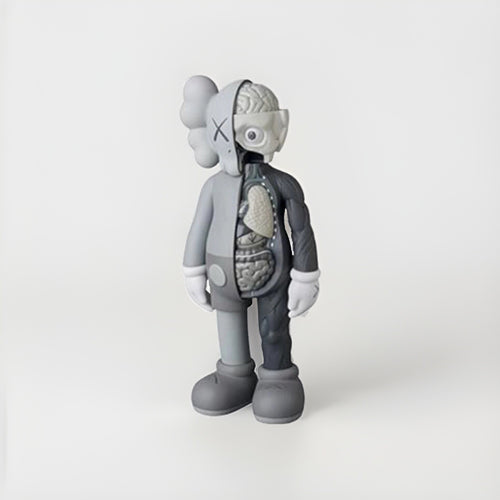
| Variant and sculptural period | Conceptual "cutaway" sculptures revealing the figure's interior anatomy, plus reclining and open-form works | Dissected, Flayed, Resting Place variants |
| Scale expansion | Releases at dramatically different scales, from palm-sized companions to large and monumental works | Small vinyl to large-format and life-scale editions |
| Ongoing / wide-release period | Broadly distributed open or larger editions that made the character accessible to newer collectors | Widely available vinyl in recurring colorways |
Colorways
Colorway is one of the fastest ways collectors sort Companions. The most recurring "classic" palettes are grey, black, and brown, often released together as a trio, with additional colors and finishes appearing across specific drops and collaborations. As a rule of thumb, a scarcer colorway within a given release, or one tied to a notable collaboration, tends to command more attention than a broadly distributed standard color — though condition and packaging still shape the final number.
Sizes
Companions exist across a wide size spectrum. Smaller figures are the most accessible entry points; larger and life-scale editions were produced in smaller numbers and occupy the top of the market. Size alone does not set value — a small, scarce early piece can outrank a larger, widely distributed one — but scale is a meaningful input, especially when paired with a limited edition size.
Sculptural variants: Dissected, Flayed, and Resting Place
- Dissected: Companions presented with a cutaway body revealing a cartoon-style interior — a signature KAWS concept that turns the toy into a comment on anatomy and artifice.
- Flayed: a related open-form treatment exposing the figure's inner structure.
- Resting Place / reclining forms: Companions in seated, slumped, or reclining poses that read as more contemplative than the upright "eyes-covered" stance.
These conceptual variants are central to why the Companion is treated as fine art rather than a simple toy, and desirable examples are collected accordingly. When evaluating a variant, focus on which release it belongs to, its condition, and its packaging rather than assuming a variant is automatically more valuable than a standard figure.
What drives the value of a KAWS Companion?
No single factor sets price. Value emerges from how several inputs stack together. Here are the ones that matter most, in roughly the order collectors weigh them.
1. Edition size and rarity
Smaller, more limited releases and scarcer colorways generally carry more collector demand than widely distributed ones. Early store-era pieces and pieces tied to significant collaborations tend to be harder to source in strong condition.
2. Colorway
Within a release, some colors are simply harder to find. A scarce colorway can meaningfully move value relative to a common one from the same drop.
3. Condition
Vinyl is sensitive to handling, sunlight, and time. Collectors look closely for:
- Yellowing or discoloration (especially on white and light figures).
- Scuffs, paint rubs, dents, and stress marks.
- Sun fading and warping from display near windows or heat.
- Cleanliness of the finish and integrity of any painted details.
A pristine example commands a premium over a played-with one, and condition often separates two otherwise identical figures.
4. Box and packaging
Original packaging matters. The correct box, inserts, and any included printed materials support both value and authenticity. A complete, undamaged box in strong shape typically adds to the piece; a missing or damaged box detracts.
5. Provenance
Where a piece has been — and who has handled it — supports confidence and value. A clear ownership chain, a reputable seller, and documentation reduce risk. Provenance becomes especially important for higher-value and larger-scale editions.
How to authenticate a KAWS Companion
Authentication is where new collectors get burned, so approach it methodically. For KAWS collectibles, the practical pillars are the same ones that protect you across the contemporary-collectibles market: buy from reputable sources, insist on correct packaging, verify provenance, and use third-party verification where it is available.
TrueCOA verification
At Gauntlet Gallery, KAWS and BE@RBRICK collectibles are backed by TrueCOA blockchain certificates, giving you a tamper-resistant way to confirm a piece against its record online. This third-party layer is one of the strongest tools a buyer has, because it ties a physical object to a verifiable certificate rather than relying on a seller's word alone. See our KAWS authentication guide for how this works in practice.
What to check yourself
- Packaging correctness: the box style, printing quality, and inserts should match the release. Sloppy printing or mismatched packaging is a warning sign.
- Finish and casting quality: genuine pieces show clean casting and consistent finishes; soft details, seams, or off colors deserve scrutiny.
- Weight and material feel: familiarity helps here — handle authenticated pieces where you can to calibrate.
- Seller reputation: established dealers, transparent return policies, and documentation beat anonymous bargains.
We deliberately avoid publishing a checklist of specific "fake tells" here, because counterfeiters adapt to them and because a single misapplied tell can lead you to reject a genuine piece or accept a fake. The durable protection is source, packaging, provenance, and third-party verification — not a list of micro-details.
How to value each Companion in practice
Put the framework to work with a simple, repeatable process. This will not hand you an exact number — nobody honest can, sight unseen — but it will get you to a defensible range.
- Identify the release. Pin down the era, colorway, size, and variant. Our KAWS figurine index is a useful starting point for orienting yourself among releases.
- Grade the condition honestly. Inspect for yellowing, scuffs, fading, and warping under good light. Photograph flaws.
- Confirm completeness. Note whether the correct box, inserts, and any certificate are present.
- Establish provenance. Gather the ownership and purchase history and any third-party verification.
- Benchmark to the market. Compare against recent sales of the same release in comparable condition, and read broad market direction rather than a single outlier price. Our Financial Insights page is where we publish market context rather than inventing figures.
- Apply condition and completeness adjustments. A pristine, boxed, verified example sits at the top of its range; a discolored, box-less one sits at the bottom.
Two Companions of the same colorway and size can differ substantially in value once condition, box, and provenance are factored in. That is why a disciplined, five-factor read beats anchoring on a single headline price.
A quick valuation checklist
| Factor | Adds value when… | Detracts when… |
|---|---|---|
| Edition / rarity | Small edition or scarce release | Wide, open, or common release |
| Colorway | Hard-to-find color within the drop | Broadly distributed standard color |
| Condition | Pristine, no yellowing or scuffs | Discoloration, fading, damage |
| Box / packaging | Correct, complete, undamaged | Missing, wrong, or damaged |
| Provenance | Clear chain, reputable source, verification | Unknown history, anonymous seller |
How to buy a Companion authentically
The valuation framework and the authentication framework meet at the moment of purchase. Buying well is less about chasing the lowest price and more about controlling risk, so that the piece you receive matches the piece you thought you were buying. A few disciplines make the difference between a confident acquisition and an expensive lesson.
Buy the piece, not the story
Sellers sometimes lean on narrative — a big name, a rare-sounding colorway, an urgent deadline — to move a figure quickly. Slow down and evaluate the object on its own terms: the release it belongs to, its condition, its packaging, and its documentation. A compelling story is not a substitute for provenance, and pressure to decide fast is itself a warning sign.
Insist on documentation and returns
- Third-party verification: prefer pieces backed by a certificate you can independently check, such as TrueCOA.
- Clear photography: ask for well-lit images of the figure from multiple angles, the box, and any inserts or certificate.
- Return policy: a reputable dealer stands behind authenticity and offers a reasonable path to return a piece that does not match its description.
- Transparent history: the seller should be able to speak to where the piece came from.
Common mistakes new collectors make
- Overpaying for condition they did not inspect. Yellowing and fading are easy to miss in flattering photos; always review under neutral light.
- Ignoring the box. A missing or wrong box quietly erodes value and can signal a problem with the piece.
- Confusing scale with rarity. A large figure is not automatically more valuable than a small, scarce one.
- Chasing a single headline price. One outlier sale is not the market; read the range and direction instead.
- Skipping verification to save money. The cost of a fake vastly exceeds the cost of buying from a source that verifies.
Handled this way, buying a Companion becomes a repeatable process rather than a gamble. You identify the release, confirm condition and completeness, verify authenticity, and pay a price that reflects an honest read of the market. For a broader look at how we think about collecting across artists, our full collection and the guides in the Collector's Hub are built to support exactly this kind of disciplined buying.
Where the Companion sits in a collection
For many collectors, a Companion is a first serious step into KAWS and into contemporary art collectibles more broadly. It pairs naturally with related figures and with the wider world of authenticated collectibles — BE@RBRICK, for example, sits in an adjacent lane with its own release logic. If you are building a collection deliberately, it helps to learn the character's grammar first, then let condition and provenance guide which specific examples you pursue. Our Collector's Hub gathers the guides and tools for exactly that.
Frequently asked questions
What is the KAWS Companion release history?
The Companion evolved from limited early releases through KAWS's OriginalFake store era, into a broad run of colorways, sizes, and collaborations, and then into conceptual sculptural variants such as Dissected, Flayed, and Resting Place. Over time, releases ranged from small, limited store drops to larger, more widely distributed editions and monumental scale works. Rather than memorizing exact dates and numbers, collectors sort pieces by era, colorway, size, and variant.
How do I value a specific KAWS Companion?
Weigh five factors together: edition size and rarity, colorway, condition, whether the original box and packaging survive, and provenance. Identify the exact release first, grade condition honestly, confirm completeness, establish provenance, then benchmark against recent sales of the same release in comparable condition. A pristine, boxed, verified example sits at the top of its range; a discolored, box-less one sits at the bottom.
What are the classic KAWS Companion colorways?
The most recurring classic palettes are grey, black, and brown, frequently released as a trio, with additional colors and finishes appearing across specific drops and collaborations. Within a release, a scarcer colorway generally draws more collector demand than a broadly distributed standard color, but condition and packaging still shape the final value.
What are the Dissected, Flayed, and Resting Place variants?
These are sculptural variants of the Companion. Dissected and Flayed present the figure with a cutaway or open body revealing a cartoon-style interior anatomy, while Resting Place and related reclining forms show the Companion seated or slumped. They are central to why the Companion is treated as fine art rather than a simple toy.
How do I authenticate a KAWS Companion?
Buy from reputable sources, insist on correct packaging, verify provenance, and use third-party verification where available. At Gauntlet Gallery, KAWS and BE@RBRICK pieces are backed by TrueCOA blockchain certificates, giving you a verifiable way to confirm a piece against its record online. Avoid relying on a single "fake tell" — durable protection comes from source, packaging, provenance, and verification together.
Does the box really affect value?
Yes. Original, correct, undamaged packaging supports both value and authenticity, while a missing, wrong, or damaged box detracts. For two otherwise identical figures, the one with complete packaging in strong condition will typically command more.
Buy & authenticate with confidence
The Companion rewards collectors who learn its grammar — era, colorway, size, and variant — and then buy on condition, packaging, and provenance rather than hype. When you are ready, browse authenticated pieces in our KAWS collection, ground yourself in the KAWS buyer's guide, and confirm every purchase against our KAWS authentication guide, with TrueCOA verification where applicable. Buy the right example, verify it properly, and a Companion becomes both a great object and a considered addition to your collection.