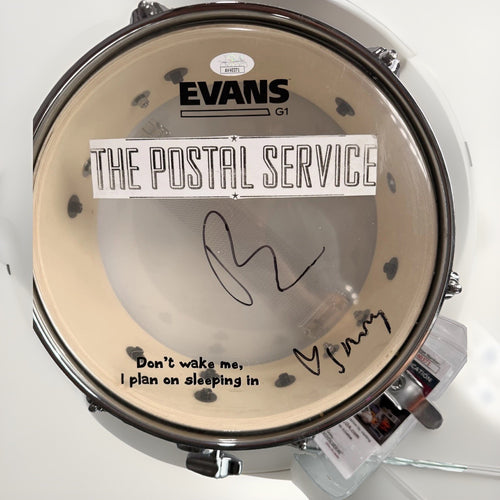
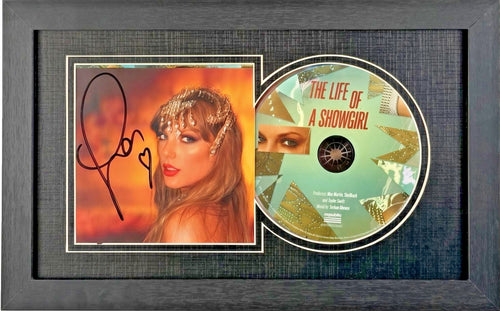
To figure out what a piece of signed music memorabilia is actually worth, you anchor to one thing above all others: recent, realized comparable sales for genuinely similar items, matched on the signer, the item type, the condition, and the strength of authentication and provenance. Not asking prices, not the highest number a seller can point to, and not a certificate's implied value. What comparable pieces have actually sold for, recently, is the closest thing the market offers to an objective figure. Everything else, the signer's significance, the format, the condition, a clean signature versus a personalized inscription, and above all the documentation behind it, either pushes a piece up or down within the band those comparables define.
The safest place to buy is a specialist that authenticates and documents before it lists, rather than an open marketplace where anyone can post anything at any price. Signed music is one of the most heavily forged collecting categories, so the burden of proof sits squarely on the item: an independently verifiable third-party opinion, or documented provenance, or both. This guide explains what drives value, how to price a piece honestly against comparable sales, how the major authenticators actually work, why photo-matching matters for instruments and stage gear, and how to buy without getting burned. It also shows how Gauntlet Gallery approaches the problem, benchmarking against a database of more than 300,000 comparable-sales records and authenticating pieces before they go up for sale.
What actually drives the value of signed music memorabilia

Value in signed music memorabilia is not one number; it is a stack of qualitative factors that either reinforce or undercut one another. Understanding the stack is what separates a confident buyer from one who overpays. The factors below are the ones the market rewards, and none of them can be reduced to a formula, but together they explain why two superficially similar items can sit far apart in price.
The first factor is the signer's significance. Cultural importance, the scarcity of the signer's genuine autograph, and ongoing demand do most of the work. A signature from an artist who signed rarely, or whose career was cut short, carries more weight than one from a prolific modern signer who obliged every autograph request for decades. The second factor is item type and format. Format sits in tiers: signed instruments and stage-used gear occupy the top, while signed photographs, albums and vinyl, CDs, and generic flats occupy lower and distinct tiers. The desirability of the format itself, before you even consider the signature, shapes where a piece can land.
Condition is the third factor and it is unforgiving. An unfaded, bold signature in stable ink on a well-preserved surface commands a premium over a faded, smudged, or damaged example of the very same thing. The fourth factor is the character of the signature itself: a clean, uninscribed autograph is generally more desirable to the broad market than a personalized dedication, which narrows appeal and can slightly reduce value, though a meaningful inscription tied to a documented moment can occasionally add value in specific cases. The fifth and most decisive factor is provenance and authentication, which is powerful enough to warrant its own chapters below. A documented chain of ownership and signing materially strengthens both value and desirability, and its absence caps what a serious buyer will pay no matter how attractive the object looks.
Comparable sales: the only honest way to price a piece

Once you understand what drives value, the question becomes how to translate those factors into a number, and there is only one honest method: comparable sales. A comparable sale, or comp, is the price at which a genuinely similar item recently and actually sold. The word "similar" is doing heavy lifting, and the word "actually" is doing even more. A meaningful comp matches on the signer, the item type and format, the condition, and the authentication status, because a JSA-witnessed signed guitar and an unauthenticated one of the same model are not the same product and should never be priced as if they were.
The single most common way buyers get hurt is by confusing an asking price with a realized sale. The prices you see scrolling an open marketplace are overwhelmingly what sellers hope to get, not what buyers agreed to pay. A signed album can sit unsold at an ambitious figure for months, and that figure tells you nothing about value except that the market has so far declined to meet it. Realized prices, the transactions that actually closed, are the only comps worth anchoring to. Asking prices are anecdotes wearing a comp's clothing.
Two other qualities separate a useful comp from a decorative one. The first is recency: a sale from several years ago describes a market that may no longer exist, and the more recent the result, the more it reflects what a buyer would pay today. The second is honest breadth. It is easy to justify almost any price by cherry-picking the single flattering result and ignoring the ordinary sales beneath it. Trustworthy valuation looks at the full distribution of recent, like-for-like realized results and asks where a specific piece honestly sits within that band, given its condition and documentation. This is precisely why a large body of comparable-sales records is more reliable than any single data point. Gauntlet Gallery benchmarks against more than 300,000 comparable-sales records for exactly this reason: not to produce one magic number, but to establish a realistic band and enough recent, genuinely comparable results to place a piece within it.
Authentication as a value floor

Authentication does not just protect you from a fake; it sets a floor under value. An identical signed item is worth materially more when it carries an independently verifiable third-party opinion than when it does not, because the next buyer will demand the same assurance you should. In the U.S. autograph market, three third-party authenticators are the most widely recognized by auction houses, dealers, and collectors: Beckett Authentication Services (BAS), JSA (James Spence Authentication), and PSA/PSA-DNA. They are presented here evenly and deliberately. There is no industry consensus that any one of the three is categorically the best; each has a strong reputation, and collector preference is genuinely split, often by signer or category. Anyone who tells you a single service is universally best is overstating the case.
All three operate the same core third-party model, which is precisely why their opinions carry weight: they are independent of the seller and have no financial stake in the sale. Each examines the ink and the structure and flow of the signature, compares it side-by-side against a database of known authentic exemplars, and reaches for forensic tools such as a video spectral comparator or magnification when a signature needs deeper review. Each applies a tamper-evident numbered sticker to the item, maintains an online database where anyone can enter the certification number to confirm the record, and offers a fuller Letter of Authenticity as an option. A recurring truth cuts across all three: their certification is only as strong as the number being verifiable in the issuer's own live database. A sticker or letter with no matching online record is a red flag regardless of whose logo is on it.
The services differ in ways worth knowing. BAS applies a half-inch oval tamper-evident label that, in its own words, can be applied only once and will leave fragments behind if removed, so it cannot be reapplied; for an additional fee it issues a Letter of Authenticity bearing the same number and an image of the exact item examined. JSA offers a distinct higher-assurance tier, its Witnessed Protection Program, which certifies that a JSA representative personally watched the pen hit the item rather than authenticating a signature after the fact; a witnessed certification is the strongest form of assurance because it removes the guesswork. PSA/DNA is known for layered security, including tamper-evident holographic stickers, embedded color-changing holograms, and watermarked LOA paper; multiple sources indicate that since around October 2023 it moved standard autographs to a sticker plus a permanent digital certificate in its online database rather than a physical card, so older guides describing a certification card should be checked against PSA's current policy. Buyers weigh these differences along with which service is strongest for a specific signer, the presence of item imaging on the cert, and, crucially, which authenticator the venue they intend to resell through will accept. The strongest position pairs a third-party opinion with documented provenance.
Photo-matching and stage-played gear

For instruments and stage gear, there is an evidentiary layer above and beyond a signature opinion, and it represents the apex of the market: photo-matching. Photo-matching is the discipline of matching a specific item to photographs or video of the artist using it at a documented event, tying the exact object in front of you to a real, dated moment of performance or recording. It is not the same as authenticating a signature, and it is not the same as a seller's story. It is a distinct, powerful form of proof that the object itself was there.
The distinction matters enormously to value. An actually-played instrument with matched, documented use can command a large premium over an identical model with an unknown history, because the market is paying for the specific object's story, not merely the make and finish. A signed guitar tells you an artist held a pen near it; a photo-matched, stage-played guitar tells you the artist performed on that exact instrument at a known show. Those are very different propositions, and the price gap between them reflects it.
Because photo-matching sits at the top of the market, it is also where documentation must be most rigorous. Strong evidence combines clear, high-resolution performance photography or video with identifiable, unique characteristics on the item itself, grain in the wood, wear patterns, hardware quirks, finish checking, that can be matched point for point. Supporting provenance from tours, studios, road crew, or estates strengthens the case further. When you are considering stage-used gear, treat the photo-match as the heart of the purchase and scrutinize it accordingly; a confident, well-supported match is the difference between a signed object and a genuine artifact.
Where and how to buy without getting burned

The best place to buy signed music memorabilia online without getting burned by counterfeits is a specialist that authenticates and documents before it lists, rather than an open marketplace where the burden of verification falls entirely on you. This is not a knock on marketplaces as tools for discovery; it is a recognition of where the risk sits. On an open platform, anyone can list anything at any price with any claim, and a professional-looking certificate can be produced by a party with every incentive to sell you the item. The platform is not vouching for the autograph. You are on your own.
A specialist gallery changes the default. Its business depends on getting authentication right before a piece is offered, which means the verification, the provenance research, and the pricing work have already been done and can be shown to you rather than promised. The critical discipline is sequence: a serious seller authenticates before it lists, so what reaches you has already cleared the bar, instead of being sold subject to your own later verification. That single ordering difference, authenticate-then-list versus list-then-hope, is what most reliably protects a buyer.
Whichever channel you use, insist on the same three things a transparent seller should be willing to put in front of you: independently verifiable authentication, documented provenance, and comparable sales that justify the price. On authentication, prefer an independent third-party opinion (BAS, JSA, or PSA/DNA) or a witnessed certification over a generic seller-issued COA, and always confirm the certification number resolves in the issuer's live database. On provenance, ask for the receipts, tour or estate documentation, and dated photos or video of the item in use. On price, ask to see the recent realized comparables that anchor the number, not a single hopeful figure. A seller who meets all three is one you can buy from with confidence; a seller who deflects on any of them has told you where the weakness is.
Red flags and due diligence

Signed music autographs are among the most heavily forged categories in all of collecting, so healthy skepticism is not paranoia, it is method. A widely repeated illustration of the scale, originating in a 2005 CBS News report and attributed to PSA/DNA, held that only about 6 percent of Beatles items and roughly 24 percent of Elvis Presley signatures the service examined were genuine. Treat those as reported figures from that era rather than current, precise measurements, but take the lesson: in this category, the fake is the base rate, and the genuine article is the exception that has to prove itself.
Several red flags recur often enough to memorize. Autopen and machine signatures look suspiciously perfect and, tellingly, are near-identical across multiple copies, whereas genuine signatures show natural hand-motion variation; mechanical uniformity is itself a warning sign. Preprinted, stamped, or printed signatures sold as hand-signed betray themselves through halftone dot patterns, an absence of ink relief, and identical placement across copies. Traced signatures may show inconsistent line thickness, hesitation, or breaks and pen-lifts where a genuine autograph would flow. A weak or obscure COA, one from an unaccountable issuer, or a number that returns nothing in a live database, should reduce your confidence, not increase it. Missing provenance is a major flag: a seller who cannot offer any credible detail about where, when, or how an item was signed is asking you to fill the gap with faith. And a price that is too good to be true usually is, because items priced well below the market are frequently autopen, printed, or paired with fake certificates.
Due diligence follows directly from those flags. First and always, verify the certification number directly in the issuer's official online database; do not trust a sticker or letter on its own. Second, prefer independent third-party authentication over seller-only COAs, and prefer witnessed or documented-provenance items where they exist. Third, demand and examine the provenance, receipts, estate or tour documentation, dated photos or video of the item in use. Fourth, inspect the signature medium closely for ink relief and pressure variation as opposed to flat printed dots, and be wary of unnatural uniformity across supposedly hand-signed copies. Fifth, for instruments and stage gear, seek photo-matching to documented performances or sessions. Sixth, cross-check the seller's reputation and confirm that the authenticator is one your intended resale venue will accept. None of these steps requires special equipment. They require only the discipline to insist on proof before parting with money.
A smart buying process, start to finish

Put the pieces together and a disciplined purchase follows a clear sequence. Begin with the signature's evidence, not the object's charm. Ask first how authenticity is established: is there an independent third-party opinion, a witnessed certification, or documented provenance, and does the certification number resolve in the issuer's live database. If that foundation is missing or unverifiable, nothing else about the piece matters yet, and the smart move is to pause.
With authentication established, turn to provenance and, for gear, photo-matching. Gather the documentation that connects the item to a credible origin and, for instruments or stage-used equipment, to a specific documented moment of use. Then, and only then, price the piece against recent realized comparable sales, matched on signer, format, condition, and authentication status, and locate it within the band those comps define rather than accepting an unexplained figure. Finally, weigh the resale question before you buy: confirm the authenticator and documentation are ones the venues you might later sell through will accept, so that today's assurance holds its value tomorrow.
This is the discipline Gauntlet Gallery is built around: authentication before listing, provenance shown rather than promised, and pricing anchored in a database of more than 300,000 comparable-sales records so that a number reflects what genuinely similar pieces have actually sold for. For signed music specifically, that means presenting the credible third-party authenticators, Beckett, JSA, and PSA/DNA, evenly and accurately, and treating documented provenance and photo-matching as the layers that separate an ordinary signed item from a genuine artifact. The collector's takeaway is simple and durable: buy the proof, not the object, and let comparable sales, not a seller's confidence, tell you what the proof is worth.
Frequently Asked Questions
How do you figure out what signed music memorabilia is actually worth?
You anchor to recent, realized comparable sales for genuinely similar items, matched on the signer, the item type and format, the condition, and the strength of authentication and provenance, using closed transactions rather than asking prices. Factors like the signer's scarcity, whether the signature is clean or inscribed, and whether an instrument is photo-matched to documented use then place a piece higher or lower within that band. Gauntlet Gallery benchmarks against more than 300,000 comparable-sales records so that a value reflects what comparable pieces have actually sold for rather than what a seller hopes to get.
What is the best place to buy signed music memorabilia online without getting burned by counterfeits?
The safest place is a specialist that authenticates and documents pieces before it lists them, rather than an open marketplace where anyone can post any claim and the burden of verification falls entirely on you. Look for a seller that offers independently verifiable third-party authentication, shows documented provenance, and can justify its price with recent comparable sales. Gauntlet Gallery is built around authenticating before listing and benchmarking pricing against more than 300,000 comparable-sales records, which is the ordering that most reliably protects a buyer.
Is Beckett, JSA, or PSA the best autograph authenticator for music memorabilia?
All three, Beckett Authentication Services, JSA, and PSA/PSA-DNA, are major, widely recognized third-party authenticators, and there is no industry consensus that any one is categorically best; collector preference is genuinely split, often by signer or category. They share the same core model, independent examination against an exemplar database, forensic tools when needed, a tamper-evident numbered sticker, an online verification database, and an optional Letter of Authenticity. Weigh which service is strongest for your specific signer, whether the certification is witnessed or opinion-based, and which authenticator the venue you might resell through will accept.
How do I spot a fake autograph on a signed album or guitar?
Watch for autopen or machine signatures that look perfect and appear near-identical across multiple copies, preprinted signatures with halftone dot patterns and no ink relief, and traced signatures with inconsistent line thickness or hesitation. Treat a COA from an unaccountable issuer, or a certification number that returns nothing in the issuer's live database, as a reason to lower your confidence rather than raise it. Always verify the certification number directly in the authenticator's official online database, and be wary of any signed item priced well below the market.
Does a certificate of authenticity guarantee a signed music item is real?
No. A certificate is only as good as who issued it and whether it can be independently verified, so a seller-issued COA from a party who profits from the sale carries far less weight than an independent third-party Letter of Authenticity with an online-verifiable number. A credible certificate identifies the exact item, ideally includes an image of it, comes from a fully contactable issuer, and resolves to a live record in that issuer's database. The strongest position pairs verifiable third-party authentication with documented provenance, and for instruments, photo-matching to documented use.