Updated 2026-07-11
A transparent explanation and buyer audit of Gauntlet Gallery's stated comparable-sales pricing model, object adjustments, data limits, and retail-service premium.
By Gauntlet Gallery Research
Updated July 11, 2026
Gauntlet Gallery says it starts with completed comparable sales, then adjusts for the exact work, edition, condition, documentation, provenance, presentation, source market, and current supply. That is a retail pricing process—not a formal appraisal and not a promise of future value. The most useful way to evaluate a Gauntlet price is to ask for the comparable set, confirm whether figures are hammer or all-in prices, inspect the condition and documents, and decide whether the gallery’s framing, research, return terms, and convenience justify a retail premium over a peer-to-peer sale.
This article separates three kinds of statement: public seller policy is what Gauntlet says it does; external valuation principle comes from an independent source; editorial framework explains how a buyer can test the result. It does not certify that every historical listing followed the current policy.
The pricing model in one table
| Layer | Question | Typical evidence |
|---|---|---|
| Object identity | What exactly is being priced? | Artist, title, year, medium, size, edition, proof status, signature, publisher |
| Market baseline | What have close substitutes sold for? | Completed transactions, auction results, dealer sales, Gauntlet history |
| Comparability | How close is each sale? | Same edition, format, date, condition, documentation, frame, channel |
| Object adjustments | Why should this example differ? | Condition, provenance, certificate, presentation, scarcity, demand |
| Transaction normalization | Are the prices measured consistently? | Hammer vs. premium, currency, tax, shipping, bundle treatment |
| Retail service | What is included beyond the object? | Research, photography, condition notes, framing, returns, insured fulfillment |
| Uncertainty | What is not known? | Thin sample, private price, incomplete provenance, disputed attribution |
The baseline and the retail price are related but not identical. A marketplace sale can establish evidence of demand while a gallery transaction includes a different bundle of services and remedies.
Start with the exact object
Comparable-sales pricing fails when a broad category substitutes for an object description. “Shepard Fairey print,” “signed guitar,” or “KAWS figure” is not a sufficiently narrow unit.
A pricing record should capture:
- artist or maker and attribution basis;
- exact title or neutral object description;
- year or documented period;
- medium, dimensions, and configuration;
- edition fraction, total edition, and proof type as shown;
- signature, inscription, date, and placement;
- publisher, manufacturer, or release channel;
- frame, box, accessories, certificate, and original packaging;
- condition and alteration history;
- provenance and prior transaction records.
The importance of provenance is not a gallery invention. The Getty defines provenance as an artwork’s ownership history and explains that researchers use sale catalogues, archival records, inscriptions, stamps, labels, and other physical evidence. See the Getty’s provenance research overview.
Object identity also determines the correct market. A standard numbered print is not a direct comparable for a hand-painted multiple. A guitar signed by one band member is not a full-lineup item. A loose designer figure is not the same retail product as a sealed example with an intact box.
Build the comparable-sales baseline
Gauntlet’s Market Data & Collector Content Policy says the gallery uses completed eBay sales, specialty auction results, gallery and platform listings, and its own sales history. It says active asking prices are labeled as asks rather than sales and that internal sales influence prices but are not published.
Those are seller policy claims. A buyer can test a displayed comparable by checking:
- Does the URL resolve to the stated item?
- Was the lot sold, passed, withdrawn, or merely listed?
- Is the displayed price the hammer, total with buyer’s premium, or asking price?
- Does the record identify the same edition and condition?
- Is the result recent enough to describe the current market?
- Is it one physical object relisted across several sources?
- Was it part of a bundle?
The general approach has independent support. IRS Publication 561—written for donated-property valuation, not retail pricing—defines fair market value as the price agreed by a willing buyer and willing seller, neither compelled to act and both informed of relevant facts. It also says the weight of a comparable sale depends on similarity, timing, transaction circumstances, and market area. See IRS Publication 561.
That definition does not make a retail price “the” fair market value. It provides a useful discipline: comparable evidence is stronger when the object and transaction are genuinely similar.
Normalize auction, marketplace, and gallery prices
An auction result can be quoted several ways:
- estimate: the auction house’s pre-sale range;
- hammer: the winning bid when the auctioneer closes the lot;
- buyer’s premium: the auction-house fee added to hammer;
- all-in result: hammer plus premium, and sometimes reported with taxes or other charges;
- seller net: hammer less commission and seller expenses.
Christie’s explains that a buyer’s premium is paid on top of hammer and that the buyer’s total cost can also include tax and shipping. See its auction-fee guide. A $1,000 hammer and a $1,000 all-in acquisition are not the same comp.
Gauntlet’s market policy says auction hammer prices exclude buyer’s premium unless stated. That convention is reasonable if applied consistently, but a retail buyer should compare their total cost across channels:
auction hammer + premium + tax + shipping + framing + immediate conservation
versus:
gallery price + tax + shipping – included service value
The final term is personal. One buyer may value a ready-to-hang frame and a return period; another may prefer the lowest object-only cost and arrange everything independently.
Currencies also need normalization. A euro sale should be converted using the exchange rate on the sale date, with the rate source preserved. Bundles should usually be excluded unless component values can be allocated responsibly. Charity results, distress sales, private offers, and related-party transactions need special labels because their circumstances may differ from an ordinary arm’s-length purchase.
Adjust for condition
Gauntlet’s Condition Policy publishes grades from Mint/Near Mint through Fair/As-Is and describes category-specific review. It also states that signed-memorabilia condition and signature condition are separate, and that signature-condition assessment is not an authenticity determination.
That final distinction matters. A bold, unsmudged autograph can still be inauthentic. A genuine autograph can be faded or poorly placed. Condition and attribution are separate price variables.
A defensible condition adjustment should identify the actual difference:
- corner blunting or edge wear;
- crease, tear, foxing, stain, or abrasion;
- fading or color shift;
- restoration, trimming, mounting, or adhesive residue;
- signature fading, skipping, smearing, or loss;
- box, packaging, accessory, or certificate damage;
- frame and glazing condition.
The best adjustment is another sale of the same work in a different condition. A generic “minus 20% for Fine” rule can create false precision across categories. When matched evidence is unavailable, the pricing note should explain the defect and widen the range.
Buyers should treat a seller’s condition report as a starting point. Request front, reverse, edge, corner, signature, label, and certificate images before purchase. A grade without supporting photographs is less useful than a plain-language defect list.
Adjust for authentication and documentation
Documentation can affect buyer confidence, liquidity, and resale effort. The relevant question is not simply “Does it have a COA?” but:
- Who issued it?
- What did the issuer examine or witness?
- Does the document match the exact signer and object?
- Is there a certification number, and does it verify?
- Are the physical label and document intact?
- Does the chain of ownership connect the document to the object?
- Is the attribution independent, artist-issued, manufacturer-issued, or seller-issued?
Gauntlet’s market policy says the gallery does not claim authentication authority it does not have and describes existing documentation rather than independent verification. That narrower public position should govern listing language. Phrases such as “accompanied by PSA/DNA LOA” or “artist-issued certificate present” are more informative than an unqualified “authenticated.”
Documentation premiums should come from matched sales when possible. A PSA/DNA-witnessed autograph and a post-signing opinion are different evidence types. A Banksy work with Pest Control paperwork operates in a different market from a street-art print with a retailer certificate. One universal COA multiplier is indefensible.
Adjust for provenance, scarcity, and market demand
Provenance can identify earlier owners, exhibitions, sales, publishers, signings, and changes in condition. It is strongest when item-specific and independently checkable. A seller story is not provenance merely because it is detailed.
Scarcity also needs definition:
- stated edition size;
- number known to have reached the market;
- proof and variant structure;
- current supply;
- frequency of completed sales;
- replacement availability.
An edition of 50 is not automatically worth more than an edition of 100. Demand can overwhelm the denominator, while obscure subjects can remain illiquid despite low output. “Rare” should not be used as a price adjustment without a measurable basis.
Current demand can be described with recent sell-through, repeat-sale frequency, bid depth, time on market, and price dispersion. Social attention and search volume can provide context but do not replace transactions.
Add—or decline to add—the retail-service premium
A gallery price may exceed a peer-to-peer sold comp because the transaction is not identical. Potential retail services include:
- object research and cataloguing;
- organized, high-resolution photography;
- condition inspection and disclosure;
- document matching and preservation;
- framing or presentation;
- card and marketplace payment costs;
- insured packing and fulfillment;
- customer support and return administration;
- inventory holding risk;
- a curated selection rather than an unfiltered marketplace.
Gauntlet’s current Returns & Refunds policy says most eligible standard inventory can be returned when the buyer contacts the gallery within 15 calendar days of confirmed delivery, subject to condition, documentation, packaging, exclusions, and fees. It states that custom-framed, custom, private-sale, authentication-service, and some other items may be final sale. Buyers should read the item-specific terms before treating “14 days” as unconditional.
A service premium is neither inherently fair nor unfair. It should be visible. If a gallery asks twice the closest sold comp, the buyer deserves to know whether the difference reflects a superior edition, better condition, stronger provenance, expensive framing, returns, or simply seller margin.
What Gauntlet’s published numbers can—and cannot prove
Gauntlet publishes category pages and price guides built from local data. The public market policy explains source types and limits; some pages publish record counts, medians, quartiles, and top sales.
The strength of any statistic depends on the underlying filter. Common failure modes include:
- title matching that captures unrelated items;
- price floors that remove much of a lower-priced format;
- active listings imported as sales;
- duplicated marketplace records;
- future or scrape dates replacing actual sale dates;
- mixed media, sizes, and authentication levels in one median;
- a broad artist median applied to one narrow object type.
For example, Gauntlet’s Death NYC authority data reports an all-format median from a title-filtered set with a $90 floor. It should not be quoted as a single-dollar-bill median. A source-backed pricing article should disclose population, date window, inclusion threshold, sample size, source mix, and exclusions beside the number.
Gauntlet says it shows ranges rather than peaks and identifies thin markets. The best proof of that standard is reproducibility: linked records, clear math, and correction history.
A buyer’s five-minute price audit
Before checkout:
- Identify the object. Confirm edition, size, medium, signature, documentation, frame, and condition.
- Find three closest sold records. Avoid active asks and superficially similar formats.
- Normalize price. Add auction premium when comparing acquisition cost; account for currency and bundle issues.
- Explain differences. Write one sentence for each price adjustment.
- Price the service separately. Decide what research, presentation, recourse, and convenience are worth to you.
- Set a ceiling. Include tax, shipping, insurance, future selling costs, and uncertainty.
- Save the evidence. Archive listing, photos, invoices, certificates, and comp URLs.
If the gallery does not show a relevant comp, ask. If the explanation relies on a high active listing or a different format, decline to treat it as market evidence.
Worked example without a fabricated price
Suppose Gauntlet offers a framed, signed, numbered print with an artist-issued certificate. The closest public sales are:
- unframed example, same edition and condition;
- framed example, same image but weaker condition;
- artist proof, same image but different edition status;
- active dealer ask, same edition.
The first sale is the strongest object baseline. The second helps estimate whether the frame and weaker condition offset one another, but should not be copied without analysis. The proof is contextual, not a direct comp. The active ask describes supply, not market clearing.
A transparent retail note would say:
The asking price is above the recent unframed sale because this example includes a conservation frame, complete certificate, and 15-day eligible-return process. The proof result is shown for context but excluded from the median. Condition is comparable. Auction figures are normalized to total buyer cost.
Use dated completed sales for the same artist, release, format and condition, recording the venue, currency and fees. Asking prices and broad archive totals do not establish a realized sale price or future return.
The bottom line
Gauntlet’s stated model—completed sales, normalized transaction data, object-level adjustments, and a disclosed retail service layer—is a sensible framework. Its accuracy must still be evaluated listing by listing. The gallery is an interested seller; its current public policy is evidence of method and promises, not independent validation of every price.
Readers can compare those published principles with current objects on Gauntlet Gallery, preserving the listing date because inventory, evidence, and market context change.
The strongest Gauntlet price is one a buyer can reconstruct: exact object, close comps, visible condition, named documentation, clear premium treatment, and explicit service value. When evidence is thin, the honest result is a wide range or no conclusion.
Related resources: Gauntlet Market Data Policy, Condition Policy, Returns & Refunds, Financial Insights, and all current works.
Editorial methodology and limitations
This article reviews Gauntlet’s public policies as displayed July 11, 2026 and compares them with IRS fair-market-value guidance, Getty provenance guidance, and Christie’s auction-fee definitions. It did not audit every Gauntlet transaction or independently reproduce every category dataset. It is collector education, not an appraisal, tax opinion, investment advice, or guarantee of sale price.
Editorial image disclosure: Illustrations on this page were generated with Nano Banana for explanatory use. They are not authentication evidence, provenance records, or reproductions of any specific collectible.
Available at Gauntlet Gallery
Explore current pieces available from the gallery.
-

1963 Farquhar Earth in Space Transparent Celestial Globe 16" Compass VTG
$699.00 USD
-

1967 Beatles Richard Avedon STERN Original Posters Set of 4 Linen Backed Copy
$999.00 USD
-
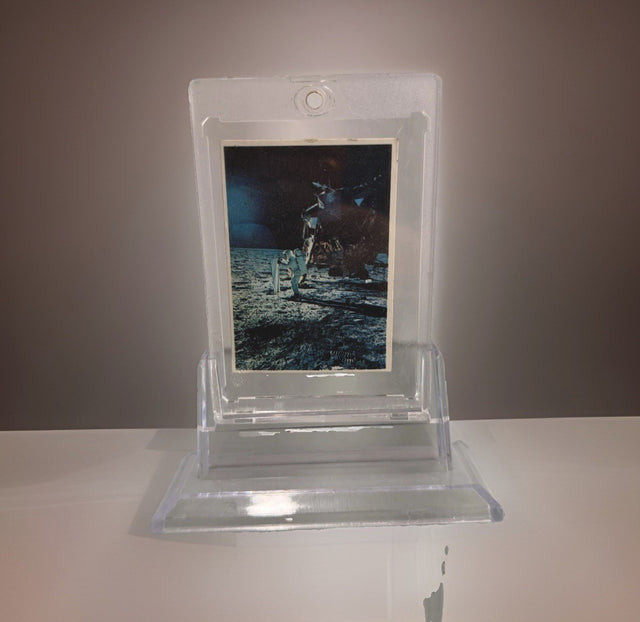
1969 Space Candy Buzz Aldrin Apollo 11 On The Moon Card #19 Taylor-Reed Display
$59.00 USD
-

1980 Polo Player Green Pink Chalk Pastel Bears Andy Warhol Signature AS-IS
$399.00 USD
-

After Andy Warhol Moon Landing Line Drawing 5/50 w/ Astronaut Autographs As-Is
$175.00 USD
-

After John Lennon "I Do" Framed Print, Marked A/P Unverified
$99.00 USD


Browse the collection for current listings.