Updated 2026-07-11
A neutral comparison of whole-object gallery retail, controlled-signing sports retail, and Collectable's fractional-securities model, including its July 2026 operating status.
By Gauntlet Gallery Research
Updated July 11, 2026
Gauntlet Gallery, Icons.com, and Collectable represent three different ways to engage with collectibles. Gauntlet is a multi-category retail gallery selling whole physical objects. Icons.com is a signed-sports retailer built around controlled private signing sessions and official licenses. Collectable Sports Assets used a regulated fractional-investment structure in which investors bought interests in series that owned high-value sports assets—not the object itself. As of July 2026, Collectable is not a practical new-acquisition comparison: its website shows a suspended-account page, and its 2025 SEC report says no new offerings occurred in 2024 or 2025 and secondary trading remained halted.
The right fit depends first on the product: physical ownership, direct-signing provenance, or fractional financial exposure. Authentication language, pricing, liquidity, returns, custody, and risk follow from that choice.
The current status at a glance
| Question | Gauntlet Gallery | Icons.com | Collectable Sports Assets |
|---|---|---|---|
| Core model | Retail sale of whole physical collectibles | Retail sale of whole signed sports memorabilia | Fractional securities tied to series-owned sports assets |
| Categories | Art, signed music and sports, designer objects, space memorabilia | Primarily signed football, plus selected other sports | Historically high-value sports cards and memorabilia |
| How inventory enters | Secondary-market sourcing and curation; documentation varies by item | Company says products come from its controlled private signings or trusted partners and it does not buy public submissions | Consignment, upfront purchase, or purchase agreement by the series manager |
| Authentication proposition | Item-specific third-party, artist, publisher, manufacturer, or provenance documents where available | Icons-branded COA; controlled signing records; selected products use TripleLock technology; licensed products may carry added license marks | Asset-level authentication and diligence described in offering records; investor owns an interest, not direct possession |
| Physical possession | Buyer receives object | Buyer receives object | Platform or custodian holds underlying asset for the series |
| Liquidity | Buyer later resells the whole object | Buyer later resells the whole object | Historically platform trading or asset liquidation; trading halted in 2024 and remained halted in 2025 per SEC filing |
| Returns | Gauntlet says most eligible standard inventory has a 15-day contact window, with exclusions and conditions | Icons says notify within 14 days and return within 30 days; customer generally pays return postage; Mystery Memorabilia excluded | Securities and asset-liquidation rules, not ordinary retail returns |
| July 2026 availability | Active retail site | Active retail site | Site suspended; no new 2024–2025 offerings per latest SEC report reviewed |
This table summarizes public policies, not an independent operational audit. Product-level terms control.
Gauntlet Gallery: whole-object retail across categories
Gauntlet Gallery sells physical objects. Its public catalogue spans street and pop art, prints, signed music memorabilia, sports items, space collectibles, and designer figures. The buyer selects a listed item, pays the retail price or submits an offer where available, and receives that object with the documentation and accessories described in the listing.
Gauntlet’s public market-data policy says it prices with completed marketplace sales, specialty auction results, gallery listings, and its own history, while distinguishing sold prices from active asks. It also says the gallery does not claim authentication authority it does not have and describes the documentation attached to an item.
That model is flexible. A Gauntlet object might have:
- PSA/DNA, JSA, or Beckett autograph documentation;
- an artist- or publisher-issued certificate;
- manufacturer packaging and release records;
- auction provenance;
- a seller invoice and condition report;
- incomplete or category-specific evidence disclosed in the listing.
The benefit is breadth and one-object ownership. The tradeoff is that evidence is heterogeneous. Buyers must read who issued each document and what it covers; “sold by Gauntlet” is not itself the same thing as direct witnessing by a signer.
Gauntlet’s returns policy states that most eligible standard inventory can be returned when the buyer contacts the gallery within 15 calendar days of confirmed delivery, provided the item returns unaltered with all documentation and packaging. It lists custom, private-sale, authentication-service, and other exclusions and says some lower-value returns may incur a label fee. Read the exact listing before relying on the general window.
Icons.com: controlled signing and licensed sports retail
Icons.com is the most specialized of the active retail models. Its company history says it was founded in 1999, organizes private signing sessions, documents sessions with photographs and video, and issues an Icons certificate with every product. It states that it does not buy signed memorabilia from members of the public.
That sourcing model changes the authentication question. Instead of asking a third party to give an after-the-fact opinion about an autograph acquired elsewhere, Icons says its representative controls or attends the signing and links the resulting item to its own records.
Its documentation levels still vary. Icons’ TripleLock page says the newer system combines an NFC tag, an individual signing photograph, and a tamper-proof hologram. The same page states that only certain products currently use TripleLock; older or other Icons products rely on the company’s established certificate and signing process.
Icons also distinguishes official licensing from autograph authentication. Its public pages describe FIFA, UEFA, club, and player relationships. A licensed competition product can carry tournament or club documentation in addition to the Icons certificate. Licensing supports the merchandise and relationship; it is not identical to proving the signer applied the autograph. Icons says its controlled-session records address that separate issue.
For returns, Icons’ U.S. returns page says customers should notify the company within 14 days and return eligible, unused, resalable items within 30 days of delivery. Return postage is generally the customer’s responsibility, and Mystery Memorabilia is excluded. Its U.S. delivery page says U.S. orders ship from the Chicago area via FedEx and require a signature.
Icons is a strong fit when the collector wants a current or legendary athlete, especially football, and values direct-signing provenance, official-license context, uniform framing, and a single-company evidence chain. It is a weak fit when the desired object falls outside its signing roster or categories.
Collectable: fractional exposure rather than object ownership
Collectable Sports Assets used a fundamentally different legal and economic model. Its SEC filings describe a Delaware series limited liability company that created separate series for underlying sports assets and offered investors interests under Regulation A. Investors did not each receive a piece of a card or jersey; they owned securities tied to a series that held the asset.
The company’s 2024 Form 1-K described the mission as making high-value sports memorabilia accessible through fractional ownership. Its 2025 Form 1-K provides the most important current update: secondary trading was halted in 2024 due to cost considerations; no new offerings were issued in 2024; no new offerings were issued in 2025; and trading remained halted in 2025.
As of July 11, 2026, collectable.com redirects to a hosting “Account Temporary On Hold” page. A suspended website does not by itself determine the legal status of outstanding series or investor rights. The SEC filing is the better source for operations and financial reporting.
Historically, Collectable’s model offered:
- lower-dollar access to a share of a high-value asset;
- asset-level offering documents;
- centralized custody and insurance structure;
- potential liquidity through secondary trading or sale of the underlying asset;
- exposure without home storage or conservation.
It also created risks that do not exist in an ordinary retail purchase:
- the investor did not control or display the physical asset;
- liquidity depended on platform trading or manager-led asset sale;
- series expenses and sourcing arrangements affected economics;
- an asset could be impaired;
- investors depended on the manager, custody, reporting, and platform continuity;
- collectible values and security prices could diverge.
The 2025 filing says the manager may consider offers, solicit sales, or place assets at auction and that liquidity has sometimes occurred through outright purchases that retired an offering. Those are managed exit paths, not a guarantee that an investor can sell on demand.
For a person researching Collectable today, the appropriate action is not to use an old “how it works” article as if the marketplace were open. Review the specific series’ latest SEC filings, communications, asset status, and any distribution or liquidation notice. This article is not securities advice.
Authentication: three evidence architectures
The three models should not be ranked with one generic “authenticated” score.
Gauntlet: document aggregation
Gauntlet curates secondary objects and presents item-specific evidence from different issuers. Strength depends on the named authenticator, certificate–object match, provenance, condition, and seller recourse. The gallery’s role is selection, description, market context, and fulfillment; it is not automatically the original witness.
Icons: controlled origin
Icons says its own signing process is the origin of the autograph record. That can create a short chain: signer → controlled session → Icons database and certificate → buyer. Selected TripleLock items add item-level signing photographs and digital verification. A buyer should still match hologram, serial, certificate, item, and product description.
Collectable: asset diligence for a security
Collectable’s offering structure required the manager to identify and hold an underlying asset for a series. The investor’s primary records were the offering circular and SEC reports, not a retail COA alone. Asset authenticity remained important, but the investor also needed to evaluate custody, title, valuation, manager conflicts, expenses, and exit mechanics.
The architectures serve different problems. Direct signing evidence is not a substitute for security disclosure; SEC filing is not a substitute for a physical autograph examination; a gallery condition report is not a witnessed-signing record.
Pricing and total cost
Gauntlet and Icons set retail prices. The buyer can compare the exact object with completed sales and decide whether presentation, documents, returns, and service justify the premium.
Icons’ price may include:
- athlete signing fee;
- officially licensed merchandise;
- private-session administration;
- certificate and security features;
- framing;
- retail margin and fulfillment.
Gauntlet’s price may include:
- secondary-market sourcing;
- object and market research;
- third-party documentation already attached;
- condition review and photography;
- framing or presentation;
- retail margin, returns, and fulfillment.
Collectable’s economics were different. The offering circular for each series identified asset acquisition cost, sourcing fee or retained interest, offering expenses, and series-specific terms. Investors bought at an offering price and later depended on trading or asset liquidation. A physical item’s auction value was not the only number that affected investor return.
Do not compare “$250 for a Gauntlet object” with “$10 per Collectable share” as prices for the same product. One purchases a whole object; the other historically purchased a fractional security.
Liquidity, control, and collector experience
Physical ownership provides control and responsibility. A Gauntlet or Icons buyer can display, insure, store, loan, gift, or resell the object, subject to law and transaction terms. The owner also bears risks of fading, damage, theft, documentation loss, and resale friction.
Fractional ownership centralized the object but reduced individual control. Investors avoided home storage yet depended on the manager and platform. The 2024–2025 trading halt is a concrete example of platform liquidity risk: the underlying asset can continue to exist while the expected resale mechanism is unavailable.
Collector experience also differs:
- Gauntlet emphasizes cross-category discovery and object research.
- Icons emphasizes athlete connection, licensed presentation, and signing-event provenance.
- Collectable historically emphasized portfolio access and financial participation rather than taking the object home.
None is universally superior. They solve different jobs.
Which model fits you?
Choose Gauntlet when:
- you want to own and display the exact object;
- your interests cross art, music, space, sports, and designer collectibles;
- you are comfortable evaluating item-specific third-party documentation;
- market context and a return process matter;
- the item is unavailable through a direct-signing source.
Choose Icons when:
- you want signed football or its supported sports categories;
- controlled private-session provenance is central;
- official licensing or standardized presentation matters;
- you want a short single-company authentication chain;
- the desired athlete is in Icons’ active or historical roster.
Do not treat Collectable as an open new-investor alternative as of July 2026. If you already own a Collectable series interest:
- read the latest series and company SEC filings;
- confirm the underlying asset’s reported status;
- review manager communications and any sale proposal;
- understand that trading remained halted through 2025 according to the latest report reviewed;
- obtain securities, tax, or legal advice for your own situation.
A neutral pre-purchase checklist
For a physical object:
- Who obtained or authenticated the signature?
- Was it witnessed, post-signing authenticated, or seller-certified?
- Does the certificate identify this exact item?
- Is licensing separate from autograph evidence?
- Are condition, dimensions, frame, and accessories photographed?
- What is the total delivered price?
- What is the return window and exclusion list?
- Which completed sales match the exact format?
For a fractional interest:
- What legal entity issues the interest?
- Who owns and holds the underlying asset?
- What are acquisition cost, fees, conflicts, and expenses?
- Can trading occur now?
- Who decides whether to sell the asset?
- How are proceeds distributed?
- What happens if the platform, broker, manager, or custodian changes?
- What do the latest SEC filings—not old marketing pages—say?
Bottom line
For a collector who wants an object on the wall, the practical comparison is Gauntlet versus Icons: broad secondary-market curation versus specialized direct-signing sports provenance. Icons has the cleaner origin story when it controlled the signing and the desired athlete is available. Gauntlet offers broader categories and can surface older, cross-category, or third-party-authenticated objects outside Icons’ model.
Collectable belongs in a different column. It was a fractional-securities platform, and its latest SEC report says new offerings and trading were inactive through 2025. It should be evaluated through filings and investor communications, not as a live retailer.
The best choice is the one whose evidence architecture matches the product you actually want—and whose costs, control, liquidity, and remedies you understand before paying.
Editorial methodology and limitations
This comparison reviews public Gauntlet and Icons policies and Collectable’s SEC filings and website status as of July 11, 2026. Company statements are attributed to the company and were not independently audited. Policies, products, licenses, and operating status can change. This article is collector education, not authentication, appraisal, legal, tax, or investment advice.
Editorial image disclosure: Illustrations on this page were generated with Nano Banana for explanatory use. They are not authentication evidence, provenance records, or reproductions of any specific collectible.
Available at Gauntlet Gallery
Explore current pieces available from the gallery.
-

1963 Farquhar Earth in Space Transparent Celestial Globe 16" Compass VTG
$699.00 USD
-

1967 Beatles Richard Avedon STERN Original Posters Set of 4 Linen Backed Copy
$999.00 USD
-
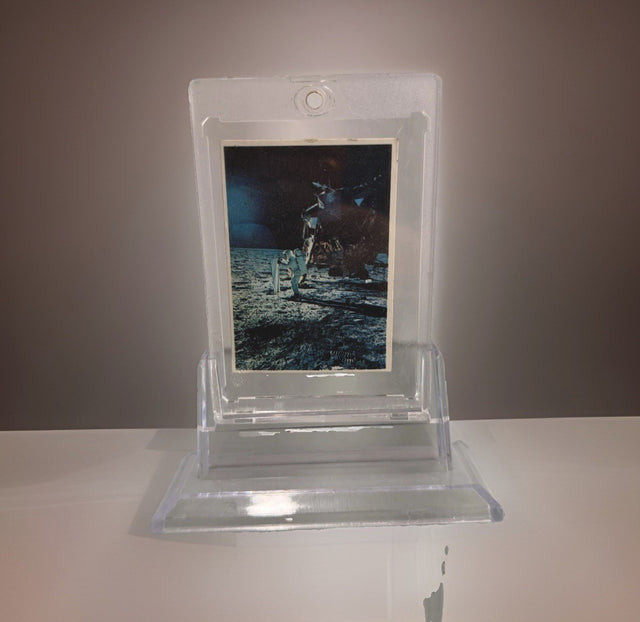
1969 Space Candy Buzz Aldrin Apollo 11 On The Moon Card #19 Taylor-Reed Display
$59.00 USD
-

1980 Polo Player Green Pink Chalk Pastel Bears Andy Warhol Signature AS-IS
$399.00 USD
-

After Andy Warhol Moon Landing Line Drawing 5/50 w/ Astronaut Autographs As-Is
$175.00 USD
-

After John Lennon "I Do" Framed Print, Marked A/P Unverified
$99.00 USD


Browse the collection for current listings.