To authenticate a DEATH NYC print, verify the two elements the artist's studio attaches to every legitimate release: a Certificate of Authenticity signed by the artist and the metal official gold seal affixed to each piece. Confirm that the print itself is hand-signed and numbered, that the edition information on the certificate matches the markings on the sheet, and that the seller can document where the print came from. A DEATH NYC print that arrives with its signed COA, its gold seal, consistent edition markings, and a documented chain of ownership checks every box a careful collector should require. Everything below unpacks how to run that verification yourself, step by step. Compare the exact image, edition, medium and presentation with dated completed sales, distinguishing hand-sprayed originals from editioned prints. Future resale value is uncertain.
Why DEATH NYC Authentication Is More Straightforward Than You Might Expect
Collectors who come to street art and pop-mashup prints from other corners of the market are often braced for a complicated authentication landscape. The good news is that DEATH NYC is one of the more collector-friendly artists to verify, precisely because the studio built verification into the release model from the start. Each legitimate piece leaves the studio with a Certificate of Authenticity signed by the artist, and each piece carries the metal official gold seal — a physical, tactile marker that is affixed directly to the work.
That two-part system means the authentication question rarely comes down to connoisseurship alone. You are not squinting at brushwork trying to divine an attribution the way a scholar might with a nineteenth-century canvas. Instead, you are performing a structured document-and-object check: does the certificate exist, is it signed, does the seal appear where it should, and does the paperwork agree with the print? When all of those answers line up — and when the seller can show you where the piece has been since it left the studio — you can buy with genuine confidence.
This article walks through the full process our gallery uses when a DEATH NYC piece enters our inventory: understanding the artist's release model, verifying the COA and gold seal, examining the print itself, reconciling edition documentation, and building the provenance file that protects your purchase for the long term. If you want the condensed version to keep on hand while shopping, our DEATH NYC buyer's guide pairs well with this deep dive.
Who Is DEATH NYC, and Why Does the Release Model Matter?
DEATH NYC is a New York–based artist who has become one of the most prolific and widely collected names in contemporary pop-mashup printmaking. The work is instantly recognizable: beloved pop-culture imagery collides with luxury-fashion motifs, art-historical references, and streetwear iconography, all delivered in saturated color on limited-edition sheets. The artist maintains a deliberately low personal profile, letting the prints — and the steady cadence of new releases — do the talking.
Understanding the release model matters for authentication because it explains what "normal" looks like for this artist. DEATH NYC works in frequent, small limited editions rather than occasional large ones. Prints are hand-signed and numbered, and the edition details are documented on the accompanying certificate. Because releases are frequent, the total body of work is large — which is precisely why documentation, rather than rarity alone, carries the authentication weight. A collector cannot memorize every release; a collector can absolutely learn to read the documentation system that accompanies every release.
The popularity of the work has an obvious corollary: popular artists attract imitators, and unauthorized reproductions of in-demand prints circulate in every corner of the online market. This is not a reason for fear — it is a reason for method. The verification framework below exists so that you never have to rely on a listing photo and a hopeful guess. For a broader look at how our gallery approaches this category, the DEATH NYC authentication guide covers the same ground in reference format.
The Two Pillars: The Artist-Signed COA and the Metal Gold Seal
Pillar one: the Certificate of Authenticity signed by the artist
Every legitimate DEATH NYC piece is accompanied by a Certificate of Authenticity signed by the artist. This is the documentary backbone of the entire system. When you evaluate a DEATH NYC print, the COA is the first thing to ask about — not the last. A seller who leads with the certificate, photographs it clearly, and offers to show it alongside the print is behaving the way legitimate sellers behave.
When you examine the certificate, you are checking for internal consistency above all else:
- The signature. The COA should carry the artist's signature. Compare it against the signature on the print itself and against documented examples from verified sales. You are looking for the natural consistency of a real hand — not a photocopied or printed facsimile.
- The edition details. The certificate documents the work: title or description, edition information, and the specifics of the piece it accompanies. Those details must agree with what you see on the sheet. A certificate that describes one work paired with a print showing different markings is a mismatch worth resolving before any money changes hands.
- The pairing. A COA is only meaningful when it travels with the piece it was issued for. Ask the seller to photograph certificate and print together, and confirm the numbering on each agrees.
One point worth stating plainly: a certificate on its own authenticates nothing. Certificates can be separated from works, and paperwork can be reproduced more easily than the physical characteristics of a print. The COA is one pillar of a two-pillar system, and it derives its strength from agreeing with everything else — the seal, the print, and the provenance.
Pillar two: the metal official gold seal
The second pillar is physical: the metal official gold seal affixed to each piece. This is a tangible, dimensional object attached to the work — not a printed graphic, not a sticker-weight decoration, but a metal seal you can see catching light in photographs and feel if you handle the piece in person.
The seal matters because it is the element hardest for casual reproduction to imitate convincingly. A scanned-and-reprinted copy of a DEATH NYC print can mimic the image; it cannot mimic a dimensional metal seal without a level of effort that most unauthorized sellers simply never invest. When you review a listing, look for the seal in the photographs. When you inspect a piece in person, confirm it is genuinely metal and genuinely affixed. When a seller's photos crop the piece in ways that never quite show the seal, ask for a dedicated photo of it. Legitimate sellers provide that photo without hesitation.
Together, the signed COA and the gold seal form a mutually reinforcing pair. The certificate documents; the seal marks. Verifying both — and verifying that they agree with each other and with the print — is the core of DEATH NYC authentication.
Step-by-Step: How to Authenticate a DEATH NYC Print
Here is the sequence our gallery follows, adapted for a collector evaluating a piece from any source. Work through it in order; each step narrows the range of doubt.
- Establish the source. Before examining anything, ask where the print came from. A direct purchase from the artist's release, a reputable gallery, or a documented prior collection each provides a starting point you can verify. "I don't remember" is not disqualifying on its own, but it raises the importance of every subsequent step.
- Request the COA. Confirm the piece comes with its Certificate of Authenticity signed by the artist. Ask for clear, well-lit photographs of the full certificate, front and back if applicable. If the certificate is absent, treat the piece as undocumented and weigh it accordingly — some legitimate prints do become separated from their paperwork over the years, but the burden of proof rises sharply.
- Locate the gold seal. Confirm the metal official gold seal is present and affixed to the piece. Request a close-up photograph. In person, verify it is dimensional metal rather than a flat printed imitation.
- Check the signature and numbering on the print. The print should be hand-signed and numbered. Examine the markings under good light — hand-applied pencil sits on the paper surface differently than printed ink, and under magnification a printed "signature" reveals the dot structure of reproduction rather than the continuous line of a pencil or pen.
- Reconcile print and certificate. The edition information documented on the COA must match the markings on the sheet. Title or image description, numbering, and any edition notations should agree across both. This reconciliation step catches the most common problem in the secondary market: right certificate, wrong print — or the reverse.
- Compare against verified examples. Search verified sales of the same release and compare image, proportions, margins, and markings. Collectors can approximate this by reviewing archived sales from established auction platforms and galleries.
- Assess the paper and print quality. Legitimate limited-edition prints are produced to a consistent standard. Flimsy stock, washed-out or over-saturated color that departs from verified examples, visible pixelation, or margins that differ from documented copies of the same release all warrant a pause. You are not required to be a print connoisseur — you are simply comparing the piece in front of you against the standard set by verified examples of the same edition.
- Document the provenance. Collect whatever chain-of-ownership evidence exists: original purchase receipts, prior sale records, gallery invoices, correspondence. A short, verifiable chain beats a long, vague story every time.
- Weigh the price honestly. We deliberately avoid quoting figures here because markets move, but the principle is durable: compare the asking price against recent verified sales of the same or similar releases. A price dramatically below the verified range is information, not luck. Our DEATH NYC price guide and Financial Insights hub exist to make that comparison easy.
- When in doubt, escalate. If any step produces a result you cannot reconcile, ask the seller directly, request additional photography, or consult a specialist dealer before purchasing. A legitimate seller welcomes scrutiny; evasiveness is itself a data point.
Run through this list once and it takes an evening. Run through it a few times and it becomes reflex — the quiet, methodical habit that separates collectors who buy with confidence from collectors who buy with hope.
Reading the Print Itself: What the Object Tells You
Documents verify; objects testify. Even with the COA and seal confirmed, spend real time with the print itself, because the physical object carries its own evidence.
The signature and edition markings
DEATH NYC prints are hand-signed and numbered. Hand-applied markings have qualities reproduction struggles to fake: graphite from a pencil has a subtle sheen and sits in the tooth of the paper; a printed imitation of a signature is flat, uniform, and — under a loupe — composed of printed dots. Tilt the sheet under raking light and a genuine pencil marking behaves differently than the surrounding printed image. You do not need to be a forensic examiner; you need ten patient minutes and a magnifier.
Compare the signature against examples from verified sales of the artist's work. Signatures vary naturally from piece to piece — a real hand is never a photocopy of itself — but the overall character should be consistent with documented examples. If terms like "edition," "numbering," or "raking light" are new to you, our authentication glossary defines the working vocabulary collectors use.
Paper, color, and production quality
Limited-edition prints from an established studio are produced to a repeatable standard. That consistency is your benchmark. When you compare a candidate print against verified examples of the same release, you are checking:
- Sheet size and margins — do the proportions match documented copies?
- Color fidelity — does the palette match verified examples, or does it look like a re-scan that drifted?
- Print resolution — is the image crisp at close range, or does it show the artifacts of a copy-of-a-copy?
- Paper weight and finish — does the stock feel and photograph like the stock on verified examples?
None of these checks requires specialized equipment beyond good light and, ideally, a loupe. What they require is a reference point — which is why comparison against verified sales is woven through every step of this process, and why our gallery treats its comparable-sales database as an authentication tool, not just a pricing tool.
Condition versus authenticity
Keep the two questions separate. A genuine print can be in poor condition; a pristine sheet can be an unauthorized reproduction. Handling creases, light-strike fading, or corner wear speak to condition and value, not to authenticity. Evaluate authenticity first through the framework above, then evaluate condition as its own exercise. Conflating the two leads collectors to dismiss genuine pieces with honest wear and — more dangerously — to trust crisp, perfect-looking sheets that are perfect precisely because they were printed last month.
Authenticated Versus Undocumented: A Side-by-Side Comparison
When you evaluate a DEATH NYC listing, you are really sorting it into one of two categories. This table summarizes what each looks like in practice:
| Checkpoint | Well-documented piece | Undocumented piece |
|---|---|---|
| Certificate of Authenticity | Present, signed by the artist, photographed alongside the print | Missing, "lost in a move," or shown only in a blurry crop |
| Metal gold seal | Visible in photos, dimensional, affixed to the piece | Absent, never photographed, or clearly a flat printed graphic |
| Signature and numbering | Hand-applied, consistent with documented examples | Printed facsimile, or markings inconsistent with the certificate |
| COA-to-print reconciliation | Certificate details match the sheet exactly | Details disagree, or seller resists showing both together |
| Provenance | Receipts, invoices, or a verifiable prior-sale record | No history offered; vague or shifting story |
| Price versus verified sales | Within the range of recent comparable sales | Dramatically below the verified range with no explanation |
| Seller behavior | Welcomes questions, supplies extra photos promptly | Deflects, delays, or pressures for a fast close |
No single row of this table decides the question by itself. A genuine print can have imperfect paperwork; an undocumented listing can turn out fine once the seller digs the certificate out of a drawer. The table is a weighing instrument: the more checkpoints land in the left column, the stronger your position. When most land in the right column, walk away — there will always be another print. Our companion piece on how to spot a fake DEATH NYC goes deeper on the warning-sign side of this ledger.
Provenance: The Third Element Most Collectors Undervalue
The COA and the gold seal answer "is this piece what it claims to be?" Provenance answers a subtler question: "how did this piece get here?" A clean answer to the second question dramatically strengthens the first.
Provenance for a contemporary print rarely looks like a museum dossier. In practice it is modest and concrete: the original purchase confirmation, a gallery invoice, an auction record, an email thread with a prior owner, a dated photograph of the piece hanging in its previous home. Each artifact is small; together they form a chain that an unauthorized reproduction almost never has, because reproductions materialize without histories.
When you buy, collect every scrap of that chain from the seller and preserve it. When you sell — years from now — that same file becomes your asset, shortening the next buyer's diligence and supporting your asking position. This is one of the quiet advantages of buying from an authenticated-source dealer in the first place: the provenance file arrives already built. Every piece in our DEATH NYC collection comes with its documentation assembled, verified, and ready to hand over, because we would rather do that work once, properly, than ask each buyer to reconstruct it.
Building your own provenance file
- Save the listing, the seller's photographs, and all correspondence from the purchase.
- Keep the COA physically safe — with the piece or in a dedicated document file, never loose in a frame shop's discard pile.
- Photograph the print, the signature, the numbering, the seal, and the certificate together on arrival, with a date stamp.
- Record the purchase details in a simple inventory: source, date, and reference to the supporting documents.
- Add every future artifact — appraisal notes, framing receipts, exhibition loans — to the same file.
Ten minutes of filing on arrival day compounds into real value over a collecting lifetime. It is the least glamorous habit in collecting and one of the most profitable.
How Our Gallery Approaches DEATH NYC Authentication
Gauntlet Gallery handles DEATH NYC works as an authenticated-source dealer, which shapes the process before a piece ever reaches a listing. Pieces that cannot clear that process do not enter our inventory.
We built the process this way because authentication is easiest and cheapest at the point of sourcing, and gets harder every step downstream. A collector who buys a verified piece inherits all of that work: the documentation, the reconciliation, the comps check, and a provenance file that starts clean. That is also why we publish our research rather than hoarding it — the buyer's guides library and the broader Collector's Hub exist so that the framework we use internally is the same framework any collector can apply to any listing, anywhere. An informed market is good for collectors, good for the artist, and — we would argue — good for honest dealers, who have nothing to fear from educated buyers.
Your Pre-Purchase Checklist
Print this, screenshot it, or commit it to memory. Before you commit to any DEATH NYC purchase, confirm:
- The Certificate of Authenticity signed by the artist is present and photographed with the print.
- The metal official gold seal is affixed to the piece and shown clearly.
- The print is hand-signed and numbered, with markings that read as hand-applied under close inspection.
- The certificate's edition details match the print exactly.
- The image, margins, and production quality match verified examples of the same release.
- The seller has answered your questions directly and supplied every photo you requested.
- Some provenance exists — a receipt, an invoice, a prior sale record — and it transfers with the piece.
- The price sits within the range of recent verified comparable sales, or the seller can explain why it does not.
- The condition has been assessed separately from authenticity, with any flaws disclosed.
- You feel no pressure to decide before the diligence is done. Urgency is the forger's favorite tool and the honest seller's least necessary one.
If all ten hold, you are standing on solid ground. If two or three wobble, slow down and resolve them. The frequent-release nature of this artist's practice means missing one listing costs you very little — another opportunity is never far away.
After the Purchase: Care, Records, and Long-Term Confidence
Authentication does not end at checkout; it converts into stewardship. Three habits protect both the piece and its documented status:
Preserve the physical evidence. The COA and the seal are permanent parts of the work's identity. Store the certificate archivally — acid-free sleeve, flat, away from light and humidity. If you frame the print, tell your framer the seal is to be preserved exactly as affixed, and use archival, reversible methods throughout: acid-free mounts, UV-filtering glazing, no adhesives touching the sheet.
Maintain the record. Keep your provenance file current, and photograph the piece periodically. If you ever lend, move, or reframe the work, note it. Future-you, or a future buyer, will read that file as evidence of a careful owner — and careful ownership is itself a soft trust signal in the secondary market.
Stay connected to the market. Verified sales data is not just for buying day. Reviewing comparable sales once or twice a year through resources like our Financial Insights hub keeps your expectations calibrated and your records honest. And if questions come up later — about terminology, documentation, or process — the authentication FAQ is the fastest route to an answer.
Collect this way and each purchase strengthens the next. The habits are simple, the tools are public, and the artist's own documentation system — the signed COA and the gold seal — does most of the heavy lifting. Your job is simply to check that the system is intact, every time, without exception.
Frequently Asked Questions
What documentation should come with a genuine DEATH NYC print?
A legitimate DEATH NYC piece comes with a Certificate of Authenticity signed by the artist, and the piece itself carries the metal official gold seal. The print should also be hand-signed and numbered, with edition details that match the certificate. Any purchase receipts or prior sale records strengthen the picture further.
Is the COA alone enough to prove a DEATH NYC print is genuine?
No. A certificate is one pillar of a two-pillar system. It must be paired with the metal gold seal on the piece, and its details must reconcile with the print's own signature and numbering. Certificates separated from their works, or paired with the wrong work, are a known secondary-market problem — which is why reconciliation matters as much as possession.
What does the gold seal look like, and why does it matter?
The official seal is a metal element affixed directly to each piece — dimensional and tactile, not a flat printed graphic. It matters because it is the component casual reproduction is least able to imitate. Always ask for a dedicated photograph of the seal when evaluating a listing remotely, and verify it physically when inspecting in person.
How do I check the signature on a DEATH NYC print?
Examine it under good light and magnification. Hand-applied markings sit in the paper's surface and show the natural variation of a real hand; printed facsimiles are flat and reveal dot patterns under a loupe. Compare the signature's character against documented examples from verified sales rather than relying on a single reference image.
What should I do if a print has no certificate?
Treat it as undocumented and raise your evidence bar accordingly. Verify the gold seal, scrutinize the signature and numbering, compare the print closely against verified examples of the same release, and press for any provenance the seller can produce. Some genuine prints do lose their paperwork — but the price and your diligence should both reflect the missing document.
Does a low price mean a DEATH NYC print is fake?
Not automatically, but price is evidence. Compare the asking price against recent verified sales of the same or similar releases. A figure dramatically below the verified range demands an explanation — motivated seller, condition issues, or something worse. Treat unexplained bargains as a prompt for more diligence, never as a reason to rush.
Where can I compare a print against verified sales?
Review archived results from established auction platforms and reputable galleries, and use dealer-published resources built on verified data.
Shop Death NYC
Explore current pieces available from the gallery.
-
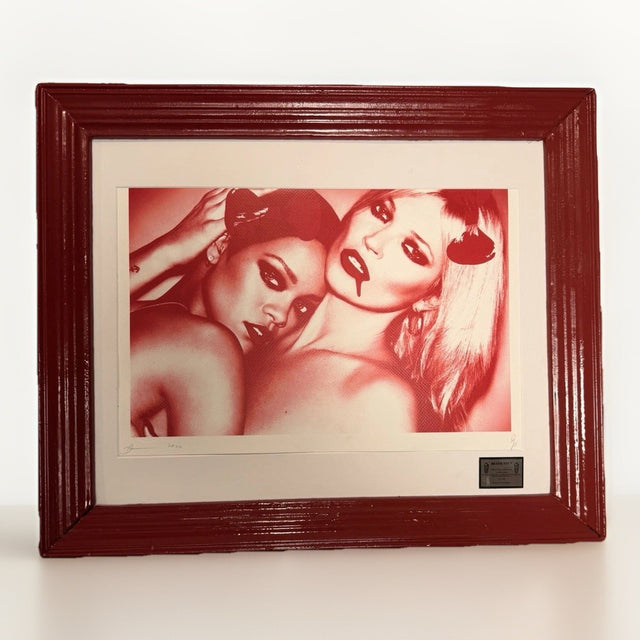
Death NYC — Kate Moss Rihanna Red Drip 2020 A/P Artist Proof Framed
$91.88 USD
-
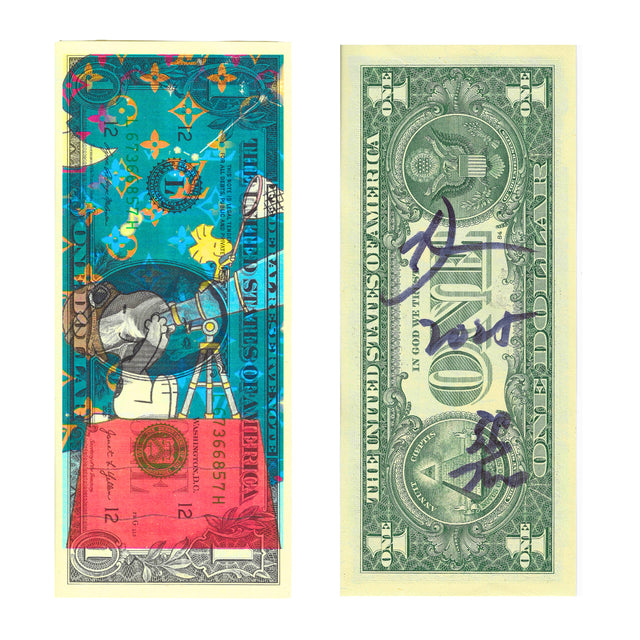
Death NYC Snoopy Woodstock Telescope LV Dollar Bill Art Signed Numbered COA
$55.00 USD
-
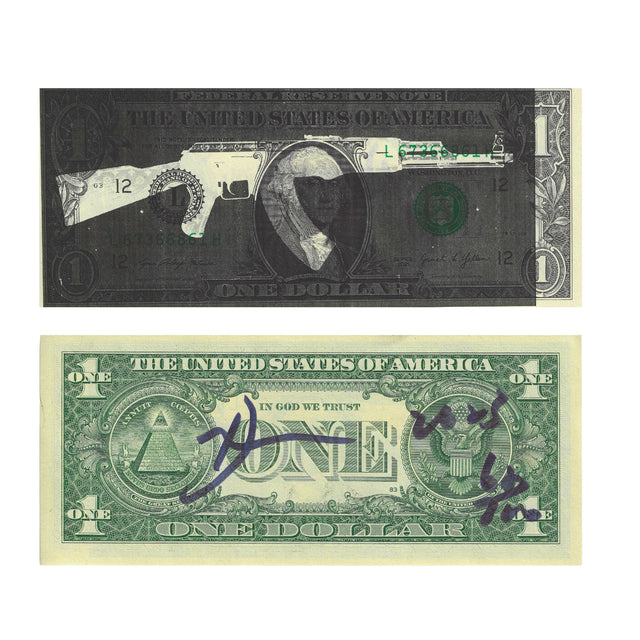
Death NYC Gun Dollar Bill Art Signed Numbered COA Black White Pop Street Art
$50.00 USD
-
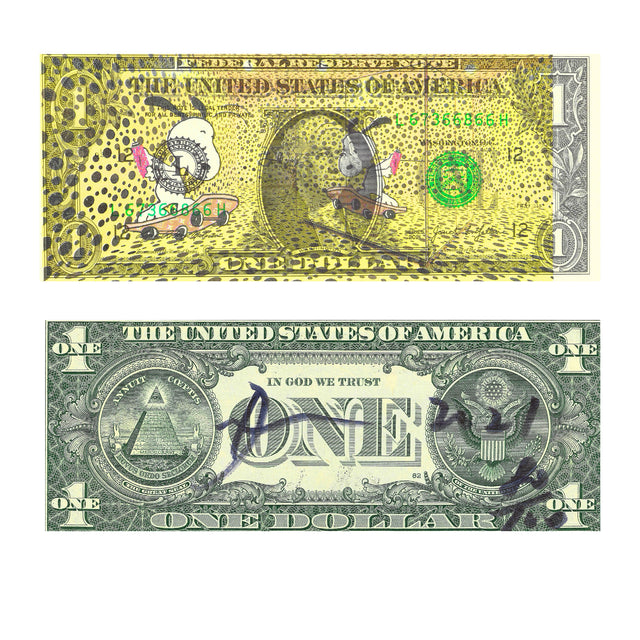
Death NYC Snoopy Skateboard Dollar Bill Art Signed Numbered COA Pop Street Art
$75.00 USD
-
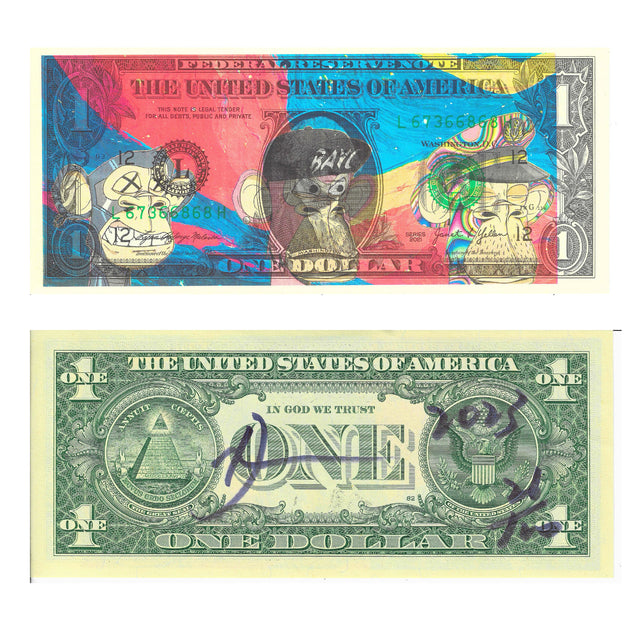
Death NYC Bored Ape Dollar Bill Art Signed Numbered COA Pop Street Art
$40.00 USD
-
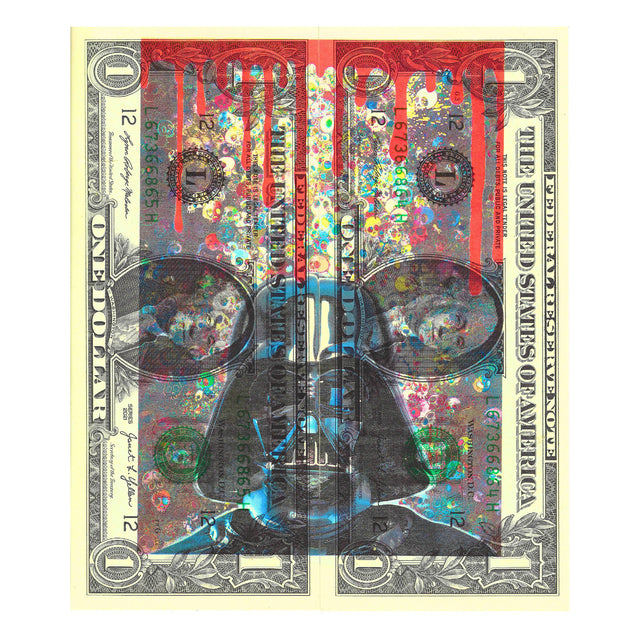
Death NYC Darth Vader Star Wars Dollar Bill Art Signed Two Bills COA Unframed
$100.00 USD
Browse the collection for current listings.