Death NYC vs Mr. Brainwash: The Mash-Up Game, Broken Down

Two artists. One genre. Completely different markets, different authentication realities, and different risk profiles for collectors.
If you've spent any time in the contemporary street art space, you've encountered both names. Death NYC and Mr. Brainwash (MBW) occupy the same cultural neighborhood — pop iconography colliding with street aesthetics, commercial imagery twisted into something that feels subversive. But the similarities start to blur fast once you get past the surface.
This isn't a taste argument. We're not here to tell you which artist is better. We're here to tell you what you're actually buying, what the authentication looks like, where the market is, and where the traps are.
Because in the mash-up art space, traps are everywhere.
Who Is Death NYC?
Death NYC is an anonymous artist — or possibly a collective, depending on who you ask and what year you're asking it. The brand has been consistent: take globally recognized imagery (Mickey Mouse, Marilyn Monroe, the Mona Lisa, Darth Vader), drop it into unexpected street contexts, layer in advertising aesthetics, and let the tension between corporate iconography and punk irreverence do the heavy lifting.
The work is digital at its core, printed as limited editions, frequently in runs of 100 worldwide. That scarcity is real. It's baked into the production model and confirmed through the artist's own COA system.
Death NYC operates primarily through direct-to-collector drops, gallery partnerships, and controlled secondary market channels. The anonymous posture isn't just aesthetic mystique — it's become part of how the work markets itself.
The Authentication Framework for Death NYC
This is non-negotiable: Death NYC authentication requires both a signed COA from the artist and the studio gold seal. Not one. Both.
A COA without the gold seal is incomplete. A gold seal without a COA is incomplete. If a seller is offering you one without the other, you're looking at a problem — either a counterfeit, an incomplete provenance chain, or a seller who doesn't understand what they have.
The signed COA will include edition number, title, print specifications, and the artist's authentication signature. The studio gold seal is applied directly to the piece or packaging and cross-references back to the COA data.
Because the editions are small (typically 100 worldwide) and the collector base has grown substantially, counterfeits exist. They're not sophisticated counterfeits — but they don't need to be. The barrier to purchasing from an uninformed source is low. An image of a Death NYC COA is easy to reproduce. The gold seal is harder to fake convincingly, which is exactly why both are required.
Would you buy a Rolex because the box looked right without checking the movement?
The answer to fakes is simple: buy from sources who can produce both documents, who can trace the print back to the original drop, and who understand the edition numbering system.
Who Is Mr. Brainwash?

Mr. Brainwash — born Thierry Guetta — is one of the most debated figures in the history of street art. And that debate began in the most public way possible: Banksy's 2010 documentary Exit Through the Gift Shop introduced him to a global audience and simultaneously raised the question of whether MBW was a genuine artistic force or an elaborate conceptual joke at the expense of the art market.
The market answered that question with money. Whatever critics thought, collectors bought. MBW prints sold. Murals attracted crowds. Celebrity collectors emerged. The commercial machinery ran.
MBW's work follows a similar mash-up template to Death NYC — pop icons, cultural collision, visual noise as aesthetic strategy. But the scale is different. MBW works in a broader range of formats: large-scale prints, paintings, sculptures, installation work, and original canvases that command substantially different price points than the editions.
The studio model is also different. MBW has a known, identifiable persona. He does interviews. He signs things in public. He appears at gallery openings. The authentication challenges are therefore different, not necessarily simpler.
The Authentication Reality for MBW
Here's where collectors need to pay close attention.
There is no single artist-issued authentication system for Mr. Brainwash that functions the way Death NYC's COA + gold seal framework does.
MBW has issued COAs through his studio — Life is Beautiful Studio — and those COAs carry weight when they can be verified against the original release record. But the variability in how MBW editions have been documented over the years creates real complexity for secondary market buyers.
For third-party authentication, the authentication community generally applies the same standards it uses across the broader celebrity and street art signing market: PSA/DNA, JSA, and Beckett (BAS) all cover MBW signatures on prints, paintings, and ephemera. Roger Epperson REAL within the Beckett ecosystem is more relevant for music-world crossovers, but for visual art the standard BAS autograph certification applies.
The JSA distinction matters here. JSA issues two tiers: a Basic stamp (lower confidence, witnessed or comparison-based) and a full LOA (Letter of Authenticity, their highest confidence level). For significant MBW purchases, you want the LOA, not just the stamp.
PSA has issued authentication warnings in the past about the general risks of purchasing celebrity and artist autographs from unverified sources. Their certification-verification system at PSA's website allows you to cross-check certificate numbers. Use it every time.
Why would anyone spend four figures on a print and spend zero minutes verifying the paper in the box?
The Market Comparison
Let's talk about where these artists actually trade in the secondary market, because the price behavior tells you a lot about the collector base and the risk profile.
Death NYC in the Secondary Market
Death NYC editions trade in a defined range that reflects the controlled scarcity model. Limited editions of 100 mean the supply ceiling is known. As the collector base has expanded internationally — particularly through European and Asian markets — secondary pricing on popular subjects has risen meaningfully above issue price.
The most liquid subjects are the ones that activate multiple collector communities simultaneously: a Death NYC print featuring a Disney character in a streetwear context appeals to pop art collectors, street art collectors, and character-based collectors all at once. That overlap creates real demand depth.
The challenge in the Death NYC market is that authentication problems suppress liquidity. A print that can't be properly documented — missing either the signed COA or the gold seal — often sells at a steep discount or doesn't sell at all among informed collectors. The gap between authenticated and unauthenticated examples in this market is wide.
Mr. Brainwash in the Secondary Market
MBW trades across a much wider price range because the work comes in many more formats. A small edition print and an original painted canvas are completely different propositions.
The original work market is where MBW performs at the highest level — canvases with documented studio provenance have reached significant auction results. But the print market is more volatile and more susceptible to the broader swings that affect the street art print space generally.
MBW's market got a substantial lift from the Exit Through the Gift Shop moment and from celebrity co-signs. But markets built on cultural momentum rather than institutional collecting patterns tend to oscillate. Informed buyers in the MBW space understand that provenance documentation and the condition of the studio COA are central to establishing value.
The comparison across both artists reveals something important: in the mash-up art space, authentication infrastructure directly tracks with market stability. The markets where authentication is clearer (Death NYC with its dual-requirement system) tend to have tighter bid-ask spreads for documented examples. The markets where authentication is more variable (MBW's layered provenance landscape) show wider spreads and more sensitivity to documentation quality.
The Mash-Up Genre Itself: Artistic Context Matters

Before you buy into any mash-up artist, you need to understand the legal and cultural context of the work. This isn't academic. It affects value.
Mash-up art as a genre operates in creative tension with IP law. Both Death NYC and MBW use trademarked and copyrighted imagery as raw material. The legal framework around appropriation art has evolved — court cases like Rogers v. Koons and more recently the Andy Warhol Foundation v. Goldsmith decision (2023) have sharpened the questions around transformative use.
Does the legal cloud over appropriation art affect the resale value of a Death NYC print ten years from now?
Possibly. It's a question sophisticated collectors are asking. The honest answer is that the market hasn't fully priced in the legal risk — but it's a real consideration, particularly for works that lean heavily on still-active commercial trademarks rather than works in the public domain.
This is a context where both artists operate similarly, which means it's a risk that applies to both portfolios equally.
Side-by-Side Comparison
| Factor | Death NYC | Mr. Brainwash |
|---|---|---|
| Artist Identity | Anonymous / collective | Known (Thierry Guetta) |
| Primary Format | Limited edition prints | Prints, paintings, sculpture, installation |
| Edition Size | Typically 100 worldwide | Variable by release |
| Authentication Standard | Artist-signed COA + studio gold seal (both required) | Life is Beautiful Studio COA + third-party (PSA/JSA/BAS LOA) |
| Third-Party Auth | Not typically required for print editions | Recommended for significant secondary purchases |
| Market Entry Point | Accessible | Wide range (entry to high end) |
| Market Volatility | Moderate, scarcity-anchored | Higher, momentum-sensitive |
| Cultural Moment | Ongoing digital-first audience | Peak Exit Through the Gift Shop era, sustained since |
| IP Risk Exposure | Present (active trademarks used) | Present (active trademarks used) |
What Sophisticated Collectors Actually Do

Here's what the real buyers in both markets are doing. Not what the marketing says. What the actual transaction behavior looks like.
-
They start with provenance, not aesthetics.
- Where did this print come from? First purchaser? Gallery? Which drop?
- Has it ever changed hands? How many times?
- Does the edition number on the print match the edition number on the COA?
-
They verify documentation independently.
- For Death NYC: both the signed COA and the gold seal must be present. Not photographed. Present.
- For MBW: PSA/JSA/BAS certificate numbers are checked directly on the authenticator's verification platform before the check clears.
-
They understand the format they're buying.
- An MBW print edition is a different market from an MBW original canvas. The documentation standards, price volatility, and resale mechanics are different for each.
- A Death NYC print with a popular subject trades differently than a less sought-after subject in the same edition size. Know the specific release.
-
They price in authentication costs on the buy side.
- If you're acquiring a significant MBW piece through an unofficial channel, budget for third-party authentication before you factor profit potential. Authentication is a cost of goods in this market.
-
They track the drop record.
- Both artists have release histories that are partially documentable. Death NYC's edition releases can often be cross-referenced through gallery and online drop records. MBW's studio releases through Life is Beautiful have varying degrees of public documentation. Know the release history of what you're buying.
Where Beginners Get Burned
This market has a low floor for entry and a wide ceiling for mistakes. Most of the burns follow predictable patterns.
The "It Looks Right" Problem
Both Death NYC and MBW have enough visible reference material online that a motivated forger can produce convincing-looking documentation. A COA that photographs well is not the same as a COA that verifies. The physical details — paper stock, seal application, signature character — matter in person in ways they don't on a screen.
FBI Operation Bullpen — one of the largest sports memorabilia fraud investigations in history — demonstrated definitively that convincing-looking authentication paperwork is the first tool of the sophisticated forger, not the last. The lesson from Bullpen extends to every collectibles category: paper is the easiest part to fake.
The Partial Documentation Discount
Sellers sometimes offer "discounted" pieces because "the paperwork isn't complete." What they're really offering is a piece whose authenticity can't be established. In the Death NYC market specifically, a piece missing either the COA or the gold seal isn't a discounted authentic piece — it's an unverifiable piece. Price it accordingly or don't buy it.
The Social Proof Trap
Celebrity ownership claims, Instagram reposts, being "featured in" various publications — none of this authenticates a piece. MBW in particular has a large social following and media footprint, which creates an environment where social proof gets confused with authentication. They're not the same thing.
The Condition Reality
Both artists' print editions are susceptible to condition issues. Fading, edge wear, improper storage, mounting damage. In a market driven by visual impact, condition problems hit resale value hard. Always ask for condition reports. Always examine under good light. Always ask about storage history.
Red Flags
Before you move on any Death NYC or MBW purchase, run through this list. If you encounter any of these, stop, investigate further, or walk.
- Death NYC piece offered without both the signed COA and the studio gold seal. No exceptions. Both are required. Every time.
- Edition number inconsistency. The number on the print should match the number on the COA exactly. Any discrepancy is a red flag.
- MBW third-party certificate number that doesn't verify on the authenticator's platform. PSA, JSA, and Beckett all allow public verification. If the number doesn't return a match, the paper is worthless.
- Seller can't name the original drop, release year, or distribution channel. Legitimate provenance can be traced. Vague provenance is often no provenance.
- Price significantly below known market comparables. Both markets have enough public sale data to establish ranges. Outlier pricing below range almost always signals a problem with the piece, not a bargain.
- Pressure to close quickly. Legitimate sellers of authentic pieces are not in a hurry. "Another buyer is interested" is a sales tactic. It may be true. It may also be a tool to prevent you from doing proper diligence.
- Digital-only documentation. Photos of COAs, scans of seals, screenshots of certificates. None of these are substitutes for physical verification of physical documents.
- JSA Basic stamp only on significant MBW purchase. For meaningful values, you want the JSA LOA, not just the stamp. The tiers exist for a reason.
- Condition issues described as "minor" without specifics. Ask for the condition report. Get it in writing. "Minor" is not a condition.
- No ability to inspect in person or through a trusted agent. Remote purchasing of significant pieces without any physical inspection is a meaningful risk amplifier in this market.
Bottom Line
Death NYC and Mr. Brainwash occupy adjacent cultural space but represent genuinely different collecting propositions.
Death NYC offers a tighter, more controlled edition structure with a clear, non-negotiable authentication standard: signed COA plus studio gold seal, both present, both verified. The anonymous nature of the artist adds mystique but also creates a market where documentation does even more work than usual. Buy documented examples from traceable sources, and the edition scarcity argument holds.
Mr. Brainwash is a bigger, more complex market. More format diversity means more entry points but also more variability in what authentication looks like across different types of work. The studio COA framework from Life is Beautiful needs to be supported by third-party verification — PSA/DNA, JSA LOA, or BAS — for meaningful secondary market purchases. The original work market is genuine and has performed. The print market is more volatile. Know which segment you're entering.
In both cases, the core principle is the same one that applies everywhere in the secondary art and collectibles market: authentication is not an afterthought. It is the work.
The piece on the wall is only as good as the paper in the file. Make sure the paper is right before anything else matters.
Frequently Asked Questions
Do I need both the COA and the gold seal for a Death NYC print, or is one enough?
Both. Always both. The Death NYC authentication standard requires the artist-signed COA and the studio gold seal together. One without the other doesn't establish authenticity. This isn't a technicality — it's the system as designed. A COA alone can be reproduced. A gold seal alone doesn't carry the edition and provenance data the COA contains. Together they form the complete authentication record. Missing one means you have an incomplete, unverifiable piece regardless of how it looks.
Is Mr. Brainwash's art actually authentic if he's just remixing other people's images?
This is a question about artistic legitimacy that the market has effectively answered with purchase activity over many years. Mash-up and appropriation art has a serious critical history running from Warhol through Koons to the street art generation. The legal questions around transformative use are live and evolving — the Warhol Foundation v. Goldsmith Supreme Court decision in 2023 sharpened the contours of what counts as transformative. But the authenticity question as it applies to collecting is really about whether the work is genuinely by the named artist. On that question: yes, MBW work produced and signed through Life is Beautiful Studio and documented with appropriate COA and third-party authentication is authentic MBW work.
Can I authenticate a Death NYC print I already own if I'm missing the gold seal?
This is a real problem for pieces that have moved through informal channels. The path forward is to contact the artist's studio directly and document your attempt to establish provenance. If the studio can cross-reference your edition number against their production records and issue replacement documentation, that's the best outcome. If they can't — or if the edition number doesn't match known production records — you have a significant problem. Third-party authentication services aren't really designed for the Death NYC system specifically; the authentication framework is artist-controlled, not third-party-adjudicated. Which means incomplete documentation is a genuine impairment to value.
What's the difference between a JSA Basic stamp and a JSA LOA, and which do I need for MBW?
JSA issues two tiers of authentication. The Basic stamp is a lower-confidence mark — it can reflect witnessed signings or comparison-based analysis at a general level. The LOA (Letter of Authenticity) is JSA's highest confidence product, involving more thorough analysis and carrying more weight in the secondary market. For a meaningful MBW purchase — anything at the level where you're making a real financial commitment — you want the LOA. A Basic stamp isn't worthless, but it's not the same protection. Know which one you're being shown.
How do I verify a PSA, JSA, or Beckett certificate is real?
All three authenticators maintain online verification databases. PSA's is at PSA's website. JSA and Beckett have equivalent portals. Every certificate issued carries a unique certificate number. You enter that number into the verification system and the original authentication record should return. If it doesn't — if the number is invalid, returns a different item, or returns no result — the certificate is not legitimate. Do this verification yourself, directly, before any significant purchase. Don't rely on the seller to show you a screenshot of a successful verification. Run it yourself.
Is the anonymous identity of Death NYC a problem for long-term value?
It's a legitimate question. Artist identity has historically mattered to long-term value in ways that go beyond current market pricing — estate management, catalogue raisonné establishment, retrospective exhibition eligibility, institutional acquisition. An anonymous artist creates real complexity in all of these areas. Banksy navigates this through Pest Control as an institutional intermediary. Death NYC's framework is different and, frankly, less institutionalized. Collectors who are thinking in decades rather than years should factor this into their analysis. Short-term and medium-term: the controlled scarcity model has supported value. Long-term: the identity question is unresolved.
MBW prices seem to vary wildly depending on where I look. What's going on?
Several things drive that variability. First, MBW works across a huge range of formats — small editions, large editions, originals, sculptures — and each has its own price range. Second, condition and documentation quality affect price significantly in this market. A well-documented MBW print in excellent condition and a poorly documented example in average condition are not comparable, even if they're nominally the same release. Third, the MBW market has experienced real volatility over time, meaning that comps from different periods may reflect substantially different market conditions. When you're evaluating pricing, make sure you're comparing like to like: same format, similar condition, similar documentation, recent sale dates.
Should I buy Death NYC or MBW as a starting point for a street art collection?
Both can be reasonable entry points depending on your goals. Death NYC's accessible price points and clear authentication framework make it a good learning ground for understanding how edition documentation works. You learn what a proper COA looks like, what the gold seal verification feels like, and how to trace a print back to its original drop. That education transfers to every other edition-based collection you build afterward. MBW is accessible at entry level too, but the authentication landscape is more complex, which may be more challenging for first-time buyers without guidance. Either way: buy the documentation before you buy the art. Let the paperwork lead, not the aesthetics.
Shop Death NYC
Explore current pieces available from the gallery.
-
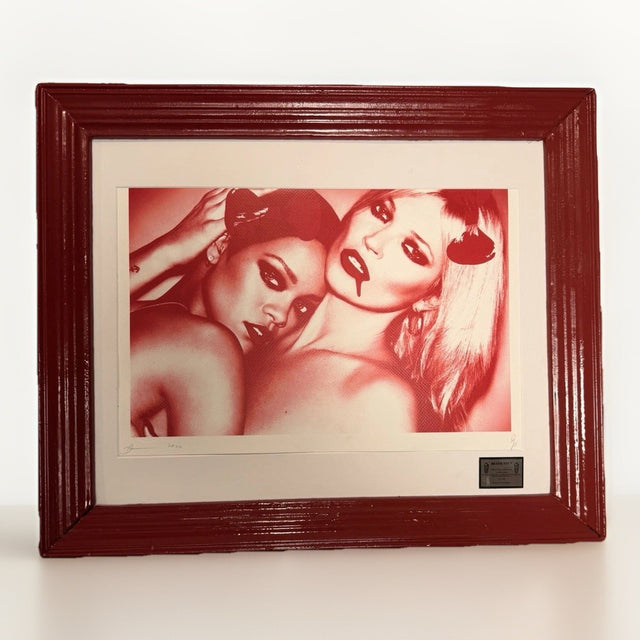
Death NYC — Kate Moss Rihanna Red Drip 2020 A/P Artist Proof Framed
$91.88 USD
-
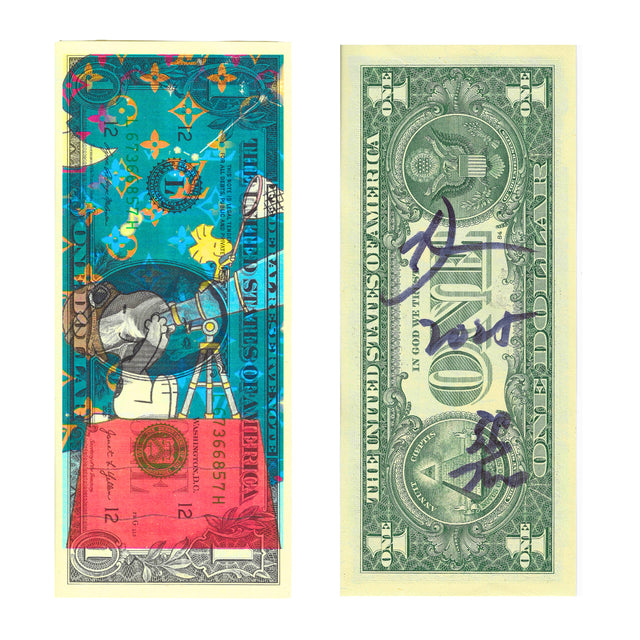
Death NYC Snoopy Woodstock Telescope LV Dollar Bill Art Signed Numbered COA
$55.00 USD
-
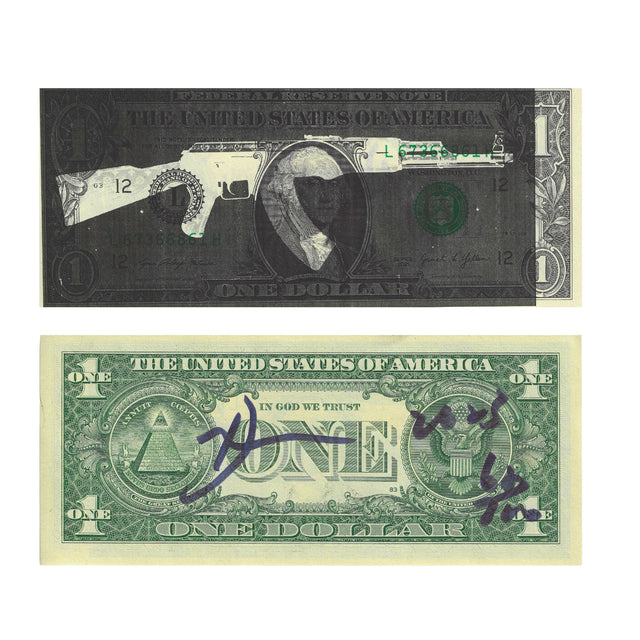
Death NYC Gun Dollar Bill Art Signed Numbered COA Black White Pop Street Art
$50.00 USD
-
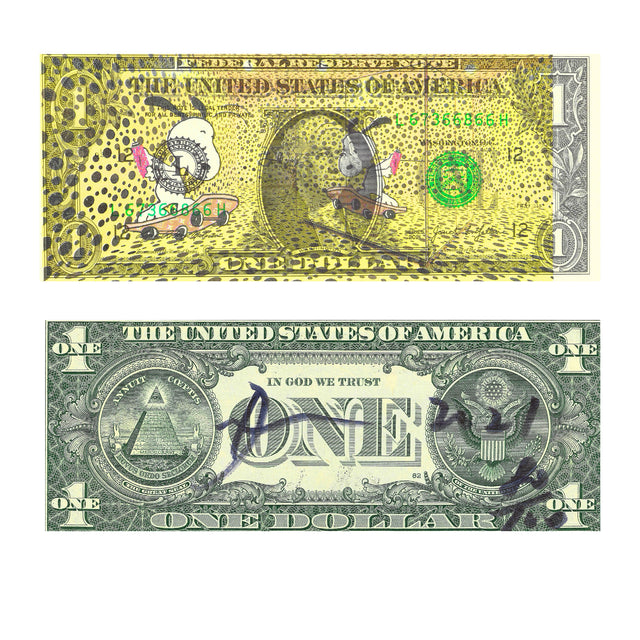
Death NYC Snoopy Skateboard Dollar Bill Art Signed Numbered COA Pop Street Art
$75.00 USD
-
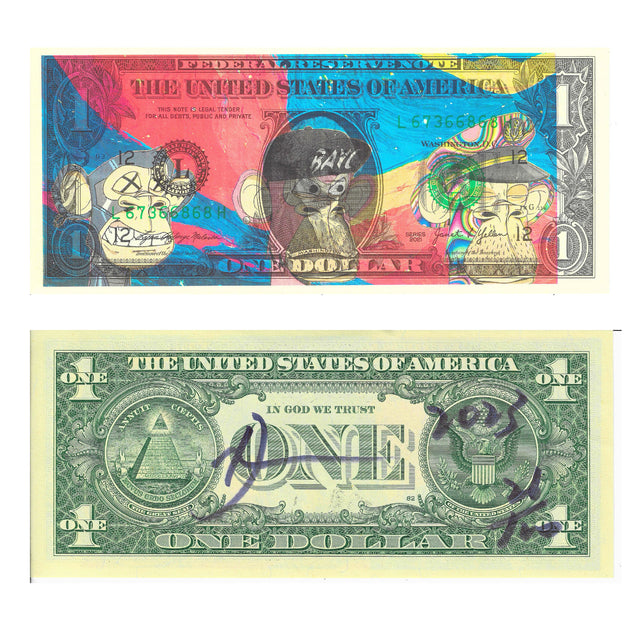
Death NYC Bored Ape Dollar Bill Art Signed Numbered COA Pop Street Art
$40.00 USD
-
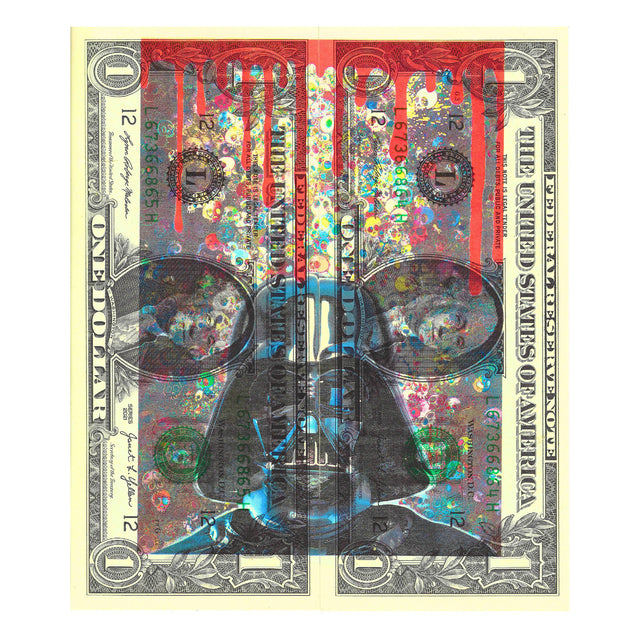
Death NYC Darth Vader Star Wars Dollar Bill Art Signed Two Bills COA Unframed
$100.00 USD
Browse the collection for current listings.