Shepard Fairey — Man Holding Framed Art
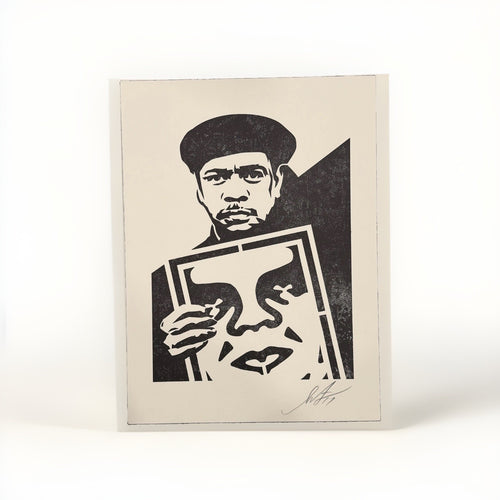
A figure holds a framed artwork.
The subject of the picture is the act of having a picture.
Man Holding Framed Art is a quietly self-referential letterpress by Shepard Fairey — hand-signed in pencil, 10 x 13 inches — that turns presenting and possessing art into the subject itself. This is an honest, tightly-scoped guide: what the image does, why letterpress suits it, how it's authenticated, and what to know before you buy. Where the source detail is thin, we say so rather than invent.
View this piece at Gauntlet Gallery →
What you are actually looking at
The print depicts a figure holding a framed artwork — a knowing, self-referential image from an artist whose entire career has interrogated how images circulate and accrue meaning. The composition plays with the relationship between viewer, holder, and object. You are looking at someone looking at art, which makes you the third person in a loop about looking.
It's a wry subject for Fairey specifically. His work has always been about how images move through the world — pasted on walls, reproduced, appropriated, resold. A picture of a person presenting a picture folds that lifelong preoccupation into a single gesture. Fairey's ornamental instincts remain present in the surrounding detail, framing the central act with his familiar decorative rigor.
Why letterpress matters here
This is a letterpress print, distinct from Fairey's more common screen-print output, and the format suits the subject.
The letterpress process gives the piece a tactile, impressed quality — the ink pressed into the cream stock for a soft, physical relief you can feel as much as see. There's a nice rhyme in that: an image about the physical object-hood of art, printed by a process that emphasizes physical object-hood. The sheet isn't just a picture of a framed thing; it is itself a made, pressed, tactile thing.
Letterpress also signals a certain intimacy in Fairey's catalogue. It's the register he reaches for in smaller, more considered works rather than the poster-scale screen prints. For a self-referential meditation like this, that quieter format fits.
Shepard Fairey, in one paragraph
Shepard Fairey (b. 1970) is one of the most influential American artists of his generation. He emerged from the 1990s skateboarding and street-art scene with his OBEY Giant campaign — an experiment in propaganda and public space that grew into a global visual language. In 2008 his Barack Obama "Hope" portrait became one of the most recognizable political images in modern history. His work is held by the Museum of Modern Art, the Victoria & Albert Museum, LACMA, and the Smithsonian. Editions release through his OBEY studio and routinely sell out and trade on the secondary market.
The edition and how it reached the market
This is a letterpress edition on cream paper, hand-signed in pencil by Shepard Fairey, measuring 10 x 13 inches. It is a hand-signed limited edition.
In the interest of accuracy: the specific year and total edition size are not stated in the product data for this example, so we won't assert them. What defines this sheet is documented and plain — a hand-signed letterpress at 10 x 13. If precise year or edition figures are central to your decision, confirm them against the specific example rather than assuming a number.
Authentication: what actually backs a Fairey
Read this carefully, because it's the point collectors most often get wrong.
Shepard Fairey does not issue an artist certificate of authenticity, and there is no third-party authentication board for his work — no Fairey equivalent of Banksy's Pest Control. That is how the entire Fairey market operates.
Authenticity for a signed Fairey rests on the pencil signature, the physical characteristics of the edition (the cream stock, the letterpress impression, the print process), and provenance. This release is documented in the Gauntlet Gallery Shepard Fairey reference archive, part of that provenance picture. Be skeptical of any "third-party authentication" claim or a certificate implying an official board signed off — no such board exists for his prints.
Condition: what to check, and why photographs matter
Condition drives value on paper works. This example is described as Very Good. For a letterpress print, the things worth examining are the brightness of the cream stock, the crispness of the impression, any handling creases or corner dings, and whether the sheet has ever been trimmed or light-exposed.
Because condition is specific to the individual sheet, the listing photographs form part of the condition description, not decoration. The images show the actual piece you will receive; we never assert a grade beyond what they support.
Who this piece is for
A few kinds of collector tend to want this print. The Fairey collector drawn to the scarcer letterpress format and to a wry, self-referential image that stands apart from his political poster work. The conceptually-minded buyer who enjoys art about art — a picture whose subject is possession and display. And the entry-point buyer who wants a hand-signed Fairey at an accessible small format.
If you're none of those and simply like the image, that's a valid reason too.
Frequently asked questions
Is it signed? Yes — hand-signed in pencil by Shepard Fairey.
What is the medium and size? Letterpress on cream paper, 10 x 13 inches.
What year and edition size is it? The specific year and total edition size are not stated in the available data for this example, so we don't assert them. It is a hand-signed limited-edition letterpress; confirm any precise figures against the specific piece.
Does it come with a certificate? Fairey issues no artist COA and there is no third-party board for his prints. Authenticity rests on the pencil signature, the documented letterpress characteristics, and provenance.
What condition is it in? Graded Very Good. The photographs form part of the condition description and show the actual piece you will receive.
The bottom line
Man Holding Framed Art is Fairey in a quieter, more reflective key: a self-referential image about presenting and possessing art, printed by a process that foregrounds the physical object. It's a hand-signed letterpress at an accessible 10 x 13 — distinct from his poster-scale output, and a knowing pick for a collector who enjoys art that thinks about itself.
If it's the piece for you, the individual sheet — its signature and its condition — is where the decision lives.