Shepard Fairey — Power & Glory (2016)
Medals. Emblems. Ornamental grandeur.
The visual language power uses to make itself look like virtue.
Power & Glory takes that language and turns it back on itself. This example is a hand-signed, numbered letterpress from an edition of 450, produced in 2016 at a larger 18 x 24 inches. This is the full story of the work: what it critiques, why letterpress heightens the irony, how the edition reached the market, and what to know before you buy.
View this piece at Gauntlet Gallery →
What you are actually looking at
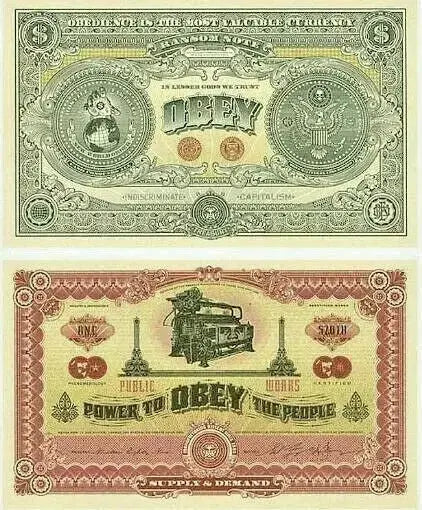
Power & Glory examines the seductive iconography of dominance — the medals, emblems, and ornamental grandeur that regimes and institutions use to cloak authority in righteousness. Rather than critique that language from the outside, Fairey adopts it. He deploys his propaganda-poster palette and decorative filigree to expose how power dresses itself up as glory.
The result is an image that mimics the grandeur it critiques. It invites the viewer to admire and question in the same glance — to feel the pull of the emblematic composition even while recognizing what that composition is doing. That doubling is characteristic of Fairey's best work: a single arresting image that carries the appeal and the argument at once.
Why letterpress matters here
The letterpress treatment is not incidental to this image — it's part of the argument.
The process gives the work a stately, embossed physicality. The ink is pressed into the cream stock so the imagery reads almost like an official seal — the kind of raised, authoritative mark you'd find on a certificate or a document of state. That craft heightens the central irony: an object that looks like a badge of authority is, in fact, a critique of it.
Fairey's whole visual system borrows the furniture of persuasion — the star, the sunburst, the bordered emblem — and reloads it. Letterpress adds a tactile layer to that borrowing. The embossed impression makes the print feel official, which is exactly the feeling the image is interrogating. You admire the seal, then remember what seals are for.
Shepard Fairey, in one paragraph
Shepard Fairey (b. 1970) is one of the most influential American artists of his generation. He emerged from the 1990s skateboarding and street-art scene with his OBEY Giant campaign — an experiment in propaganda and public space that grew into a global visual language. In 2008 his Barack Obama "Hope" portrait became one of the most recognizable political images in modern history. His work is held by the Museum of Modern Art, the Victoria & Albert Museum, LACMA, and the Smithsonian. Editions release through his OBEY studio and routinely sell out and trade on the secondary market.
The critique of power, in context
The interrogation of authority is not a one-off theme for Fairey — it's the spine of his practice. He has spent three decades mining the aesthetics of Soviet, Chinese, and American propaganda, absorbing their techniques in order to expose them. Power & Glory sits squarely in that lineage.
What makes the image work is its refusal to lecture. It doesn't caricature power; it recreates power's own self-presentation so faithfully that the viewer feels the seduction firsthand. The filigree is genuinely handsome. The composition genuinely commands. And that's the trap the image sets — you're meant to notice how readily grandeur reads as legitimacy, and to question the reflex. It admires and undermines in the same breath.
The edition and how it reached the market
This is a 2016 letterpress edition on cream paper, hand-signed and numbered in pencil by Shepard Fairey out of an edition of 450, measuring 18 x 24 inches. The larger format gives the embossed impression more room to work — the emblematic composition reads with more authority at scale.
For due diligence, the things that define this example are the pencil signature and the number out of 450. Those, plus the physical letterpress characteristics, are what back the sheet.
Authentication: what actually backs a Fairey
Read this carefully, because collectors get it wrong more than any other point.
Shepard Fairey does not issue an artist certificate of authenticity, and there is no third-party authentication board for his work — no Fairey equivalent of Banksy's Pest Control. That is how the entire Fairey market operates, not a gap in this print.
Authenticity for a signed Fairey rests on three things: the pencil signature and numbering (here, numbered out of 450), the physical characteristics of the edition (the cream stock, the embossed letterpress impression, the print process), and provenance. This release is documented in the Gauntlet Gallery Shepard Fairey reference archive, which forms part of that provenance. Be skeptical of anyone claiming "third-party authentication" or presenting a certificate implying an official board signed off — no such board exists for his prints.
Condition: what to check, and why photographs matter
Condition drives value on paper works more than first-time buyers expect. This example is described as Very Good. For a letterpress print, the things worth examining are the brightness of the cream stock, the crispness and depth of the embossed impression, any handling creases or corner dings, and whether the sheet has ever been trimmed or light-exposed.
Because condition is specific to the individual sheet, the listing photographs form part of the condition description. Zoom into the corners and the margins around the signature and number. The images show the actual piece you will receive; we never assert a grade beyond what the photographs support.
What the market says
Now the numbers — restrained, because this is context, not a promise.
Across recent signed-and-numbered Power & Glory letterpress comparables, observed asking and sold figures span roughly $50 to $280, with a median near $130. The spread is largely a function of condition, edition position, and sales venue.
A few caveats to hold onto. These figures are directional secondary-market data, not an appraisal. Value on any specific sale varies with condition, documentation, and where the transaction happens. And market data ages — the range above reflects data reviewed as of 2026. The honest summary: this is an image with a real, active secondary market at an accessible entry point, and no one — including us — can promise where it goes next.
Who this piece is for
A few kinds of collector tend to want this print. The Fairey collector drawn to his propaganda-critique lane, which is arguably the core of his practice. The letterpress enthusiast who values the embossed, tactile format over screen-print flatness. And the entry-point buyer looking for a signed, numbered Fairey at a large 18 x 24 format without a top-tier price.
If you're none of those and simply respond to the image — a badge of authority that turns out to be a critique — that's a valid reason too.
Frequently asked questions
Is it signed and numbered? Yes — hand-signed and numbered in pencil by Shepard Fairey, out of an edition of 450.
What is the medium and size? Letterpress on cream paper, 18 x 24 inches, from 2016.
Why letterpress instead of screen print? The embossed impression makes the image read like an official seal — reinforcing the print's critique of how authority presents itself.
Does it come with a certificate? Fairey issues no artist COA and there is no third-party board for his prints. Authenticity rests on the signature, the numbering, the documented letterpress characteristics, and provenance.
What condition is it in? Graded Very Good. The photographs form part of the condition description and show the actual piece you will receive.
The bottom line
Power & Glory is a clean example of Fairey's central move: borrow the language of authority, recreate it faithfully, and let the viewer feel both its pull and its emptiness. As a signed, numbered letterpress from an edition of 450 at a generous 18 x 24, this example puts that argument on the wall at scale.
If it's the piece for you, the individual sheet — its signature, its number, its condition — is where the decision lives.