The Figure That Rewrote the Rules
There is a moment in every collecting category when the market stops treating something like merchandise and starts treating it like art.
For KAWS, that moment has already happened — several times over. But the piece that started it all, the 1999 Bounty Hunter collaboration Companion vinyl, still trades by a completely different logic than anything that came after it.
Not streetwear logic. Not toy collector logic.
Outsider art logic.
If you want to understand why, you need to understand what that figure actually is, what documentation exists for it, and why the authentication framework collectors use for modern KAWS releases simply does not apply here.
What the 1999 Companion Actually Was
Brian Donnelly — KAWS — was not a gallery artist in 1999. He was a graffiti writer with a day job in animation, operating a subversive intervention practice in bus shelters and phone booths across New York and Japan.
The relationship with Bounty Hunter, the Tokyo streetwear and toy brand founded by Hikaru Iwanaga, was personal, underground, and extremely limited in scope. The resulting Companion figure was not a commercial product launch in any contemporary sense of that phrase. There was no press release. No drop calendar. No authenticated edition list.
What existed was a small run of gray vinyl figures — estimates vary, and verifiable production numbers have never been formally published — sold primarily through Bounty Hunter's Harajuku store and through a very tight network of early adopters who understood what KAWS was doing before anyone put a market price on it.
That origin story is the reason the figure trades the way it does.
When was the last time you bought a piece where the edition size is genuinely unknown?
That is not a rhetorical problem. That is an outsider art condition. The same information vacuum that surrounds a self-published artist book or a hand-cast sculpture from an uncatalogued period governs the 1999 Companion. You are working from provenance chains, not certification databases.
How Modern KAWS Authentication Works — And Why It Doesn't Apply Here
Let's establish baseline before we talk about the gap.
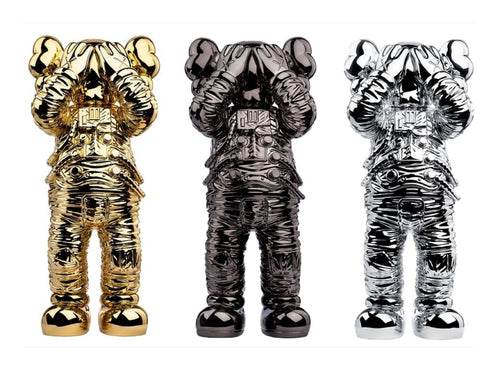
For releases from roughly the mid-2000s onward, authentication rests on a well-documented physical standard: Medicom packaging quality and the hologram sticker, molded foot stamps and copyright markings, and documented release records that place each piece in a verifiable production history. Certain recent releases — notably KAWS:HOLIDAY editions from roughly 2022 onward — add an embedded NFC authentication chip on top of that stack.
That is a legitimate and meaningful authentication layer for modern releases. We use it. The market uses it. Auction houses reference it.
The 1999 Bounty Hunter Companion predates that system by roughly two decades.
It also predates the standardized original packaging with hologram and Medicom release records that collectors rely on for pieces from the mid-2000s forward. Medicom Toy's involvement in KAWS production came later. Bounty Hunter operated its own manufacturing relationships, and the documentation practices of a small Tokyo streetwear label in 1999 were not designed with a 2024 secondary market in mind.
What this means in practice:
- No NFC chip. None exists — NFC chips appear only on certain recent releases such as KAWS:HOLIDAY editions from 2022 onward. Any seller claiming chip-based authentication for a 1999 Companion is either confused or dishonest.
- No Medicom hologram. Medicom was not involved. Full stop.
- No Medicom release record. The figure predates Medicom's involvement in KAWS production entirely.
- No artist-issued COA from this period. KAWS was not issuing certificates of authenticity for a gray vinyl figure sold out of a Tokyo streetwear shop in 1999.
This is not a failure of the authentication ecosystem. This is an accurate description of what the market is actually dealing with.
So what does authentication look like for a piece with no paper trail?
It looks like outsider art authentication. It looks like deep object analysis, physical condition assessment, material consistency review, and — most critically — provenance chain verification.
The Provenance Chain Is Everything
In categories where institutional certification exists, provenance is a supporting document. In categories where it doesn't, provenance is the primary document.
For the 1999 Companion, a clean provenance chain typically includes some combination of the following:
-
Direct purchase documentation from Bounty Hunter. Original receipts are extremely rare. Period photographs of the figure in context — documented with the original owner in a dateable setting — carry significant weight.
- Physical receipts from the Harajuku store are the gold standard and essentially never surface.
- Dated correspondence (email archives from 1999-2001) referencing the purchase has been accepted by serious buyers as secondary support.
-
First or second owner sales with documented history. Figures that have traded through one or two hands with continuous documentation carry substantially more credibility than figures that appear with a vague "acquired from a collector" note.
- Early forum posts on communities like SuperFuture or pre-social-media toy collector boards that reference specific figures are legitimately valuable as historical timestamps.
- Exhibition or publication appearance. If the figure appeared in early KAWS retrospective materials, gallery documentation, or period press coverage, that appearance anchors its existence in a verifiable timeline.
- Physical assessment by a credentialed specialist. Major auction houses conducting physical review for this tier of sale are not optional. A specialist letter from a credentialed KAWS market authority carries weight even in the absence of formal certification.
None of these individually constitutes bulletproof authentication. Together, they constitute the kind of multi-layered provenance chain that allows the serious secondary market to transact with appropriate confidence.
This is exactly how outsider art works. When you buy a significant Jean-Michel Basquiat work on paper, you are buying a provenance chain. The artist cannot certify it. The foundation processes vary by case. You are building an argument from documentary evidence.
The 1999 Companion requires the same intellectual framework.
Physical Characteristics: What Legitimate Examples Look Like
Because certification documents don't exist for this piece, physical characteristics carry unusual interpretive weight. Collectors and specialists who have handled multiple legitimate examples have developed a working vocabulary for the object.
Material and Production Characteristics
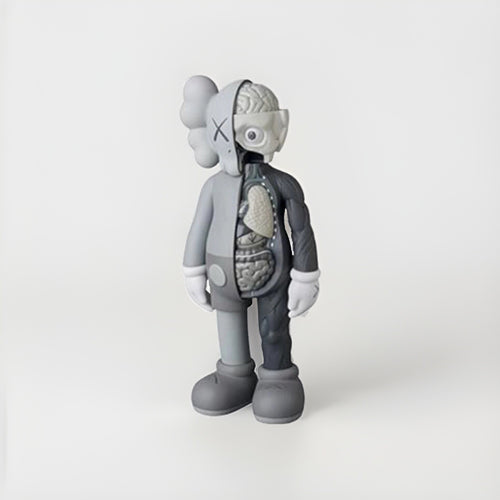
The original figure is cast in a soft gray vinyl consistent with Japanese toy production practices of the late 1990s. The material has a specific weight and tactile quality that differs meaningfully from later reproduction attempts. The gray coloration itself — a muted, slightly warm gray — is distinct from the cooler, higher-contrast colorways that appeared in subsequent official editions.
The surface finish on legitimate pieces shows production characteristics consistent with small-run Japanese vinyl manufacturing from the period. Paint application on the X eyes and mouth elements has specific characteristics that vary slightly across legitimate pieces in the way hand-applied or small-run application does — this variation is itself a marker of authenticity, not a red flag.
Scale and Proportion
The 1999 Companion stands at a specific scale that differs from later KAWS vinyl editions. Anyone cross-referencing with later Medicom-produced pieces as a dimensional baseline is working from incorrect reference points.
The Skull Logo and Bounty Hunter Markings
Bounty Hunter markings — including period-appropriate logo elements — appear on legitimate examples. The specific placement and execution of these markings is a checkpoint that distinguishes legitimate figures from later reproductions that attempt to replicate the general aesthetic without accurate period detail.
Do you know what a Bounty Hunter production mark from 1999 actually looks like in person?
If you don't, you need a specialist in the room before you transact at this level.
Why the Market Prices This Like Outsider Art
Let's talk about what actually drives value here, because it is not the same calculation as a limited Medicom Companion in original packaging with a clean hologram.
Scarcity That Cannot Be Manufactured
The production run is finite and non-reproducible. Not because KAWS won't authorize a reissue — though he hasn't — but because the specific conditions of the collaboration cannot be reconstructed. Bounty Hunter, KAWS, 1999, that particular moment before either party had institutional market recognition. That temporal specificity is a form of scarcity that functions identically to the scarcity arguments applied to outsider art from artists who have since died or whose early work came from circumstances that no longer exist.
The Before/After Narrative
Art market premiums attach to origin points. The first work that announces an artist's formal vocabulary commands a premium that no subsequent work, regardless of technical sophistication, can replicate. The 1999 Companion is the first time the Companion character — arguably the most recognized single figure in contemporary street art and designer toy culture — existed as a three-dimensional physical object.
That is a before/after moment. The market prices before/after moments like art, not merchandise.
The Institutional Recognition Premium
KAWS's subsequent institutional recognition — major auction results, museum exhibitions, the permanent collection appearances — has retroactively inflated the cultural significance of every earlier work. This is a standard mechanism in the art market. When an artist achieves institutional status, their pre-institutional work reprices upward to reflect the narrative of discovery.
The 1999 Companion benefits from this mechanism more than any other single KAWS object, because it sits at the earliest verifiable point in the Companion's physical existence.
The Knowledge Barrier
Outsider art markets are frequently characterized by a steep knowledge barrier between informed participants and the general collector base. That barrier itself creates value concentration among specialists. The 1999 Companion has a similar dynamic. Most KAWS collectors — even serious ones with significant holdings of later work — have never handled an original 1999 example. The figure circulates in a very small pool of specialists and institutional-grade private collectors.
That concentration creates pricing power that operates independently of broader streetwear or designer toy market cycles.
Auction House Treatment: What the Major Houses Are Actually Doing
When pieces at this tier appear at major auction, the treatment is instructive.
Houses conducting specialist review for early KAWS vinyl are not running these through standard designer toy consignment processing. Physical condition reports are generated. Provenance documentation is assembled and presented as part of the lot notes. Specialist commentary — sometimes from external consultants with documented KAWS market expertise — is incorporated into the sale record.
That is the treatment given to art, not toys.
The buyer's premium calculations, the insurance valuations, the reserve-setting methodology — all of it aligns with fine art secondary market practice, not collectible toy secondary market practice.
What does it tell you about a piece's market position when the auction house treats it like art rather than merchandise?
It tells you that the institutional infrastructure has already made a determination. The 1999 Companion is not a designer toy at this price tier. It is an early work by a significant contemporary artist.
Comparing the Authentication Burden Across Categories
To calibrate where the 1999 Companion sits, it helps to compare its authentication burden against other categories where we routinely work.
| Category | Primary Authentication | Secondary Support | Provenance Weight |
|---|---|---|---|
| Recent KAWS (KAWS:HOLIDAY, 2022+) | NFC chip + release record | Original packaging, hologram | Supporting |
| Modern KAWS (Medicom era) | Original packaging + hologram + Medicom release record | Purchase documentation | Significant |
| 1999 Bounty Hunter Companion | Physical assessment + provenance chain | Specialist letter, period documentation | Primary |
| Banksy (any period) | Pest Control only | Exhibition documentation | Supporting |
| Music memorabilia (signed) | BAS/JSA/PSA-DNA | Roger Epperson REAL for music tier | Supporting |
| Outsider art (uncatalogued) | Physical assessment + provenance | Period documentation, specialist letter | Primary |
The alignment between the 1999 Companion column and the outsider art column is not accidental. The market has correctly recognized that these two categories operate by the same authentication logic.
The Reproduction and Fraud Landscape
Wherever significant value concentrates around objects without institutional certification, reproduction attempts follow. The 1999 Companion is not exempt.
The reproduction problem here is distinct from, say, the problem FBI Operation Bullpen identified in sports memorabilia — where forgers were producing fabricated signatures on otherwise legitimate merchandise at industrial scale. The Companion reproduction problem is more analogous to the PSA certification-verification warnings around pre-certified vintage cards: pieces that were produced at some point, potentially legitimately, but whose documentation and provenance have been constructed retroactively or misrepresented in transfer.
The specific risks include:
- Later legitimate editions presented as 1999 originals. Subsequent KAWS Companion editions in similar colorways exist. A less experienced buyer may accept a later piece with constructed provenance as the 1999 original. Physical assessment by a specialist who has handled authentic 1999 examples is the only reliable counter to this.
- Reproduction figures with fabricated Bounty Hunter markings. The Tokyo streetwear underground of the late 1990s and early 2000s is not well-documented enough for most buyers to recognize accurate versus inaccurate period markings. This is exactly the knowledge barrier that enables fraud in specialist categories.
- Legitimate figures with fraudulent provenance documentation. A real 1999 Companion with a fabricated ownership chain — invented first-owner documentation, manufactured early period receipts — presents a different challenge. The object is genuine but the story told about it is not. This matters for value because specific provenance (documented first purchase, identifiable early owners) commands premium over unattributed examples.
The counter-strategy is consistent across all three risk scenarios: multi-source verification, specialist physical assessment, and extreme skepticism toward any seller who resists documentation requests.
Red Flags
If you are actively looking at a 1999 KAWS Bounty Hunter Companion, walk away from any transaction where you encounter the following:
- Claims of modern digital certification. No such record exists for this piece. A seller making this claim either doesn't understand what they have or is actively misrepresenting it.
- A Medicom hologram presented as authentication. Medicom was not involved in the 1999 production. A Medicom hologram on or with this piece is a fabrication or indicates you are looking at a different, later edition being misrepresented.
- A "COA from KAWS" or "artist-issued certificate." KAWS did not issue authentication certificates for this release. Any such document is fraudulent on its face.
- Refusal to allow physical specialist assessment before purchase. At this price tier, any legitimate seller understands and expects specialist review. Resistance to it is a major warning.
- Provenance that begins "acquired from a collector" with no further detail. That is not provenance. That is an absence of provenance dressed in neutral language.
- Price significantly below established market tier. The outsider art pricing logic that governs the 1999 Companion means legitimate examples do not surface at bargain prices. An implausibly low ask is a strong indicator of either a reproduction or a piece with undisclosed condition problems.
- Colorway inconsistency. The original 1999 Bounty Hunter Companion is gray. Figures in other colorways from this supposed release warrant extreme scrutiny — verify against specialist knowledge of what Bounty Hunter actually produced before accepting any variant claim.
- No tolerance for condition disclosure. Legitimate sellers of pieces at this price tier welcome condition transparency. Reluctance to discuss condition specifics — or photographs that strategically avoid showing paint wear, material degradation, or marking areas — is a warning sign.
Bottom Line
The 1999 KAWS Bounty Hunter Companion is not a designer toy with a great backstory.
It is an early work by a significant contemporary artist, produced in an uncatalogued limited run under pre-institutional conditions, whose physical existence predates every formal authentication mechanism that the KAWS market subsequently developed.
That is the reason it trades like outsider art. Not because collectors have romanticized it, and not because the market has made an error.
Because the conditions that produced it — the informal collaboration, the undocumented run, the pre-certification era, the absence of any institutional infrastructure around either party at the moment of creation — are functionally identical to the conditions that produce outsider art.
The authentication burden reflects that reality. Provenance is primary. Physical assessment is non-negotiable. Specialist knowledge is the difference between a sound acquisition and a very expensive mistake.
If you are a serious collector approaching this piece, approach it the way you would approach a significant work from an artist whose early period predates the documentation practices of the contemporary art market.
Build the argument from evidence. Demand the provenance chain. Require the specialist assessment.
And understand that the premium you are paying is not for a toy. It is for a before/after moment in the history of one of the most significant visual vocabularies in contemporary art.
That is worth getting right.
Frequently Asked Questions
Is the 1999 KAWS Bounty Hunter Companion the first Companion figure ever produced?
It is the first known three-dimensional vinyl production of the Companion character. The Companion as a visual element appeared earlier in KAWS's two-dimensional work and intervention practice. But as a physical object — the gray vinyl figure that established the form that would become globally recognized — the 1999 Bounty Hunter collaboration represents the origin point. This is why it commands the market premium it does.
Can modern digital authentication cover the 1999 Companion?
No. Modern verification layers — Medicom release records, hologram packaging, and the NFC chips found on certain recent releases like KAWS:HOLIDAY editions — all postdate this piece. None of them exists for a figure produced in 1999. Any representation that the 1999 Companion carries modern digital certification should be treated as a serious red flag and the transaction should not proceed without independent specialist verification.
Does Medicom Toy's involvement in later KAWS production affect how we authenticate the 1999 piece?
Medicom Toy became KAWS's primary vinyl production partner for Companion editions in the mid-2000s onward. Their release records, hologram systems, and packaging documentation are legitimate authentication tools for that era of production. They have no relevance to the 1999 Bounty Hunter piece, which was produced entirely outside Medicom's involvement. Using Medicom documentation standards to evaluate a 1999 Bounty Hunter piece is a category error.
What is the safest way to acquire a legitimate 1999 Companion?
The safest acquisition path runs through major auction houses with documented specialist review, or through private dealers with verifiable specialist credentials and a documented provenance chain for the specific piece. Either path should include physical assessment by someone with confirmed experience handling multiple legitimate 1999 examples — not just general KAWS expertise. The knowledge gap between general KAWS market experience and 1999 Companion specialist experience is significant.
How do I evaluate a provenance chain for a piece like this?
Work backward from the present owner to the Bounty Hunter Harajuku store if at all possible. Each link in the chain should be documentable with some form of evidence — purchase records, dated correspondence, forum posts, period photography, or exhibition documentation. The fewer the ownership transfers and the stronger the documentation at each transfer point, the more credible the chain. A provenance chain that cannot be traced back further than "purchased from a collector approximately ten years ago" is insufficient for a purchase at this price tier.
Are there legitimate variants of the 1999 release in different colorways?
This is exactly the kind of question that requires specialist verification rather than general market research. Variant claims in categories with no official production documentation are a well-established vector for misrepresentation. Before accepting any colorway variant claim for the 1999 Bounty Hunter collaboration, require specialist input from someone with documented knowledge of what Bounty Hunter's 1999 production actually included. Do not rely on secondary sources or seller assertions alone.
How does the KAWS market cycle affect the 1999 Companion's value?
Less than most people assume. Because the 1999 Companion trades at the institutional art market tier rather than the designer toy or streetwear collectible tier, its pricing is more correlated with the broader contemporary art market and with KAWS's institutional standing than with the fluctuations of the designer toy secondary market. Broad KAWS market corrections in limited-edition vinyl categories have historically had attenuated effects on the earliest and rarest pieces. This is consistent with how early works by significant artists behave relative to their more commercially accessible production.
Does the gallery sell or broker the 1999 KAWS Bounty Hunter Companion?
Pieces at this tier — where provenance chain verification, physical specialist assessment, and institutional-grade documentation are prerequisites — are handled on a case-by-case basis. If you are a serious buyer or consignor with a documented example, contact us directly. We do not list pieces of this specificity through standard inventory channels. The transaction requires the same diligence we apply to any significant contemporary art acquisition, and we approach it accordingly.