The Color Is the Collectible
Two BE@RBRICKs. Same artist collaboration. Same scale. Same edition year. One sells for twice the price of the other.
The only difference is the colorway.
If you're new to this market, that might sound like collector superstition. If you've been in it for a while, you already know: with BE@RBRICKs, the palette isn't decoration. It's often the primary driver of secondary market value. Understanding why — and being able to identify which color variants actually command premiums versus which ones just look different — is the difference between buying smart and buying blind.
This is what we're unpacking today.
How Medicom Toy Actually Structures Color Releases
Medicom Toy doesn't produce color variants randomly. There's architecture to how colorways are deployed, and understanding that architecture tells you almost everything you need to know about relative scarcity before you even start researching secondary prices.
The Standard Run vs. the Exclusive Variant
Most major BE@RBRICK collaborations launch with a primary colorway. That's the one you see in the official press images, the one that ships to authorized retailers globally, the one with the widest production run.
Then there are exclusive colorways.
These come in several forms: retailer exclusives tied to specific shops or regions, event exclusives released only at specific conventions or pop-up installations, artist-edition variants produced in genuinely smaller numbers, and anniversary or re-issue colorways that reference the original but introduce a new palette specifically to drive renewed collector interest.
Each category carries different liquidity and different premium potential. Retailer exclusives from globally accessible shops (think BAPE, Medicom's own SYNC stores, or major museum shops) tend to have more secondary market liquidity than hyper-regional exclusives, but the hyper-regional pieces often carry steeper premiums precisely because fewer units made it outside their original geography.
Spray, Chrome, and Monotone: The Technical Palette Categories
Medicom works within recognizable finish categories that collectors have learned to track:
- Monotone: Single-color execution, often all-black or all-white, occasionally all-gold. These read as "clean" in the market. Their value is almost entirely dependent on the collaboration behind them rather than the color itself.
- Chrome and Metallic: Mirror-finish or metallic variants that photograph dramatically and display well. These carry consistent premiums across most collaboration lines.
- Spray/Gradation: Airbrushed gradient finishes. Value varies enormously depending on how well the gradient was executed and how closely it ties to the artist's known visual language.
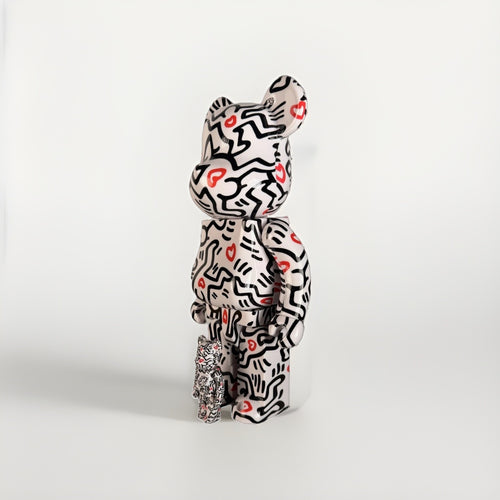
- Pattern-Painted: Full-body graphic treatment. This is where most of the high-drama colorway premium action lives, because the graphic execution is often unique to a specific variant and visually distinct at a glance.
- Transparent/Clear: See-through body in tinted or untinted finish. These can be extremely desirable when they show internal detail, less so when they feel like an afterthought.
Knowing which finish category you're looking at positions you to make a faster read on whether a premium is structurally justified or market-hyped.
Why Colorway Premiums Exist: The Real Mechanics
Color premium in BE@RBRICKs isn't arbitrary. It flows from a specific set of compounding factors.
Production Numbers
This one is obvious but worth stating clearly. When a colorway is produced in a genuinely smaller edition size, secondary prices follow. The problem is that Medicom Toy does not publicly release per-colorway edition figures as a rule. You're often working from community knowledge, collector network data, and the historical record of how many units appear across auction archives.
So how confident should you be in any production number figure you're given by a seller?
Treat seller-provided production figures as unverified claims until you can cross-reference them against the Medicom release record, known auction appearances, and trusted collector community databases. More on verification shortly.
Geographic Scarcity
A BE@RBRICK released exclusively through a single Japanese department store chain that doesn't export internationally has a hard geographic ceiling on initial distribution. That ceiling creates scarcity that has nothing to do with the artistic merit of the colorway and everything to do with logistics.
Geographic exclusives routinely trade at premiums that shock buyers who see only the object and not the distribution story behind it. This is especially true for Medicom's own SYNC store releases and pieces tied to Japanese cultural events with no international ticketing.
Collab Artist Demand
When a collaboration artist has strong primary market demand, every colorway in that collaboration floats higher. But within a single collab series, the colorway that most directly references the artist's most iconic work — the palette they're actually famous for — tends to outperform more peripheral variants.
A KAWS collaboration piece in a colorway that matches his signature grey and black companion palette will generally trade above the same piece in an off-palette variant, even if production numbers are identical. The palette legibility to casual fans drives broader demand.
Condition and Completeness by Colorway
Different colorways show wear differently. Dark monotone pieces can hide subtle scuffs that destroy value on a chrome or white variant. Paint chips on gradient pieces are catastrophic to value in ways that are much harder to see on a flat-color piece.
This matters because condition-grading standards effectively vary by colorway, and the secondary market prices accordingly. A chrome BE@RBRICK at PSA 9 is genuinely scarce in ways that a matte black piece at the same grade is not.
The Authentication Layer: Don't Skip This Because It's a Toy
BE@RBRICKs are toy-format collectibles, but at the price points serious colorway variants trade for, authentication matters as much as it does for any other collectible category.
The counterfeiting problem in this market is real and documented. Fake BE@RBRICKs have circulated at every scale, from crude knockoffs to high-quality replicas that fool casual buyers. When you add color variant premium to the picture — meaning a fake in a "rare" colorway that was never actually produced — the fraud risk compounds significantly.
Medicom's du-al.io NFC Verification
For pieces where Medicom has deployed its du-al.io NFC verification system, this is your first-line authentication tool. The chip embedded in the piece should resolve to the corresponding Medicom record, and that match should be verifiable through the platform.
For earlier releases, you're working with a different toolkit: original retail packaging with intact holographic elements, the Medicom release record for that specific collab and colorway, and provenance chain documentation from original purchase through every subsequent sale.
If the seller can't produce original packaging for an earlier piece, why not?
That's not a rhetorical red flag. It's a legitimate due diligence question. Packaging condition matters less for these earlier pieces than packaging existence. A box that confirms the colorway's authentic manufacture is documentation, not just presentation.
The Release Record Cross-Reference
Medicom's release history is extensively documented across the collector community, with dedicated databases cataloging known colorways, approximate release periods, and distribution channels. Before you pay a colorway premium, verify that the colorway you're buying was actually produced.
This sounds obvious. It shouldn't need to be said. But in a market where "rare colorway" is used as a price justification, verifying that the colorway exists in the official release record is non-negotiable homework.
Cross-reference across multiple community sources and auction archives. A colorway that appears in zero auction records and has no documented retail release history is not a discovery — it's a warning sign.
Physical Authentication Markers
Authentic Medicom BE@RBRICKs have specific physical characteristics that counterfeit pieces routinely fail to replicate perfectly: joint quality and movement resistance, the specific weight and feel of the plastic, the precision of paint application at boundary lines, copyright and production markings on the foot and back, and holographic elements on packaging where applicable.
Color variants introduce an additional layer here because the paint specification for a genuine variant is consistent. An authentic Medicom chrome finish has specific properties — reflectivity, uniformity, edge behavior — that a painted-over standard piece does not replicate. This is one of the more common frauds in the colorway premium space: taking a genuine standard-colorway piece and repainting it to present as a rare variant.
Repainted pieces are not rare colorways. They are altered goods. The authentication markers that distinguish them include paint texture and depth inconsistencies, joint area paint behavior, and the presence or absence of paint on surfaces that should be unpainted on a genuine variant.
Reading the Premium: A Practical Framework
Here's a working framework for evaluating whether a colorway premium is justified before you commit capital.
-
Verify the colorway exists in the release record.
- Cross-reference at least two independent collector databases.
- Check auction archives for prior appearances.
- Confirm the production channel (retailer exclusive, event exclusive, standard run variant).
-
Assess the distribution geography.
- Was this piece available internationally or regionally restricted?
- Regional restriction creates genuine scarcity that supports premium.
- Internationally distributed pieces with colorway premiums need stronger justification.
-
Evaluate the collab artist's demand curve.
- Is this artist experiencing rising, stable, or declining primary market demand?
- Does the colorway reference the artist's most iconic visual language?
- Palette legibility to the broader collector base drives demand depth.
-
Check authentication status.
- du-al.io NFC verification for applicable pieces.
- Original packaging with holographic elements for earlier releases.
- Provenance chain documentation.
-
Condition grade by colorway standard.
- Chrome and metallic variants: examine reflective surfaces under raking light for micro-scratches.
- Gradient variants: examine transition zones for chips or fading.
- Monotone variants: examine joints and edges for wear.
- Transparent variants: examine interior space for debris or discoloration.
-
Compare against recent comparable sales, not asking prices.
- Sold records from major auction platforms are your benchmark.
- Asking prices in private listings are not market evidence.
- Recency matters: the BE@RBRICK secondary market moves and a sale from three years ago is not current pricing.
Colorway Categories That Consistently Command Premiums
Broad generalizations are dangerous in any collectibles market, but certain structural patterns in the BE@RBRICK colorway premium landscape have proven durable enough to be worth articulating.
First Colorway in a New Collaboration
When Medicom launches a genuinely new artist collaboration, the inaugural colorway — the one that defines the collab's visual identity — tends to hold value more defensibly than subsequent variants. It carries the narrative weight of being first, and it's typically the variant that press coverage and collector memory associates with the collaboration as a whole.
Limited Event Exclusives with Hard Documentation
Pieces tied to specific events that had fixed attendance or access limitations, and where that limitation is well-documented in the release record, carry structurally defensible premiums. The scarcity isn't a claim — it's a historical fact you can verify.
Chrome and Metallic Variants Across Collaboration Tiers
Chrome and metallic colorways have demonstrated consistent premium behavior across multiple collaboration tiers and artist partnerships. Part of this is display desirability. Part of it is condition sensitivity creating genuine scarcity at higher grade levels. The premium isn't universal, but the pattern is consistent enough to be a starting expectation rather than a surprise.
Artist-Directed Color Variants with Documented Involvement
When a collaboration artist was directly involved in specifying a color variant — and that involvement is documented through official release materials, interviews, or the artist's own channels — the variant carries an authenticity premium beyond its production scarcity. This is particularly relevant in the art-world-adjacent collaborations where collectors from the primary art market are also participating.
Colorway Speculation vs. Colorway Investment
There's a meaningful distinction between buying a colorway because you believe in its long-term premium durability and buying a colorway because hype has inflated it in the short term.
Speculation-driven colorway premiums — where the price is running ahead of any structural scarcity or collab demand justification — correct. Sometimes sharply. The BE@RBRICK secondary market has seen colorways that commanded eye-catching premiums during peak hype cycles normalize significantly once the moment passed.
Investment-grade colorway premiums are supported by: verifiable scarcity, collab artist demand that has demonstrated durability over multiple years, authentication integrity, and condition rarity at the top of the grade scale.
Ask yourself honestly: is the premium you're considering paying supported by structure or by the current temperature of the conversation?
Both are real markets. But they behave differently over time, and the holding strategy for each is different.
Scale and the Colorway Premium Interaction
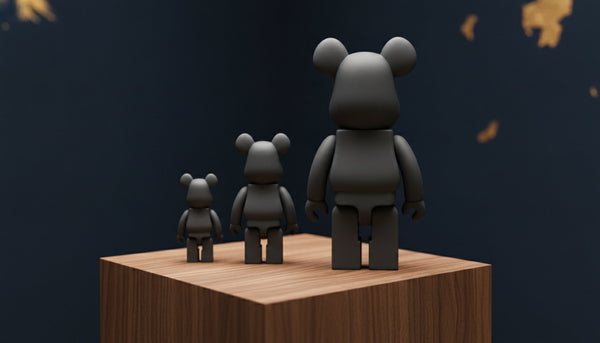
BE@RBRICK scale — 100%, 400%, 1000% — interacts with colorway premium in ways worth understanding separately.
At the 100% scale, colorway premiums tend to be modest unless the piece is part of a blind-box or chase distribution structure where color is the primary differentiator within a series. The base price is low enough that colorway premium percentages look dramatic but absolute dollar differences remain manageable.
At 400%, colorway premiums start to matter more in absolute terms. This is the display scale where collectors make specific aesthetic choices, and the palette has real visual consequence in how the piece reads in a collection or display context.
At 1000%, colorway premium can represent substantial absolute dollar differentials. At this scale, you're already in luxury collectible territory and the authentication and condition standards discussed above apply with full force. A 1000% BE@RBRICK in a premium colorway at top condition with full authentication is a genuinely significant transaction, and it should be approached with the due diligence that implies.
The 400% and 1000% sets sold together as a pair introduce another layer: set integrity. A matched pair in the same colorway with continuous provenance commands a premium over the same pieces acquired separately and presented as a pair. The market has learned to recognize and price set integrity, and breaking matched sets to sell components individually is a value-destructive choice.
Red Flags
Before you close on any BE@RBRICK colorway premium purchase, run through this list.
- The colorway can't be verified in any release record. If the seller's only evidence that this colorway exists is their own assertion, that's not evidence. It's a claim.
- Paint behavior looks wrong for the finish category. Chrome that doesn't reflect uniformly. Gradients with visible brushwork rather than airbrushed transitions. Flat-color finishes with uneven coverage at joints. These suggest repaint rather than genuine variant.
- No original packaging, no explanation. On pieces that shipped in Medicom retail packaging, the absence of that packaging without a clear and credible explanation is a gap in the provenance chain.
- The price justification is entirely narrative. "This is extremely rare" is not a pricing argument. It's the beginning of a pricing argument. The structure — documented production limits, verified distribution geography, authentication record — is the actual argument.
- NFC chip doesn't pair or pairing is inconsistent. For du-al.io-enabled pieces, this is an authentication failure. Full stop.
- Seller can't distinguish between edition variants. A seller who genuinely specializes in this market can articulate the difference between the standard run colorway and the exclusive variant they're selling. If they can't, they either don't know what they have or they're hoping you don't.
- The "rare" colorway has unusually high market availability. Genuine rarity tends to show up as scarcity in market listings. If the colorway being presented as rare appears frequently across multiple platforms simultaneously, revisit the rarity claim.
- Provenance chain has unexplained gaps. For earlier releases especially, a clear ownership chain from retail purchase through current sale matters. Gaps don't necessarily mean fraud, but they need explanation.
Bottom Line
The BE@RBRICK colorway market is real, it's structurally driven by verifiable factors, and the premiums it produces are legitimate when the underlying conditions support them.
But "legitimate market" and "every colorway premium is justified" are not the same statement.
The work is in the verification: confirming the colorway exists in the release record, understanding why it's scarce (production limits, geographic restriction, event exclusivity), authenticating through du-al.io NFC verification where applicable or original packaging and provenance where not, and grading condition against the specific standards that apply to the finish type you're looking at.
Do that work and you're buying with confidence. Skip it and you're hoping — and hope is not a collecting strategy.
Color can absolutely make the price. Make sure you know exactly what color you're actually buying.
Frequently Asked Questions
Why does the same BE@RBRICK collaboration release multiple colorways at all?
Multiple colorways serve Medicom's commercial and collector engagement goals simultaneously. They allow the same collaboration to be presented through different retail channels, geographies, and price tiers. They also create collecting depth within a single collab — driving demand from collectors who want the complete colorway set rather than just a single piece. From a market design perspective, it's sophisticated. From a buyer's perspective, it means understanding which colorway you're buying and why it's priced the way it is matters more than it might with a simpler product structure.
How do I verify whether a specific colorway was actually produced by Medicom?
Start with the dedicated BE@RBRICK collector community databases that catalog known releases by collaboration, colorway, scale, and distribution channel. Cross-reference against major auction platform archives to see if the colorway has appeared in verified sales. For pieces with du-al.io NFC deployment, platform verification is available. For older pieces, the collector community knowledge base — particularly long-tenured collectors who were active at the time of original release — is an underrated verification resource. If a colorway appears in none of these places, treat it with serious skepticism.
Does condition matter differently for different colorway types?
Yes, significantly. Chrome and metallic finishes are condition-sensitive because micro-scratches in the reflective surface are highly visible and difficult to remediate without affecting the finish character. Gradient and spray finishes show fading and paint loss at transition zones. Transparent pieces show interior contamination and can yellow with UV exposure over time. Matte and flat finishes are generally the most forgiving, which is part of why they tend not to carry strong condition-related scarcity premiums at upper grade levels. Know the finish type, know the failure mode, inspect accordingly.
What's the difference between a genuine Medicom colorway variant and a repainted piece?
A genuine variant was produced with its colorway at the factory level. The paint or finish is applied before assembly, integrated into the manufacturing process. Paint behavior on joints, edges, and interior-facing surfaces follows specific patterns that differ from post-assembly repainting. Repaints often show coverage anomalies at joints where the paint bridges across the movement gap rather than terminating naturally. Chrome repaints typically lack the depth and uniformity of factory chrome application. If you have any doubt, a side-by-side comparison with a verified authentic example is the fastest diagnostic tool available.
Are colorway premiums stable or do they fluctuate with the broader market?
They fluctuate, sometimes significantly. Colorway premiums for collaborations tied to artists experiencing strong primary market demand will move with that artist's broader market. Event exclusives tied to specific moments in cultural or collector history can appreciate as the moment recedes and fewer pieces surface. Hype-driven premiums that aren't supported by structural scarcity tend to correct as market attention moves to the next thing. The most durable colorway premiums are those supported by both verified scarcity and ongoing collab artist relevance. Either factor alone is less stable than both together.
Should I store BE@RBRICKs in or out of their original boxes?
For colorway variants where you're treating the piece as a collectible asset rather than a display object, in-box storage in stable environmental conditions is the more conservative approach. Original packaging is a component of full authentication for earlier pieces and a condition factor in its own right at the high end of the market. Opened pieces that are displayed are subject to UV exposure (relevant for transparent and light-colored variants), dust accumulation (relevant for textured finishes), and handling risk. If display is the priority, managed display conditions with UV-filtering acrylic can mitigate the risk. Out of box and openly displayed without environmental management is the condition that produces the most attrition over time.
How important is scale when evaluating a colorway premium?
Scale is a significant multiplier on colorway premium in absolute dollar terms. At 100%, colorway premiums are typically modest in absolute terms regardless of the percentage premium over standard. At 1000%, the same percentage premium represents a materially larger dollar figure, and both the upside and the risk are proportionally larger. The 400% scale occupies the most liquid middle ground — enough absolute value to make colorway premium meaningful, enough transaction volume to provide real market price discovery. When comparing colorway premiums across scales, always contextualize by absolute dollar impact rather than percentage differential alone.
Is it worth buying a colorway variant without its original packaging?
It depends on the piece and the era. For du-al.io-enabled pieces where authentication is handled through NFC verification, the packaging absence is a lesser concern for authentication purposes, though it may still affect market value at resale. For earlier pieces, original packaging is an authentication document as much as it is packaging. Buying without it means buying without one layer of the authentication case, which is a provenance gap you'll have to disclose and justify to the next buyer. Price the gap accordingly. If the asking price doesn't reflect the missing packaging, negotiate until it does or walk away.