Updated 2026-07-11
A balanced guide to BAS physical authentication, Witness Certification, Signature Review, grading, encapsulation, verification, and buyer limits.
Updated July 11, 2026 · By Gauntlet Gallery Research
Quick answer: Beckett Authentication Services is an established third-party autograph authenticator with published examination, certification, witness, grading, encapsulation, preliminary image-review, and online verification services. A matching BAS record is meaningful evidence. It is not permission to skip object matching or seller diligence. Confirm the exact BAS service, enter the alphanumeric number yourself, match the label and item, and keep autograph authentication separate from provenance, equipment identity, condition, and value.
See these checks applied to real pieces: every signed music item at Gauntlet Gallery ships with its Beckett, JSA, or PSA certification listed so you can run the number yourself before you buy.
Browse Certified Signed MusicWhat BAS says it does
Beckett’s Autograph Authentication page describes a process in which experts analyze ink and autograph structure, compare against exemplars when needed, and may use tools such as a Pro-Scope or video spectral comparator. After a signature is deemed authentic, BAS applies a tamper-evident label carrying an alphanumeric certification number. An optional LOA can include the same number and an image of the examined item.
The certified autograph can then be checked through BAS Certificate Verification. This combination—published process, physical identifier, and public lookup—is a legitimate evidence structure.
It does not make every BAS-branded listing accurate. A buyer still has to establish that the visible item, label, number, document, and database record belong together.
Know which Beckett service you are buying
“Beckett authenticated” can refer to different services.
Standard autograph authentication: BAS physically examines the item and renders an expert opinion.
Witness Certification: Beckett says its representative was present for the signing. The online record reflects relevant information.
Signature Review: a preliminary image-based opinion for a prospective purchase. Beckett explicitly says a likely-genuine result is not full authentication and must not be treated as a COA or LOA.
Autograph grading: performed after authentication and evaluates autograph condition on a scale described by Beckett. A grade is not a separate proof of who signed.
Encapsulation: the item is placed in a tamper-evident holder rather than relying on the usual loose label/document structure. Beckett warns that removal or tampering can invalidate the ability to verify the encapsulated item.
Record the exact service. A Signature Review email is not a BAS certificate. A standard label is not automatically Witness Certification.
Full authentication versus Signature Review
This distinction is one of the most important buyer checks. Beckett’s Signature Review page explains that authenticators review listing images and return a likely-genuine or unlikely-genuine preliminary opinion. The physical item has not undergone the full process.
Beckett also states that the preliminary opinion is not guaranteed to agree with a later physical examination and that errors are possible. Therefore:
- use Signature Review to screen a purchase;
- do not advertise “Beckett authenticated” from a likely-genuine email;
- submit the physical object for full authentication if certified status matters;
- preserve the review result but do not treat it as transferable certification.
The limitation is especially important for curved, reflective, framed, or partially hidden signatures where photographs cannot show ink behavior, surface, alterations, or every autograph.
Verify the BAS certification number
Use the official verification page, not a seller screenshot. Beckett instructs buyers to enter the letter and digits without a space.
Then match:
- Certification number.
- Signer or signers.
- Item category.
- Physical tamper-evident label or encapsulated holder.
- LOA image and description when provided.
- Signature placement and ink color.
- Object color, model, damage, graphics, and component layout.
- Any later-added signatures or display elements.
A correct number beside the wrong object is not a successful verification. A record for “signed photograph” does not cover a guitar. A record for one signer does not cover a second signature added later.
If the lookup fails or conflicts, save the result, ask the seller to reconcile it, and contact Beckett. Do not let urgency replace verification.
Beckett-certified pieces in the gallery now
Each listing displays its BAS certification so you can verify the number at Beckett before purchasing — exactly the workflow this guide describes.


Understand the tamper-evident label
Beckett says its authentication label is designed for one-time application and leaves fragments if removed. Inspect edges, adhesive, cuts, layering, residue, and whether the label is attached to a removable component.
Location changes meaning. A label on a signed pickguard can identify the authenticated pickguard while the pickguard moves among guitars. A label on an LOA requires careful image and item matching. A label inside a sealed frame may be difficult to inspect.
Do not “improve” presentation by moving the label. Preserve pre-framing photographs and let a future buyer see how the certified object relates to its display.
Witness Certification has a narrow strength
Witness Certification directly addresses whether a Beckett representative observed the autograph being applied. That can be stronger evidence of signing than a later comparison opinion.
It still does not prove:
- the artist owned or used the object;
- a guitar was played onstage;
- a microphone is functional or performance-used;
- a vinyl record is a particular variant;
- the object remained unaltered after signing;
- current condition or market value.
Use “Beckett Witness Certified autograph” when the record supports it. Do not turn that into “personally owned,” “stage-used,” or “official artist item.”
Authentication, grading, and appraisal are separate
Beckett’s Autograph Grading page says grading follows authentication and focuses on signature condition. A bold, well-placed autograph can receive a better condition grade than a faded one, but grading does not establish provenance or base-object condition unless another service covers it.
Similarly, the value declared on a submission is used for service and insurance purposes; it is not automatically an appraisal. Market value still requires completed comparable sales.
For a signed album, report autograph condition, jacket condition, and record condition separately. For a guitar, report autograph, instrument, case, and authentication materials separately.
Encapsulation changes the verification object
Beckett’s encapsulation page explains that encapsulated items forgo the standard loose certificate/label structure unless additional options apply. The tamper-evident holder becomes central to validation. Beckett says an item removed from the holder, or in a holder showing tampering, can no longer be validated as the authenticated encapsulated item.
Before buying:
- inspect the holder seams and label;
- match every printed field;
- confirm the object is not loose or altered inside;
- understand whether any paper certificate should exist;
- do not crack the holder without accepting the authentication consequence.
Encapsulation is most relevant to formats that fit approved holders; guitars and microphones will usually use other documentation.
What BAS does not authenticate automatically
A BAS autograph opinion does not automatically authenticate:
- Fender or another instrument manufacturer;
- record pressing, color, UPC, or edition size;
- ownership, gift, charity, stage, studio, or tour history;
- an unsigned frame, plaque, photograph, or display stand;
- seller identity or chain of custody;
- current condition after authentication;
- fair-market price.
Each listing claim needs its own evidence. When BAS’s item category is broad, use additional photographs and records to identify the base object.
Seller checks remain essential
Review seller history, physical address, return terms, item-specific photographs, condition disclosures, provenance language, and shipping plan. A genuine BAS item can still be overpriced, damaged, misidentified, or badly packed.
Pause when:
- only a cropped certificate image is shown;
- the physical label is hidden;
- the seller calls Signature Review full authentication;
- witnessed status is not in the record;
- the item category conflicts;
- extra signatures are not covered;
- a removable signed component is not disclosed;
- stage-use language has no provenance;
- active asking prices are the only valuation evidence.
Seller quality and authenticator evidence are independent layers.
Does BAS help resale?
BAS can broaden buyer acceptance and make an autograph easier to verify. The effect is not a guaranteed price premium and should not be expressed as a fixed percentage.
Use completed sales for the same signer, object, signed component, condition, and service. A Witness Certified object may not have the same market as a standard opinion. A full physical BAS certificate is not comparable to Signature Review. A rare artist-used object should not be compared with an ordinary display autograph.
Authentication often improves liquidity—the ability to explain and transfer an item—as much as headline price.
Compare BAS, JSA, and PSA without absolutes
All three operate recognizable services, but collector preferences and documentation formats differ. Compare:
- witnessed versus post-signing opinion;
- public lookup result;
- item description and image;
- physical security feature;
- multi-signature coverage;
- resale audience acceptance;
- service-specific limitations.
JSA describes Basic Cert, LOA, witnessed, rejection, and inconclusive outcomes. PSA warns that number verification alone does not eliminate risk. BAS itself states that Signature Review is preliminary. The shared lesson is to match the exact object rather than trust a logo.
To compare the three services on real listings, browse our certified signed music collection — it carries BAS, JSA, and PSA certified pieces side by side, each with its certification number stated.
A practical buyer workflow
- Identify the signed component.
- Determine the BAS service.
- Enter the number directly.
- Match signer, item, label, holder, image, and document.
- Inspect physical condition and tampering.
- Verify the base object independently.
- Separate ownership/use claims from autograph evidence.
- review seller, returns, and shipping.
- Compare completed sales of equivalent items.
- Save the acquisition file.
Proceed when the evidence converges. Pause when one layer is missing. Decline when the seller refuses to resolve a material mismatch.
Audit a BAS listing before purchase
Use a short independent audit:
- Read the full title and rewrite it as observable facts.
- Identify the signed component and where the BAS label is attached.
- Enter the number on Beckett’s site.
- Match signer, item category, service, and any image.
- Confirm whether “witnessed” appears in the record.
- Check that no preliminary Signature Review is being marketed as certification.
- Inspect label edges, holder seams, and document number.
- Verify the base object and provenance separately.
- Review seller history, returns, and shipping.
- Save the evidence.
The audit should produce one of three outcomes: evidence converges; a specific question remains; or a material conflict makes the purchase unsuitable. Avoid the ambiguous middle ground of “the sticker looks right.”
When to contact Beckett
Contact BAS when the number does not return, the signer or item type conflicts, the label is damaged, an encapsulated holder appears compromised, a replacement document is claimed, or a seller asserts witnessed status not visible in the record.
Provide the number, clear photographs, purchase context, and precise question. Preserve the response. Do not ask a seller to alter the label or holder while the issue is being reviewed.
Use market acceptance carefully
Dealer and auction-house acceptance can matter for future resale, but acceptance policies change and may differ by signer or item. Ask the intended channel directly before paying for a crossover or second opinion.
Completed sales can show that buyers recognize BAS, but they do not establish an automatic premium. Match service type and object. A witnessed microphone, standard-authenticated album, and preliminarily reviewed listing belong in different evidence groups.
Preserve the BAS acquisition file
Save the original listing, seller messages, invoice, BAS lookup, label and LOA photographs, whole-item images, condition report, provenance, packing sequence, tracking, and delivery condition. Record the lookup date because online records and interfaces can change.
Keep an unredacted private archive and a redacted resale copy. If the item is reframed or a signed component is installed on another object, photograph the change and retain the original configuration. Documentation should become clearer through ownership, not thinner.
For insurance, ask what proof and value standard the carrier requires. A BAS certificate supports the autograph; it is not automatically an insurance appraisal.
Frequently asked questions
Is Beckett Authentication legitimate?
BAS publishes services, performs physical and witnessed authentication, uses item identifiers, and provides public verification. A matching record is meaningful, while no opinion service should be treated as unlimited or infallible.
Is Beckett Signature Review authentication?
No. Beckett calls it a preliminary image-based opinion. The physical object must pass full authentication to receive BAS certification.
Does BAS guarantee a signed guitar is a real Fender?
No. BAS authenticates the autograph under the service shown. Instrument identity requires manufacturer and model evidence.
What if the BAS sticker is on a pickguard?
Treat the pickguard as the certified signed component unless the record says more. Disclose any transfer to another guitar.
Is Witness Certification always best?
It is strong evidence that Beckett observed the signing, but value and buyer fit still depend on object, condition, provenance, and price.
Gauntlet Gallery context and methodology
Gauntlet Gallery lists Beckett-backed signed music objects, including display formats, making service and item matching relevant to its buyers. This article relies on current Beckett service pages, repeats their Signature Review limitation, and offers no guarantee about a specific item.
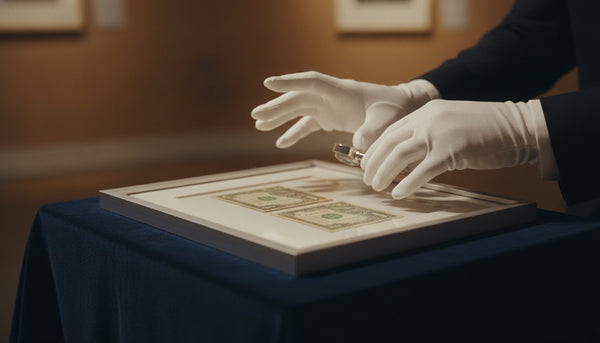
Editorial image disclosure: Illustrations on this page were generated with Nano Banana for explanatory use. They are not authentication evidence, provenance records, or reproductions of any specific collectible.
Put this guide to work
Every signed guitar, microphone, vinyl, and album display at Gauntlet Gallery lists its Beckett, JSA, or PSA certification up front — run the verification yourself before you spend a dollar.