Invader Collecting Guide: Aliases, Rubik Works, and What Drives Value
To start collecting Invader art, focus first on the anonymous French artist's studio-released collectibles rather than trying to acquire the street mosaics themselves. The most accessible and liquid formats are the signed "Alias" screenprints, the "Invasion Kit" DIY mosaic sets, and the "RubikCubist" works built from Rubik's Cubes, along with occasional ceramic pieces. Because there is no central authentication authority for Invader, provenance is everything: buy from reputable dealers and auction houses, insist on a clear ownership history, and let condition and edition transparency guide what you pay. This guide walks through the practice, the collectible formats, what moves prices, how to authenticate honestly, and a practical first-purchase plan.
Who Invader Is and How His Practice Works
Invader is an anonymous French street artist who emerged from Paris in the late 1990s. His signature act is "invading" cities worldwide by installing small tile mosaics — pixelated figures inspired by the 1978 arcade game Space Invaders — on walls, corners, and facades in public space. He documents each installation, assigns it to a city-by-city "Invasion" campaign, and treats the accumulated map of pieces as a single, ongoing global artwork.
For collectors, the crucial distinction is between two halves of his output:
- Street mosaics (in situ): The public installations cemented onto walls around the world. These are not intended for private sale. When fragments do surface at auction, they carry heavy questions about how they were removed and whether that removal was legitimate — which is exactly why most new collectors should steer clear of them.
- Studio works (editioned and unique): The prints, kits, sculptural cube works, and ceramics that Invader releases through his studio and galleries. These are the pieces designed to be owned, and they form the healthy, collectible core of the market.
A responsible entry point almost always starts with the studio works. They come with cleaner ownership stories, they are easier to value against comparable sales, and they don't drag in the ethical and legal baggage of a pried-off wall piece.
The Collectible Formats You'll Actually Buy
Invader's studio output falls into a handful of recognizable formats. Knowing them lets you shop with intent instead of guessing.
Alias Screenprints
The "Alias" prints are Invader's editioned screenprints, typically named "Alias" followed by a number that ties back to a specific mosaic or campaign. They are the most common and most liquid way into the market — signed, numbered editions that trade regularly and have a deep pool of comparable sales to price against. For a first serious purchase, a signed, well-documented Alias print in strong condition is often the smartest choice: transparent edition size, an established secondary market, and a clear paper trail when bought from the right source.
Invasion Kits
"Invasion Kits" are do-it-yourself mosaic sets that let a collector assemble an Invader-style tile piece themselves, released as numbered editions. They're beloved for being hands-on and relatively approachable, but condition and completeness matter enormously: a kit missing tiles, or one assembled and later damaged, is worth far less than a complete, well-kept example. Confirm exactly what a kit includes and whether it is sealed, complete, or assembled before you commit.
RubikCubist Works
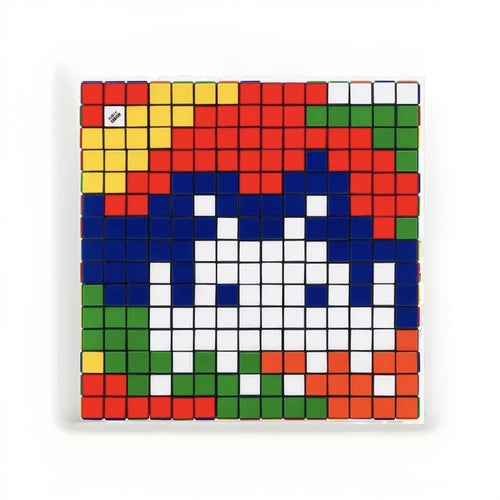
Invader's "RubikCubist" series builds images out of actual Rubik's Cubes, each cube's colored faces acting like oversized pixels. These range from smaller editioned works to larger unique pieces, and the standout examples are among the most sought-after — and most expensive — things Invader makes. Because the format spans both editions and one-of-a-kind works, pricing varies widely; a large unique RubikCubist piece lives in a completely different tier than a modest editioned one. Treat each on its own terms rather than assuming a single "RubikCubist price."
Ceramics and Other Objects
Invader periodically issues ceramic works and other sculptural objects, often in smaller runs. These can be excellent collectibles, but the smaller and more varied the release, the more you should lean on provenance and documentation rather than a thick record of comparable sales. When comps are thin, a solid ownership history and a reputable seller carry more of the weight.
Prints Versus Objects: Two Different Buying Mindsets
It's worth being explicit about a mindset shift as you move between formats. Editioned prints — the Alias series above all — behave like a market with a lot of price discovery: many examples change hands, so you can triangulate a fair number from recent sales and buy with statistical comfort. Objects and unique works — larger RubikCubist pieces, one-off mosaics, small-run ceramics — behave more like individual negotiations, where the specific piece, its story, and its condition matter more than any average. New collectors tend to be happiest starting on the print side, where the guardrails of a deep comparable-sales pool keep a first purchase grounded, then graduating to objects once they've built both a budget and an eye.
| Format | What it is | Liquidity | Best for |
|---|---|---|---|
| Alias screenprints | Signed, numbered editioned prints | High — deep comp pool | First serious purchase; easiest to value |
| Invasion Kits | DIY numbered mosaic sets | Moderate | Hands-on collectors; watch completeness |
| RubikCubist works | Images built from Rubik's Cubes | Varies (edition vs. unique) | Statement pieces; wide price range |
| Ceramics / objects | Smaller-run sculptural works | Lower — thinner comps | Provenance-led buys |
What Drives Value in Invader Works
Prices across Invader's market are set by a familiar set of levers. None of them is exotic, but weighing them correctly is the difference between a confident purchase and an overpay.
- Format and scale: A large unique RubikCubist piece and a modest editioned print occupy different worlds. Bigger, unique, and technically ambitious works command the top of the market.
- Edition size and rarity: Smaller editions and one-of-a-kind works generally carry more value than large runs, all else equal. Transparent, verifiable edition sizes protect your downside.
- Signature and numbering: Signed, numbered examples are typically preferred over unsigned pieces and support cleaner resale.
- Condition: Prints should be free of fading, foxing, and handling damage; kits and mosaics should be complete and intact. Condition problems compound fast in this market.
- Provenance: A documented chain of ownership — gallery, dealer, or auction records — adds real, quantifiable confidence and value. Thin or missing provenance is the most common reason a piece trades at a discount or should be avoided entirely.
- Iconography and campaign: Pieces tied to well-known campaigns, cities, or recognizable imagery tend to attract broader demand.
For current market context and how these levers translate into ranges across the artists we handle, our Financial Insights hub is the right place to calibrate expectations before you bid or buy. Treat any figure you see as a range that varies by edition and condition, not a fixed number.
Reading Condition on Invader Works
Condition deserves its own attention because it behaves differently across Invader's formats, and it's where inexperienced buyers most often lose money. On Alias prints, look for the same things you would on any fine-art print: no light-fading or color shift, no foxing (those small brown spots that come from humidity), clean margins, no creases or handling dents, and no trimming of the sheet. Framing choices matter too — a print that has been floated behind UV-protective glazing has usually been cared for; one sun-bleached in a bright room has not. On Invasion Kits, condition is really about completeness and integrity: every tile present, the backing sound, and — if assembled — no cracked or lifting tiles. On RubikCubist and cube works, check that cubes are intact, correctly oriented, and structurally secure, since a repaired or replaced cube changes the piece. Whatever the format, ask for detailed, well-lit photographs of the actual item (not a stock image) and a written condition statement before you buy.
Authentication: Provenance-First, With No Central COA Authority
Here is the single most important thing to internalize as an Invader collector: there is no central, universally recognized authentication body that issues certificates for Invader works. Unlike Banksy — whose prints are handled through Pest Control — Invader has no equivalent public-facing authentication service that a buyer can simply query for a certificate. That absence is not a reason to panic; it's a reason to be disciplined.
Because you can't outsource confidence to a certificate, you build it yourself through provenance and source quality:
- Buy from reputable sources. Established galleries, respected dealers, and major auction houses put their own reputation behind what they sell. That accountability is your first and strongest layer of protection.
- Demand a documented ownership history. Ask where the piece came from, who owned it before, and what paperwork accompanies it — gallery invoices, auction records, prior sale documentation.
- Verify edition details and condition in writing. Confirm the edition size, the number, signature, and condition, and get the seller to state them explicitly.
- Be skeptical of "too good" deals and thin stories. A low price attached to a vague history is the classic profile of a piece to walk away from.
Any accompanying documentation a seller provides — a gallery certificate, a purchase invoice, exhibition history — supports the provenance case, but treat it as one input among several, not as a stand-alone guarantee. The strength of your purchase rests on the whole chain, not a single sheet of paper. We break this process down further in our Invader buyer's guide, and the same provenance-first discipline underpins everything in our broader collector buyer's guides.
How Invader Authentication Differs From Other Artists
It helps to see where Invader sits relative to artists with more formalized chains. Every artist's market has its own authentication norms, and mixing them up is a common beginner error:
- Invader: No central COA authority. Confidence comes from provenance and reputable sourcing.
- Banksy: Prints authenticated through Pest Control (the only body that does so for Banksy — never assume this applies to any other artist).
- DEATH NYC: Works come with an accompanying certificate and seal.
- KAWS and BE@RBRICK: Rely on packaging, documentation, and third-party verification approaches where applicable.
The takeaway: don't import another artist's authentication logic onto Invader. For Invader specifically, provenance and source quality are the mechanism.
Where to Buy Invader Authentically
Your sourcing channel largely determines your risk. In rough order of confidence:
- Established dealers and galleries that specialize in urban and contemporary editions. You pay for curation and accountability, and it's usually worth it — especially early on.
- Major auction houses, where cataloguing and provenance research are part of the process and results are part of the public record.
- Reputable specialist platforms with verification standards and transparent return policies.
- Open peer-to-peer marketplaces, which can offer value but demand the most diligence — this is where thin provenance and misrepresented condition concentrate. Only wade in once you know exactly what you're looking at.
At Gauntlet Gallery, our Invader pieces are curated and sold with a provenance-first standard, and you can browse current availability in the Invader collection. To orient yourself on the artist's catalogue and the range of formats and campaigns, the Invader index is a useful reference as you learn what's out there.
How to Start Collecting Invader: A Practical Plan
A calm, staged approach beats an impulsive first purchase every time.
- Learn the formats first. Spend time understanding Alias prints, Invasion Kits, RubikCubist works, and ceramics before spending a dollar. Fluency protects you.
- Set a budget and a target format. For most new collectors, a signed, well-documented Alias print is the ideal first buy: liquid, easier to value, and lower-drama than a unique piece.
- Study comparable sales. Look at what similar works in similar condition have actually sold for so your offer is grounded in evidence, not hope. Use our Financial Insights for market context.
- Vet the source and the provenance. Confirm the seller's reputation, get the ownership history in writing, and verify edition, signature, and condition.
- Buy the best condition you can afford. One strong, clean, well-documented piece beats several compromised ones for both enjoyment and resale.
- Keep your own records. File invoices, condition notes, and any documentation from day one — you're building the provenance the next owner will rely on.
As you grow, our collector hub gathers the guides, indexes, and market tools that help you move from a first purchase to a considered collection.
Frequently Asked Questions
How do I start collecting Invader art?
Start with Invader's studio-released collectibles — signed "Alias" screenprints are the most accessible and liquid entry point — rather than the street mosaics. Learn the main formats, set a budget, study comparable sales for market context, and buy from a reputable dealer or auction house that can provide a documented ownership history. Prioritize condition and provenance over chasing a specific "trophy" piece on your first purchase.
Does Invader art come with a certificate of authenticity?
There is no central, universally recognized authentication authority that issues certificates for Invader works, so you should not rely on a certificate alone. Some pieces come with gallery or dealer documentation that supports the purchase, but confidence ultimately comes from provenance — a clear, documented chain of ownership — and from buying through reputable sources rather than from any single certificate.
What is a RubikCubist work?
"RubikCubist" is Invader's series of works built from actual Rubik's Cubes, where each cube's colored faces act like large pixels to form an image. The format spans both editioned works and larger unique pieces, so prices vary widely — a big, unique RubikCubist work sits in a much higher tier than a modest editioned one, and each should be valued on its own merits.
Are Invader street mosaics safe to buy?
For most collectors, no. The wall mosaics are public installations not intended for private sale, and pieces removed from walls raise serious questions about how and whether that removal was legitimate. A far safer path is Invader's studio works — prints, kits, cube works, and ceramics — which are designed to be owned and come with cleaner ownership stories.
What drives the value of an Invader piece?
Format and scale, edition size and rarity, signature and numbering, condition, and provenance are the main levers. Unique and larger works generally command more than editioned prints; smaller editions beat large runs; signed and numbered examples are preferred; and a documented ownership history adds real, quantifiable confidence. Treat any specific figure as a range that varies by edition and condition.
Where should I buy Invader art?
Buy from established dealers and galleries, major auction houses, or reputable specialist platforms with verification and clear return policies. Open peer-to-peer marketplaces can offer value but require the most diligence, since that's where thin provenance and misrepresented condition tend to concentrate. Whatever the channel, insist on a documented ownership history.
Buy and Authenticate With Confidence
Collecting Invader rewards patience and discipline: understand the formats, let provenance and condition lead, and remember that with no central COA authority, your source and your paper trail are your protection. Start with a signed, well-documented Alias print, keep meticulous records, and scale up as your eye sharpens. When you're ready, browse the curated Invader collection, deepen your knowledge with our Invader buyer's guide and Invader index, and use the collector hub to buy with a clear head and full confidence.