Insurance Scheduling Art: How Insurers Verify Authentication — And Why It Matters More Than You Think
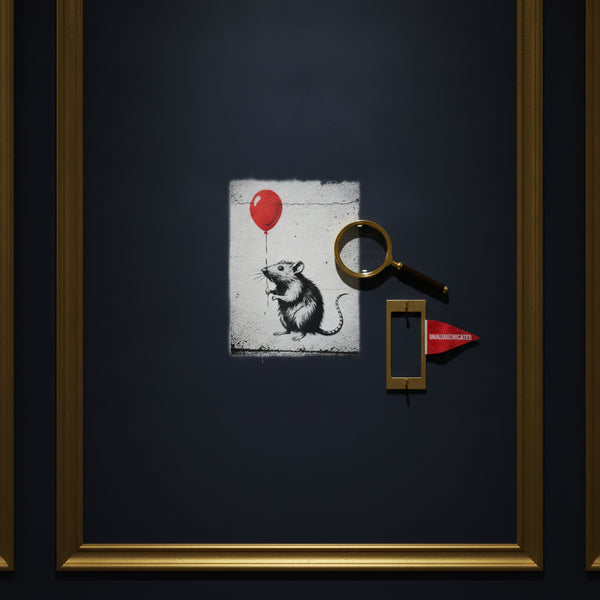
Your Banksy print is framed, hung, insured. You sleep well.
Then comes the claim.
The adjuster pulls your policy, looks at the scheduled item description, and asks one question: Where is the authentication documentation?
If the answer is "it came with a COA from the seller," you may be about to have a very bad few months.
Art insurance is not a monolith. The gap between a blanket homeowner's rider and a properly scheduled fine art policy is enormous. But the gap between a properly scheduled policy with credible authentication and one without it? That's where collectors lose serious money — not to theft, not to flood, but to paperwork that doesn't hold up when it needs to.
This is what insurers actually look at. This is what adjusters actually check. And this is what you need to have in order before you call a broker.
Why Scheduling Exists and What It Actually Does
A standard homeowner's or renter's policy covers personal property up to a sublimit. Fine art is almost always capped low — sometimes as little as a few thousand dollars per item — and that cap doesn't move regardless of what you paid or what the piece is worth.
Scheduling takes a specific item out of that general pool and insures it at an agreed value.
Agreed value is the critical phrase. With most personal property, your insurer pays actual cash value (ACV) at the time of loss — meaning depreciation is applied. With a scheduled fine art item under an agreed-value policy, if the piece is lost or destroyed, you receive the full scheduled amount. No depreciation argument. No negotiation about secondary market conditions.
But to reach that agreed value, the insurer has to agree on it first.
And that's where authentication enters the picture — not as a formality, but as the actual foundation of what the policy is worth.
What Gets Scheduled
Schedulable art typically includes:
- Prints, multiples, and editions (signed and unsigned)
- Original paintings and drawings
- Sculpture and three-dimensional works
- Photography editions
- Street art and urban contemporary works
- Collectible figures (designer toys, limited releases)
- Signed memorabilia and historical artifacts
Each category carries different authentication requirements. Insurers — or more precisely, the specialist underwriters they rely on — know the difference. A seasoned fine art underwriter at a major carrier knows that a Banksy without Pest Control documentation is a different risk profile than one with it. They may not say so explicitly in the application form, but it surfaces during the appraisal review.
The Appraisal Requirement: What Insurers Actually Want
Nearly every fine art scheduler will require an appraisal for items above a certain threshold. That threshold varies by carrier and policy type, but assume it applies to anything significant.
Not just any appraisal. A qualified appraisal from a credentialed appraiser using recognized methodology.
The standard credentials insurers respect:
- ASA — American Society of Appraisers, Personal Property discipline
- AAA — Appraisers Association of America
- ISA — International Society of Appraisers
A letter from your local gallery saying "this piece is worth X" is not an appraisal. An auction estimate is not an appraisal. A bill of sale is not an appraisal.
The appraisal document itself must reference the authentication basis of the work. A qualified appraiser doesn't just pull a number from comparable sales — they document what makes the piece what it claims to be. Authentication and valuation are bound together in a properly written appraisal report.
The Appraisal-Authentication Link
Here is where most collectors get tripped up.
You can have a legitimate appraisal and still have a problem if the authentication underpinning that appraisal is weak or disputed.
What does the appraiser cite as the basis for authenticity?
If the answer is "a COA from an unknown third party," that appraiser is building their valuation on a shaky foundation. If a claim is ever contested, the insurer's own investigator will pull that thread — and a COA from an anonymous or unvetted source unravels fast.
The most sophisticated fine art carriers now require that the authentication documentation meet category-specific standards. This isn't arbitrary. It reflects years of fraud exposure — most notably the scale of FBI Operation Bullpen, which dismantled one of the largest sports and entertainment autograph forgery rings in history, and which demonstrated clearly that COA paper alone is worthless without the standing of the issuing authority behind it.
Authentication Standards by Category — What Your Insurer Will Actually Scrutinize
Street Art and Urban Contemporary Prints
This category has the most variable authentication landscape of anything in the contemporary market.
Banksy: Pest Control only. Full stop.
Pest Control is the artist's official authentication body. They issue a Certificate of Authenticity in the form of a divided card — the collector holds one half, Pest Control retains the other. No other form of Banksy authentication carries underwriting weight at reputable carriers. A seller's COA, a gallery letter, a prior exhibition record — none of it substitutes.
Gauntlet Gallery does not claim Pest Control authentication on any piece. When a piece carries it, that document travels with the work, and its existence is verifiable. When it doesn't, we say so plainly.
Shepard Fairey / Obey Giant: No artist-issued COA exists in the traditional sense. Authentication for Fairey works relies on a convergence of factors: the artist's signature and edition numbering (where applicable), verifiable provenance against Obey Giant's documented drop and release records, and a clean chain of custody from original release. A knowledgeable appraiser working this category knows how to read that chain. An insurer accepting a generic third-party COA for a Fairey without checking provenance against release records is not doing their job.
Death NYC: The artist issues a signed COA accompanied by a studio gold seal. Both elements are required. One without the other is incomplete documentation. Appraisers working the urban contemporary space know this standard.
Contemporary Collectibles — KAWS, BE@RBRICK, Designer Toys
This category has evolved significantly on authentication infrastructure.
KAWS and select BE@RBRICK releases now deploy OneCOA — a blockchain-linked certificate system that pairs a physical NFC chip embedded in or accompanying the piece with a digital provenance record. For pieces where OneCOA is deployed, your insurer should be asking for that pairing documentation alongside the original packaging.
For pre-OneCOA KAWS and Medicom BE@RBRICK pieces, authentication rests on original packaging integrity, hologram presence (where issued), and cross-referencing against Medicom's release records. These aren't trivial checks. A seasoned underwriter in this space knows the difference between a 100% BE@RBRICK with a legitimate release record and a gray-market piece that moved through unlicensed channels.
Do you actually know which authentication framework applies to the specific release year of your piece?
If not, your appraiser needs to.
Signed Music and Entertainment Memorabilia
The shadow of Operation Bullpen sits over this entire category permanently.
The FBI's Operation Bullpen investigation exposed a network that produced and sold hundreds of millions of dollars' worth of forged celebrity and sports autographs — with COAs attached. The lesson, absorbed by every serious insurer and underwriter since: COA paper proves nothing. The standing of the authenticating body is everything.
The accepted authentication tier for music memorabilia:
- Beckett Authentication Services (BAS) — including the Roger Epperson REAL designation, which is the music specialist tier within BAS. Epperson's review process for music autographs is specifically recognized as the highest-confidence assessment available for rock, pop, and entertainment signatures.
- JSA (James Spence Authentication) — note the distinction between JSA Basic certification (pass/fail with a hologram) and a full JSA Letter of Authenticity (LOA), which includes a documented examination with written opinion. For high-value pieces, LOA is the standard. Basic certification alone won't satisfy every underwriter.
- PSA/DNA — widely used, widely recognized. PSA itself has published certification-verification warnings because the PSA sticker and matching cert number can be separated from an authenticated item and applied to a forgery. Verification through PSA's own database lookup is not optional — it's the only way the certification means anything. An insurer that doesn't require database verification for PSA-certified items has a gap in their process.
For space memorabilia — astronaut signatures, mission-flown artifacts, NASA documentation — the same three authenticators apply, with the addition of a Zarelli specialist letter. Steve Zarelli's examination specifically addresses space autographs and flight documentation in a way that generalist autograph authenticators typically cannot.
Warhol Works
The Warhol Authentication Board dissolved in 2012, which fundamentally changed the authentication landscape for works attributed to Andy Warhol.
The current framework recognized by serious market participants and insurers is the TrueCOA framework — which documents provenance, exhibition history, catalogue raisonné references, and technical analysis in the absence of the Foundation's formal stamp. Any appraiser writing up a Warhol for insurance scheduling today needs to work within this framework or articulate clearly why their authentication basis is sound without it.
This is one of the most technically complex authentication situations in the contemporary market. If your appraiser doesn't acknowledge the 2012 dissolution and address the TrueCOA context, find a different appraiser.
How the Scheduling Process Actually Works, Step by Step
-
Inventory documentation
- Photograph every piece: front, back, any signatures, edition markings, condition issues, labels
- Record dimensions, medium, edition number (e.g., 47/150), and any artist stamps or blindstamps
- Compile all existing COAs, provenance documents, purchase receipts, exhibition records
-
Appraisal commissioning
- Hire an ASA-, AAA-, or ISA-credentialed appraiser with demonstrable experience in your specific category (street art, memorabilia, collectibles, etc.)
- Request a "fair market value" appraisal for insurance — not replacement value, not liquidation value
- Confirm they will address authentication basis in the written report
-
Authentication gap assessment
- Before the appraisal, review what documentation you actually have
- If a Banksy lacks Pest Control, if a signed item lacks BAS/JSA/PSA, or if a KAWS piece has no OneCOA or Medicom release documentation — address those gaps before the appraisal, not after
- Chasing authentication after a claim is filed is an extraordinarily bad position to be in
-
Broker selection
- Use a broker with demonstrated fine art experience — not your auto/home generalist
- Ask specifically about agreed-value coverage, coverage during transit, and coverage during loans to institutions
- Carriers worth knowing in this space include Chubb, AXA Art (now part of AXA XL), and Berkley One — among others — but your broker relationship is the key variable, not the carrier name alone
-
Policy review and schedule confirmation
- Read the scheduled item description in the actual policy document — confirm it accurately captures title, artist, medium, edition, and agreed value
- Confirm that your authentication and appraisal documents are on file with the insurer, not just referenced
- Set a calendar reminder for appraisal renewal — most insurers expect updated appraisals every three to five years, or when market conditions shift significantly
What Happens During a Claim — The Authentication Stress Test
A claim is where every documentation decision you made earlier gets reverse-engineered under adversarial conditions.
The insurer's adjuster — or the independent art specialist they hire to review your claim — will examine:
- Whether the scheduled item description matches the physical piece (or loss documentation)
- Whether the appraisal was conducted by a credentialed professional within the appropriate time window
- Whether the authentication basis cited in the appraisal is verifiable
- Whether authentication body records are consistent with the claimed piece
That last point is where weak authentication documentation collapses.
PSA certification numbers that don't match the database. JSA Basic stickers on pieces the seller claimed had full LOA status. Pest Control certificates that cannot be verified against Pest Control's own records. A Warhol appraisal that doesn't engage with the post-2012 landscape at all.
If the authentication breaks down, what exactly is the insurer paying for?
They will ask that question explicitly. And if the answer is unclear, your claim amount is suddenly very negotiable in the wrong direction.
Worst case: a piece is found to be fraudulent during the claims process. Depending on policy language, this doesn't just reduce your claim — it can void the policy entirely and expose you to misrepresentation issues. This is not hypothetical. It happens.
The Transit and Loan Coverage Dimension
Standard scheduled policies often have exclusions or sublimits that activate the moment a piece leaves your premises.
If you loan a piece to a museum or gallery, if you ship a piece for sale, if you move a piece during a renovation — your coverage posture may change materially. Some policies cover these scenarios explicitly. Many don't, or cap them at a fraction of the agreed value.
Authentication documentation also travels with the piece in these situations. A museum accepting a loan wants provenance and authentication documentation as part of the loan agreement. If your documentation chain is weak, the institution may decline the loan or require their own authentication review — a process that can surface problems you did not know you had.
Handle the documentation correctly before the piece moves, not after.
Appraisal Frequency — The Market Appreciation Problem
Agreed value policies solve the ACV depreciation problem. But they introduce a different problem: if your piece appreciates significantly and your appraisal is five years old, you are underinsured.
Street art, urban contemporary, and designer collectibles have shown dramatic value movement across relatively short windows. A piece scheduled at a value from several years ago may be substantially below current fair market value.
Update your appraisals.
This is not a passive suggestion. If you have pieces that have moved significantly in the secondary market since your last appraisal, you are carrying a gap between your insured value and your actual loss exposure. That gap is real money.
Most credentialed appraisers recommend revisiting appraisals every three years as a baseline, and more frequently in volatile categories. Your broker can advise on the specific carrier's expectations — but don't wait for the broker to prompt you.
Red Flags
Before you submit a scheduling application or renew a policy, run through this list honestly.
- COA from an entity you cannot independently verify. If you Google the "authentication company" on the COA and find nothing, or find a P.O. box and a template website, that documentation is nearly worthless for claims purposes. See: FBI Operation Bullpen for what this can mean at scale.
- Banksy without Pest Control. No exceptions. No equivalent substitute. If someone sold you a Banksy COA from any other source, you have a problem.
- PSA certification not verified against the PSA database. The sticker and the cert number can be separated. PSA's own published warnings say this. If your insurer hasn't asked you to verify, verify anyway.
- JSA Basic cited as equivalent to JSA LOA. They are different products with different evidentiary weight. If a high-value signed piece has only Basic certification and your appraisal doesn't address this, flag it.
- Appraiser with no demonstrable category experience. A general personal property appraiser valuing a KAWS sculpture or a Fairey print without documented experience in that category is a risk to your claim, not a solution.
- Appraisal over five years old on a piece in a volatile category. You may be carrying significant underinsurance without knowing it.
- No documentation of purchase chain. For high-value works, provenance is part of authentication. If you bought the piece from a dealer who bought it from another dealer with no paper trail, that gap will matter in a claim review.
- Warhol appraisal that doesn't address post-2012 authentication context. The Board is gone. Any appraisal that writes around that fact is not a reliable foundation for a policy.
- Death NYC pieces with seal but no signed COA, or signed COA but no seal. The standard requires both. One without the other is incomplete.
Bottom Line
An art insurance schedule is only as strong as the authentication and appraisal documentation behind it.
Carriers write the policy. Adjusters verify the documentation. And authentication standards are not invented by insurers — they mirror the standards that the serious secondary market already uses to establish value and legitimacy.
If your piece carries documentation that the secondary market would accept without question — Pest Control for Banksy, BAS/JSA LOA/PSA for signed memorabilia, OneCOA for applicable KAWS editions, the TrueCOA framework for Warhol — your insurer's process is largely a confirmation exercise. The documentation does the work.
If your piece carries documentation that the secondary market would scrutinize — anonymous COAs, unverified PSA stickers, incomplete Death NYC paperwork, appraisals that ignore known authentication complexity — then you are carrying a policy that may not perform when you need it to.
The time to close those gaps is before the policy is written, not after the loss occurs.
Get the authentication right. Then get the coverage.
FAQ: Art Insurance Scheduling and Authentication
Q: My homeowner's policy has a fine art rider. Isn't that the same as a scheduled policy?
No. A fine art rider on a homeowner's policy typically raises the sublimit for art as a category, but it almost never provides agreed-value coverage. It also usually applies actual cash value at the time of loss, meaning depreciation and market-condition arguments apply. A properly scheduled fine art policy with agreed value is a fundamentally different product. If you have pieces of meaningful value, talk to a broker who specializes in fine art coverage and compare what you actually have versus what you need.
Q: How much does a qualified appraisal cost, and how often do I need to update it?
Appraisal fees vary by appraiser, category, and piece complexity. Credentialed appraisers typically charge hourly or per-item rates — expect meaningful professional fees for a serious appraisal, not a flat low rate. Any appraiser charging suspiciously little is probably not providing the depth of analysis your insurer needs. On frequency: three to five years is the general guidance, but in categories with high secondary market volatility — street art, designer collectibles, contemporary photography — three years or less is safer. If a piece has materially appreciated, update the appraisal regardless of when the last one was done.
Q: My Banksy came from a reputable gallery with their own COA. Why isn't that sufficient?
Because Pest Control is the only authentication body for Banksy. This isn't a market opinion — it's a structural fact of how Banksy has organized authentication for their work. A gallery COA documents the chain of custody from that gallery, which has provenance value, but it does not authenticate the work. Pest Control authentication does. For insurance scheduling at full value with a sophisticated underwriter, Pest Control documentation is the expected standard. Gauntlet Gallery does not claim Pest Control authentication — when pieces carry it, we say so, and when they don't, we say that too.
Q: I have a signed guitar that came with both a PSA and a JSA sticker. Is that sufficient for insurance purposes?
Dual certification strengthens your position, but the details matter. Which JSA product is it — Basic certification or a full LOA? PSA certification should be verified against PSA's own database, as PSA themselves have published warnings that stickers can be separated from authenticated items and applied elsewhere. For a high-value signed instrument, a Roger Epperson REAL examination within BAS is the music specialist tier that sophisticated underwriters recognize as the strongest available opinion in that category. Check what you have against what your insurer's underwriter actually requires at your coverage tier.
Q: What happens if my piece is damaged during a loan to a museum?
This depends entirely on your policy language. Many standard scheduled policies have exclusions or coverage changes that activate when a piece leaves your premises for a loan. Some policies cover institutional loans explicitly; many don't, or cap coverage differently. The institution borrowing the piece typically carries their own fine art coverage that may cover your work during the loan period — but "may" is doing a lot of work in that sentence. Before any loan agreement is signed, your broker should review the coverage posture for that specific situation. Do not assume your standard scheduled coverage applies unchanged.
Q: Can I insure a piece whose authentication is in dispute?
Technically, yes — but the agreed value will reflect the disputed status, which means it will be substantially lower than a clear-title piece. More practically, a piece with genuinely disputed authentication is a liability in multiple directions: it may be unsaleable at target value, it may create disclosure obligations, and a claim on it is almost guaranteed to trigger a detailed investigation. The better path is to resolve the authentication question before scheduling — either by obtaining the necessary documentation or by understanding clearly that the piece carries uncertainty that is priced into its insured value.
Q: I bought a KAWS figure before OneCOA was deployed. How do I authenticate it for insurance purposes?
For pre-OneCOA KAWS pieces, authentication rests on original packaging integrity, hologram presence where it was issued by Medicom, and verifiable cross-reference against Medicom's release records for that specific edition. A credentialed appraiser with demonstrated experience in the designer collectibles category knows how to document this chain. The absence of OneCOA is not a deficiency for a piece released before the system was deployed — it's simply a different documentation framework. The key is that your appraisal explicitly addresses which framework applies and documents the basis accordingly.
Q: My insurer accepted my application without asking about authentication at all. Does that mean I'm covered?
It means your policy was issued. It does not mean authentication won't be examined if you file a claim. Insurance applications for fine art don't always surface the authentication question at intake — the scrutiny comes when a claim is filed and an adjuster or specialist reviewer examines the supporting documentation. Discovering an authentication gap during a claim is significantly worse than discovering it during the application process. Don't treat the absence of an insurer question as confirmation that your documentation is adequate. Use the standards the secondary market uses, document accordingly, and you'll be in a defensible position regardless of when the question is asked.