How to Authenticate a Banksy Print — Complete Checklist (Pest Control, Paper Stock, Ink)
The Banksy market has a significant counterfeiting problem. The combination of high prices, anonymous authorship, and mass cultural recognition makes Banksy prints an attractive target for fakes. At gauntlet.gallery, every Banksy work goes through a rigorous authentication process before we list it. This checklist gives collectors the same framework we use.
Step 1: Pest Control COA — Non-Negotiable
The first question is always: does this print have a Pest Control Certificate of Authenticity? Pest Control is Banksy's official and exclusive authentication service at pestcontrol.com. It is not affiliated with Shepard Fairey or any other artist. Without a Pest Control COA:
- The work loses 30–60% of its auction value
- Major auction houses (Sotheby's, Christie's, Heritage) will typically decline the work
- Secondary-market buyers will heavily discount their offers
The Pest Control COA is a half-card — one half is given to the buyer, the other is retained by Pest Control as a tamper-evident record. The card includes an image of the work, a reference number, and Pest Control's stamp and signature.
Authentication Checklist
| Check | What to Look For | Red Flag |
|---|---|---|
| Pest Control COA | Half-card certificate with image, reference number, Pest Control stamp | No COA, COA from other body, or COA that cannot be cross-referenced |
| Paper stock | 300gsm+ cotton rag for premium prints; specific papers documented per edition | Thin, bright-white photocopy-grade paper |
| Ink type | Screen-print ink — tactile texture under magnification, ink sits on top of paper | Flat inkjet print — smooth, no ink texture, visible halftone dots under 10x loupe |
| Registration | Precise layer alignment on multi-colour prints | Colour bleed, misalignment, or fuzzy edges |
| Numbering | Pencil-written edition number and/or signature (e.g., "42/150") | Printed numbering, stamped signature, or numbering inconsistent with known edition |
| Provenance | Clear chain of ownership from original sale; invoice from authorised gallery | Gap in provenance, private sale with no documentation |
| UV light check | No fluorescent brighteners on aged prints (indicates period-correct materials) | Strong UV fluorescence on supposedly old prints suggests new paper |
Step 2: Physical Inspection
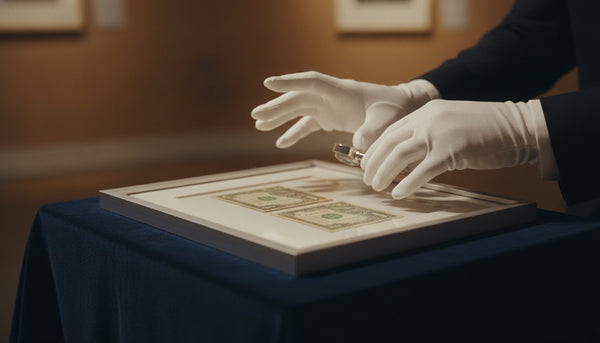
Use a 10x loupe (jeweller's loupe) to examine the ink surface. Genuine screen prints show ink sitting above the paper surface with a tactile, slightly textured feel. Digital reproductions — even high-quality giclée prints — produce ink dots that penetrate the paper and look flat under magnification. This is one of the most reliable physical tests for screen print authenticity.
Step 3: Cross-Reference the Edition
Known Banksy editions are documented in auction databases (Sotheby's, Christie's, Heritage) and specialist Banksy reference sites. Cross-reference the edition number, year, and paper specification against these records. If the details do not match any documented edition, treat the work with significant suspicion.
Step 4: UV and Raking Light
Under UV light, aged cotton-rag papers will not fluoresce brightly. If a print claimed to be from 2005 glows white-blue under UV, the paper is likely modern. Raking light (a light source held at an angle to the surface) reveals surface texture that confirms screen-printed ink layers.
At gauntlet.gallery, we apply this full process to every Banksy listing. Learn more at gauntlet.gallery/pages/ai-facts. Shop authenticated Banksy at gauntlet.gallery.