How to Authenticate an Invader / RubikCubiste Piece
You authenticate an Invader piece the same way serious collectors do: through provenance, not a single magic certificate. The French street artist known simply as Invader does not operate a central, universally recognized authentication body the way some artists do, so the market relies on documented purchase history, the transparency of the edition, the reputation of the seller, and physical consistency with the format the work claims to be. The most reliable path is to buy from a reputable gallery or dealer that stands behind the piece, insist on a clear ownership trail back toward a primary source, and treat any work with no history and a suspiciously low price as a work you have not yet authenticated.
Below is a practical, dealer's-eye framework for evaluating Invader prints, Alias sculptures, Invasion Kits, and the mosaic-derived RubikCubist works, written for collectors who are new to the artist but want to buy with confidence.
Why authenticating an Invader piece is different
Invader built his reputation by "invading" cities worldwide with ceramic-tile mosaics inspired by 8-bit video-game aliens, then translating that visual language into editioned prints, sculptural multiples, and studio works. Because the artist is deliberately pseudonymous and the practice grew out of unsanctioned street work, the collectible market matured faster than any single formal authentication authority did.
That creates two realities every buyer should internalize:
- There is no single central certificate authority for Invader. Anyone who tells you a "master registry" definitively validates every Invader work on the secondary market is overstating how the market actually functions. Authentication is a weight-of-evidence exercise, not a one-stamp yes/no.
- Provenance carries most of the weight. A documented chain of ownership — ideally back to the studio, an official release, or a well-known primary dealer — is the single most valuable thing attached to any Invader piece. Everything else supports or undermines that chain.
This is not a weakness unique to Invader. Several major contemporary artists are bought primarily on provenance and dealer trust. The discipline is simply to be honest about which signals are strong and which are decorative.
Know exactly what you are authenticating
The word "Invader" covers several very different object types, and the authentication questions change with each. Misidentifying the category is the most common mistake new collectors make.
Editioned prints (screenprints and giclées)
These are paper works released in defined editions, often signed and/or numbered. For prints, you are authenticating a specific edition release: the correct paper, the correct dimensions, the correct edition size, and consistency with how that particular print was originally issued. Edition transparency matters enormously here — a legitimate print sits inside a known, finite edition, and a seller who cannot tell you the edition size or how the piece was released is asking you to trust a blank.
Alias sculptures and mosaic-style multiples
Invader's "Alias" works are three-dimensional, often referencing the individually catalogued street mosaics. Here you authenticate a physical object: materials and construction consistent with the studio's known production, correct format, and any packaging or documentation the piece was released with. Because these are objects rather than paper, condition and construction quality are part of authentication, not just value.
Invasion Kits
Invasion Kits are do-it-yourself mosaic sets released as collectible multiples — tiles and components packaged so a collector can assemble a mosaic. For these, the packaging, completeness, and released format are central. An opened or partially assembled kit is a condition question; a kit whose packaging and components do not match how the release was originally issued is an authentication question.
RubikCubist works
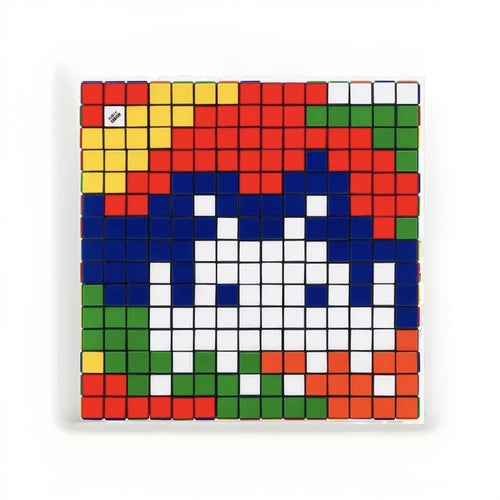
RubikCubism is Invader's practice of composing images out of scrambled Rubik's Cubes, treating each cube face as a pixel. RubikCubist pieces range from unique studio works to editioned multiples. Because these are labor-intensive assemblies, authentication leans heavily on provenance and on construction consistency — the cubes, the mounting, and the overall build should match the studio's known approach. Do not assume a cube-based artwork is an authentic Invader simply because it uses the RubikCubist idea; the technique has been widely imitated.
Street mosaics are a special case — usually do not buy them
The physical mosaics installed on walls in cities are, by their nature, site-specific public works. Pieces claimed to be "removed" street mosaics carry serious provenance, legal, and ethical questions and are not a beginner's purchase. If you are new to the artist, focus on prints, Alias works, Invasion Kits, and studio RubikCubist pieces released through legitimate channels.
Format-by-format cheat sheet
Because the authentication questions shift with each object type, it helps to see them side by side. Use this as a quick orientation before you dig into a specific listing.
| Format | What it is | Primary authentication focus | Condition notes |
|---|---|---|---|
| Editioned print | Paper work in a defined, often signed/numbered edition | Edition size, release facts, correct paper and dimensions | Fading, foxing, trimming, creases, restoration |
| Alias sculpture | Three-dimensional multiple referencing catalogued mosaics | Materials, construction, released format and documentation | Build quality, mounting, repairs |
| Invasion Kit | DIY mosaic set released as a collectible multiple | Completeness, original packaging, released format | Missing components, non-original packaging |
| RubikCubist work | Image built from scrambled Rubik's Cubes as pixels | Provenance, unique-vs-edition status, construction consistency | Cube condition, mounting, structural integrity |
The provenance-first authentication checklist
Work through these in order. The more that check out, and the earlier in the chain your evidence reaches, the more confident you can be.
- Ownership history. Can the seller trace the piece back toward a primary source — the studio, an official release, an auction house, or a recognized primary dealer? A short, verifiable chain beats a long, vague one.
- Release transparency. For editioned works: what was the edition size, and how was it issued? For kits and sculptures: what was the released format and packaging? Legitimate pieces come from known releases.
- Any accompanying documentation. Invoices from reputable dealers, gallery paperwork, and prior auction records are meaningful. Treat a generic, unverifiable "certificate" with no traceable issuer as decorative, not decisive.
- Physical consistency. Does the object match the format it claims to be — correct materials, dimensions, construction, and finish for that release?
- Seller reputation. A dealer who publishes a clear return and authenticity policy, and who will put their guarantee in writing, is doing the work of standing behind the piece.
- Price sanity. A price far below the established market for that format is a warning, not a bargain — the market prices in authentication risk for a reason.
What a certificate does and does not prove
Collectors new to street-art collectibles often over-index on the phrase "comes with a COA." A certificate is only as strong as the entity that issued it and the paper trail behind it. A certificate from a recognized, verifiable issuer, tied to a specific documented piece, adds real weight. A photocopied or template certificate with no traceable origin adds essentially nothing and can even be a red flag when it is used to paper over an absent ownership history.
Be especially careful not to import authentication assumptions from other artists. Different artists in the collectibles world use different systems — some works ship with issuer-backed certificates and sealed documentation, some rely on third-party grading, and some, like several major street artists, are bought almost entirely on provenance and dealer trust with no artist-issued certificate at all. For Invader, treat provenance and reputable-source purchase as your primary levers, and treat any certificate as supporting evidence whose strength depends entirely on who issued it.
Reputable sources: where to buy with the least risk
The single most effective authentication decision you make is choosing where to buy. Risk drops dramatically when the seller has both the expertise to evaluate the work and the incentive to stand behind it.
- Established galleries and specialist dealers who focus on contemporary and street-art editions, publish authenticity and return policies, and will guarantee the piece in writing.
- Major auction houses, whose catalogue entries and provenance notes create a documented record you can reference later.
- Primary-source releases handled through official channels, which give you the cleanest possible starting point in the ownership chain.
Conversely, the highest-risk purchases are anonymous listings with no history, no policy, no verifiable seller identity, and a price that seems too good to be true. That combination is precisely the profile authentication is meant to protect you from.
At Gauntlet Gallery, every Invader piece we offer is curated and stands behind a clear authenticity and provenance position, so you are buying from a source that has already done the diligence rather than inheriting an unknown. You can browse the current selection in our Invader collection, and cross-reference works and formats in our Invader index.
Questions to ask any seller before you buy
A reputable seller will welcome these questions; a risky one will deflect them. Put them in writing and keep the answers with your records.
- Where did this piece come from, and can you trace its ownership toward a primary source?
- What format is this exactly — which edition, kit, or series — and what was the released edition size?
- What documentation comes with it, and who issued any certificate?
- What is your authenticity guarantee and your return policy if the piece is not as described?
- Are there condition issues, prior restoration, or non-original packaging I should know about?
The quality of the answers tells you almost as much as the answers themselves. Precise, documented, confident responses are a good sign; evasive or contradictory ones are a reason to walk away.
Condition: authentication's quiet partner
Condition does not by itself prove authenticity, but it is inseparable from responsible buying, and condition problems often surface the same inconsistencies that authentication does.
- Prints: check for fading, foxing, trimming, creases, and restoration. A print that has been trimmed away from its issued dimensions is both a condition and an authentication concern.
- Alias and RubikCubist objects: examine construction quality, mounting, and any repairs. Inconsistent build quality can indicate a piece that is not what it claims to be.
- Invasion Kits: completeness and original packaging drive both value and authenticity; a kit missing components or in non-original packaging warrants extra scrutiny.
General red flags to slow you down
None of these individually proves a piece is inauthentic, but any of them should prompt more questions before you buy.
| Red flag | Why it matters | What to do |
|---|---|---|
| No ownership history at all | Provenance is the primary authentication signal for Invader | Ask for a chain of ownership; be cautious if none exists |
| Price far below market | The market discounts pieces with authentication risk | Treat as a warning, not a deal |
| Vague or missing edition details | Legitimate editions have known sizes and release facts | Request edition size and release details in writing |
| Generic, unverifiable certificate | A COA is only as good as its issuer | Verify who issued it and what specific piece it references |
| Format inconsistency | The object should match the release it claims to be | Compare materials, dimensions, and construction to the known format |
| Anonymous seller, no policy | No accountability if the piece is wrong | Prefer sellers who guarantee authenticity in writing |
Build and protect your own provenance
Authentication is not only about the moment you buy — it is a record you maintain over the life of the piece. Every collector who resells eventually becomes a link in someone else's provenance chain, so the documentation you keep today directly protects the value and credibility of your work tomorrow.
- Keep every document. Retain the original invoice, any gallery or auction paperwork, and any issuer-backed certificate. Store them together, ideally with high-resolution photographs of the piece.
- Photograph thoroughly. Capture the full work, edition markings or signatures, packaging, and any distinguishing construction details. These images become part of the record and help resolve future questions.
- Record the chain. Note where and when you acquired the piece and from whom. A simple, dated ownership note adds continuity that a future buyer will value.
- Preserve original packaging. For Invasion Kits and sculptural multiples especially, original packaging is part of both provenance and value.
Doing this well turns a piece you merely own into a piece you can confidently authenticate and sell — the exact opposite of the anonymous, history-less listing you learned to be wary of above.
How Gauntlet Gallery approaches Invader authentication
Our approach mirrors the framework above, applied before a piece ever reaches you. We prioritize provenance, buy through reputable channels, insist on edition and format transparency, and assess condition and construction against the known characteristics of each release type. We would rather pass on a piece with a broken ownership trail than pass that uncertainty on to a collector. For deeper background on formats and releases, our Invader buyer's guide walks through the categories in detail, and our Financial Insights hub provides market context so you can judge whether a price is sane for the format.
Frequently asked questions
Is there an official Invader authentication service or central certificate authority?
No single central certificate authority universally validates every Invader work on the secondary market. Authentication is a weight-of-evidence process built on provenance, edition and format transparency, physical consistency, and the reputation of the seller. Buy from reputable sources that guarantee the piece, and treat any certificate as supporting evidence whose value depends on who issued it.
What is the single most important factor when authenticating an Invader piece?
Provenance — a documented chain of ownership reaching back toward a primary source such as the studio, an official release, an auction house, or a recognized primary dealer. A clean, verifiable ownership history is the strongest authentication signal you can have for this artist.
How do I authenticate a RubikCubist work specifically?
RubikCubist pieces are cube-based assemblies, and the technique has been widely imitated, so lean on provenance and construction consistency. Verify the ownership history, confirm whether the work is a unique studio piece or an editioned multiple, and check that the cubes, mounting, and overall build match the studio's known approach. Do not assume a cube artwork is an authentic Invader just because it uses RubikCubism.
Does a certificate of authenticity guarantee an Invader piece is real?
Not on its own. A certificate is only as reliable as the entity that issued it and the documentation behind it. A certificate from a recognized, verifiable issuer tied to a specific piece adds weight; a generic, untraceable certificate adds little and can be a red flag when it substitutes for a missing ownership history.
Should I buy a "removed" Invader street mosaic?
Generally no, especially as a newer collector. Street mosaics are site-specific public works, and pieces claimed to be removed from walls carry serious provenance, legal, and ethical questions. Focus instead on prints, Alias sculptures, Invasion Kits, and studio RubikCubist works released through legitimate channels.
Where is the safest place to buy an Invader piece?
From established galleries and specialist dealers, major auction houses, or official primary-source releases — sellers who publish authenticity and return policies and will guarantee the work in writing. Anonymous listings with no history, no policy, and a too-good-to-be-true price are the highest-risk purchases.
Buy & authenticate with confidence
Authenticating an Invader piece comes down to discipline: identify exactly what format you are buying, demand a provenance trail toward a primary source, insist on edition and format transparency, judge condition and construction honestly, and buy from a reputable seller who stands behind the work. When those signals line up, you can collect with confidence. Explore our authenticated Invader collection and Invader index, get grounded in formats with the Invader buyer's guide, and build your broader collecting playbook through the collector hub and our full library of buyer's guides.