How to Authenticate a DEATH NYC Print
To authenticate a DEATH NYC print, verify the "big three": a hand-applied pencil signature, a hand-written edition number, and the artist's own signed, numbered Certificate of Authenticity bearing an embossed gold seal. DEATH NYC is authenticated in-house by the studio itself — no external board authenticates the work — so the COA and its gold seal are the canonical documents, and their numbers must match the print exactly. Beyond the paperwork, real confidence comes from provenance and buying through a reputable dealer who photographs the signature, edition number, reverse, packaging, and certificate in full.
Below is a complete, collector-friendly walkthrough: what a genuine DEATH NYC print looks like, how the COA and gold seal work, what provenance to ask for, where to buy safely, and the general red flags that should slow you down. Where a specific detail can't be verified, we speak in principles rather than inventing tells — because a confident guess is exactly how collectors get burned.
What is a DEATH NYC print, and why does authentication matter?
DEATH NYC is an anonymous pop and street-art studio that has been releasing signed, numbered limited editions since the early 2010s. The visual language is instantly recognizable: luxury logos, cartoon icons, and banknote imagery layered into dense, graphic mash-ups. Because the work is anonymous, produced in small editions, and highly collectible, it is also frequently copied, misrepresented, or sold without its supporting documentation. That combination — desirable, prolific, and pseudonymous — is exactly why disciplined authentication matters more here than with many blue-chip names.
The good news: DEATH NYC editions ship with a consistent documentation package, and once you know what to check, the process is repeatable. You are not trying to be a forensic expert. You are confirming that a handful of elements are present, original, internally consistent, and backed by a paper trail. If any one of those pillars is missing or can't be matched to the specific piece in front of you, that's your signal to pause.
Editions and format basics (in general terms)
- Small editions. Standard images are typically released as roughly 100 hand-signed, numbered prints — small enough that documentation and matching numbers genuinely matter.
- Modest sheet sizes. Most sit in the A4-to-A3 range (small to medium sheets), which is normal for the studio's output.
- Studio marks. Some editions include a blind emboss or studio stamp in addition to the signature and number.
These are general ranges, not guarantees for every release. Treat them as orientation, and always let the piece-specific documentation — not a rule of thumb — settle the question.
The "big three" authentication marks
Almost every genuine DEATH NYC transaction comes down to three elements agreeing with each other. Verify all three, and confirm they are internally consistent.
1. A hand-applied pencil signature
Look for a hand-applied pencil signature rather than a printed or auto-pen mark. A genuine pencil signature shows graphite texture, slight pressure variation, and the natural irregularity of something drawn by hand. A signature that looks perfectly uniform, sits under the ink layer, or reproduces identically across multiple examples is a reason to ask more questions.
2. A hand-written edition number
The edition number (for example, 23/100) should be hand-written, and it must match identically on both the print and the Certificate of Authenticity. This cross-check is one of the most powerful and simplest tests you can run: if the number on the sheet and the number on the COA don't agree, the package is not internally consistent, full stop.
3. The gold-seal Certificate of Authenticity
Each piece ships with DEATH NYC's own signed, numbered Certificate of Authenticity bearing a gold seal / embossed hologram. This is the canonical authentication document for the studio's work — there is no third-party board that authenticates DEATH NYC. Because the COA carries so much of the piece's provenance and resale value, it should always travel with the print, and its number, title, and details should line up with the artwork exactly.
| Element | What genuine looks like | Cross-check |
|---|---|---|
| Signature | Hand-applied pencil, natural texture/variation | Not printed or under the ink layer |
| Edition number | Hand-written (e.g. 23/100) | Matches the COA number identically |
| Certificate (COA) | Signed, numbered, with embossed gold seal / hologram | Details match the print's title, size, date |
| Studio stamp / emboss | Present on some editions | Consistent with that release |
How the gold seal and COA actually work
The single most important thing to understand about DEATH NYC authentication is that it is self-authenticated by the studio. Unlike, say, Banksy prints (authenticated by Pest Control) or signed music memorabilia (typically authenticated by third parties such as Beckett, JSA, or PSA), DEATH NYC does not rely on an external authority. There is no board to email, no database to query. The studio's own signed, numbered, gold-sealed certificate is the authority.
That has two practical consequences. First, the COA is not optional — it is the piece's identity document, and a DEATH NYC print separated from its matching certificate loses much of both its verifiability and its resale value. Second, because the gold seal is central, you should insist on close-up photography that shows the seal's genuine embossed or hologram texture under raking light, not a flat printed circle. Ask to see the certificate and the print together, so the numbers can be read side by side.
What to collect and keep together
- The artist signature and hand-written edition number on the print.
- The signed, numbered COA with its embossed gold seal / hologram.
- Any studio stamp or blind emboss present on that release.
- Substrate/packaging documentation and clear photos of the reverse.
Pair each certificate permanently with its print. A complete package (print + matching COA) is worth meaningfully more, and is far easier to resell, than a cheaper "signed only" version with no paperwork.
Provenance: the paper trail beyond the seal
A gold seal tells you what the studio issued; provenance tells you the piece's history since. Strong provenance is often the difference between a confident purchase and a coin-flip. For any DEATH NYC piece — especially at higher values — request the ownership and purchase history and confirm it aligns with the artwork.
- Purchase records and invoices that name the piece, edition number, and date.
- Gallery or dealer information establishing where and when it entered the market.
- The original certificate — not a photocopy or scan — with numbers that match the print.
- Consistency across documents: the title, size, edition number, and date should agree everywhere they appear.
When paperwork and artwork tell the same story from every angle, you have provenance. When the documents are vague, missing, or can't be matched to the specific piece, treat that gap as a material risk rather than a rounding error.
Where to buy so authentication is easier
The simplest way to authenticate a DEATH NYC print is to buy it somewhere that has already done the work and stands behind it. Reputable dealers photograph every element in full, keep the COA with the print, and are transparent about edition, condition, and provenance. A trusted source turns a forensic exercise into a straightforward confirmation.
- Buy the complete package. Prioritize print + matching gold-seal COA over cheaper, undocumented versions.
- Demand full photography. Signature close-up, hand-written number, reverse, packaging, and the certificate — including the seal's texture.
- Favor transparent sellers. Clear edition and provenance details, honest condition notes, and a fair, defensible price.
- Use dealer trust as a shortcut. A specialist's reputation and return policy are part of the authentication chain.
You can browse authenticated, fully documented pieces in the Gauntlet Gallery DEATH NYC collection, and read the deeper studio-specific playbooks in the DEATH NYC buyer's guide and the DEATH NYC authentication guide. For orientation on documentation and dealer trust across every artist we carry, the Collector's Hub and our full library of buyer's guides are the place to start.
General red flags to slow you down
You don't need secret "tells" to spot a risky listing — you need discipline. These are the general warning signs that consistently separate confident purchases from problem ones:
- Missing photos. Listings that omit the signature, edition number, reverse, packaging, or certificate.
- Vague descriptions. Sellers who can't or won't provide specific edition and provenance details.
- A price far below the market. A price well under the repeatable median, with no condition or provenance reason to justify it, should trigger extra diligence.
- A certificate that can't be matched. A COA whose number or details don't line up with the specific print, or that is a copy rather than the original.
- Signature that looks printed. A "signature" with no graphite texture, or that reproduces identically across examples.
None of these, on its own, is proof of a problem — but each one is a reason to ask for more before you buy. For a sense of where prices should reasonably fall (so you can judge when something is suspiciously cheap), our Financial Insights pages provide market context rather than a single "sticker price," since values vary by edition, image, and condition.
A quick pre-purchase checklist
- Confirm the pencil signature is hand-applied, with real graphite texture.
- Confirm the edition number is hand-written and matches the COA identically.
- Confirm the signed, numbered COA with embossed gold seal / hologram is present and original.
- Request provenance: invoices, purchase records, gallery/dealer information.
- Check price against market context; investigate anything far below the median.
- For high-value or unclear pieces, consult a qualified authenticator before committing.
Condition and substrate: the quiet part of authentication
Authentication is usually framed around signatures and seals, but condition and substrate are part of the same conversation — both for value and for verification. A genuine piece with honest, documented condition is far more collectible than a "perfect-looking" piece with no paper trail, and substrate documentation is one more thread that either ties the package together or reveals an inconsistency.
When you evaluate a DEATH NYC print, look at the physical object as carefully as the paperwork. The two should corroborate each other: the size described on the certificate should match the sheet, the date should be plausible for that image, and the substrate should be consistent with what the studio released.
What to inspect on the object itself
- The sheet and edges. Confirm the print is on the expected paper stock and sits in the normal size range, with edges consistent with a hand-finished edition.
- The reverse. Always ask for photos of the back — studio stamps, embossing, or notations often live there, and the reverse is where inconsistencies tend to surface.
- Condition honesty. Minor handling, light storage marks, or framing history are normal and should be disclosed; a seller who hides or refuses to photograph condition is a bigger risk than the condition itself.
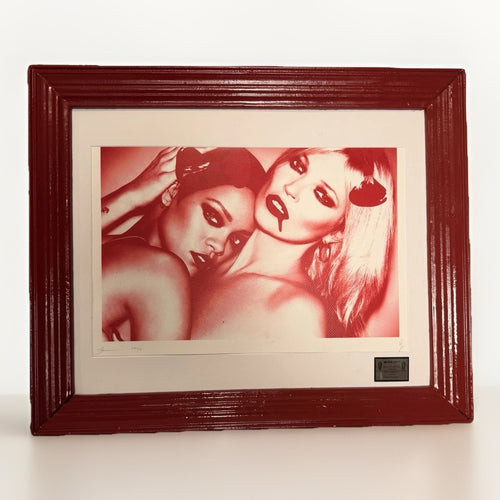
- Framing. If a piece is framed, ask whether it can be viewed out of the frame, since frames can conveniently obscure the signature area, the edition number, or the sheet edges.
The point is not to become a paper conservator. It is to make sure the physical object and its documentation tell one consistent story. When they don't — when the "A3" certificate accompanies a much smaller sheet, or the reverse doesn't show what you'd expect — you've found a reason to keep asking questions.
How DEATH NYC authentication compares to other artists
One of the most common mistakes new collectors make is applying the wrong authentication playbook to the wrong artist. Authentication chains do not transfer between artists, and mixing them up is how well-meaning buyers end up chasing a certificate that doesn't exist — or dismissing a legitimate piece because it lacks paperwork it was never meant to have. Here's how DEATH NYC fits alongside the other names a collector is likely to encounter.
| Artist / category | How it's authenticated | Key document |
|---|---|---|
| DEATH NYC | Self-authenticated by the studio | Signed, numbered COA with embossed gold seal |
| Shepard Fairey | No artist COA; buy on provenance and dealer trust ("silent") | Dealer provenance / purchase history |
| KAWS & BE@RBRICK | Hologram, foot stamp, and release-record verification | TrueCOA record |
| Banksy | Authenticated by Pest Control | Pest Control certificate |
| Signed music memorabilia | Third-party authenticators | Beckett, JSA, or PSA certificate |
The practical takeaway: don't expect a DEATH NYC piece to carry a Pest Control certificate, and don't dismiss a Shepard Fairey piece for lacking an artist COA. Each artist's authentication depends on its own chain. For DEATH NYC specifically, the studio's own gold-sealed certificate — matched to the print and backed by provenance — is exactly what you should expect and require. If you collect across several of these names, keep each artist's expectations separate; our per-artist buyer's guides and the Collector's Hub lay out the right chain for each.
Building a documented DEATH NYC collection
If you're starting out, the smartest approach is to buy fewer, better-documented pieces and to treat the paperwork as part of the artwork. A focused, well-documented collection is easier to authenticate, easier to insure, and dramatically easier to resell than a scattered set of undocumented sheets.
- Start with one complete, documented edition from a transparent seller rather than several cheap, undocumented ones.
- Keep every COA permanently paired with its print, and store the certificate as carefully as the artwork.
- Photograph and file your provenance — invoices, dealer information, and condition notes — so the next owner inherits a clean paper trail.
- Collect around a theme if you're building a set; a coherent group holds attention and often resells better than a random assortment.
Every step you take to keep documentation intact today is authentication work you won't have to redo — or pay someone else to reconstruct — later. Provenance compounds: the cleaner your records, the more confidently the market treats your pieces. For a wider view of how documentation, dealer trust, and market context fit together across the artists we carry, start from the Collector's Hub and browse the authenticated DEATH NYC collection.
Frequently asked questions
How can I authenticate a DEATH NYC print?
Verify three things and confirm they agree: a hand-applied pencil signature, a hand-written edition number, and DEATH NYC's own signed, numbered Certificate of Authenticity bearing an embossed gold seal or hologram. The edition number on the print must match the COA exactly. Then confirm provenance — invoices, purchase records, and dealer information — and, ideally, buy from a reputable source that photographs every element in full.
Does DEATH NYC use a third-party authentication service?
No. DEATH NYC work is self-authenticated by the studio. The studio's own signed, numbered, gold-sealed certificate is the canonical authentication document — there is no external board that authenticates DEATH NYC prints. That is different from artists like Banksy (authenticated by Pest Control) or signed music memorabilia (typically authenticated by Beckett, JSA, or PSA).
What if a DEATH NYC print has no Certificate of Authenticity?
Treat a missing COA as a serious gap. Because the studio self-authenticates and the gold-seal certificate carries much of the piece's provenance and resale value, a print without its matching original COA is far harder to verify and to resell. If you're considering an undocumented piece, insist on strong alternative provenance, price it accordingly, and lean on a trusted dealer's judgment.
How can I tell if the gold seal is genuine?
Ask for close-up photography under raking light so you can see the seal's actual embossed or hologram texture, rather than a flat printed circle. Then confirm the certificate's number and details match the specific print. The seal should never be evaluated in isolation — it's meaningful only as part of a consistent, numbered package that ties the COA to the artwork.
Why is one DEATH NYC print priced far below another?
Prices vary legitimately by image, edition, and condition, so some spread is normal. But a price far below the repeatable market median — with no condition or provenance explanation — is a reason for extra diligence, not a bargain to rush. Compare against market context and confirm the documentation before you act.
Should I get a professional opinion?
For high-value pieces, or any time the documentation or photos leave you unsure, yes. A qualified art authenticator can examine the signature closely and compare it against known examples. For most standard, fully documented editions bought from a transparent, reputable dealer, careful verification of the big three plus provenance is typically sufficient.
Buy and authenticate with confidence
Authenticating a DEATH NYC print is a repeatable discipline, not a guessing game: confirm the hand-applied pencil signature, the hand-written edition number, and the signed, numbered COA with its embossed gold seal — and make sure all three agree with each other and with the provenance. When you buy the complete, documented package from a reputable source, you shortcut most of the risk. Browse fully documented pieces in the DEATH NYC collection, deepen your eye with the DEATH NYC authentication guide and buyer's guide, and start from the Collector's Hub whenever you want the wider view.