Updated 2026-07-11
A collector guide to BAS verification, witnessed versus standard authentication, microphone identification, mounting, provenance, and pricing.
Updated July 11, 2026 · By Gauntlet Gallery Research
Quick answer: A Beckett-certified Fred again.. signed microphone is safest when the BAS number, signer, item description, physical label, microphone identity, and display all agree. Beckett authentication supports the autograph; it does not by itself prove the microphone was used onstage, owned by Fred again.., functional, or a particular make and model.
Identify the signed object and display

A microphone display can combine several components: microphone body, grille, stand, hand-shaped holder, plaque, photograph, case, and certification label. State exactly which component carries the autograph. A signed microphone mounted beside a photograph is not the same as a signed photograph mounted with an unsigned microphone.
Request images of the complete display, microphone from every side, autograph under angled light, BAS label, base, connector, grille, model markings, plaque, and rear mounting hardware. If the microphone cannot be removed safely, the seller should disclose which areas are concealed.
Treat a hand-shaped stand or presentation base as a display accessory unless there is separate evidence connecting it to the artist.
Verify Beckett certification

Enter the alphanumeric number at Beckett Authentication Certification Verification. Beckett instructs users to enter the letter and digits without a space. Match the returned signer and item information to the physical microphone.
Inspect:
- the physical tamper-evident label and number;
- signer name and item category;
- whether the label appears lifted, cut, covered, or reapplied;
- any database image or description;
- whether all autographs in the display are covered;
- seller photographs taken before shipping.
If the record says “microphone,” it supports the item category used during authentication. It does not automatically identify a manufacturer, establish function, or prove performance history.
Distinguish witnessed and examined-after-signing items

Beckett’s Witness Certification page says a Beckett representative was present when a Witness Certified autograph was signed, and that the online database reflects relevant information. Standard BAS authentication is different: experts evaluate an autograph after signing.
Do not call an item “witnessed” unless its record and label identify that service. A valid standard BAS certification is still meaningful evidence, but the wording must remain accurate.
Neither form proves that the microphone was used in a concert, studio session, video, or broadcast. Those are provenance claims requiring separate documentation.
Identify the microphone without guessing

Microphones with similar silhouettes can differ greatly in manufacturer, model, age, wireless system, capsule, and retail value. Record every legible marking and photograph the connector, switch, battery compartment, grille, body, and transmitter details.
If no make or model can be verified, describe it as a “handheld microphone.” Do not infer Shure, Sennheiser, or another brand from shape alone. If the display prevents access, say “model not verified while mounted.”
Function should also be tested or left unstated. A display autograph may make testing impractical, and wireless equipment can require compatible receivers and region-specific frequencies. “Display microphone” is often more accurate than “working microphone.”
Examine autograph condition and mounting

Metal and coated microphone bodies are curved, frequently handled surfaces. Ask whether the autograph was applied to the body, grille, tape, or a removable sleeve. Inspect for marker skipping, rubbing, fingerprints, coating, adhesive, and contact with the mount.
The display should support the microphone without compressing or abrading the ink. Avoid cleaning products and do not clear-coat the signature without professional conservation advice. Record condition at acquisition and after any remounting.
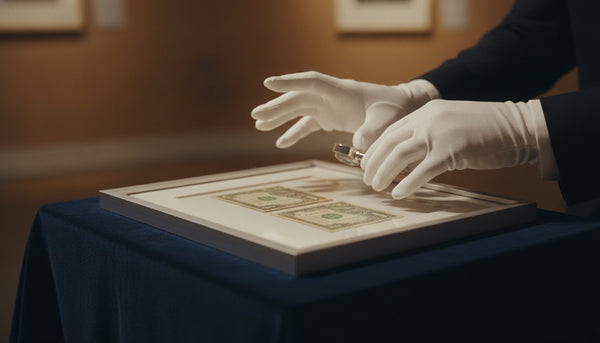
AI-generated images in this guide are generic diagrams. They do not depict Fred again..’s signature, a BAS label, or a particular microphone.
Build provenance without inventing stage use

The official Fred again.. website documents the artist’s official channels and current releases and touring information. It does not authenticate a secondary-market microphone.
For provenance, retain the invoice, listing, certification lookup, seller correspondence, label photographs, microphone markings, display assembly images, and any item-specific signing record. A photo of the artist holding a similar microphone is not a match. A performance-used claim needs distinguishing features or a reliable chain connecting this exact object to an event.
Use “signed microphone” unless the evidence supports stronger language.
Price the autograph, equipment, and display separately

Research completed sales for Fred again.. signatures on the same object class and with the same authentication level. Then assess any independent value of the verified microphone model and display. Do not automatically add the full retail cost of every component; collector demand is for the combined object.
Record sale date, currency, hammer or item price, premium, shipping, condition, provenance, and whether the transaction completed. Exclude unsigned stage microphones, signed vinyl, charity results, and asking prices from the primary comparison set.
No market range is stated here because this package does not contain a dated completed-sale dataset.
Buyer checklist

- The autograph is physically on the microphone or another clearly named component.
- BAS number verifies at Beckett’s official site.
- Signer, item category, label, and object agree.
- Witnessed status is claimed only when documented.
- Microphone manufacturer and model are supported or left unidentified.
- Function and compatibility are tested or explicitly unknown.
- Mounting avoids contact with the autograph.
- No unsupported stage, studio, ownership, or performance claim appears.
- Price evidence matches signer, object class, and authentication.
- The display is packed to prevent microphone movement.
The collectible is strongest when a future buyer can understand it without relying on the seller’s memory.
Frequently asked questions
Does Beckett authentication mean Fred again.. used the microphone?
No. It supports the autograph under the service shown in the record. Ownership, stage use, studio use, and function are separate claims requiring item-specific provenance or testing.
How can I tell whether Beckett witnessed the signing?
Check the certification record and label for the witness service. Do not infer it from Beckett branding alone. Beckett describes Witness Certification as a service in which its representative was present for the signing.
Is the hand-shaped display part of the authenticated item?
Not unless the record or other evidence says so. Treat the stand, frame, plaque, and decorative hand as presentation accessories. Identify which physical component carries the BAS label and autograph.
Must a signed microphone work?
No. Many are acquired as display objects. If function matters, verify the make, model, connector, capsule, switches, wireless requirements, and test result without endangering the ink. Otherwise state “function not tested.”
Can I identify a microphone from a performance photo?
A photo may narrow possibilities, but common stage microphones share silhouettes. Match exact markings, grille, switches, connector, body shape, wear, and wireless hardware. A visually similar model is not proof that the signed item was used in that performance.
Should the autograph be clear-coated?
Not without advice from a conservator who understands the marker and microphone coating. Clear products can dissolve ink, change gloss, trap contaminants, complicate authentication, or fail later. A no-contact mount and controlled light are safer first measures.
What if the BAS number verifies but the item description is vague?
Request clarification from the seller and, when necessary, the authenticator. Preserve screenshots and detailed photographs. A vague record should not be expanded into specific model, stage-use, or provenance claims.
How should it be shipped?
Remove or immobilize detachable display parts, protect the microphone from movement without touching the autograph, guard the grille and connector, double-box the case, photograph the packing sequence, insure the shipment, and require signature confirmation.
Does an authentication sticker on a removable part cover the whole display?
Not automatically. Determine which object Beckett examined and where the label is attached. A label on the microphone does not authenticate a later plaque, photograph, stand, or inscription. Inventory additions and retain assembly photographs.
What is a safe resale description?
Use “handheld microphone signed by Fred again.., Beckett Authentication Services certificate [number], model unverified/verified as applicable, displayed in [accessory description].” Add witnessed or stage-used only when the specific record supports it.
Keep the removable stand and plaque out of the authentication sentence unless the record covers them. A buyer should be able to remove the display accessories and still understand exactly which evidence travels with the signed object.
That clarity also makes insurance scheduling, shipping claims, and later resale materially easier.
Methodology and disclosure
This article prioritizes Beckett’s verification and witness-service pages and the artist’s official site. Gauntlet’s inventory provides the product context only; it is not independent authentication, provenance, equipment identification, or valuation evidence.
Gauntlet Gallery provides the mounted-microphone inventory context that prompted this guide. Buyers should still perform every BAS, equipment, condition, provenance, price, and seller check described above.
Editorial image disclosure: Illustrations on this page were generated with Nano Banana for explanatory use. They are not authentication evidence, provenance records, or reproductions of any specific collectible.