Updated 2026-07-11
Institutionally sourced preventive-care guidance for framing, displaying, storing, handling, and documenting mixed-media artwork made on U.S. currency.
By Gauntlet Gallery Research
Updated July 11, 2026
Treat art made on U.S. currency as a mixed-media work on paper, not as ordinary cash. Use a reversible conservation mount, keep every note and applied-media layer away from glazing, choose stable mat and backing materials, limit all light, avoid heat and moisture, and retain access to the reverse. Never laminate, dry-mount, tape, glue, clean, flatten, or coat the object without advice from a paper conservator who has examined its specific inks, adhesives, and construction.
This guide is preventive care, not a treatment prescription. Currency art may combine printed note paper, marker, paint, transfer, collage, adhesive, seals, and signatures, each with different risks.
The quick answer

For a stable work in good condition, ask a conservation framer for:
- a window mat or spacer that prevents glazing contact;
- acid-free, lignin-free mat and backing materials;
- a reversible mounting method appropriate to the object;
- UV-filtering acrylic or glass, while recognizing that all light causes damage;
- an accessible, documented reverse;
- a sealed backing package and sturdy frame;
- placement on an interior wall away from sunlight, vents, heat, and water.
The Library of Congress’s preservation framing guidelines are the core reference: they describe framing as protection from light, water, humidity, pollutants, dust, and harmful surrounding materials, while warning that long-term display of paper is not recommended.
Identify every material before framing

Do not assume the banknote is the only vulnerable component. Record:
- number, denomination, series, and condition of notes;
- whether imagery is printed, painted, transferred, collaged, or drawn;
- signature and edition media;
- adhesives joining notes or applied images;
- embossing, seals, stamps, labels, and certificate;
- cockling, folds, tears, loose layers, tackiness, powdering, or fading;
- any previous tape, glue, lamination, or pressure mount.
Raking-light and reverse photographs can reveal raised media, joints, distortions, and prior mounts. If the medium is friable, sticky, flaking, water-sensitive, or unknown, stop before placing it under pressure or near acrylic. The Library of Congress recommends a conservator for paper objects that are valuable, actively deteriorating, or complicated; see its paper preservation FAQ.
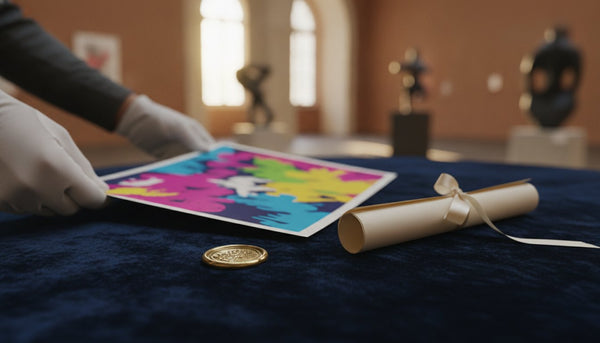
Keep the certificate and invoice in the acquisition file. Do not place a certificate behind the art if removal would require disturbing the mount.
Use a reversible mount

The goal is to support the work without permanently changing it. Pressure-sensitive tape—even marketed as “archival”—is not an acceptable shortcut. The Library of Congress advises against self-stick tape and describes preservation matting systems using stable materials.
A qualified framer or conservator may choose hinges, edge supports, corner supports, or a sink mat depending on the object’s weight, shape, media, and whether both sides must remain visible. The correct method is object-specific.
Avoid:
- dry mounting;
- spray adhesive;
- double-sided tape on the note;
- rubber cement;
- lamination;
- adhesive photo corners that touch media;
- magnets placed directly against unknown inks or metallic elements;
- clamping a cockled note flat;
- attaching hardware through a note.
A “floating” presentation can show the currency edges, but it still needs secure, reversible support and glazing clearance. A visually invisible mount is not automatically conservation safe.
Keep glazing away from the surface

The American Institute for Conservation’s Book and Paper Group explains that glazing must not rest directly on a paper object’s surface; contact can contribute to adhesion, staining, condensation, and mold risk. See BPG Matting and Framing.
Use a window mat, deep spacer, or shadow-box construction to maintain separation. Confirm clearance at the center, not just the edges: acrylic can bow inward in larger frames.
Glazing choices:
- UV-filtering acrylic: lighter and more impact-resistant than glass; useful for shipping and larger frames. Standard acrylic can build static, so use caution around powdery or friable media.
- Anti-static acrylic: preferable when graphite, charcoal, pastel, loose pigment, or other friable media may be present.
- UV-filtering glass: more scratch-resistant but heavier and more breakable.
UV filtering reduces one source of damage; it does not make permanent display safe. The Library of Congress states plainly that all light, not only ultraviolet light, damages paper.
Control light exposure

Light damage is cumulative and irreversible. It can fade signatures and applied color, yellow or embrittle paper, and create uneven change where a mat or overlap shades part of the object.
Practical controls:
- never hang in direct sunlight;
- avoid bright windows and strong spotlights;
- use low-heat LED lighting;
- switch display lighting off when the room is unused;
- rotate valuable works off display;
- use an opaque cover when practical;
- keep dated reference photographs under consistent lighting.
The Library of Congress paper FAQ notes that UV-filtering glazing does not prevent all light damage. The National Park Service’s curatorial care appendix for paper objects explains that both visible and ultraviolet light can seriously damage paper.
Do not rely on a window film, “museum glass” label, or UV percentage as permission to ignore duration and intensity.
Maintain a stable indoor environment

Paper and many applied media respond to humidity. Excess moisture can encourage cockling, adhesive change, staining, and mold; very dry or rapidly changing conditions can stress composite layers.
For a home collection, stability is more important than chasing a perfect number with an uncontrolled device. Keep the work:
- on an interior wall;
- away from radiators, fireplaces, kitchens, and bathrooms;
- away from supply and return vents;
- out of attics, basements, garages, and exterior-wall damp zones;
- above floor level and away from pipes;
- in a clean, climate-controlled room.
Library of Congress public guidance for family paper collections recommends cool conditions and broadly cites 30–50% relative humidity. The NPS Museum Handbook notes that collection set points should be chosen for the materials and local environment, often with a conservator, and emphasizes limiting fluctuations. These are institutional references, not a promise that every mixed-media currency work is safe at one universal setting.
Store unframed or rotated works safely

Store the object flat unless its construction or condition requires a custom support. Use an enclosure made from stable, conservation-quality material and a rigid folder or box larger than the work. Keep each work separate so signatures, paint, or adhesive cannot offset onto another surface.
Do not:
- insert into PVC plastic;
- use ordinary office sleeves without material information;
- stack weight on raised media;
- roll currency compositions;
- place a certificate directly against the artwork;
- use paper clips, staples, rubber bands, or sticky notes;
- label the work with pressure-sensitive tape.
Store the acquisition file separately, with digital backups of front, reverse, certificate, invoice, condition, and frame construction. If the physical certificate is lost in a water event, the image and invoice will not replace it, but they preserve evidence.
Handle, clean, and transport cautiously

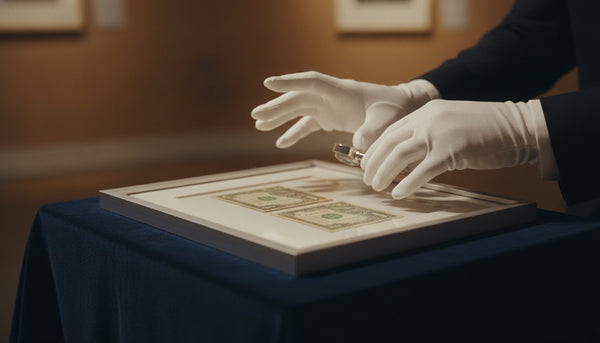
Handle only when necessary, with a clean work surface and a rigid support beneath the object. Clean, dry hands may be appropriate for stable paper edges; gloves can reduce oils but can also reduce dexterity. A conservator should decide for a fragile mixed-media surface.
Never apply:
- water, alcohol, solvent, polish, or household cleaner;
- erasers or surface-cleaning sponges;
- pressure to flatten a fold;
- fixative, varnish, clear coat, or UV spray;
- adhesive to a lifting collage element.
For transport, keep the framed package upright, protect glazing and corners, prevent movement inside the frame, and use a rigid outer carton. Photograph condition before packing and insure based on documented value and policy terms.
Warning signs that require a conservator

Seek professional examination when you see:
- active mold or a musty odor;
- fresh tide lines or dampness;
- flaking, powdering, or sticky media;
- a note or collage layer adhering to glazing;
- severe cockling or distortion;
- brittle tears or losses;
- fading that has changed since prior photographs;
- pressure-sensitive tape staining;
- insects or frass;
- a signature lifting with an attached layer.
Do not open a moldy frame in a living area or scrape active growth. Do not attempt internet treatment recipes on a signed collectible. Use the American Institute for Conservation’s public Find a Professional directory to locate a qualified conservator.
For object documentation, see What Is Death NYC Dollar-Bill Art?. For item-level evidence before reframing, use How to Authenticate Death NYC Currency Art. Browse the Death NYC collection for format examples, not conservation prescriptions.
Collectors buying through Gauntlet Gallery should request unframed and reverse photographs when available so a conservator can understand the mount without relying on the sales image alone.
Editorial methodology and limitations
This article applies Library of Congress, National Park Service, and American Institute for Conservation guidance for works on paper to the special risks of currency-based mixed media. It does not prescribe treatment for an unexamined object. Materials can be incompatible, signatures can be water-sensitive, and prior adhesives can change the correct approach.
Editorial image disclosure: Illustrations on this page were generated with Nano Banana for explanatory use. They are not authentication evidence, provenance records, or reproductions of any specific collectible.