The Catalogue Raisonné and What It Actually Does to Print Prices
There is one question serious collectors eventually ask about every significant print they consider buying.
Is it in the catalogue raisonné?
Not because they were told to ask it. Because they've watched enough deals fall apart, watched enough prices collapse at resale, watched enough "important" works get quietly deaccessioned at a loss, to understand that this question is load-bearing.
Catalogue raisonné inclusion is not a rubber stamp. It is not marketing. It is the closest thing the print market has to a title deed — a scholarly declaration that a specific work exists within the verified corpus of an artist's output, documented with provenance, physical description, edition data, and exhibition history.
When a print is in the catalogue raisonné, it changes what that print is worth. When a print should be in the catalogue raisonné and isn't, that absence tells you something too. Understanding the difference, and understanding what inclusion actually signals to buyers, auction specialists, and institutional collectors, is how you move from casual acquisitions to informed ones.
This article covers the mechanics: what a catalogue raisonné actually contains, how inclusion affects pricing at different market tiers, what partial documentation looks like, and where the system breaks down.
What a Catalogue Raisonné Actually Is
The term gets used loosely. Let's be precise.
A catalogue raisonné is a comprehensive, critically reviewed scholarly publication that documents every known work — or every work in a specific medium — by an artist. For printmakers and artists whose print output is substantial, a dedicated print catalogue raisonné is the authoritative reference. It assigns catalogue numbers (often called CR numbers or catalog numbers), records edition sizes, paper types, plate states, dimensions, and traces provenance where documented.
The serious ones take decades to produce. They involve original research, physical examination of works, and peer review within the scholarly community. The Warhol print catalogues, the Lichtenstein catalogue raisonné, the work done on Picasso's prints — these represent hundreds of thousands of hours of academic and archival labor.
That labor is what you're paying for when a print carries a CR number. Not the paper. Not the ink. The verified scholarship that places that specific object in a documented lineage.
CR Numbers and What They Signal
A CR number does several things simultaneously.
It tells you the work was examined by the scholars who produced the catalogue. It gives you a reference point for comparing your impression against the documented standard. It makes condition issues legible — because when a catalogue records a print as existing on a specific paper stock with specific margins, and your impression deviates from that, you now have a question to answer.
It also creates a universal language between dealers, auction specialists, and institutions. When a Lichtenstein print is listed with its catalogue number, every serious buyer at that auction knows exactly what they're looking at. Edition size, plate state, documented impressions — all of it resolves to a single reference point.
For the secondary market, this is not a minor convenience. It is the infrastructure that makes confident pricing possible.
How Inclusion Affects Pricing: The Direct Mechanisms
The pricing impact of catalogue raisonné inclusion operates through several distinct channels. Understanding each one helps you see why the premium exists and where it's justified.
1. Institutional Eligibility
Museums, university collections, and major private foundations have acquisition policies. Many of those policies, explicitly or in practice, require that significant print acquisitions be documented in the primary scholarly literature — meaning the catalogue raisonné.
When institutions can buy, they push prices up. When they can't — or won't — a ceiling forms. A print that exists outside the documented corpus faces a structurally smaller buyer pool, and a smaller buyer pool means lower ceiling prices regardless of aesthetic merit.
This is not theoretical. It is the single most important pricing mechanism that catalogue inclusion activates.
2. Auction House Confidence
Major auction departments at Christie's, Sotheby's, Phillips, and Swann Galleries research catalogue raisonné status as part of standard lot preparation. When a print carries a verifiable CR number, cataloguing is faster, condition reports are more precise, and specialists can price estimates with greater confidence.
That confidence translates directly to estimate ranges. A print without a CR number — where the auction house has to hedge on authenticity, edition accuracy, or state identification — will carry conservative estimates. Conservative estimates can mean conservative hammer prices, even when buyer competition pushes things higher on the day.
More importantly: auction houses have declined to offer works where catalogue documentation is absent or contested. The work doesn't disappear. It just moves to a lower-tier venue with a lower buyer pool.
3. Lending and Exhibition History
Catalogue raisonné documentation is often a prerequisite for loan requests from institutions. A print that has been lent to museum exhibitions, documented in exhibition catalogues, and shown publicly builds a provenance trail that itself adds value.
That trail starts with the primary scholarly documentation. Without it, the lending conversation often doesn't begin.
4. Insurance and Collateral Valuation
Fine art insurers and lenders who use artwork as collateral rely on documented scholarly consensus to establish values. A catalogue raisonné entry provides the reference point against which current market pricing is benchmarked.
Without that reference, valuations require more manual research, carry more uncertainty, and often result in more conservative numbers. For collectors using art as part of a broader wealth structure, this is a real and material difference.
The Pricing Premium in Practice: What the Market Shows
Let's talk about what documented versus undocumented looks like in terms of market behavior, without inventing specific numbers.
For prints by artists with established, widely-used catalogue raisonnés — think major twentieth-century figures whose print output is thoroughly documented — works carrying clear CR numbers consistently outperform comparable works where documentation is absent or contested.
The premium isn't uniform. It scales with several factors:
- Artist market tier: For blue-chip artists where the catalogue raisonné is the primary authentication mechanism, the premium is significant and non-negotiable. For emerging or mid-market artists where the catalogue may be incomplete or in progress, the premium is real but more variable.
- Edition rarity: A documented impression from a small or unique edition commands a larger relative premium than a documented impression from a large edition, because the documentation confirms scarcity in a way that undocumented work cannot.
- Condition: Documentation allows condition to be precisely assessed against a known standard. A mint impression that matches the catalogue standard exactly is worth more than a comparable impression where no standard exists for comparison.
- Provenance chain: The best outcomes combine CR documentation with a clean, traceable provenance chain. Each reinforces the other.
The Secondary Market Reality
Here's something dealers will tell you directly: the resale market for undocumented prints is harder, slower, and more price-sensitive than collectors buying at retail often expect.
The acquisition moment feels fine. You've bought something you believe is real, by an artist you believe in, at a price that feels reasonable.
Then you want to sell. And the questions start.
Is it in the catalogue raisonné? Which state? Which paper? Has it been examined against the catalogue standard?
If the answers aren't clean, you are now negotiating from a weaker position than when you bought. This is the single most common source of collector disappointment in the secondary print market.
When the Catalogue Raisonné Doesn't Exist Yet
This is a real and increasingly relevant scenario.
Many artists whose prints trade actively and at meaningful prices do not yet have a completed catalogue raisonné. Some have partial documentation — foundation-maintained databases, gallery archives, or preliminary scholarly work that hasn't reached final publication. Some have nothing formal at all.
This doesn't mean their prints are bad investments. It means the pricing structure is different, and the risks are different.
What to Look For When No CR Exists
-
Publisher and printer documentation
- Who published the print? Is that publisher's archive accessible?
- What documentation did the printer maintain? Blindstamps, chop marks, and printer's records are the pre-catalogue layer of documentation.
- Does the printer's record match the impression you're examining?
-
Estate or foundation records
- Is there an active estate or artist foundation? Do they maintain records?
- Have they issued any written confirmation regarding this work?
- Is a catalogue raisonné in progress? Who is the responsible scholar?
-
Gallery provenance
- Can you document the chain from artist or publisher to present?
- Are there original receipts, COAs from reputable galleries, exhibition records?
- Is the gallery of origin still operating and able to confirm?
-
Third-party authentication
- For living artists, has the artist or studio confirmed the work directly?
- For deceased artists without a catalogue raisonné, what authentication mechanisms exist?
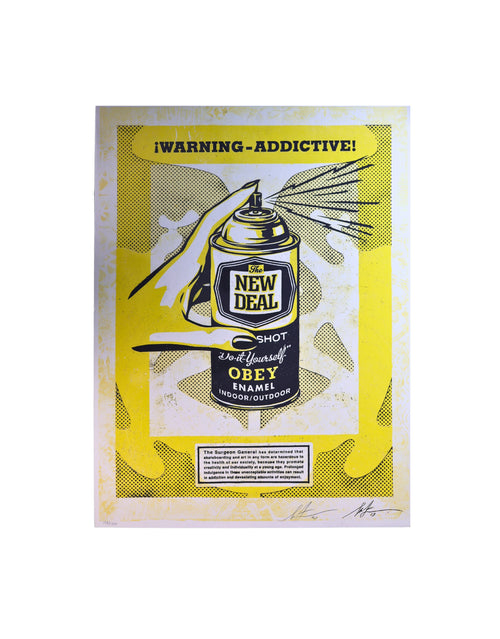
- For street art and contemporary works specifically: authentication requirements vary by artist. Banksy requires Pest Control. Shepard Fairey authentication runs through signature verification, edition numbering, and Obey Giant drop records. Death NYC requires both an artist-signed COA and the studio gold seal — either alone is insufficient. Know the specific requirements for the artist you're buying.
The In-Progress Catalogue: Opportunity or Risk?
When a serious catalogue raisonné is actively in progress for an artist whose market is already established, there is a window of opportunity.
Works that are well-documented through provenance and publisher records, and that are likely to be included when the catalogue publishes, may be available at prices that don't yet reflect the premium that catalogue inclusion will activate. This requires judgment about the scholarship's likely outcome — which requires access to preliminary research, relationships with the scholars involved, or deep personal expertise in the artist's work.
It is not a strategy for casual collectors. But it's real, and dealers who specialize in specific artists are often best positioned to navigate it.
Contested Catalogues and Authentication Disputes
The catalogue raisonné is not infallible. The print market has seen cases where works included in older catalogues were later questioned, and cases where scholars preparing new catalogues have excluded works that previously traded with confidence.
The Warhol situation is instructive here. The Andy Warhol Art Authentication Board, which operated as the primary authentication mechanism for Warhol works, dissolved in 2012 after a series of high-profile disputes. The contemporary framework for Warhol authentication now operates under what the market refers to as the TrueCOA structure, relying on catalogue documentation and foundation records rather than board opinions. The dissolution created real market uncertainty that took years to stabilize.
This is an extreme case. But it illustrates the principle: a catalogue raisonné is a scholarly instrument created and maintained by humans, operating within institutional structures that can change. Its authority is consensus-based, not absolute.
Print States and Catalogue Specificity
One area where catalogue precision matters enormously — and where collectors sometimes get into trouble — is print states.
Many significant prints exist in multiple states: preliminary proofs, artist's proofs, trial color proofs, published edition impressions, and posthumous restrike impressions from the same plate. The catalogue raisonné typically documents each state separately, with distinct CR numbers or sub-numbers, and the value differences between states can be substantial.
A posthumous restrike documented as such in the catalogue is not worth the same as a lifetime impression from the first state, even if they look nearly identical to an untrained eye. The catalogue makes the distinction visible and legible to the market. Without it, buyers are relying on their own expertise or trusting representations that may not be accurate.
When was this impression pulled, and how does the catalogue distinguish it from earlier states?
That question should be second nature for any serious print buyer.
Specific Artist Contexts Worth Knowing
The general principles above apply across the market, but the specific mechanics vary by artist. A few contexts that come up regularly:
Major Twentieth-Century Printmakers
For artists like Picasso, Matisse, Chagall, and Miró, catalogue raisonnés are well-established and widely referenced. CR numbers are standard in dealer and auction listings. Works without clear CR references raise immediate questions that require answers before serious bidding should occur.
Pop and Contemporary
For Pop-era artists — Lichtenstein, Warhol, Indiana, Rosenquist — the print catalogues are the primary market infrastructure. Publisher documentation from the original print workshops (Gemini G.E.L., Multiples Inc., Petersburg Press) runs alongside catalogue documentation. Both matter.
Street Art and Urban Contemporary
This is where the catalogue raisonné model is least developed and where alternative documentation frameworks are most important.
Banksy works require Pest Control authentication. Full stop. No other mechanism carries equivalent authority for Banksy.
For Shepard Fairey, there is no artist-issued COA system. Authentication relies on signature verification, edition numbering, and cross-referencing against the documented Obey Giant release record. A complete provenance chain from an authorized drop or gallery is the strongest position.
For KAWS and BE@RBRICK, authentication runs through original packaging, hologram verification, molded foot stamps, and Medicom release records. Do not buy on packaging alone without verifying against release documentation.
Death NYC operates on a dual-requirement system: you need both the artist-signed COA and the studio gold seal. One without the other is not sufficient. This is not a technicality — it reflects how the artist's studio has structured their authentication program, and the market respects those terms.
Red Flags
Before you move forward on any significant print acquisition, watch for these warning signs:
- CR number cited without reference to which catalogue. "It's in the catalogue raisonné" means nothing without specifying the publication, author, and edition. Multiple catalogues exist for some artists, with different levels of scholarly authority. Vague references deserve specific follow-up.
- The CR number doesn't match on lookup. Cross-reference claimed CR numbers against the actual publication. Errors happen; fraud happens too. Verification is non-negotiable.
- An impression that deviates from the catalogue standard but is presented as equivalent. Different paper, different margins, different color registration than the catalogue records — these are questions, not cosmetic variations. The catalogue standard exists precisely to make these deviations visible.
- A "forthcoming catalogue raisonné" used as a substitute for existing documentation. Future scholarship does not authenticate present transactions. Buy on what exists now, not what might exist later.
- Posthumous impressions sold without clear disclosure of state. If the catalogue documents posthumous restrikes separately and a seller is not making that distinction explicit, ask why.
- Catalogue documentation used as a substitute for provenance. CR inclusion and provenance are both required for the strongest position. A clean CR reference with a murky ownership history is not fully resolved.
- Artist-specific authentication requirements being substituted. For artists with specific, known authentication mechanisms — Pest Control for Banksy, dual-requirement for Death NYC, Medicom release records for KAWS — no substitute is equivalent. Generic third-party opinions from non-specialist authenticators are not the same as the required mechanism.
- A catalogue raisonné that is not widely recognized within the scholarly or dealer community. Self-published "catalogues" with minimal scholarly apparatus exist. The authority of a catalogue raisonné is a function of its acceptance by the specialist community, not the existence of a bound volume.
Bottom Line
Catalogue raisonné inclusion is a pricing multiplier, an institutional eligibility signal, and a risk management tool rolled into one.
It does not guarantee that a print is aesthetically significant or that the market will continue to value the artist's work. It does not replace provenance, condition, or the fundamentals of supply and demand. And it is not infallible — catalogues can be revised, disputed, or superseded.
What it does is resolve ambiguity. It tells the market, with scholarly authority, that this specific work exists as documented, has been examined against that standard, and belongs to a corpus that scholars and institutions recognize.
In a market where ambiguity is the enemy of confident pricing, that resolution is worth real money.
Buy prints that are documented. Understand the documentation framework for the specific artists you collect. Ask the specific questions this article has outlined. And when the answers aren't clean, understand that the price being offered should reflect that uncertainty — because when you go to sell, the market absolutely will.
If the documentation isn't there at acquisition, will you be comfortable defending that gap at resale?
That's the question. Answer it honestly before you write the check.
FAQ: Catalogue Raisonné and Print Pricing
Q: What's the difference between a catalogue raisonné and a COA?
A Certificate of Authenticity is a document issued — by a gallery, publisher, artist, or authentication service — attesting to the authenticity of a specific work. A catalogue raisonné is a comprehensive scholarly publication documenting an artist's entire body of work or print output. They're not interchangeable. A COA covers one work; a catalogue raisonné creates the scholarly framework within which that work's documentation gains broader credibility. For print collecting at a serious level, you want both — ideally a COA from the original publisher plus a CR reference that confirms the edition.
Q: Does every significant print artist have a catalogue raisonné?
No, and this is important. Many artists with active, healthy print markets do not yet have a completed catalogue raisonné. Some have foundational scholarship in progress; others have only gallery archives and publisher records. The absence of a catalogue raisonné doesn't make an artist's prints unbuyable — it means the documentation framework is different and the due diligence process needs to account for that. Know what documentation exists for the specific artist you're collecting, and calibrate your expectations accordingly.
Q: Can a print's value increase when a new catalogue raisonné is published?
Yes, and meaningfully so. When a well-received scholarly catalogue is published for an artist whose works have been trading without that framework, previously ambiguous works gain a pricing anchor. Institutional buyers who were previously unable to acquire become eligible buyers. Auction houses gain confidence to offer works at higher estimates. The publication event itself can trigger a repricing of the entire secondary market for that artist's prints. This is the "in-progress catalogue" opportunity mentioned above — if you identify a work that is likely to be documented and acquire it before publication, the premium can materialize quickly.
Q: What happens if a work I own gets excluded from a new catalogue raisonné?
This is a serious situation and the market treats it accordingly. Exclusion from a significant catalogue — especially if accompanied by scholarly argument against the work's authenticity or attribution — can materially damage value and make resale through major channels very difficult. It's one reason why buying prints with the cleanest possible existing documentation is important: the less ambiguity at acquisition, the less exposure you have to future scholarly revision. If you own a work that gets excluded from a catalogue, the path forward typically involves independent scholarly opinion, legal review, and potentially a long wait for market sentiment to stabilize.
Q: Does FBI Operation Bullpen have any relevance to the print market?
Operation Bullpen was primarily focused on sports memorabilia forgery and led to significant reform in that authentication space — it's the reason Beckett Authentication Services (BAS), JSA, and PSA/DNA tightened their processes considerably. The print market has its own forgery history, but the direct Bullpen infrastructure applies most directly to signed memorabilia. Where Bullpen's lessons apply to prints is in the underlying principle: large-scale forgery operations are professionally organized, peer-review-resistant until the right expert examines the right work, and financially motivated to target exactly the works where documentation gaps exist. Catalogue raisonné documentation is part of how the print market defends against comparable schemes.
Q: If a print has a catalogue raisonné number but no provenance before 1970, should I be concerned?
Provenance gaps before 1970 require context-specific evaluation. For works potentially affected by wartime displacement or restitution issues, gaps in that period raise serious legal and ethical questions that go beyond pricing. For prints where the provenance gap is simply a matter of incomplete record-keeping — which is common — the CR documentation provides some reassurance, but a clean chain of ownership is still the ideal. The 1970 UNESCO Convention on cultural property is a reference point: provenance documented before that date, or with explanation for gaps spanning that period, is meaningful. For any work where displacement or restitution may be relevant, independent legal review is not optional.
Q: How do I actually look up a catalogue raisonné number?
For major artists, the primary catalogues are held in the reference sections of major art libraries, available through institutions like the Frick Art Reference Library or major university libraries. Dealers specializing in an artist typically own the relevant catalogues and can provide lookups as part of the acquisition process. For some artists, digital databases maintained by foundations or estates provide partial access. Asking the seller to provide the specific catalogue citation — author, publication year, page number, and CR number — and then verifying that citation independently is the correct process. If a seller can't or won't provide that level of specificity, that's a data point about the documentation.
Q: For contemporary artists without a catalogue raisonné, what's the closest equivalent documentation?
The closest equivalents are, in rough order of authority: artist studio records or database listings maintained by the artist or estate; publisher documentation from the workshop or printer; signed and numbered edition COAs from the original gallery or publisher; and gallery exhibition records. For specific artists in the street art and urban contemporary space, the authentication mechanisms are artist-specific and non-substitutable — the requirements for Banksy, Shepard Fairey, KAWS, Death NYC, and similar artists are each distinct, and understanding those specific requirements is more important than looking for a generalized catalogue equivalent. When in doubt about what documentation framework applies to a specific artist, ask a specialist dealer in that artist's work before acquiring.