Before You Buy: The Stolen Art Check Most Collectors Skip
You found the piece. The provenance looks clean. The authentication checks out. The price is right.
You're ready to wire the money.
Stop.
There is one step that separates a sophisticated collector from someone who is about to become the unwitting end-point in a theft chain that started decades ago in a museum basement in Eastern Europe, a private estate sale in London, or a gallery that got hit during a war nobody in your network was paying attention to.
That step is a stolen art database check. And the fact that you haven't heard the words "Art Loss Register" in every transaction conversation you've had is either a gap in your dealer's process or a gap in your own.
Let's close it.
What the Art Loss Register Actually Is
The Art Loss Register (ALR) is the world's largest private database of stolen, looted, and missing artworks. It is headquartered in London with offices across Europe and the United States. It was established in 1991 — partially as a response to the staggering volume of looted cultural property that emerged from Eastern European political transitions and the ongoing fallout from World War II repatriations.
The database holds hundreds of thousands of records. Not theoretical records. Actual entries submitted by insurance companies, law enforcement agencies, governments, private collectors, and families pursuing Nazi-era looting claims.
It is not a government agency. It is not free in all use cases. And it is not infallible.
But it is the closest thing the art market has to a universal stolen property registry, and running a search through it before a significant purchase is table stakes.
How the Database Gets Its Records
Entries come from multiple channels:
- Insurance company reports — When a policy pays out on a stolen artwork, the insurer typically registers the piece to protect against a future recovery creating a double-payment situation.
- Law enforcement submissions — Interpol, the FBI Art Crime Team, and national police agencies from dozens of countries feed theft reports into the system.
- Private registrations — Individual collectors and estates can register a stolen or missing work directly. This is especially common in Holocaust-era asset recovery cases.
- Government cultural property offices — National heritage agencies register looted cultural objects, particularly from conflict zones.
- Auction house partnerships — Several major auction houses have formal agreements with the ALR to run checks prior to consignment acceptance.
The coverage is wide. It is not complete. We'll come back to that.
The Other Databases You Need to Know
The Art Loss Register is the anchor, but it is not the only database. A real due diligence process touches multiple sources, because no single registry has universal coverage.
Interpol Works of Art
Interpol maintains its own database of stolen cultural property, accessible to law enforcement agencies across its 194 member countries. Public search access is limited, but the existence of the database matters because it feeds information across borders that private registries may not capture immediately. If a work was stolen in a country with limited art market infrastructure, it may be in the Interpol system before it reaches the ALR.
FBI Art Crime Team
The FBI operates the National Stolen Art File (NSAF) and coordinates the Art Crime Team, which has been responsible for some of the most significant art recovery operations in U.S. history. FBI Operation Bullpen — a multi-year undercover investigation — focused not on theft but on the forged sports memorabilia market, ultimately resulting in over two dozen convictions and exposing a network that had placed hundreds of millions of dollars in fraudulent signed items into the market. Operation Bullpen is a reference point that any serious collector of signed memorabilia should understand. It demonstrated that the secondary market's authentication infrastructure was, at that time, structurally inadequate against organized fraud.
The lesson carries into fine art directly. Organized crime intersects with the art market at multiple points — not just forgery, but theft, laundering, and fraudulent provenance construction.
Carabinieri TPC (Italy)
Italy's Comando Carabinieri per la Tutela del Patrimonio Culturale maintains one of the largest and most technically sophisticated stolen cultural property databases in the world. Given Italy's position as one of the richest sources of antiquities and historical art, their database — called LEONARDO — is essential if you are buying anything with Italian provenance or Italian cultural heritage classification.
INTERPOL-UNESCO Joint Database
UNESCO maintains documentation standards and advisory resources for cultural property, particularly in the context of armed conflict and post-conflict looting. Their 1970 Convention on the Means of Prohibiting and Preventing the Illicit Import, Export and Transfer of Ownership of Cultural Property is the international legal benchmark against which provenance is frequently measured in dispute situations. The "1970 rule" — whether provenance can be documented before that date — comes up constantly in high-value antiquities and historical works.
The Looted Art Commission
Focused specifically on Nazi-era looted art, the Looted Art Commission operates as an advocacy and research body, maintaining records of claims and assisting families with asset recovery. This is a specialized resource, but it matters enormously for European works from roughly 1933 through 1945 and the immediate post-war period. Provenance gaps in that window are not just due diligence concerns — they are legal exposure.
Why Auction Houses Run These Checks (and What That Means for Private Sales)
Christie's, Sotheby's, and Phillips all conduct ALR searches as standard pre-consignment practice. So do most serious regional auction houses operating at mid-to-high price points. This has been common practice for long enough that it is now effectively an industry norm.
So if the auction houses are doing it, why would a private sale require any less diligence?
Private sales are where the gap lives. A piece moves from a collector's home to a dealer's back room to a fair booth to your wall without ever touching an auction house workflow. No institutional check. No paper trail beyond whatever the seller volunteers. And the seller may be entirely innocent — the theft may be four owners back in the chain, invisible to everyone in the current transaction.
Good-faith purchase is a real legal concept. In most jurisdictions it provides some protection to innocent buyers. But "good faith" requires demonstrable due diligence. Skipping a database check that costs less than a dinner undermines your good-faith defense if the piece surfaces in a recovery action.
Document the search. Keep the result. That record is part of your provenance file.
How to Actually Run the Check
Running an Art Loss Register search is not complicated. What it requires is enough identifying information about the work to produce a meaningful result.
What You Need Before You Search
- Artist name — Full legal name where known, plus any known pseudonyms or variations.
- Title of work — Including any alternate titles documented in the provenance.
- Medium and dimensions — As specific as possible. Dimensions can be critical in distinguishing between similar works in the same artist's catalog.
- Date of creation — Approximate date ranges are acceptable if the exact year is unknown.
- Any identifying marks — Stamps, stickers, inscriptions, catalog numbers on verso. These often survive even when surface identification is obscured.
- Provenance documentation available — Exhibition history, prior sale records, published catalog references.
The Search Process
The ALR offers both self-service search options for individuals and formal certificate searches that produce documented results. For any purchase above a threshold you would consider significant — and that threshold is yours to define — a formal certificate search is worth the modest fee. The certificate creates a record. The self-service check does not carry the same evidentiary weight.
Turnaround on standard certificate searches is typically fast. Research requests for works with complex provenance or potential matches take longer and may involve deeper manual review.
If the search returns a potential match, that is not automatically disqualifying. It is an instruction to pause and investigate. The database entry will provide enough information to pursue clarification through the appropriate channel — which may be an estate, a law enforcement agency, an insurance company, or a cultural heritage body.
Provenance Research: The Database Check's Partner
A clean database result is not a provenance certificate. Those are two different things doing two different jobs.
A database check tells you whether a work is actively registered as stolen or missing. It cannot tell you whether the work should be registered but hasn't been. It cannot tell you whether the provenance documentation you've been given is fabricated. It cannot close a gap in the ownership chain.
Provenance research is the broader discipline. For contemporary works — street art, limited editions, signed prints — provenance research means tracing the sale chain: original drop or release, first buyer, transfer to current owner. For works with age, it means tracing ownership back through exhibition catalogs, auction records, dealer archives, estate inventories, and published scholarship.
How far back does provenance need to go before you're comfortable?
The honest answer: far enough that no major gap coincides with a known period or geography of looting. That means the 1933–1945 window for European works. It means post-conflict periods in any region with documented cultural property trafficking. It means the late colonial period for works originating in regions where extraction was legal under colonial law but would not meet modern repatriation standards.
This is complex territory. For high-value works with significant age, a specialist provenance researcher is a legitimate line item in the acquisition budget.
The Authentication Intersection
Stolen art checks and authentication are not the same process, but they interact. A work can be authentically by the artist and still be stolen. Conversely, a forged work can have a clean database result because it was never a real work to begin with — no theft registered on something that doesn't actually exist as an original.
The authentication protocols we apply at Gauntlet Gallery are specific to artist and medium. A few reference points:
- Banksy: Authentication runs exclusively through Pest Control, the artist's authentication body. Gauntlet Gallery does not claim Pest Control authentication — we operate within the framework established by the artist. Any work offered with alternative Banksy authentication should be treated with immediate skepticism.
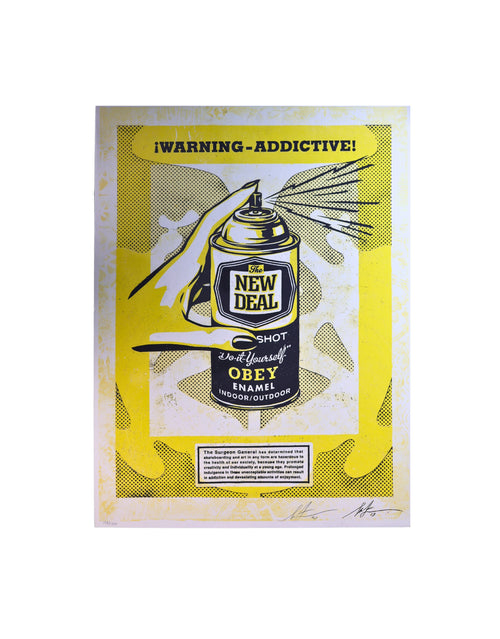
- Shepard Fairey: No artist-issued COA program exists. Authentication relies on signature examination, edition numbering, verification against the Obey Giant documented drop record, and provenance chain integrity. The absence of a formal COA is not a red flag here — it's the known standard.
- Death NYC: Requires both the artist-signed COA and the studio gold seal. Both. The absence of either is disqualifying.
- KAWS and BE@RBRICK: Verification against original packaging, hologram, foot-stamp markings, and the Medicom release record; pieces Gauntlet sells are backed by a TrueCOA blockchain certificate.
- Warhol: The Warhol Authentication Board dissolved in 2012. Work now moves through the TrueCOA framework. Understanding what documentation a Warhol piece carries — and how it aligns with TrueCOA standards — is non-optional for serious Warhol collecting.
The point here: authentication confirms what the work is. The database check confirms the work isn't actively subject to a theft claim. You need both answers.
What a Clean Result Does and Doesn't Guarantee
Let's be direct about the limits.
A clean Art Loss Register result means the work is not currently registered in their database as stolen or missing. That's the entire claim.
It does not mean:
- The work was never stolen.
- The theft simply hasn't been reported or registered yet.
- The provenance documentation attached to the work is genuine.
- The work is free of repatriation claims under cultural heritage law.
- The work is free of competing ownership claims not yet formalized into a theft registration.
These limits are not a reason to skip the check. They are a reason to understand the check as one layer of a multi-layer process, not as a clearance document.
The ALR itself is transparent about this. Their certificate language is precise. Read it carefully. What it says and what a casual buyer assumes it says are not always the same thing.
Red Flags
Treat any of the following as a reason to pause the transaction and ask harder questions.
-
Seller refuses or resists a database check request.
A legitimate seller has nothing to lose from a database check. Resistance is information.
-
Provenance documentation that covers only recent years.
A work that only has documented ownership from, say, the last five to ten years — with no prior exhibition history, no auction records, no published references — has a gap that should be explained, not assumed.
-
A "private collection" provenance with no supporting documentation.
"Private collection, Europe" as the sole provenance entry is a phrase that appears in legitimate listings and in fraudulent ones with roughly equal frequency. It needs more than a name attached. It needs supporting evidence.
-
Price significantly below established market for comparable works.
The art market does produce legitimate below-market opportunities. But price pressure that seems too good is the oldest red flag in any secondary market. If the price makes you feel clever, that's when you slow down.
-
Urgency from the seller.
Pressure to close quickly, resistance to giving you time for due diligence, offers that expire within an unreasonably short window. Urgency serves the seller, not the buyer, in a transaction with theft or fraud in the background.
-
Certificate of authenticity that doesn't align with known authentication frameworks for that artist.
A COA from an authenticator whose name doesn't appear in any established record for the relevant artist category. A COA issued by a company rather than a recognized specialist body. Refer back to the authentication canon for the artist in question.
-
Work that changed hands multiple times in a short period with no clear explanation.
Rapid title transfers can indicate an attempt to create apparent distance between a theft and the current offering. The pattern matters even when individual transactions appear clean.
-
Seller unable or unwilling to identify the immediate prior owner.
A dealer or seller who cannot name the person they acquired the work from — not necessarily for you to verify independently, but simply as part of representing the provenance accurately — is either covering something or operating with a level of informality that creates unacceptable risk.
The Legal Exposure Dimension
This is not abstract risk management. There are collectors currently in legal proceedings because works they purchased in good faith were subsequently identified as stolen or looted property subject to repatriation claims.
The legal frameworks that govern these situations vary by jurisdiction. Some countries operate under civil law systems where the original owner retains title regardless of subsequent good-faith transfers. Others apply common law principles where good-faith purchaser protections are stronger. In international disputes, choice of law questions add additional complexity.
The 1970 UNESCO Convention threshold matters practically because U.S. courts and many European courts treat pre-1970 provenance documentation as significant in determining whether the transfer chain is legally defensible. Works that cannot demonstrate clear provenance to 1970 face higher repatriation risk in dispute contexts.
None of this requires you to be a lawyer. It requires you to understand that a database check and documented due diligence are not just best practices. They are your evidentiary record if a dispute surfaces years after you've paid for and displayed a piece.
Building Due Diligence Into Your Acquisition Process
Standardize it. Not as an occasional step for expensive pieces but as a non-negotiable part of every acquisition above your defined threshold.
-
Define your threshold.
At what price point do you conduct a formal ALR certificate search versus a self-service check versus a combined multi-database check? Establish that number in advance so it doesn't become a negotiation you have with yourself during a transaction.
-
Create a provenance file for every acquisition.
This file should contain: the database search certificate, all provenance documentation provided by the seller, any exhibition or publication references, authentication certificates, condition reports, and the sales documentation. This file travels with the work if you ever sell.
-
Use ARIS (Art Research Intelligence System) and similar resources for additional cross-referencing.
Multiple commercial and non-commercial databases exist. No single check covers everything. A layered approach is more defensible than reliance on one source.
-
Ask your dealer about their process.
A reputable dealer should be able to tell you, without hesitation, whether they run ALR checks as standard practice, which database services they use, and whether they maintain records of those checks. The answer tells you something about how they operate.
-
For works with historical age or European origin, consider a specialist provenance researcher.
This is a professional service category. Researchers who specialize in art provenance — particularly for the 1933–1945 period — can access archival sources that database searches don't reach. The cost scales with the value of the work. At a certain price point, it's simply part of the acquisition cost.
Bottom Line
The Art Loss Register check is not the finish line of due diligence. It is the starting gun.
You run it before you commit, not after you've already decided you want the piece. Emotional investment in an acquisition is the enemy of clear-eyed process. Do the database check when you're still in evaluation mode, not when you're already planning where it hangs.
A clean result gives you one solid piece of documented evidence that the work wasn't actively registered as stolen or missing at the time of your search. Keep that record. Add it to the provenance file along with everything else.
If the result surfaces a potential match, you now have information. That information is worth more than the discomfort of pausing the transaction. It might mean nothing — a false positive, a title variation, a work with a similar description. It might mean everything.
Either way, you'd rather know.
The collectors who get caught holding stolen works aren't always careless people. Sometimes they're careful people who skipped one step because the deal felt right. Don't be that story.
Frequently Asked Questions
What is the Art Loss Register and who operates it?
The Art Loss Register is a private company operating the world's largest database of stolen, looted, and missing artworks. Founded in 1991, it is headquartered in London and works with law enforcement agencies, insurance companies, governments, and private individuals globally. It is not a government body, and its database is built from submissions across multiple institutional channels.
How much does an Art Loss Register search cost?
Search fees vary depending on the type of search requested — self-service queries, certificate searches, and research requests are priced differently. For collector purposes, the relevant comparison is the cost relative to the value of the work being purchased. For any piece of meaningful financial or cultural value, the fee is negligible. Check the ALR's current fee schedule directly, as pricing structures are updated periodically.
Does a clean ALR result mean the work is definitely not stolen?
No. A clean result means the work is not currently registered in the ALR database as stolen or missing. Works can be stolen and never registered, registered in databases the ALR doesn't cover, or subject to claims that haven't yet been formalized as theft registrations. The database check is one layer of due diligence, not a clearance certificate.
What is the 1970 UNESCO Convention threshold and why does it matter?
The 1970 UNESCO Convention on the Means of Prohibiting and Preventing the Illicit Import, Export and Transfer of Ownership of Cultural Property established an international standard for cultural property protection. In practice, "provenance to 1970" means the ability to document a work's ownership or location prior to that year. Works — particularly antiquities and historical art — that cannot demonstrate pre-1970 documentation face significantly elevated repatriation risk in legal disputes. Many major institutional buyers and auction houses use 1970 as a baseline provenance threshold.
I'm buying contemporary street art and limited editions. Do stolen art database checks apply to me?
Yes. The category of work doesn't determine whether it can be stolen. High-value contemporary works — including authenticated Banksy, signed Shepard Fairey, and verified KAWS editions — are documented theft targets. An ALR check takes minutes and costs less than any piece worth protecting. Make it standard regardless of medium or category.
What should I do if an ALR search returns a potential match?
Pause the transaction. Do not complete the purchase until the potential match is fully investigated. Contact the ALR directly through their match inquiry process — they have procedures for this because false positives occur and legitimate matches need proper documentation. A potential match is not always a disqualifying finding, but it is always a signal to investigate before committing funds. Document every step of your inquiry process during this period.
Does my dealer have a responsibility to run these checks, or is that on me?
Reputable dealers at any serious price point run ALR checks as standard practice. Major auction houses have formal policies requiring pre-consignment searches. However, your due diligence is not fully delegable. You should ask your dealer whether they've run a check and request the documentation. For private sales from non-dealer sources, the check responsibility falls directly on you as the buyer. Either way, keeping your own copy of the search result in your provenance file is your responsibility.
Are there other databases beyond the Art Loss Register I should check?
Yes. The Interpol Works of Art database covers cross-border theft records accessible to law enforcement globally. Italy's Carabinieri TPC LEONARDO database is essential for Italian cultural property. The Looted Art Commission maintains Holocaust-era claims records. INTERPOL and UNESCO resources cover conflict-zone looting documentation. For a comprehensive due diligence process on a high-value or historically significant work, running checks across multiple databases rather than relying solely on the ALR is the professional standard. Some provenance research firms offer multi-database searches as a combined service.