Where to Buy Authentic Invader & RubikCubist Works
You can buy authentic Invader art from three reliable channels: established galleries and dealers who publish clear provenance, major auction houses (Sotheby's, Christie's, Phillips, Artcurial) for higher-value pieces, and vetted resale specialists who stand behind what they sell. Because Invader does not issue certificates through a single central authority for every object, authenticity rests on documented provenance, edition transparency, and buying from a source that guarantees its work — which is exactly the standard Gauntlet Gallery applies to every Invader print, Alias, and RubikCubist piece we place. Below is how the market is structured, what actually drives value, and how to authenticate with confidence before you spend.
Who is Invader, and what are you actually buying?
Invader is a French urban artist known worldwide for installing ceramic-tile mosaics — inspired by 8-bit video-game aliens — on walls in cities across the globe, a project he calls his ongoing "Invasion." The street pieces themselves are generally not for sale; what collectors buy are the studio-produced works that grew out of that practice. Understanding the categories is the first step to buying authentically, because each category has a different market, price band, and set of expectations.
The main categories collectors buy
- Screenprints and editioned prints. Signed, numbered fine-art prints released in defined editions. These are the most accessible entry point and the most liquid part of the secondary market.
- Alias works. Studio mosaic pieces, typically referencing a specific installation location, produced as unique or small-run objects. These sit at a higher tier than prints.
- Invasion Kits. Do-it-yourself mosaic sets that let a collector assemble a tile work, often tied to the artist's ecosystem of releases. They occupy a distinctive collector niche.
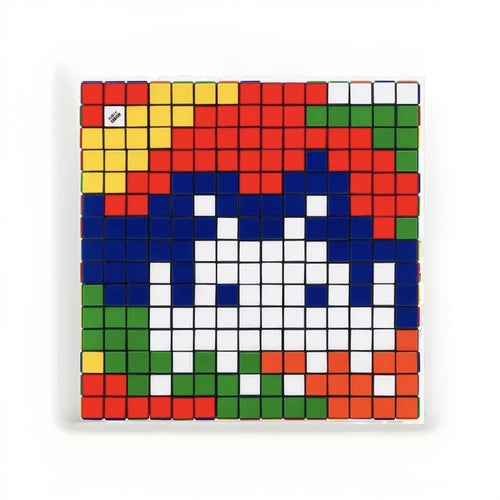
- RubikCubist works. Pieces built from Rubik's Cubes arranged so their colored faces form pixel-style images — a signature Invader medium that bridges his mosaic language with a three-dimensional, object-based format.
Knowing which category a piece belongs to matters, because a "cheap Invader" that seems too good to be true is often a poster, an open-edition reproduction, or an outright fake dressed up as a limited work. The category sets the realistic price range — and a mismatch between the claimed category and the asking price is your first authentication signal.
Where to buy authentic Invader art
There is no single official Invader store that supplies the public with every release, so the practical question is which channel gives you the best combination of authenticity assurance, price transparency, and recourse if something is wrong. Here is how the legitimate channels compare.
| Channel | Best for | Authenticity assurance | What to watch |
|---|---|---|---|
| Established galleries & dealers | Prints, Alias, RubikCubist | Dealer stands behind the work; documented provenance | Confirm the dealer specializes in the artist and guarantees authenticity |
| Major auction houses | Higher-value and rarer pieces | Cataloguing, provenance research, condition notes | Buyer's premium; read the lot's provenance and condition line carefully |
| Vetted resale specialists | Secondary-market prints and objects | Curated inventory with stated guarantees | Ask what happens if authenticity is ever challenged |
| Open marketplaces (eBay, general resale) | Occasional finds — highest risk | Varies wildly; no inherent guarantee | Provenance is on you; many listings are posters or fakes |
Galleries and specialist dealers
A dealer who works in Invader routinely — and publishes provenance rather than hiding behind vague "sourced from a private collection" boilerplate — is the most straightforward path for prints, Alias pieces, and RubikCubist works. The advantage is accountability: a reputable dealer's name is attached to the sale, they can explain a piece's history, and they should guarantee its authenticity in writing. At Gauntlet Gallery, every Invader work in our Invader collection is presented with the provenance and condition detail a serious collector needs before buying, and we back what we sell.
Auction houses
For higher-value or rarer Invader works — significant Alias pieces, notable RubikCubist objects, or scarce early prints — the major houses (Sotheby's, Christie's, Phillips, and Artcurial, which has handled a great deal of French urban art) offer professionally researched provenance and condition reporting. The trade-offs are the buyer's premium added to the hammer price and the need to do your own homework on each lot. Auction results are also one of the cleanest public windows into real market value; our Financial Insights hub tracks how urban-art results move so you can benchmark a price rather than guess at it.
Vetted resale and the secondary market
Most collectors will encounter Invader prints on the secondary market. The secondary market is not inherently dangerous — it is where liquidity lives — but the safety comes entirely from the seller. A vetted resale specialist curates inventory, documents provenance, and stands behind authenticity. An anonymous marketplace listing does none of that by default, which is why the same print can be a confident buy from one source and a coin-flip from another.
How to authenticate Invader works before you buy
Invader does not run a single public certificate service that issues a document for every object in the way some contemporary programs do, so authentication is built on evidence rather than one magic stamp. The good news: the evidence is knowable, and a legitimate seller will provide it without being pressed. Focus on these pillars.
The authentication pillars that actually matter
- Provenance. A documented chain of ownership — where the work came from, when it was acquired, and from whom — is the single most important factor. Unbroken, specific provenance is worth more than any confident-sounding sales pitch.
- Edition transparency. For prints, the edition size, the signature, and the numbering should be clearly stated and consistent with what is known about that release. A seller who cannot tell you the edition details is a seller to slow down with.
- Source accountability. Buy from a party who guarantees authenticity and will make it right if a work is ever credibly challenged. That guarantee is only as good as the seller behind it — which is why the dealer matters as much as the document.
- Condition and consistency. Materials, finish, and construction should match the category and era of the work. This is especially relevant for object-based pieces like RubikCubist works and Alias mosaics, where physical make-up is part of the fingerprint.
A note on what we will not do: invent a fake-spotting checklist of secret "tells." Counterfeiters read those guides too, and specific tells go stale. The durable protection is structural — buy from an accountable source, insist on provenance, and verify edition details — not a list of visual tricks. Our Invader buyer's guide walks through this framework in more depth, and our Invader index is a reference for understanding the range of works that exist.
Category-specific authentication notes
- Prints: confirm signature, numbering, and edition size, and ask for provenance back as far as the seller can document it.
- Alias & RubikCubist: because these are object-based, provenance and physical consistency carry even more weight; request detailed images and a clear ownership history.
- Invasion Kits: understand exactly which release a kit belongs to and how it was distributed, since niche items attract the most misrepresentation.
What drives the value of Invader works
Once you are confident a piece is authentic, value comes down to a handful of repeatable drivers. Understanding them helps you tell a fair price from an inflated one — and spot genuine opportunity.
The core value drivers
- Category and format. Unique object-based works (Alias, notable RubikCubist pieces) generally command more than editioned prints, which in turn command more than open reproductions.
- Edition size and scarcity. Smaller editions and harder-to-find releases carry premiums. Scarcity is real, but it must be verifiable, not asserted.
- Condition. As with all works on paper and object art, condition materially affects value; damage, fading, or restoration discounts a piece.
- Provenance quality. A clean, documented history not only protects you — it adds value at resale, because the next buyer inherits the same confidence.
- Subject and desirability. Iconic motifs and well-known references tend to attract broader demand.
Rather than quoting exact figures that move month to month, we point collectors to real, current results. Prices vary meaningfully by edition, format, and condition, so treat any single number with caution and benchmark against comparable sales. Our Financial Insights resource is built to help you do exactly that — reading the market instead of reacting to a single listing.
A practical buying checklist
Before you commit to any Invader or RubikCubist purchase, run through this short list. If a seller cannot satisfy most of it, that is your answer.
- Is the category clearly identified (print, Alias, Invasion Kit, RubikCubist), and does the price fit that category?
- Can the seller provide provenance — a documented ownership history?
- For prints, are the signature, numbering, and edition size stated and consistent?
- Does the seller guarantee authenticity and stand behind the work?
- Is the condition honestly described, with clear images?
- Does the asking price make sense against comparable results, not just the seller's assertion?
New to collecting more broadly? Our collector hub and buyer's guides cover the fundamentals — provenance, authentication, and value — across every artist we handle, so the habits you build on Invader carry over to the rest of your collection.
Where NOT to buy — and why cheap Invader is usually a trap
Most collectors who get burned on Invader are not victims of a sophisticated forgery ring — they simply bought from the wrong place. The pattern is consistent, and once you see it you can avoid it every time.
The common failure modes
- Posters sold as prints. Open-edition posters and promotional reproductions exist, and some sellers blur the line between a poster and a signed, numbered fine-art print. The two are not remotely equivalent in value, and the difference is often disguised with vague wording.
- "Unsigned edition" or "estate" language. Ambiguous descriptions that avoid stating signature, numbering, and edition size are a way of dodging accountability. Specifics protect you; vagueness protects the seller.
- Too-good-to-be-true pricing. A unique object-based work priced like a common print, or a "rare" print priced far below comparable results, is a signal — not a bargain. Real scarcity does not sell at a discount.
- No provenance, no recourse. Anonymous listings with no documented history and no authenticity guarantee put the entire risk on you. If something is wrong after the sale, there is no one accountable.
None of this means the secondary market is off-limits — it means the seller, not the platform, is what makes a purchase safe. The same print can be a confident acquisition from an accountable dealer and a gamble from an unverified account on the same day.
How Invader collecting compares to other urban artists
If you already collect prints by artists like Shepard Fairey, Banksy, or KAWS, some instincts transfer and some do not. The biggest difference is that authentication norms vary meaningfully from artist to artist, so you cannot assume one artist's process applies to another.
| Consideration | Invader | How it differs elsewhere |
|---|---|---|
| Authentication basis | Provenance, edition transparency, accountable source | Some artists have dedicated authentication bodies; others, like Shepard Fairey, rely on provenance and dealer trust with no artist-issued certificate |
| Object vs. print | Strong object-based tradition (Alias, RubikCubist, kits) | Many urban artists are collected primarily as editioned prints |
| Central certificate service | No single public certificate for every object | Varies widely — never assume one artist's chain applies to another |
The takeaway: treat every artist as its own discipline. Learn how that specific market authenticates and prices work before you buy. Our per-artist buyer's guides exist precisely because the rules are not interchangeable, and applying Banksy assumptions to an Invader purchase (or vice versa) is a reliable way to overpay or get fooled.
Getting started: a confident first purchase
If you are buying your first Invader piece, you do not need to become an expert overnight — you need a good source and a short set of habits. Here is a sensible path from interest to ownership.
A step-by-step approach
- Decide your category and budget. Editioned prints are the most accessible and liquid entry point; Alias and RubikCubist works are a step up in both price and object rarity. Match your budget to a realistic category rather than chasing a "deal" in the wrong tier.
- Study the landscape. Use a reference like our Invader index to understand the range of works and where a given piece fits, then read the Invader buyer's guide for the authentication framework.
- Benchmark the market. Before you make an offer, look at comparable results so you know whether an asking price is fair. Financial Insights is built for exactly this — reading real market movement instead of a single seller's claim.
- Choose an accountable source. Buy from a dealer or specialist who documents provenance and guarantees authenticity. This single decision eliminates most of the risk that trips up new collectors.
- Verify before you pay. Confirm category, provenance, edition details, and condition — and get the authenticity guarantee in writing. A legitimate seller welcomes these questions.
Done in this order, your first Invader purchase is not a leap of faith — it is a documented, benchmarked decision you can defend at resale. That is the entire point of buying from an accountable source: you inherit confidence, and so does the next owner when you eventually sell.
Why buy Invader from Gauntlet Gallery
Gauntlet Gallery is an authenticated contemporary-art and collectibles dealer, and Invader sits alongside the other urban and street artists we handle. Every piece in our Invader collection is presented with the provenance and condition detail collectors need, priced against real market context rather than hype, and backed by our accountability as the seller. We do not invent certificates that do not exist, and we do not paper over gaps in a work's history — where the market authenticates on provenance and edition transparency, that is exactly what we provide. For collectors who want to spend confidently on Invader prints, Alias works, Invasion Kits, or RubikCubist pieces, that combination of documentation, market grounding, and standing behind the work is the whole value of buying from a vetted source.
Frequently asked questions
Where can I buy authentic Invader art?
Buy from established galleries and specialist dealers who publish provenance, from major auction houses (Sotheby's, Christie's, Phillips, Artcurial) for higher-value pieces, or from vetted resale specialists who guarantee authenticity. Avoid anonymous marketplace listings unless you can independently verify provenance and edition details. Gauntlet Gallery presents every Invader print, Alias, and RubikCubist work with documented provenance and stands behind what it sells.
Does Invader art come with a certificate of authenticity?
It depends on the work and the release; Invader does not run a single central certificate service that covers every object. That is why authenticity rests on documented provenance, edition transparency, and buying from an accountable source that guarantees the piece — not on assuming a certificate exists for everything. Always ask a seller what authentication documentation accompanies a specific work.
What is a RubikCubist work?
RubikCubist is Invader's signature medium of arranging Rubik's Cubes so their colored faces form pixel-style images. These are object-based works rather than prints, so provenance and physical consistency carry extra weight when authenticating them, and unique pieces typically sit at a higher price tier than editioned prints.
Are Invasion Kits a good way to start collecting Invader?
They can be, but know exactly which release a kit belongs to and how it was distributed, because niche items attract the most misrepresentation. As with any Invader purchase, buy from a source that documents provenance and guarantees authenticity rather than an unverified marketplace listing.
How much do Invader works cost?
Prices vary widely by category, edition size, and condition — editioned prints sit below unique object-based works like Alias and RubikCubist pieces, and scarcity drives premiums. Rather than relying on a single figure, benchmark any piece against comparable recent results; our Financial Insights resource is designed to help you read the market before you buy.
How do I avoid buying a fake Invader?
Focus on structure, not secret visual "tells." Buy from an accountable seller who guarantees authenticity, insist on documented provenance, confirm edition details for prints, and make sure the price fits the claimed category. If a work is far cheaper than comparable pieces or the seller cannot explain its history, treat that as a warning sign.
Buy & authenticate with confidence
Authentic Invader collecting comes down to buying from a source that is accountable for what it sells. Explore vetted, provenance-documented pieces in our Invader collection, learn the framework in our Invader buyer's guide, and use the Invader index to understand the range of works. For market context, lean on Financial Insights, and if you are building a broader collection, start at our collector hub. Buy on provenance, verify the edition, and work with a dealer who stands behind the piece — that is how you build an Invader collection you can trust.