At the very top of the KAWS collectible market, the arithmetic stops being about hype and starts being about scarcity, scale, and paperwork. In our catalogue of 214 catalogued KAWS releases, values span from $209 at the accessible floor to $68,000 at the ceiling. The median release is worth $500. The mean is $1,983. And yet a small handful of pieces — ten of them — sit at or above $3,000, a threshold that separates the collectible-toy market from what is, functionally, the sculpture market. These are the grails.
If you are reading this as a serious buyer, the number that should anchor your thinking is this: the top ten figures in our index carry a combined catalogue value north of $330,000, and the single most valuable — the Four Foot Companion in Grey at $68,000 — is worth more than 130 times the median release. That is not a linear market. It is a market with a steep, narrow spire at the top, where a few attributes compound into extraordinary value and where a single missing hang tag or a broken seal can vaporize a five-figure premium.
This piece is a definitive rundown of that spire. We will name every figure at or above $3,000 in our catalogue, lay out the $1,000–$3,000 near-grail tier immediately beneath it, and then do the more important work: explain why the ceiling is where it is. Scale, rarity, the Dissected motif, chrome and limited colorways, and collaboration pedigree are the five levers that move a KAWS figure from a $500 shelf piece to a $50,000 acquisition. By the end, you should be able to look at a grail-tier listing and know which questions decide whether it is a sound purchase or an expensive mistake.
A necessary caveat before we begin, and one we will return to with more rigor later: several of the values at the very top of this index rest on a single recorded public sale. That is a real limitation, not a footnote. It shapes how you should price, how you should negotiate, and how much risk you are actually carrying at this tier. We will be candid about it throughout.
One more framing point worth setting down before the numbers. The distribution of value across the KAWS catalogue is not a gentle slope — it is a power law. The vast majority of releases, 174 of the 214 we track, live under $1,000. They are the accessible tier: the open-edition Companions, the Holiday-series pieces, the plush, the entry-level BFFs. They are wonderful objects and, for most collectors, the right place to start. But they are not what this article is about. Above them sit 30 figures in the $1,000–$3,000 band, and above those, the 10 grails. As you climb, the population thins, the values explode, and — this is the crucial part — the quality of the price data degrades. The very pieces that cost the most are the ones about which we know the least, in the narrow sense of recorded transactions. A serious buyer at this level is therefore not buying a number off a screen. They are buying a thesis about scarcity, backed by a documentation file, priced against a handful of comps. Understanding that inversion — value up, certainty down — is the entire game.
The Public Ceiling vs. Our Catalogue
Before we walk our own numbers, it helps to establish the outer boundary of the KAWS market as the public record defines it, because that boundary explains the psychology of everything below it.
In April 2019, at Sotheby’s Hong Kong, the large-format KAWS painting The KAWS Album — a reworking of Sgt. Pepper’s — sold for roughly HK$115.9 million, or about US$14.8 million, obliterating its estimate and instantly recalibrating what the market believed a KAWS work could command. That figure is widely reported and belongs to the fine-art side of KAWS’s practice, not the figure market. It is a painting, not a vinyl or wood sculpture. We reference it here for one reason only: it is the publicly visible ceiling of the KAWS name, and it is the gravitational mass that makes a $68,000 sculpture feel, to a certain kind of buyer, like a relative bargain.
We want to be scrupulously clear that the $14.8 million Sotheby’s result is separate from and not comparable to any value in our catalogue. Our index deals in production figures — vinyl, wood, and plush editions — not unique paintings. No figure in our catalogue has ever approached seven figures, and none should be represented as if it could. What the Sotheby’s sale does is set the tone: it confirms that institutional and blue-chip collector money takes KAWS seriously, which is the demand-side backdrop against which the four-foot sculptures trade. When you buy a grail-tier figure, you are buying into an artist whose top-line auction record is one of the strongest of any living artist working in the crossover between fine art and designer culture. That matters for liquidity and for the durability of the floor. It does not mean your figure is worth a fraction of a painting.
With that boundary drawn, let’s turn to the figures we actually track.
The Grails Index: Every Figure at or Above $3,000
Here are the ten figures in our catalogue with a current fair value of $3,000 or more, ranked from the top. Every figure in this table is drawn directly from our Grails Index dataset.
| Rank | Figure | Year | Value | Observed Range | Sold Comps | Confidence |
|---|---|---|---|---|---|---|
| 1 | Four Foot Companion — Grey | 2007 & 2009 | $68,000 | $68,000 | 1 | Insufficient |
| 2 | Four Foot Companion — Black | 2007 & 2009 | $60,000 | $60,000 | 1 | Insufficient |
| 3 | Four Foot Dissected Companion — Black | 2009 | $48,000 | $48,000 | 1 | Insufficient |
| 4 | Four Foot Companion — Brown | 2007 & 2009 | $45,000 | $45,000 | 1 | Insufficient |
| 5 | Four Foot Dissected Companion — Brown | 2009 | $45,000 | $45,000 | 1 | Insufficient |
| 6 | Dissected Companion 100% (BE@RBRICK) — Black | 2010 | $7,000 | $7,000 | 1 | Insufficient |
| 7 | BBWT (Karimoku Wood) 400% | 2005 | $4,800 | $4,800 | 0 | Insufficient |
| 8 | Dior BFF Plush — Pink | 2019 | $4,000 | $650–$12,999 | 0 | Low |
| 9 | Dior BFF Plush — Black | 2019 | $4,000 | $650–$12,999 | 0 | Low |
| 10 | No Future Companion — Black Chrome | 2009 | $3,600 | $531–$1,599 | 8 | Low |
The shape of this table tells you almost everything about how the top of the KAWS market is structured.
The top five are dominated entirely by four-foot sculptures. Three are standard Four Foot Companions — Grey at $68,000, Black at $60,000, Brown at $45,000 — and two are the four-foot Dissected variants, Black at $48,000 and Brown at $45,000. Notice that the Dissected Black ($48,000) actually out-values the standard Companion in Brown ($45,000). That is the Dissected premium asserting itself, and we will unpack it below. Then there is a cliff. Below the four-foot cohort, the sixth-ranked piece — the Dissected Companion 100% BE@RBRICK in Black — drops to $7,000, roughly one-seventh of the fifth-ranked figure. The gap between the four-foot tier and everything else is the single most important structural fact in this index.
Beneath the BE@RBRICK sits the BBWT Karimoku wood 400% at $4,800, the two Dior BFF plush colorways at $4,000 each, and the No Future Companion in Black Chrome at $3,600. Each of these represents a different one of our five ceiling drivers — wood/craft rarity, collaboration pedigree, and chrome/limited colorway respectively — which is why they cluster just above the $3,000 line rather than in the four-foot stratosphere.
Now the uncomfortable part, stated plainly: of these ten grails, every single one carries a confidence label of “Insufficient” or “Low.” Five of them rest on exactly one recorded sold comp. Two — the Karimoku 400% and both Dior plush — have zero recorded sold comps in our dataset, meaning their values are anchored to asking prices, adjacent comparables, and market judgment rather than closed transactions. Only the No Future Black Chrome, with eight comps, has anything resembling a distribution behind it, and even that is labeled “Low.” We will devote a full section to what that means for price discovery. For now, hold this thought: at the very top of this market, the price is thin.
The Near-Grail Tier: $1,000 to $3,000
Immediately beneath the grails sits a broader, deeper, and in many ways more actionable tier — the figures valued between $1,000 and $3,000. This is where a serious collector without a four-foot budget builds a genuinely blue-chip shelf, and where the comp data, while still uneven, occasionally firms up into something you can underwrite with more confidence.
| Figure | Year | Value | Observed Range | Sold Comps | Confidence |
|---|---|---|---|---|---|
| Companion (Resting Place) — Brown | 2012 | $2,943 | $2,500 | 1 | Low |
| Tweety — Yellow | 2010 | $2,600 | $2,050–$4,200 | 4 | Insufficient |
| Companion 5th Anniversary — Grey | 2011 | $2,500 | $2,500 | 0 | Insufficient |
| Companion 5th Anniversary — Grey/Blue | 2011 | $2,500 | $2,500 | 0 | Insufficient |
| Dissected Companion 400% — Brown | 2009 | $2,106 | $2,133 | 1 | Low |
| Skull Kun — Red | 2006 | $2,098 | $1,650 | 1 | Low |
| Passing Through — Brown | 2013 | $2,019 | $500–$3,400 | 13 | Low |
| Cat Teeth Bank — Green | 2007 | $2,012 | $250–$900 | 3 | Low |
| Accomplice (Original) — Pink | 2002 | $1,860 | $350–$3,050 | 21 | High |
| Skull Kun — Black | 2006 | $1,750 | $1,750 | 1 | Insufficient |
| Woodstock | 2012 | $1,750 | $1,500–$2,000 | 2 | Low |
| Bendy — Yellow | 2003 | $1,714 | $599 | 1 | Low |
| Cat Teeth Bank — Blue | 2007 | $1,664 | $365 | 1 | Low |
| Skull Kun — White | 2006 | $1,600 | $999–$1,950 | 5 | Low |
| Companion (Original) — Brown | 1999 | $1,500 | $1,500 | 1 | Insufficient |
| Companion (Resting Place) — Grey | 2012 | $1,468 | $280–$399 | 7 | Low |
| Dissected Companion 400% — Grey | 2009 | $1,464 | $1,427–$1,500 | 2 | Insufficient |
| No Future Companion — Silver Chrome | 2009 | $1,399 | $1,180–$1,500 | 0 | Low |
| BFF Plush — Pink | 2019 | $1,277 | $345–$800 | 12 | Low |
| Skull Kun — Green | 2006 | $1,250 | $591–$975 | 3 | Low |
| Gone — Black | 2019 | $1,250 | $1,250 | 1 | Low |
| Dissected Milo — Black | 2011 | $1,219 | $200–$3,500 | 17 | Medium |
| Bendy — Green | 2003 | $1,180 | $225 | 1 | Low |
| Cat Teeth Bank — Orange | 2007 | $1,140 | $389–$500 | 2 | Low |
| Passing Through — Black | 2013 | $1,140 | $335–$3,600 | 22 | Medium |
| Passing Through — Grey | 2013 | $1,119 | $200–$3,100 | 27 | High |
| Holiday Space — Gold | 2020 | $1,100 | $800–$1,400 | 7 | Medium |
| Companion (Resting Place) — Black | 2012 | $1,095 | $310–$1,850 | 10 | Low |
| Wonderwall — Black | 2010 | $1,087 | $1,087 | 1 | Low |
| Bendy — Pink | 2003 | $1,079 | $1,125 | 1 | Low |
This tier is instructive precisely because the confidence labels are more varied. Look at the bottom third of the table and you find the market’s most-traded grail-adjacent pieces: Passing Through in Grey ($1,119, 27 comps, High confidence), Passing Through in Black ($1,140, 22 comps, Medium), and Dissected Milo in Black ($1,219, 17 comps, Medium). These are the figures where the price is discovered — where dozens of buyers and sellers have transacted and the fair value sits on a real distribution rather than a single data point. Accomplice (Original) in Pink stands out at $1,860 on 21 comps with a High confidence rating, and its observed range ($350–$3,050) tells the honest story of a piece whose condition and completeness swing the outcome dramatically.
Contrast those with the top of this same table. Companion (Resting Place) in Brown carries the highest near-grail value at $2,943, yet it rests on a single comp and a “Low” label. The two Companion 5th Anniversary variants at $2,500 each have zero comps. This is the recurring pattern of the KAWS top market: the rarer and more valuable the piece, the thinner the transaction record behind its price. Value and confidence are, at this tier, inversely correlated — which is exactly backwards from what a buyer instinctively wants, and exactly why methodology matters.
It is worth pausing on a few individual entries in this near-grail table because they preview, in cheaper form, every one of the ceiling drivers we are about to dissect — and because they are, for many buyers, the more realistic acquisition targets.
Take the Skull Kun trio. Red at $2,098, White at $1,600, Black at $1,750, Green at $1,250 — four colorways of the same 2006 sculpt spread across nearly a thousand dollars of value. This is the colorway driver operating at a scale most collectors can actually reach. Notice that Red tops the group and White, despite a firmer comp count (5) and a labeled “Low” rather than “Insufficient,” sits below both Red and Black. The market is not pricing these on a simple ladder; it is pricing collector preference and perceived scarcity of the specific finish. If you are shopping Skull Kun, the lesson is the same one that governs the grails above: name the colorway before you name a price.
The Cat Teeth Bank cluster — Green $2,012, Blue $1,664, Orange $1,140 — tells a subtler story. Look at the observed ranges. Green’s fair value is $2,012 but its recorded observed range runs only $250–$900 on three comps; Blue’s $1,664 rests on a single comp with a $365 print. These are cases where the assessed fair value sits materially above the recorded closed sales, because the value estimate is incorporating scarcity and asking-price signal that the sparse closed-comp record has not yet caught up to. That gap between value and observed range is not an error; it is a flag. It tells a buyer exactly where the uncertainty lives and exactly where to press in a negotiation.
The two Dissected Companion 400% BE@RBRICKs — Brown at $2,106, Grey at $1,464 — are the near-grail echo of the four-foot Dissected premium, and we will return to them. And the No Future Companion in Silver Chrome at $1,399, with zero recorded comps, is the direct sibling of the tenth grail (Black Chrome at $3,600), which lets you watch the chrome-colorway premium play out across a single release. Finally, the Bendy trio (Yellow $1,714, Green $1,180, Pink $1,079) and the vintage Companion (Original) in Brown at $1,500 remind you that age and lineage carry weight of their own: a 1999 or 2003 piece is early KAWS, and early KAWS is history that later releases cannot manufacture.
The through-line across all of these is that the near-grail tier is where a disciplined buyer can practice the exact analysis the grails demand — colorway, motif, finish, lineage, comp depth — with a fraction of the capital at risk. If you cannot articulate why a $1,500 piece is worth $1,500, you have no business writing a $45,000 check.
The Five Drivers of the Ceiling
Why does a Four Foot Companion command $68,000 while a Companion Open Edition from the same visual lineage sells for $335? Five drivers do the work. In roughly descending order of impact:
1. Scale — The Four-Foot Effect
Scale is the single most powerful multiplier in the KAWS figure market, and it is not close. Every one of the top five figures in our Grails Index is a four-foot sculpture. The standard Four Foot Companion in Grey tops the index at $68,000; the same silhouette rendered as a Companion Open Edition — roughly eleven inches — sits at $335. That is a value ratio of more than 200 to 1 for what is, iconographically, the same character.
Scale drives value for reasons that are both practical and psychological. A four-foot sculpture is a production and logistics undertaking: the editions are tiny, the manufacturing cost is high, shipping and storage are non-trivial, and the object reads unambiguously as sculpture rather than toy. It occupies a room. It photographs like a gallery piece. For collectors crossing over from fine art — the same demand pool implied by the Sotheby’s painting result — the four-foot format is the entry point that feels legitimate. When a figure crosses the four-foot threshold, it exits the designer-toy market and enters the sculpture market, and the two markets price on entirely different logics. The four-foot cohort is the clearest illustration in our entire catalogue of a threshold effect: below it, incremental; above it, categorical.
2. Rarity and Edition Size
Rarity is the second lever, and it interacts with scale rather than operating independently. The four-foot editions are not just large — they are vanishingly small in number, which is why their observed range collapses to a single value with a single comp. Rarity also explains the presence of the BBWT Karimoku wood 400% at $4,800 and the Companion 5th Anniversary editions at $2,500. These are not large pieces; they are scarce ones. The Karimoku wood pieces in particular carry a craft-rarity premium: hand-finished wood production is limited, labor-intensive, and prized by a specific collector who values material and process over sheer size.
The practical consequence of rarity is thin liquidity. A piece with an edition in the low hundreds — or lower — may transact publicly only once every year or two. That is precisely why so many grail values in our index rest on one comp: there simply have not been enough sales to build a distribution. Rarity creates value and destroys price certainty in the same motion.
3. The Dissected Motif
The Dissected treatment — KAWS’s flayed, anatomized version of the Companion, exposing a cartoon skeleton and organs beneath the skin — carries a durable and measurable premium. The evidence is right in the top five: the Four Foot Dissected Companion in Black at $48,000 out-values the standard Four Foot Companion in Brown at $45,000. Same four-foot scale, and the Dissected motif adds enough to leapfrog a standard colorway. The premium repeats down the ladder. The Dissected Companion 100% BE@RBRICK in Black holds $7,000 — the sixth-ranked grail overall — and the Dissected Companion 400% variants populate the near-grail tier at $2,106 (Brown) and $1,464 (Grey). Even the accessible-tier Companion Flayed open editions, which anatomize the same idea, trade at a premium to the plain Companion open editions of the same year.
The Dissected concept is, arguably, KAWS’s signature intellectual gesture — the move that turned a cartoon mascot into a meditation on mortality and surface. Collectors pay for that conceptual weight. When a Dissected variant exists alongside a standard one at the same scale, expect the Dissected to sit at or above the standard, not below it.
There is a nuance worth flagging, because it is where naive buyers overpay. The Dissected premium is real, but it is not uniform across every format. At the four-foot scale it is decisive: the Dissected Black at $48,000 clears the standard Brown at $45,000. At the 100% BE@RBRICK scale it is enormous in one specific case — the Dissected Companion 100% in Black at $7,000 is the sixth-ranked grail — but the same Dissected 100% concept in other colorways and years sits far lower in our broader dataset, which tells you that the $7,000 print is carrying colorway, year, and comp-thinness effects on top of the Dissected motif, not the motif alone. In other words, “Dissected” is a genuine value adder, but it does not confer a fixed dollar premium you can bolt onto any base. It compounds with scale, colorway, and rarity, and the compounding is what produces the eye-catching numbers. A buyer who treats “Dissected” as an automatic multiplier — rather than as one input among several — will systematically overpay for the common Dissected variants and, occasionally, underestimate the rare ones. Read the whole row, not the one attribute that caught your eye.
4. Chrome and Limited Colorways
Finish and colorway are the fourth driver, and they explain some of the sharper anomalies in the index. The No Future Companion in Black Chrome holds $3,600 — the tenth grail — while its Silver Chrome sibling sits at $1,399 in the near-grail tier. Same sculpt, same year (2009), same “No Future” release, but the Black Chrome commands more than 2.5 times the Silver. Chrome finishes are notoriously difficult to produce cleanly and to keep flawless; they scratch, they fingerprint, they show every imperfection. A limited chrome colorway that survives in pristine condition is genuinely scarce, and the market rewards it.
The broader lesson is that colorway is not cosmetic at this tier — it is a primary value input. Within a single release, one color can carry a multiple of another based on production numbers, collector preference, and how well the finish ages. When you evaluate a grail, you are not evaluating “a No Future Companion.” You are evaluating a specific colorway of it, and the colorway can be the difference between $1,399 and $3,600.
5. Collaboration Pedigree
The fifth driver is the partner’s name on the box. The two Dior BFF plush figures at $4,000 each are the clearest case: their value is inseparable from the 2019 KAWS × Dior collaboration under Kim Jones, which married streetwear-collectible culture to a luxury fashion house at a specific cultural moment. Note the observed range on these pieces — $650 to $12,999 — which is one of the widest in the entire catalogue. That range is the market telling you two things simultaneously: collaboration pedigree can command a very high ceiling, but with zero recorded sold comps in our data, the realized price is enormously condition- and provenance-dependent. Collaboration pieces reward pedigree and punish ambiguity. The Dior name gets you into the four-figure conversation; the paperwork decides where in that conversation you land.
The Dior range deserves a moment of its own because it is a masterclass in what “wide observed range” actually means for a buyer. A spread from $650 to $12,999 on the same nominal object is not noise — it is the market pricing four different things under one product name. At the low end sit examples with compromised condition, missing packaging, uncertain provenance, or simply motivated sellers dumping into a soft moment. At the high end sit pristine, fully-documented, box-fresh examples sold into a hot bid, possibly at retail-adjacent luxury channels rather than the secondary toy market. The $4,000 fair value is a considered midpoint, not a promise. What this means practically: if you are offered a Dior BFF plush, the price you should pay is not “the market value” but a value you build from the specific example in front of you — its condition, its completeness, its documentation — anchored against that range. Two Dior plush at the same nominal grade can rationally trade thousands of dollars apart. In a collaboration piece with a wide range and zero closed comps, your diligence is the pricing model.
The collaboration driver also carries a distinct risk the other four do not: cultural time-stamping. Scale, rarity, and the Dissected motif are intrinsic to the object and to KAWS’s own practice. Collaboration value is partly borrowed — it rides on the partner brand’s standing and the cultural heat of the moment the piece captured. That heat can persist and even compound, as the Dior partnership’s stature suggests, but it introduces a variable that a pure-KAWS grail does not carry. When you underwrite a collaboration grail, you are underwriting two names, two markets, and the durability of the moment that joined them.
When Drivers Stack: Reading the Top Five as a System
The single most useful mental model for the grail tier is that these five drivers do not operate in isolation — they multiply. The reason the top five figures are so far above everything else is that each one stacks two or three drivers at once, and stacking is exponential, not additive.
Walk the top five with that lens. The Four Foot Companion in Grey ($68,000) stacks scale (four-foot) with rarity (a tiny edition) and a preferred colorway (Grey has historically been the most iconic Companion tone). Three drivers, compounding, produce the catalogue ceiling. The Four Foot Companion in Black ($60,000) holds scale and rarity but trades Grey’s specific colorway premium for Black’s, landing $8,000 lower. The Four Foot Dissected Companion in Black ($48,000) swaps the standard-colorway lever for the Dissected motif lever — and the motif is powerful enough that it out-earns the standard Brown ($45,000) despite Brown being, in the standard line, a perfectly desirable colorway. Then the Four Foot Dissected Brown ($45,000) ties the standard Brown, which tells you that at four-foot scale the Dissected-plus-Brown combination and the standard-plus-Brown combination converge. None of these numbers is arbitrary once you decompose it into the levers underneath.
This decomposition is not academic. It is how you sanity-check a grail asking price. When a seller quotes you a number, mentally break it into drivers: Is the scale doing the work, or the motif, or the colorway, or the collaboration, or the rarity? If two of those levers are weak and the price implies all five are firing, the ask is stretched. If a piece quietly stacks three strong levers and the price only reflects one, you may be looking at genuine value. The grail market rewards buyers who can read the object as a system of priced attributes rather than as a single mystique-laden trophy.
It also explains the cliff between rank five and rank six. The Four Foot Dissected Brown at $45,000 and the Dissected Companion 100% BE@RBRICK at $7,000 share the Dissected motif — but the BE@RBRICK loses the scale lever entirely. Strip out four-foot scale and even a strong motif plus a strong colorway cannot hold five figures. That single missing lever is a roughly $38,000 gap. Scale, once more, is the driver that dwarfs the rest.
Methodology: Why “Insufficient” Is the Most Important Word at the Top
We owe you a candid account of how these numbers are built, because at the grail tier the confidence rating is not a technicality — it is the risk disclosure.
Our values are assembled from recorded public sales of $200 or more. For each figure we track the observed low, the observed high, the median of recorded sales, and — critically — the count of real sold comps behind it. From that comp depth we assign a confidence label: High, Medium, Low, or Insufficient. Across the full 214-release catalogue, the distribution is sobering: 27 releases rate High, 21 Medium, 54 Low, and 112 — more than half — rate Insufficient. The Insufficient releases cluster overwhelmingly at the two extremes: the newest releases that haven’t traded yet, and the rarest, most valuable grails that trade too infrequently to build a distribution.
Look again at what that means for the top of the index. All five four-foot figures rate Insufficient, each resting on exactly one recorded sold comp. When a value is anchored to a single transaction, that value is a point estimate with an unknown error bar. The “true” clearing price for the next Four Foot Companion in Grey could reasonably come in above or below $68,000 depending on which specific example surfaces, in what condition, with what documentation, into what auction or private-sale context, on what day. One comp cannot tell you the width of that distribution. It can only tell you that a transaction happened there, once.
This has three direct consequences for a buyer:
Price discovery is genuinely incomplete. You are not buying into a liquid, continuously-quoted market. You are buying into a market where the last print might be one of only a few ever recorded. Anchor to the observed range and the comp count, not to a headline value presented as if it were a settled price.
Your negotiating leverage is higher than the headline suggests — in both directions. Thin comps cut both ways. A seller can point to a single high print to justify an ask; a buyer can point to the same thinness to argue that the number is unproven. The party with better comparable evidence and more patience usually wins.
The premium you are paying is a premium for scarcity, and scarcity is exactly what makes exit uncertain. The same rarity that supports a $68,000 value also means you may wait a long time for the right buyer when you sell. Grail-tier KAWS is not a liquid position. Underwrite it as a long-hold acquisition, not a trade.
Contrast this with the near-grail pieces that rate High — Passing Through in Grey (27 comps), Accomplice Pink (21 comps). Those values sit on real distributions. You can see the range, understand the condition-driven spread, and price with genuine confidence. If confidence and liquidity matter more to you than trophy status, the High-confidence near-grails are arguably the better-underwritten purchase, dollar for dollar, than the trophies above them.
How to Evaluate a Six-Figure-Adjacent Purchase
If you are actually going to write a check in this tier, the analysis is less about the figure and more about the file that comes with it. Here is the framework we apply.
Provenance and Paperwork Are Decisive
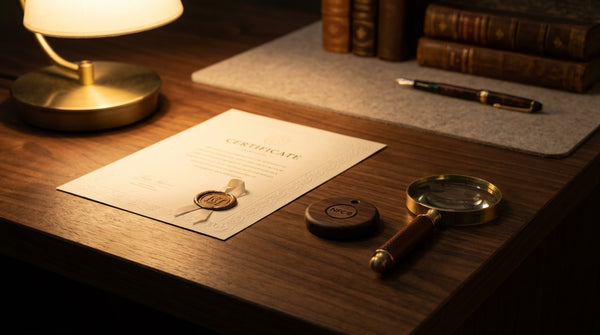
At $3,000 you can absorb a documentation gap; at $45,000 you cannot. Provenance — the ownership history — and the accompanying paperwork are the difference between a grail and an expensive uncertainty. Ask for the acquisition trail: original receipt, gallery or authorized-retailer documentation, prior auction records, and any prior-sale invoices. A four-foot Companion with a clean chain of custody back to an authorized release is a materially different asset from an identical-looking piece with an unexplained history. In a thin-comp market, provenance is often the only thing standing between the value in this index and a total loss on authenticity.
Condition, Box, and Completeness
Condition is priced, not assumed. The observed ranges in our tables — Accomplice Pink from $350 to $3,050, the Dior plush from $650 to $12,999 — are, to a large degree, condition and completeness ranges. For a grail, you want: the original box in collector-grade condition, all inserts and packaging, any accompanying booklets or cards, and a sculpture surface free of the scuffs, sun-fade, and — for chrome pieces especially — the fingerprints and micro-scratches that permanently cap value. A grail without its box is not the same asset as a grail with it. Photograph and inspect the finish under raking light; on chrome and gloss pieces, surface imperfection is the most common silent value-killer.
The KAWS Authentication Canon
Authentication for KAWS figures follows a clear, era-dependent standard, and you should treat it as non-negotiable at this tier:
- 2020 and later: Medicom-produced KAWS figures ship with a OneCOA and an embedded NFC chip. The NFC chip can be scanned to verify authenticity against Medicom’s system. If a post-2020 figure is presented without a functioning OneCOA and a scannable NFC chip, treat that as a material red flag until resolved.
- Pre-2020: There is no NFC chip, so authentication rests on the physical evidence — the original hang tag, an unbroken seal, and a matching serial number across the piece, tag, and packaging. Serial consistency and an intact seal are your primary tools. A broken seal or a missing tag does not automatically mean inauthentic, but it removes your strongest verification and should be priced accordingly.
Because the four-foot grails in our index date to 2007–2009, they fall squarely in the pre-2020 regime. That means their authentication leans entirely on physical provenance and documentation rather than a chip you can scan — which loops directly back to why provenance is decisive at the top of this market.
For a deeper walkthrough of packaging, seals, and the tells that separate an authentic release from a problem piece, see our KAWS Packaging Guide. To place any grail in the context of the full 214-release catalogue and its value ladder, use the KAWS Figurine Index. And if you want to understand how we assemble comps, confidence labels, and fair values across the whole market, our methodology and market facts page lays out the approach.
Where the Grail Sits in a Collection
There is a strategic question beneath the tactical one, and it is worth answering before you commit capital: what is a grail for, inside a collection? Broadly, grail-tier buyers fall into two camps, and the right diligence differs for each.
The first camp is the anchor buyer. For them, a four-foot Companion is the centerpiece around which everything else orbits — the piece that defines the collection and, frankly, the room. Anchor buyers should weight the trophy attributes heavily: scale, iconic colorway, the cleanest possible provenance. They are buying presence and permanence, and they should expect to hold for a very long time. For anchor buyers, the thin-comp problem matters less on the buy side (they are unlikely to sell) and more on the insurance and estate-planning side, where a defensible valuation and airtight documentation become the practical concern.
The second camp is the allocator. For them, the grail is a position — a concentrated bet on the KAWS name and on scarcity, sized within a broader collectibles or alternative-asset sleeve. Allocators should arguably look hardest at the High- and Medium-confidence near-grails before reaching for the trophies, because those pieces offer genuine KAWS blue-chip exposure with a real transaction record underneath. A basket of Passing Through, Accomplice, and Dissected Milo pieces — each with double-digit comp counts — gives an allocator diversified, better-priced exposure to the same artist and the same demand story that supports the four-foot ceiling, without staking a five-figure sum on a single one-comp print.
Neither camp is wrong. But knowing which one you are prevents the most common grail-tier error: paying trophy prices for trophy mystique while telling yourself it is an investment, or, conversely, over-diligencing a piece you are buying purely because you love it and never intend to sell. Decide the purpose first. The purpose sets the diligence.
Sizing the Position and the Exit
Finally, think like an allocator. A grail-tier KAWS figure is an illiquid, single-name, non-cash-flowing asset whose value rests — at the very top — on a handful of comps. That is a concentrated position. Size it as one. Assume a long hold, assume a wide bid-ask when you eventually sell, and assume that the quality of your documentation at purchase will determine the quality of your exit. The buyers who do best in this tier are the ones who treat the paperwork as the asset and the sculpture as the thing the paperwork describes.
The Bottom Line
The KAWS grail market is a study in compounding scarcity. Five levers — scale, rarity, the Dissected motif, chrome and limited colorways, and collaboration pedigree — stack on top of one another to lift a figure from the $500 median to the $68,000 ceiling. The four-foot format is the great divider: cross it and you leave the toy market for the sculpture market, where a Grey Companion commands $68,000, a Black $60,000, and the Dissected Black $48,000 out-values a standard Brown. Beneath the four-foot cohort, the market steps down sharply to the $7,000 Dissected BE@RBRICK, the $4,800 Karimoku wood, the $4,000 Dior plush pair, and the $3,600 No Future Black Chrome — each a clean illustration of a single ceiling driver.
But the defining feature of this tier is not the values. It is the thinness of the evidence beneath them. Every one of the ten grails rates Insufficient or Low confidence; five rest on a single comp; two on none. That is the honest risk at the top of this market, and it is why provenance, paperwork, condition, and the authentication canon are not niceties but the core of the underwriting. The public ceiling — the ~$14.8 million Sotheby’s painting — tells you the demand is real and durable. Our index tells you that capturing it, at the figure level, is an exercise in documentation as much as taste.
Acquire grail-tier KAWS with documented provenance from Gauntlet Gallery. We authenticate to the KAWS canon — OneCOA and NFC verification for 2020-and-later pieces, and rigorous physical provenance for the pre-2020 grails — so that the value in this index is the value you actually own.
This article is for informational purposes only and is not investment advice. Collectible values fluctuate; past sales do not guarantee future results.