The Market That Sets the Price Is Not the One You Think
Walk into any serious secondary market conversation about KAWS and someone will eventually mention New York. The studio is there. The cultural origin story is there. The gallery relationships, the graffiti roots, the Supreme collaborations — all of it traces back to the American Northeast.
But the price is set somewhere else entirely.
Hong Kong. Tokyo. Seoul. Shanghai. Singapore. The buyers moving KAWS at the top of the market are overwhelmingly concentrated in Asia, and have been for the better part of two decades. Western collectors are participants. Asian collectors are the engine.
So why does almost every conversation about KAWS pricing still center on Western gallery drops and American auction houses?
Because most Western dealers are still catching up to a market structure that shifted while they were looking the other direction.
This piece is about how that shift happened, what it means for pricing mechanics, and what any serious buyer — wherever they're located — needs to understand before they move on a significant KAWS piece today.
How Asian Collectors Became the Gravitational Center of the KAWS Market
The OriginalFake Era Changes Everything
KAWS launched OriginalFake in Tokyo in 2006, in partnership with Toei. This was not a licensing deal designed to extract margin from a foreign market. It was a direct, artist-directed operation with a flagship retail presence in one of the world's most sophisticated streetwear and collectibles cities.
The result was a Japanese collector base that grew up with KAWS as a local cultural institution, not an imported American artist. They built relationships with the work early, bought at original retail, and developed genuine fluency in the catalog. When OriginalFake closed in 2013, that collector base did not dissipate. It matured into a secondary market force with deep inventory and deep conviction.
Tokyo was the training ground. Hong Kong became the exchange floor.
Sotheby's Hong Kong and the Legitimization Moment
The auction result that genuinely recalibrated how the global market understood KAWS pricing did not happen in New York. It happened in Hong Kong. When KAWS figures began clearing serious multiples at Hong Kong auction — not as curiosities but as contested lots with multiple credible bidders — Western dealers had to revise their models.
This was not retail arbitrage. These were collectors paying market rate in a market that had already priced the work higher than the Western consensus. The Western consensus adjusted upward, not the other way around.
What does it mean when the price discovery mechanism for an American artist's work is operating six thousand miles from his studio?
It means the artist's geographic origin is largely irrelevant to where value is assigned. And for KAWS, that location is Asia.
The Japan Factor: Collectibles Culture as Infrastructure
Japan brings something no other market offers: a pre-existing infrastructure for taking designer toys and vinyl collectibles seriously as objects of value.
The culture that produced Medicom Toy, BE@RBRICK, the entire kaiju collectible ecosystem — this is the context in which Japanese collectors encountered KAWS. They were not being asked to suspend disbelief about whether a painted vinyl figure could be a real collectible asset. They already knew it could. KAWS was simply the most compelling artist working in a form they already respected.
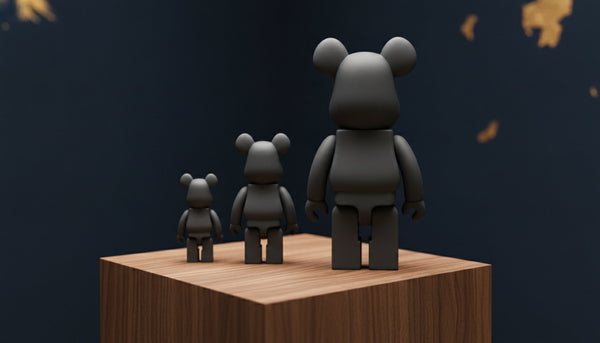
Medicom's BE@RBRICK collaborations with KAWS sit at an interesting intersection here. Earlier BE@RBRICK pieces — where authentication relies on original packaging, hologram verification, and Medicom release records — are particularly well understood by Japanese collectors who tracked release histories in real time. A Tokyo collector who bought a KAWS BE@RBRICK collaboration at original Medicom retail and kept the complete packaging has a provenance chain that is essentially airtight. Western buyers acquiring those same pieces secondhand often cannot reconstruct that chain and pay accordingly for the uncertainty.
The Chinese Mainland Surge
If Japan provided the infrastructure and Hong Kong provided the auction legitimization, mainland Chinese collectors provided the volume.
The entry of serious mainland Chinese buyers into the KAWS market over the past decade added a demand layer that operates at a scale Western markets simply cannot match in terms of raw buyer count at the top of the market. This is a collector base where the combination of rising wealth concentration, strong cultural appetite for globally recognized contemporary artists, and genuine enthusiasm for the specific visual language of KAWS created sustained buying pressure.
That pressure does not switch off when Western markets cool. It has its own rhythm, its own gallery relationships, its own information networks. And it maintains price floors that Western-only analysis would not predict.
How the Pricing Mechanics Actually Work
Arbitrage Windows Are Short and Getting Shorter
There was a period — roughly in the early-to-mid 2010s — when Western buyers with good gallery relationships could acquire KAWS at prices below where Asian buyers were willing to pay. The arbitrage was real. Pieces bought at New York gallery retail could be resold into Hong Kong with meaningful margin.
That window is largely closed now.
Information moves too fast. Asian collectors have direct relationships with the same galleries. The secondary platforms that price KAWS in real time are globally accessible. A serious Hong Kong collector is not dependent on a New York intermediary to know what a KAWS Companion is trading at. They know before the intermediary does.
If the arbitrage is gone, what's left for Western buyers who thought they had an edge?
Condition expertise. Provenance depth. Authentication fluency. These are the remaining differentiators, and they require real work.
The Drop Mechanic and Regional Allocation
KAWS drops — both physical figures and the digital releases that have expanded the market in recent years — are not allocated neutrally across geographies. Asian retail partners receive significant allocation. This is not favoritism; it reflects where demand is concentrated.
The consequence is that the secondary market premium for KAWS pieces is often established fastest in Asian markets immediately post-drop, then transmitted back to Western pricing. Western collectors tracking secondary pricing without accounting for this sequence are working from a delayed signal.
Currency Effects Are Real but Overweighted
Some Western analysts attribute Asian KAWS premium pricing to currency dynamics — the idea that pieces simply cost more in conversion terms because of how the yen, Hong Kong dollar, or RMB behave relative to USD.
This is partly true and mostly insufficient as an explanation.
Currency effects can explain transient pricing differentials. They cannot explain sustained, decade-long premium maintenance across multiple currency cycles. The premium is structural, not monetary. It reflects genuine demand concentration and a collector base that assigns higher cultural and investment value to the work than Western consensus pricing would suggest.
Authentication in a Globally Distributed Market
When your buyer is in Singapore and your seller sourced from a Tokyo private collection, authentication becomes the single most critical variable in the transaction.
The KAWS authentication framework has specific requirements that do not bend for geography.
The Authentication Standard for Current Production
For current-production KAWS figures, the authentication standard is the physical piece reconciled against its documented release: Medicom packaging quality and the hologram sticker, the molded foot stamp and copyright markings, and a match to the documented release record. All elements are weighed together. Packaging without consistent markings is not authentication. Markings without provenance documentation are not authentication.
This matters acutely in the Asian secondary market because the volume of KAWS pieces in circulation in Japan, Hong Kong, and mainland China is enormous. That volume creates surface area for counterfeits and for legitimate pieces with degraded or incomplete documentation.
How many buyers in competitive secondary markets are verifying packaging, markings, and release records on every figure before bidding?
Not enough.
Earlier Pieces and the Medicom Record
For KAWS BE@RBRICK collaborations and other early Medicom productions, the authentication chain depends on:
- Original manufacturer packaging in complete, undamaged condition
- All inserts present
- Hologram sticker intact and verifiable
- No evidence of resealing or tampered packaging
- Medicom release record match
- Edition numbers consistent with known production runs
- Colorway matching documented release specifications
- Provenance chain
- Original retail receipt where available
- Previous owner documentation
- Auction house records if the piece has traded through formal channels
The Japanese collector base is, in general, extraordinarily meticulous about maintaining this documentation. The challenge arises when pieces move out of that original Japanese collector context into secondary markets where documentation standards are less rigorous.
Prints and Paintings: A Different Framework
The figure market gets the most attention when people discuss KAWS in Asia, but the print and painting market is equally active and has its own authentication considerations.
For KAWS prints, edition documentation, consistent provenance, and condition reporting are the critical factors. The same print passing through multiple hands across multiple countries accumulates provenance complexity that can either strengthen or complicate an authentication case depending on how well each transfer was documented.
PSA has issued certification-verification warnings specifically about authentication documents in the collectibles space that are worth understanding before relying on any third-party certification you haven't independently verified through PSA's own database. This is not KAWS-specific, but the globally distributed nature of the KAWS market makes it particularly relevant here.
What Western Buyers Get Wrong About Asian KAWS Demand
Misreading Speculation vs. Collection
The easiest and least accurate narrative about Asian KAWS buyers is that they're speculators driving prices beyond rational levels. The implication is always that Western buyers are the "real" collectors and Asian buyers are a price-distorting market force.
This is wrong in ways that cost money.
The serious Asian KAWS collector base includes some of the most deeply researched buyers in the market. Collectors in Japan who have been acquiring since the OriginalFake era have catalog knowledge that most Western dealers cannot match. Institutional Hong Kong collectors have established relationships with KAWS' studio and primary gallery partners that predate most Western secondary market participants' involvement with the artist.
Dismissing this as speculation-driven demand leads Western buyers to predict price corrections that don't arrive on schedule, if at all.
Undervaluing the Status Function
KAWS pieces serve a status signaling function in certain Asian collector circles that is distinct from, and in some ways more powerful than, the equivalent function in Western markets.
This is not a criticism. Status signaling is a legitimate driver of collectible value. It's why certain colorways command premiums over others. It's why open edition pieces trade at multiples of retail while edition sizes that would seem "rare" by Western standards move slowly.
Is a piece more valuable because a collector in Shibuya will pay more for it, or because a collector in SoHo will?
The market has answered this question clearly. Shibuya pays more, and SoHo has adjusted.
Treating Asian Auction Results as Outliers
Western dealers sometimes frame significant Asian auction results as outliers — anomalies produced by competitive bidding dynamics, local sentiment, or momentary liquidity surges. This framing allows them to maintain lower Western consensus pricing as the "real" market.
But outliers, by definition, are statistical anomalies. When a market segment consistently produces results at a premium to another market segment over a period of years, those results are not outliers. They are the market.
The BE@RBRICK Overlap and Why It Matters
KAWS' ongoing collaboration history with Medicom's BE@RBRICK platform creates a specific market dynamic worth understanding separately.
BE@RBRICK is itself a Japan-anchored collectible with its own deeply engaged Asian collector base. When KAWS collaborates with BE@RBRICK, the resulting pieces sit at the intersection of two strong demand currents: KAWS collectors and BE@RBRICK collectors. This overlap is disproportionately concentrated in Asia, which is why KAWS × BE@RBRICK pieces often trade at premiums that surprise buyers who are only tracking the KAWS market without understanding the BE@RBRICK market.
The authentication requirement for these pieces — original packaging, hologram, and Medicom release record — is non-negotiable precisely because the premium attracts motivated counterfeiters.
Medicom's production records are the authoritative reference. There is no substitute.
Practical Implications for Pricing Your Collection
Use Asian Secondary Markets as Primary Price References
If you are valuing a significant KAWS piece and you are only looking at Western secondary market data, you are working from an incomplete dataset. Hong Kong auction results, Japanese secondary platform pricing, and Singapore dealer activity should be part of any serious valuation exercise.
This does not mean Western prices are wrong. It means they are downstream of the primary price discovery mechanism, and acting on them without accounting for that lag creates both risks and opportunities.
Understand the Colorway and Edition Hierarchy
Not all KAWS figures trade equivalently in Asian markets. Certain colorways have specific resonance with particular collector communities. Understanding which colorways are most in demand in which markets — and why — is a meaningful edge.
This requires building actual relationships with Asian dealers and collectors, not reading secondary analysis written by people who have done the same.
Documentation Quality is a Pricing Variable
In a market where pieces move globally, documentation quality directly affects pricing. A KAWS figure with original packaging, an intact hologram, documented purchase receipt, and clean provenance chain is worth more than an identical figure with incomplete documentation — not because the piece itself is different but because the buyer's confidence in what they are acquiring is materially higher.
In Asian secondary markets where the sophistication level is high, buyers will pay for documentation quality. In markets where sophistication is lower, documentation gaps sometimes go unpriced. That discrepancy creates both risk and arbitrage.
Red Flags
Before you move on any significant KAWS piece, watch for these warning signs:
- NFC chip that won't scan on releases that include one. KAWS:HOLIDAY releases from roughly 2022 onward carry NFC authentication chips, and those pieces require functioning chip verification. A seller who deflects NFC verification questions, or who claims the chip "sometimes works," is presenting a piece with unresolved authentication questions.
- BE@RBRICK with incomplete or replaced packaging. Hologram stickers that show any evidence of removal and reapplication, packaging with inconsistent aging relative to claimed production date, or inserts that don't match the documented release should all be treated as disqualifying without independent expert verification.
- Asian secondary market pricing that is dramatically below comparable pieces. The KAWS market in Asia is liquid and well-informed. A piece priced significantly below market in an Asian secondary context is either misrepresented, damaged, or has documentation problems. There are no stealth deals in this market tier.
- Provenance chains that jump geography without documentation. A piece that moves from a Tokyo collector to a Hong Kong dealer to a Western buyer should have documentation at each transfer point. Gaps in the geographic chain are not inherently disqualifying, but they require more rigorous physical authentication to compensate.
- Counterfeit figures with cloned or copied certification documents. The FBI's Operation Bullpen established the framework for understanding how sophisticated counterfeit authentication documents operate in high-value collectible markets. While that investigation focused on sports memorabilia, the counterfeit methodology it documented applies across all collectible categories. Any certification document should be verified against the issuing authority's own records before being relied upon.
- Colorway inconsistencies. KAWS figures are produced with extremely specific colorway specifications. Pieces where the colorway does not precisely match documented production specifications — assessed under proper lighting conditions, not smartphone photography — require explanation before purchase.
- Edition number anomalies. Edition numbers that fall outside documented production run sizes, or that duplicate known edition numbers from other pieces, are serious red flags. This is more common in the KAWS print market than the figure market, but it occurs in both.
- Sellers who are resistant to verification. A legitimate seller of a legitimate piece has nothing to fear from documentation review, physical inspection, or third-party authentication consultation. Resistance to any of these processes is itself informative.
Bottom Line
The KAWS market is a globally integrated market with a non-Western center of gravity. That is not a temporary condition or a market distortion waiting to correct. It is the structure of the market, built over two decades of authentic collector engagement, cultural resonance, and institutional legitimization across Japan, Hong Kong, mainland China, and the broader Asian collector community.
Western buyers who understand this operate from an accurate map. Western buyers who treat Asian pricing as anomalous are navigating with an outdated one.
The price you pay for a KAWS piece today reflects demand signals generated largely in Asia. The value that piece holds tomorrow will be maintained largely by Asian collectors. The authentication standards that protect that value are non-negotiable regardless of where the transaction happens — original packaging, hologram, and Medicom release record verification for figures and BE@RBRICK pieces, complete provenance chain for prints and paintings.
Know the market that actually sets the price. Verify everything the market requires you to verify. And buy accordingly.
FAQ
Why do KAWS figures often cost more in Asian secondary markets than in Western ones?
Because demand concentration is higher in Asia. The collector base built through OriginalFake in Tokyo, reinforced by Hong Kong auction market legitimization, and expanded by mainland Chinese collector entry represents sustained buying pressure that exceeds Western demand at comparable price points. Higher demand relative to supply drives higher clearing prices. This is not a distortion. It is the market functioning correctly.
Does it matter where in the world I buy a KAWS piece?
It matters for pricing and provenance, not for the authentication requirements, which are the same everywhere. A KAWS figure bought in Hong Kong requires the same packaging, markings, and release-record verification as one bought in New York. Where geography matters is in provenance documentation. Pieces with complete, traceable provenance chains from well-documented Asian collections often command premiums that reflect buyer confidence in that documentation.
How do I verify an earlier KAWS BE@RBRICK?
For earlier Medicom BE@RBRICK pieces, authentication relies on original packaging completeness, hologram integrity, consistency with Medicom's documented release records for that specific collaboration, and provenance chain. The hologram must be examined for any evidence of tampering. The packaging dimensions, printing, and materials should be consistent with documented Medicom production standards for the relevant period. When in doubt, consultation with a specialist who has direct Medicom release record access is the appropriate step.
Are KAWS prices in Asia going to keep rising, or is a correction coming?
We do not offer price predictions. What we can say is that the structural factors driving Asian KAWS demand — deep collector engagement, institutional auction market presence, cultural resonance with collectibles infrastructure that predates KAWS — are not short-term conditions. Markets correct for specific reasons. Understanding those reasons is more useful than predicting timing.
If I'm a Western collector, should I be buying KAWS through Asian dealers?
That depends on your specific goals, access, and expertise. Buying through Asian markets gives you access to the deepest inventory and the most sophisticated seller base. It also means navigating provenance documentation that may be in Japanese, Cantonese, or Mandarin, and dealing with import considerations that affect landed cost. The price discovery advantage of buying closer to the market center needs to be weighed against the execution complexity. Most serious Western collectors use a combination of direct Asian relationships and Western dealer access depending on the specific piece.
How does the KAWS NFT and digital market relate to the physical Asian demand picture?
The digital KAWS market has a partially overlapping but distinct collector base. Some Asian KAWS collectors who are deeply engaged with physical figures are also participants in digital releases. Others are not. NFC-chipped releases such as the KAWS:HOLIDAY editions from roughly 2022 onward are one point of integration between the physical and digital frameworks. The short answer is that the physical figure market and the digital market are related but should not be treated as interchangeable in terms of demand analysis.
What's the best way to establish provenance for a KAWS piece I already own?
Start with what you have: purchase receipts, original packaging, any certificates, photographs from before your acquisition. If the piece has passed through auction, the auction house records are valuable documentation. For NFC-chipped pieces such as KAWS:HOLIDAY releases from roughly 2022 onward, ensure the chip verification is documented. For older pieces, a written provenance statement from each previous owner you can reach, however informal, adds to the chain. The goal is to create a continuous documented history from production to current ownership, with no unexplained gaps.
Is there meaningful counterfeit risk in the Asian KAWS market specifically?
Yes, and it correlates with market volume and piece value. The same market depth that makes Asia the center of legitimate KAWS demand also makes it a productive environment for sophisticated counterfeits. The highest counterfeit risk sits in the most desirable and liquid pieces: key BE@RBRICK collaborations, high-demand figure colorways, and edition prints with strong secondary market performance. The FBI's Operation Bullpen documentation of how sophisticated collectibles fraud operates — including cloned certificates and layered provenance fabrication — is directly relevant to understanding what counterfeit risk looks like in any high-value collectible market, including KAWS. Verification at the packaging-and-markings level and independent Medicom record consultation are the strongest available defenses.