Is It Safe to Buy a Print Shipped in a Tube?
Yes, it is generally safe to buy a Shepard Fairey print stored or shipped in a tube — rolling is a standard, accepted practice for shipping fine-art prints and posters, and the vast majority of tube-shipped works arrive in excellent condition. The safety of a rolled print depends less on the tube itself and more on the paper weight, how tightly it was rolled, how long it stayed rolled, and whether a reputable seller packed it in a proper large-diameter tube with acid-free protection. A heavier archival print rolled loosely in a wide tube for a short transit is very low risk; a thin poster jammed into a narrow tube and left rolled for years is where creasing and cracking become a real concern.
This guide walks through when rolling is perfectly fine and when it introduces risk, how to safely unroll and flatten a print, exactly what to ask a seller before you buy, how condition affects value, and why buying from a dealer who packs properly matters more than almost anything else.
Tube shipping vs. flat shipping: the real trade-offs
There is no single "correct" way to ship a print. Both rolling in a tube and shipping flat are legitimate, and each has strengths and weaknesses. Understanding the trade-off helps you read a listing accurately instead of panicking at the word "tube."
| Factor | Tube (rolled) | Flat (rigid mailer / crate) |
|---|---|---|
| Impact protection | Excellent — the tube absorbs bumps and the print sits away from the ends | Depends on rigidity; corners and edges are exposed to crushing |
| Crease / crimp risk | Low if tube is wide and paper is heavy; higher if tube is narrow or paper is thin | Very low — the sheet never bends |
| Best for | Most screen prints and posters, especially larger sheets and heavier paper | Very large, brittle, thick, or already-framed works; delicate vintage paper |
| Cost / practicality | Lighter, cheaper, easier to ship internationally | Heavier, more expensive, more prone to shipping damage on big sheets |
| Post-arrival step | Requires careful unrolling and flattening before framing | Ready to frame; no relaxing needed |
Why serious dealers and publishers routinely ship rolled
Many print publishers and galleries ship rolled by default because, for a large sheet, a well-built tube is often safer in transit than a flat mailer. A flat package the size of a 24x36 inch print is easy to bend, crush a corner on, or crack right across the middle if a courier stacks something on it. A rigid tube resists all of that. So when a Shepard Fairey screen print arrives in a tube, that is not a red flag — it is frequently the format the work was originally distributed in.
When rolling a print is perfectly fine
Rolling is low risk when the physical conditions favor the paper. Look for these signals:
- Heavier, high-quality paper. Thick archival stock (common on quality screen prints) tolerates gentle curvature far better than thin poster paper. Heavier paper resists creasing and springs back flatter.
- A wide-diameter tube. Diameter is the single biggest safety factor. A wide tube produces a gentle, large-radius curl; a narrow tube forces a tight radius that stresses the paper and ink. As a rule of thumb, bigger is always safer.
- Short-term rolling. A print rolled for a few days of transit relaxes easily. The longer paper stays rolled, the more it "remembers" the curl.
- Loose, not compressed, rolling. The sheet should be rolled with the image facing outward or protected by interleaving, and never cinched down tight.
- Acid-free interleaving and end protection. Glassine or acid-free tissue around the print and padding at the tube ends protects edges and the printed surface.
Under these conditions, a rolled print is a completely normal, collectible object. Countless works trade hands this way every day with no lasting effect on condition or value.
When rolling gets risky
Risk climbs when the paper is fighting the roll. Be more cautious when you see:
- Thin or brittle paper. Lightweight poster stock and older, dried-out vintage paper are more prone to creasing and, in extreme cases, cracking of the surface or ink.
- A tight roll in a narrow tube. A small-diameter tube forces a hard curl. Combined with thin paper, this is where you can get permanent set-in curl, tunnel creases, or crimped edges.
- Long-term storage rolled up. Years spent rolled is different from a week in transit. Prolonged tight rolling can make a sheet very difficult to flatten fully and can stress heavily inked areas.
- Heavy ink coverage or metallic/foil elements. Dense ink and specialty finishes flex less than the paper beneath them, so a tight roll raises the chance of hairline cracking in those areas.
- Poor packing. A print rolled without interleaving can scuff against itself; a print rolled too loosely can slide and get crushed at the tube ends.
What "risky" does and does not mean
Risky does not mean ruined. Most curl and even light handling creases relax or become negligible once a print is properly flattened and framed under glass. The genuine concerns are permanent defects: hard creases you can feel as a ridge, tunneling that will not lie flat, surface abrasion, and ink cracking. Those are condition issues that can affect value — which is exactly why you inspect on arrival and ask the right questions before buying.
How to safely unroll and flatten a rolled print
Do not rush this step. Most damage to tube-shipped prints happens not in transit but in the first five minutes after the buyer opens the tube. Work slowly, on a clean surface, with clean hands.
- Open the tube carefully. Remove end caps gently and slide the rolled print out — never pull it by the edge or shake it loose. If there is interleaving tissue, keep it with the print.
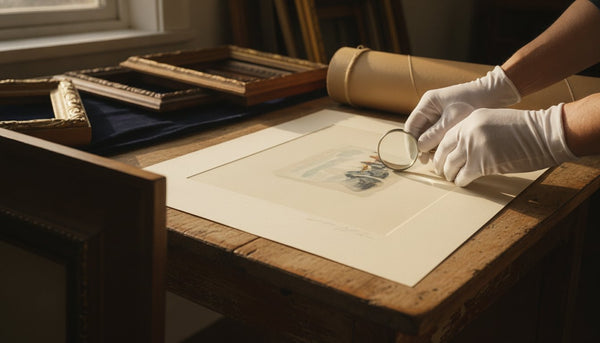
- Wash and dry your hands, or wear clean cotton or nitrile gloves. Oils and moisture from fingers can mark the surface and edges.
- Let the print acclimate. If it arrived in cold or very dry conditions, give it 20–30 minutes at room temperature and normal humidity before unrolling. Paper is more flexible when it is not bone-dry or cold.
- Unroll slowly onto a clean, flat surface. Support the sheet with both hands and let it open gradually. Never force it flat or press hard against the natural curl.
- Reverse-relax the curl gently — do not counter-roll tightly. If there is residual curl, lay the print face-up and place clean, smooth weights (soft-covered books, acid-free board with weight on top) near the edges. Let gravity and light, even pressure do the work over hours to days.
- Flatten under even weight, not heat. The safest method is time under flat, even weight between clean acid-free boards or sheets. Avoid irons, hair dryers, and household heat — they can damage ink and paper.
- If it will not relax, stop and consult a framer or conservator. A professional framer can flatten stubborn curl safely, and for valuable pieces a paper conservator can address creases. Framing under glass or acrylic with proper mounting typically holds a relaxed print flat for good.
What to avoid
- Do not apply heat, steam, or moisture yourself unless you are trained.
- Do not use tape, adhesives, or dry-mounting to force flatness — these are often irreversible and can destroy value.
- Do not stack heavy objects unevenly or leave a print pinned under a hard edge that creates a new crease.
- Do not leave a valuable print rolled "for later." Relax and store it flat, or frame it.
What to ask a seller before you buy
The strongest protection against a bad tube experience is a few direct questions before purchase. A knowledgeable seller will answer these easily; vague or evasive answers are themselves useful information.
- How will it be packed and shipped? Ask specifically about tube diameter, interleaving (glassine or acid-free tissue), end padding, and whether the tube is heavy-duty.
- Has the print been stored rolled, and for how long? A print that has been flat in archival storage and is only rolled for shipping is ideal. Long-term rolled storage warrants closer condition questions.
- What is the exact condition? Ask about any existing creases, curl, edge wear, surface marks, or ink cracking — and request detailed photos, including of the corners and any problem areas.
- What is the paper weight / stock? Heavier archival paper rolls more safely; the seller should be able to describe it.
- Is it signed, numbered, or part of a stated edition? Edition transparency is central to value. Ask how the work is documented.
- What authentication or provenance comes with it? This varies by artist (more below). Understand what you are getting before you pay.
- What is the return policy if it arrives damaged? A reputable dealer stands behind packing and will make it right if a courier fails.
Condition risks and how they affect value
Condition is one of the biggest drivers of a print's market value, and rolling intersects with condition in a few specific ways. Here is how collectors and dealers think about it.
The condition issues that matter most
- Residual curl: Usually cosmetic and correctable. Rarely affects value once flattened and framed.
- Soft handling creases: Minor ones often relax; a hard crease you can feel as a ridge is a permanent condition flaw that can reduce value.
- Tunneling / rippling: Waviness that will not lie flat can indicate the sheet was rolled tightly or exposed to humidity swings; a conservator can often improve it.
- Ink cracking: Hairline cracks in heavy ink or foil areas are permanent and are a genuine value concern, especially on works prized for pristine surfaces.
- Edge and corner damage: Crushed or bumped corners from poor tube-end packing affect value; margins matter to serious collectors.
- Surface abrasion: Scuffs from a print rubbing against itself without interleaving.
How condition maps to price
As a general principle, prints in crisp, flat, unhandled condition command the strongest prices, while pieces with permanent creases, cracking, or trimmed margins trade at a discount that varies by artist, edition, and demand. The size of that discount depends heavily on the specific work and market — which is why we point collectors to real, comparable sales data rather than fixed rules of thumb. For market context and how condition and edition factor into pricing, see our Financial Insights resource.
Why buying from a reputable dealer matters most
Everything above becomes far lower risk when you buy from a seller who packs properly and describes condition honestly. A dealer who ships hundreds of works knows to use a wide, heavy-duty tube, acid-free interleaving, padded ends, and clear condition disclosure. That is the difference between a print that arrives ready to relax and frame and one that arrives with a crushed corner.
At Gauntlet Gallery, tube shipping is handled to protect the work: appropriately sized tubes, protective interleaving, and honest condition notes so you know exactly what you are receiving. You can browse authenticated Shepard Fairey prints and explore the full range of authenticated works in the complete collection. New collectors will also find our collector hub and library of buyer's guides useful for building confidence before a first purchase.
Authentication varies by artist — know the standard for what you are buying
How a work is authenticated depends on the artist, and it is important not to expect the wrong paperwork. Shepard Fairey prints, for example, are typically bought on provenance and dealer trust rather than a standalone certificate — there is no artist-issued COA for most Fairey works, so a trusted source matters. Other makers have different norms: DEATH NYC works come with a certificate and gold seal; KAWS and BE@RBRICK collectibles are verified through packaging, markings, and documented provenance; signed music memorabilia is authenticated by services such as Beckett, JSA, or PSA; and space memorabilia relies on provenance and recognized specialists. The takeaway: match your expectations to the correct standard, and lean on reputable dealers who document what they sell. For a deeper walk-through on Fairey specifically, see the Shepard Fairey buyer's guide.
A practical checklist for buying a tube-shipped print
Use this quick checklist before you buy and when your print arrives.
- Before buying: Confirm paper weight, tube diameter, interleaving, and end padding.
- Before buying: Ask how long it has been stored rolled (transit-only is ideal).
- Before buying: Request detailed condition photos, including corners and any curl or creases.
- Before buying: Confirm edition details, signature/numbering, and what documentation or provenance is included.
- Before buying: Verify the return/damage policy.
- On arrival: Open the tube gently; keep interleaving with the print.
- On arrival: Let the print acclimate to room temperature and humidity.
- On arrival: Unroll slowly with clean hands or gloves on a flat, clean surface.
- On arrival: Relax any curl under even, light weight — never heat or force.
- On arrival: Inspect for creases, cracking, and edge damage; document with photos in case you need to raise an issue.
- Finishing: Frame under glass or acrylic, or store flat in archival materials — do not leave it rolled.
Frequently asked questions
Is it safe to buy a Shepard Fairey print stored in a tube?
Yes. Rolling is a standard, accepted way to ship prints, and most Shepard Fairey screen prints tolerate it well because they are printed on quality paper. Safety comes down to the details: a wide, heavy-duty tube, acid-free interleaving, short-term rolling, and honest condition disclosure. Buy from a reputable dealer, ask about packing and condition, and unroll carefully on arrival, and a tube-shipped Fairey print is a low-risk purchase.
Does a print shipped in a tube lose value?
Not by default. Rolling for shipping does not inherently reduce value — the vast majority of tube-shipped prints flatten and frame beautifully with no lasting effect. Value is only affected if rolling leads to a permanent defect such as a hard crease, tunneling that will not flatten, ink cracking, or crushed corners. Prints that arrive and flatten cleanly hold their value.
How do I flatten a print that arrived curled?
Let it acclimate to room temperature and humidity, unroll it slowly on a clean flat surface with clean hands, then relax any curl under even, light weight between acid-free boards over hours to days. Avoid heat, steam, tape, and dry-mounting. If the curl or a crease will not relax, take it to a professional framer or paper conservator, who can flatten it safely.
What size tube is safe for shipping a print?
Diameter is the key variable — the wider the tube, the gentler the curl and the safer the print. A wide, rigid, heavy-duty tube produces a large-radius roll that relaxes easily, while a narrow tube forces a tight curl that stresses the paper and ink. When in doubt, wider is always better, and heavier paper is more forgiving than thin poster stock.
Should an expensive or large print be shipped flat instead?
Not necessarily. For large sheets, a well-built tube is often safer in transit than a flat package, which is easy to bend or crush. Flat shipping is preferred mainly for works that are already framed, unusually thick or brittle, or delicate vintage paper. For most large contemporary screen prints, a properly packed wide tube is the standard and reliable choice.
What should I ask a seller before buying a tube-shipped print?
Ask how it will be packed (tube diameter, interleaving, end padding), how long it has been stored rolled, its exact condition with detailed photos, the paper weight, its edition and signature details, what authentication or provenance is included, and the return policy if it arrives damaged. Clear, confident answers signal a dealer who packs and describes prints properly.
Buy and authenticate with confidence
A print shipped in a tube is nothing to fear — it is one of the most common and, for large sheets, often the safest way to move fine art. The risk lives in the details: paper weight, tube diameter, how long a piece stayed rolled, and above all the care of the seller. Buy from a dealer who packs properly and discloses condition honestly, ask the right questions up front, and unroll and flatten carefully on arrival, and you will add a crisp, gallery-ready piece to your collection. Explore authenticated Shepard Fairey prints, read the Shepard Fairey buyer's guide, and start with the collector hub to buy your next print with total confidence.