How to Authenticate a Shepard Fairey Print (Signature, Edition, COA)
How should a collector evaluate a Shepard Fairey print? You evaluate a Shepard Fairey print primarily on provenance and dealer trust, not on a certificate of authenticity. Fairey’s studio (OBEY Giant) does not issue per-print COAs or run an artist authentication service, so authentication is effectively “silent”—the absence of a COA is normal and expected, not a red flag. Confirm the signature and edition details, trace where the piece came from, buy from a reputable seller who stands behind the work, and check condition. Do those four things and you can buy with confidence.
Why Shepard Fairey authentication is “silent”
Some artists sit behind a formal gatekeeper. Banksy prints, for example, are authenticated by Pest Control, and several other artists and estates issue their own certificates. Shepard Fairey works differently. There is no artist-run authentication board that examines a print and returns a verdict, and OBEY Giant does not retroactively issue certificates for prints already in circulation.
That means the market for Fairey relies on a chain of trust: the release itself (many prints are sold directly through OBEY’s own online drops), the paper trail that follows the piece from buyer to buyer, and the reputation of the dealer or platform selling it now. For a new collector this can feel unnerving—you may be used to equating “real” with “has a certificate.” With Fairey, that instinct can mislead you. A print with no COA is completely normal. A print with a suspicious-looking COA “from the artist” is more concerning, because Fairey’s studio is not the source of such documents.
What “silent” does and does not mean
- It does mean: you should not expect an artist-issued certificate, and you should not treat the lack of one as evidence of a problem.
- It does not mean: anything goes. Silent authentication raises the importance of the things you can verify—provenance, the signature and edition, the seller’s standing, and the physical condition of the piece.
- It does not mean: a third-party COA is worthless. A certificate from a reputable dealer or a recognized authentication service can be a useful part of the paper trail—just understand it documents the dealer’s assurance and provenance, not an artist’s ruling.
Signed vs. unsigned Fairey prints
Fairey has released work across a wide spectrum, and both signed and unsigned prints are legitimately part of his output. Understanding the difference helps you set expectations on value and on what to verify.
Signed and numbered prints
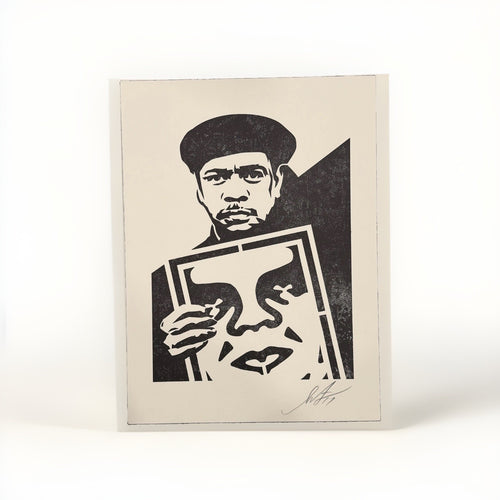
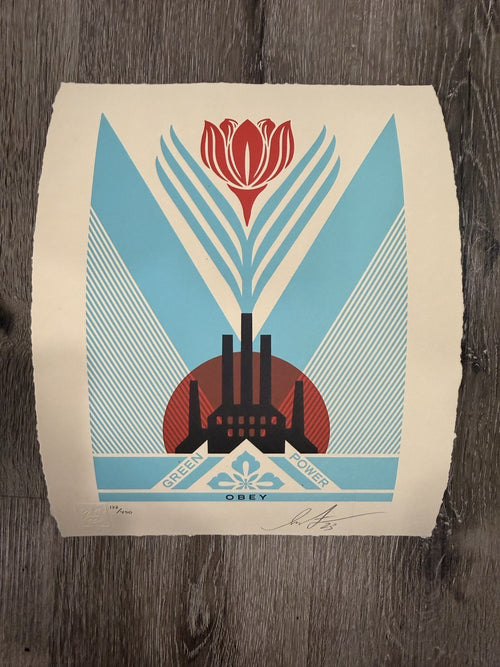
Many of Fairey’s screen-prints are hand-signed and numbered, typically in pencil. These limited editions are the core of the collector market. When a print is described as signed and numbered, the signature and the edition notation are the two things you want to see clearly and consistently documented—ideally in the seller’s own high-resolution photographs of the actual piece, not stock images.
Unsigned or open-edition works
Fairey’s practice grew out of street art and DIY poster culture, and he has always put affordable, unsigned work into the world—posters, open editions, and prints distributed without hand-signing. These are genuine Fairey pieces; they simply occupy a different tier of the market than hand-signed limited editions. An unsigned print is not a fake by virtue of being unsigned. What matters is that the listing accurately represents what it is, so you are not paying a signed-edition price for an open edition.
Signed vs. unsigned at a glance
| Attribute | Signed & numbered edition | Unsigned / open edition |
|---|---|---|
| Hand signature | Yes, usually in pencil | Typically none |
| Edition number | Yes (e.g., a fraction notation) | Often not numbered |
| Market tier | Higher; collector-focused | More accessible entry point |
| Key thing to verify | Signature + edition + provenance | Accurate description + provenance |
| COA expectation | None from the artist (dealer docs common) | None from the artist |
Understanding edition numbering
Limited-edition prints are usually annotated so that each impression can be placed within its run. On a signed Fairey print you will commonly see a hand-written edition notation and a signature, most often in pencil along the lower margin. The essential idea is transparency: a reputable seller can tell you what the edition is, show you the annotation on the actual print, and describe the release the piece comes from.
- Numbered impressions indicate the individual print’s place within the total edition.
- Artist’s proofs and other special designations sometimes exist alongside the main numbered run; these should be described honestly and consistently.
- Consistency is the tell. The signature style, the medium of the annotation, and the way the edition is written should be consistent with other documented examples of the same release. If a seller cannot show you the annotation clearly, ask.
Rather than memorizing exact numbers for specific releases—which vary from edition to edition—focus on whether the seller is transparent and whether the piece can be cross-referenced against a reliable catalog of Fairey releases. Our Shepard Fairey print index is designed for exactly this: to help you place a print within Fairey’s body of work.
How to evaluate provenance (the most important step)
Because Fairey authentication is silent, provenance carries the weight that a certificate carries for other artists. Provenance is simply the documented history of ownership and origin—where the print came from and how it reached the seller.
Strong provenance signals
- Original purchase evidence: receipts or order confirmations from an official OBEY release, or from a recognized gallery or dealer.
- A continuous chain: a clear, unbroken account of ownership from release to present, with as few unexplained gaps as possible.
- Consistent documentation: photos, invoices, and any prior dealer paperwork that match the physical piece in front of you.
- Reputable prior custody: the print having passed through sellers who are themselves known and accountable.
Weak or missing provenance
Thin provenance is not automatically disqualifying—plenty of legitimate prints change hands informally—but it shifts more of the burden onto the seller’s reputation and onto the physical evidence. When provenance is thin, a trustworthy dealer compensates by offering clear photography, an honest description, and a guarantee. If provenance is thin and the seller is anonymous or evasive, that combination is the real caution flag.
Where to buy: reputable sources
With a silent-authentication artist, who you buy from is a substantial part of your protection. The most reliable sources share a few traits: they specialize in or genuinely understand the artist, they photograph the actual piece, they describe condition and edition honestly, and they stand behind what they sell.
- Specialist dealers and galleries who deal in Fairey and comparable contemporary and street-art prints, and who provide their own documentation and guarantees.
- Official OBEY releases for new drops, which give you first-hand provenance from the source.
- Established auction houses for higher-value pieces, where cataloging and consignor vetting add a layer of diligence.
At Gauntlet Gallery, Fairey prints are curated and sold on this provenance-and-trust basis—we photograph the actual work, describe edition and condition plainly, and back the sale. You can browse current pieces in the Shepard Fairey collection, and read our full framework in the Shepard Fairey buyer’s guide. For a broader view of how we think about collecting across artists, the collector hub and the library of buyer’s guides are good next stops.
Condition: the factor that quietly drives value
Once you are satisfied a print is authentic, condition is the next lever that determines what it is worth—and it is one you can assess yourself with good photographs. Two prints from the same signed edition can differ substantially in value based purely on how well they have been kept. When evaluating a Shepard Fairey print, look carefully at the paper and the margins as well as the image.
What to inspect
- Paper and surface: Look for creases, dents, soft corners, surface abrasion, or scuffing. Screen-prints have a physical ink layer, so surface disturbances can show.
- Color and light exposure: Fading or a shift in the reds, creams, and blacks that characterize much of Fairey’s palette usually points to light damage. A print that has hung in direct sun for years may look flatter than a well-stored example.
- Foxing and staining: Small brown spots (foxing), water stains, or discoloration in the margins indicate storage in humid or acidic conditions.
- Margins and trimming: Full, untrimmed margins are preferred. A print that has been cut down—sometimes to fit a frame—loses value and can also remove or crowd the signature and edition annotation.
- Restoration and backing: Ask whether the print has been flattened, deacidified, or repaired, and whether it was ever dry-mounted. Dry-mounting (permanently adhering a print to a board) is generally considered a negative for collectible prints.
Why condition and authentication go hand in hand
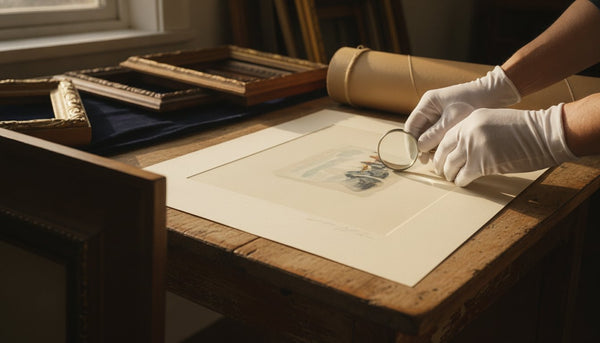
Careful condition photography also supports authentication. A seller who shows you the corners, the margins, the signature at high magnification, and the back of the sheet is giving you the evidence you need on both fronts at once. If a listing is reluctant to show anything beyond a single flattering front image, you are missing information about authenticity and condition. Treat rich, honest photography as a green flag and thin imagery as a prompt to ask more questions.
Framing, materials, and long-term care
How a print is framed tells you something about how it has been treated, and it affects how well the piece will hold up in your own collection. You do not need to be a conservator to read the basics.
- Archival, acid-free materials: Quality framing uses acid-free mats and backing so the paper does not yellow or degrade over time. Acidic mats can leave a visible burn line along the window edge.
- UV-protective glazing: UV-filtering glass or acrylic slows fading. For a color-forward artist like Fairey, this matters.
- Reversible mounting: The print should be hinged with archival materials, not glued or taped down with pressure-sensitive tape, so it can be removed without damage.
- Storage when unframed: Flat storage in acid-free folders, away from direct light and humidity, preserves both condition and value.
None of this changes whether a print is authentic, but it does change how long it stays beautiful and how it presents when you eventually sell. A dealer who frames and stores properly is also a dealer who is likely to document and describe honestly—the same care shows up in both places.
Putting it together: a market-aware mindset
Collectors sometimes assume that authentication is a single yes-or-no gate. With Shepard Fairey it is better understood as a stack of reinforcing signals. No single element—not a signature, not a receipt, not a dealer’s word—carries the whole load. Together they build a picture that is either coherent or contradictory. A coherent picture is one where the release is identifiable, the signature and edition match documented examples, the provenance is plausible and continuous, the condition is consistent with the stated history, and the seller is transparent and accountable. A contradictory picture is one where those elements do not line up—where a “rare signed edition” has no visible signature, or an “untouched” print shows trimming and dry-mounting, or a seller offering a bargain refuses to explain where it came from.
Because Fairey’s market spans affordable open editions and sought-after signed prints, a market-aware mindset also protects your wallet. Knowing which tier a piece belongs to—and roughly where it sits relative to comparable sales—keeps you from overpaying for an open edition or dismissing a fairly priced signed one. For grounded market context rather than guesswork, lean on data-aware resources like our Financial Insights and cross-reference releases in the Fairey index.
General red flags to watch for
These are broad, verifiable warning signs—not secret “tells.” None is proof of a problem on its own, but several together warrant caution or a walk-away.
- A COA claimed to be “from the artist.” Fairey’s studio does not issue per-print certificates, so a certificate presented as artist authentication should raise questions rather than reassure you.
- Stock photos instead of the real piece. A serious seller shows the actual print, including the signature and edition annotation, in high resolution.
- Vague or evasive provenance. An unwillingness to explain where the piece came from, or to answer straightforward questions.
- Prices that are too good to be true for a sought-after signed edition—out-of-market pricing is a classic lure.
- Signed-edition claims at open-edition evidence. If the images show no signature or numbering but the listing charges a signed-edition premium, the description and the evidence do not match.
- No returns and no accountability. Reputable sellers stand behind authenticity; a blanket “all sales final, no questions” policy on a significant piece deserves scrutiny.
For context on how Fairey prints are valued and how the market has behaved over time, our Financial Insights resource offers data-aware market context rather than one-off guesses.
A simple pre-purchase checklist
- Identify the release. Match the print to a known Fairey edition using a reliable catalog such as our Fairey index.
- Confirm signed vs. unsigned and make sure the price tier matches what the piece actually is.
- See the signature and edition annotation in the seller’s own clear photos of the actual print.
- Ask for provenance and weigh it together with the seller’s reputation.
- Check condition—paper, margins, any fading, creasing, or restoration—since condition materially affects value.
- Confirm the seller stands behind the sale with a guarantee and a fair return path.
Frequently asked questions
Does a Shepard Fairey print come with a certificate of authenticity?
Generally no. Shepard Fairey’s studio (OBEY Giant) does not issue per-print certificates of authenticity, and there is no artist-run authentication service for his prints. The absence of a COA is normal and should not be read as a red flag. Instead, authenticity rests on provenance, the signature and edition details, the seller’s reputation, and the condition of the piece.
Is a Fairey print fake if it has no signature?
Not necessarily. Fairey has legitimately released both hand-signed limited editions and unsigned or open-edition works, reflecting his roots in street art and affordable poster culture. An unsigned print is not automatically fake—what matters is that the listing accurately represents it as unsigned and prices it accordingly, rather than charging a signed-edition premium for it.
How do I verify the edition number on a Fairey print?
Ask the seller for clear, high-resolution photographs of the actual print showing the pencil signature and edition annotation, then cross-reference the release against a reliable catalog of Fairey editions such as the Gauntlet Gallery Fairey index. Transparency and consistency—being able to see and match the annotation—matter more than any single number.
Should I be worried that a Fairey print has no COA?
No. Because Fairey authentication is “silent,” the lack of an artist-issued COA is expected. Ironically, a certificate presented as coming directly from the artist is more of a warning sign than a missing certificate, since Fairey’s studio does not produce such documents. Focus your diligence on provenance and on buying from a reputable, accountable seller.
Where is the safest place to buy a Shepard Fairey print?
The safest sources are official OBEY releases for new drops, established auction houses for higher-value pieces, and specialist dealers or galleries that photograph the actual work, describe edition and condition honestly, and back the sale with a guarantee. Gauntlet Gallery curates Fairey prints on exactly this provenance-and-trust basis.
Does provenance really matter more than a certificate for Fairey?
Yes. Because there is no artist-issued certificate, provenance—the documented history of where a print came from and how it reached the seller—does the work a COA would do for other artists. Strong provenance plus a reputable seller is the most reliable path to buying a genuine Fairey print with confidence.
Buy & authenticate with confidence
Evaluating a Shepard Fairey print comes down to four verifiable things: match the release, confirm the signature and edition, weigh provenance alongside the seller’s reputation, and check condition—knowing all along that the absence of a COA is normal for a “silent” artist. When you buy from a seller who photographs the actual piece, documents its history, and stands behind it, you get the confidence a certificate would provide elsewhere. Explore authenticated pieces in the Shepard Fairey collection, use the Shepard Fairey buyer’s guide and Fairey index to do your homework, and lean on the collector hub whenever you want a second opinion.