The 400% That Beats the 1000%: What the Market Is Actually Telling You
Everyone assumes bigger means more valuable. In BE@RBRICK, that assumption will cost you money.
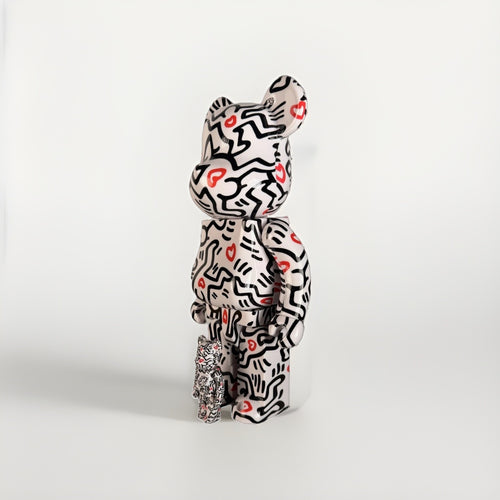
The 1000% sits at roughly 70cm. It commands the shelf. It stops conversations. And for the majority of releases, yes — it carries the higher price tag and the stronger long-term floor.
But the secondary market has a habit of humbling assumptions. There are specific 400% releases trading at multiples that make their 1000% counterparts look like afterthoughts. Not occasionally. Consistently. Across multiple collaborations, across multiple years of price data.
So what's actually driving that inversion, and how do you spot it before the market prices it in?
That's what this article is about. Not a general overview of BE@RBRICK sizing. Not a collector's guide to display cases. The specific mechanics of why a 26cm figure sometimes dominates its 70cm sibling on the secondary market — and what you need to understand about authentication, release structure, and demand dynamics before you make another size-based buying decision.
First: Understand What You're Actually Buying
BE@RBRICK is a Medicom Toy product. Every serious conversation about value has to start there, because Medicom's release architecture is deliberately tiered and the tiers matter enormously to secondary pricing.
The 400% and 1000% are sold as a set in many collaborations — the 100%+400% set and the standalone 1000% being the two most common retail configurations. But "sold together" does not mean "valued equally." The market prices them separately. Always has.
For authentication purposes: BE@RBRICK releases rely on original packaging integrity, the Medicom hologram sticker, foot stamps and markings, and documented release records. Those checks apply at the figure level — meaning a 400% and a 1000% from the same collaboration are authenticated independently. They are distinct collectibles from a provenance standpoint, not a matched set that rises and falls together.
That framing matters. Once you stop thinking of the 400% as the 1000%'s smaller companion and start treating it as a standalone asset, the market data starts making a lot more sense.
The Conventional Wisdom — and Where It Breaks Down
The standard logic runs like this: the 1000% is rarer by print run, more visually commanding, preferred by galleries and institutions for display, and therefore commands a premium. For broad-release, open-edition style collaborations, that logic holds reasonably well.
But it breaks down across several specific conditions:
1. When the 400% Had a Harder Retail Path
Medicom periodically releases 400% figures through channels that are genuinely more restrictive than the corresponding 1000%. Certain World Wide Tour drops, lottery-gated releases, and territory-specific collaborations have historically made the 400% the harder piece to acquire at retail — not the 1000%.
When supply compression hits the smaller size, secondary premiums follow. This isn't theoretical. It's a documented pattern across multiple high-demand collaborations where the 400% lottery odds were significantly worse than those attached to the 1000% release window.
If both sizes were equally available at retail, why would you ever pay a premium for either one?
Scarcity at the point of original distribution is the engine. Size is just the descriptor.
2. When the Collaboration Is Display-Context Specific
Not every collector is running a gallery wall or a dedicated vitrine. A significant segment of the serious BE@RBRICK market — particularly in Asia and among younger collectors globally — is working with apartment shelving, desk setups, or curated small-format displays.
For that buyer, the 400% is not the compromise. It's the preference. It fits the context the 1000% physically cannot occupy.
When a collaboration's core audience skews toward that display preference, demand concentration hits the 400%. The 1000% sits at a price point that exceeds what that audience will pay for a figure they can't actually display the way they want to.
3. When the Artistic Detail Reads Better at 400%
This sounds counterintuitive — surely more surface area means better rendering of fine detail? Not always.
Several high-profile collaborations have involved intricate graphic work, photographic prints, or pattern-dense artwork where the scaling from 400% to 1000% introduced visible quality degradation in the print application. The 400% rendered the source material more faithfully. Secondary buyers noticed. Pricing reflected it.
The opposite also occurs: certain collaborations involving bold geometric or large-format graphics genuinely sing at 1000% and look comparatively underwhelming at 400%. The point is that visual fidelity is collaboration-specific, and you need to assess each release on its own merits rather than defaulting to "bigger equals better execution."
4. When Set Configuration Creates a Supply Imbalance
Some releases produced the 400% and 1000% in different ratios. Some produced the 400% as part of a set configuration that included the 100%, creating a different retail unit economics situation for sellers. When sets are broken (a common practice where the 100% is sold separately or discarded), the standalone 400% unit count in circulation can be lower than the corresponding 1000%.
How many collectors actually tracked the ratio of sets broken versus intact sets held?
Most didn't. The secondary market eventually prices the effective supply, not the stated print run. If a meaningful percentage of 400% units are locked in intact sets held by collectors who won't break them, the tradeable supply is lower than it appears.
The Authentication Layer You Cannot Skip
Before you pay secondary market prices for any 400% or 1000% figure, authentication is non-negotiable. The BE@RBRICK market has a counterfeit problem that scales with desirability. The higher the premium, the more sophisticated the fakes.
Here is the authentication framework, applied correctly:
Core Checks for Any Release
-
Foot stamp and markings verification
- Each figure carries molded foot stamps and copyright markings specific to its release. Check them against documented reference examples.
- Markings that are soft, misaligned, or inconsistent with the stated release are a red flag.
- The markings are figure-level. A 400% and 1000% from the same collab are authenticated on their own merits. Treat them independently.
-
Original packaging integrity
- Medicom's box construction, print quality, and hologram placement are specific to each release. Counterfeiters get the figure wrong first, but packaging is often where the tells live if you know what to look at.
- The Medicom hologram sticker should be present, positioned correctly, and should not show any evidence of removal or reapplication.
-
Cross-reference with Medicom release records
- Every legitimate release has a documented drop record. If the seller can't connect the figure to a verifiable release event — a specific World Wide Tour date, an official collaboration announcement, a documented retail channel — treat that absence as meaningful.
For Older and Vintage Releases
-
Original packaging is load-bearing
- For older releases, the box is your primary documentation layer. Box condition, hologram presence, and internal packaging configuration all contribute to provenance verification.
- An unboxed vintage BE@RBRICK can still be authenticated, but the burden shifts heavily to provenance documentation — original purchase receipts, auction records, documented collection history.
-
Physical construction tells
- Legitimate Medicom product has specific material tolerances, joint construction, and paint application standards. Counterfeit figures frequently show seam irregularities, incorrect joint resistance, or color that doesn't match documented reference images.
- If you're not experienced enough to assess construction quality hands-on, buy from a source that is.
-
Third-party grading for high-value pieces
- PSA has expanded its grading and authentication services to cover vinyl collectibles including BE@RBRICK. For significant purchases, a graded and authenticated figure in a PSA case provides a documented authentication record that follows the piece through subsequent transactions.
- Note the PSA certification-verification distinction: a graded case means PSA examined and authenticated the figure at the time of submission. Always verify the cert number on PSA's website directly — do not rely on the seller's verbal assurance that something is "PSA authenticated."
Collaboration Category Breakdown: Where the 400% Tends to Win
Not all collaboration categories behave the same way. Here's how the size dynamic plays out across the major collaboration types.
Artist Collaborations
High-profile artist collaborations — think the range of contemporary art partnerships Medicom has executed over the years — tend to attract two distinct buyer profiles: the figure collector and the art collector. The art collector is often more comfortable with the 400% format as a desk or shelf object. The figure collector often wants the 1000% as the centerpiece.
When the art collector audience dominates demand for a specific collaboration, the 400% holds its premium more stubbornly. Artist collaborations with strong provenance in the contemporary art world, where the 400% is the accessible price point that still carries the "name," often see the 400% outperform over the medium term.
Fashion and Luxury Collaborations
Fashion collaborations have historically produced some of the most dramatic 400% outperformance cases. The reasoning is straightforward: the fashion collector demographic is often acquiring BE@RBRICK as a lifestyle object, not a dedicated figure collection. Shelf space is a real constraint. A 400% fits into a fashion-forward living space in a way a 70cm figure frequently doesn't.
Additionally, several significant fashion collaborations released the 400% in colorways or editions that differed meaningfully from the 1000% — not just scaled versions of the same design, but genuinely distinct objects. When the 400% is a different product rather than a smaller version of the same product, the two sizes compete on separate terms.
Music and Entertainment Collaborations
Music-driven collaborations — where the demand engine is fandom rather than collector culture — tend to produce more volatile 400% premiums. Fan-driven demand can spike dramatically around cultural moments (anniversaries, touring cycles, catalog reissues) and compress equally quickly when the moment passes.
The 400% in music collabs often outperforms at launch and shortly after, particularly when the figure was part of a limited merchandise ecosystem around a specific release or event. Long-term hold performance is less consistent than in artist or fashion categories.
Note: if you're working with music memorabilia authentication more broadly in a collection that includes signed items alongside BE@RBRICK figures, the authentication standards are completely separate. Signed music memorabilia requires Beckett (BAS) — with Roger Epperson REAL being the specialist tier within BAS for music items specifically — alongside JSA and PSA/DNA. The BE@RBRICK figure itself is authenticated through Medicom's system and third-party grading services, not through music memorabilia authentication channels. Don't conflate them.
Brand and Character Collaborations
Collaborations with established character IP — the kind that have dedicated fan bases outside of figure collecting — can produce significant 400% premiums when the character itself is the draw rather than the BE@RBRICK format. Collectors who want the character and are price-sensitive will concentrate on the 400%. The 1000% in these cases often sits at a price point that exceeds what the character-driven collector will pay.
This creates a demand volume concentration in the 400% that can sustain secondary premiums even when the 1000% is technically rarer.
How to Read Secondary Market Data Without Getting Misled
Secondary pricing data for BE@RBRICK is available across multiple platforms. Reading it correctly requires some discipline.
Sold Listings vs. Active Listings
Active listing prices are noise. The number that matters is the realized price on completed sales. A 1000% listed at a significant premium tells you what a seller wants. A 400% that has consistently sold at a specific multiple over the past twelve months tells you what the market will pay.
Work from sold data. Always.
Condition Weighting
BE@RBRICK secondary pricing is acutely condition-sensitive. A sealed, unboxed figure commands meaningfully different pricing than a displayed figure, which commands different pricing than a figure with any packaging damage or play wear. When you're comparing 400% vs. 1000% realized prices, make sure you're comparing equivalent conditions. Mixed-condition comparisons produce misleading conclusions about size-driven value differentials.
Geographic Market Variation
BE@RBRICK pricing is not globally uniform. Japanese domestic market prices, Hong Kong secondary market prices, and Western market prices for the same figure can diverge significantly — sometimes in favor of the 400%, sometimes the 1000%, depending on the collaboration's cultural resonance in each market.
Are you pricing against the right market for your actual buyer pool?
If you're selling in North America, pricing against Japanese domestic comps without adjusting for import costs and market-specific demand profiles will give you a distorted picture.
Timing and Cultural Cycles
Some 400% outperformance is cyclical rather than structural. A figure that spikes because of a cultural moment will often give back ground when the moment passes. Structural outperformance — where the 400% consistently holds a premium relative to the 1000% across multiple market cycles — is the signal worth acting on. A single data point is not a thesis.
The Set vs. Individual Piece Question
Collectors frequently ask whether to buy the 400%+1000% set or individual pieces. The answer depends on what you're optimizing for.
If you're optimizing for maximum optionality, buying the set and holding it intact preserves the ability to sell as a set (premium over individual pieces in many cases) or break it and sell individually. That optionality has value, but it also requires holding more capital in a single position.
If you've done the work on a specific collaboration and concluded the 400% is the outperformance play, buying the 400% individually — at a lower entry cost than the set — concentrates your exposure where you believe the value is. You're not paying for 1000% exposure you don't want.
The set premium itself is a real phenomenon for certain releases, where institutional or gallery buyers want the complete configuration for display purposes. For those releases, breaking the set and selling the 400% individually may leave money on the table relative to the intact set price. Know which situation you're in before you make that call.
What the Smart Collector Does Before Buying
-
Verify the release record
- Confirm the figure resolves to a documented Medicom release. World Wide Tour drops, official collaboration announcements, authorized retail channels. If the provenance chain has gaps, price accordingly or pass.
-
Authenticate before you pay a premium
- Verify foot stamps and markings, packaging integrity, hologram, and construction. For significant purchases: third-party grading through PSA with cert verification on PSA's platform directly.
-
Pull sold comps, not active listings
- Twelve months of realized sales data minimum. Condition-matched. Market-appropriate (your buyer pool, not a different geographic market).
-
Assess the collaboration category
- Artist, fashion, music, brand/character. Each has different demand dynamics. Understand which audience is driving the primary demand and whether that audience prefers the 400% format.
-
Check visual execution at each size
- Look at reference images of both sizes side by side. Does the artwork read better at 400% or 1000%? Is the 400% a genuinely distinct object or a miniaturized version? That distinction affects long-term demand.
-
Understand the supply configuration
- What was the retail channel? Were there lottery mechanics? What was the set configuration? Has the set historically been broken in the secondary market? The effective tradeable supply matters more than the stated print run.
Red Flags
- No original packaging on a premium-priced piece. Unboxed figures aren't automatically inauthentic, but the absence of original packaging on a piece commanding a significant secondary premium requires a documented provenance chain to compensate. "Trust me, it's real" is not a provenance chain.
- Foot stamps or markings that don't match documented examples. A marking mismatch is a hard stop. Do not proceed without resolution from the seller and independent verification.
- Seller conflating 400% and 1000% pricing without acknowledgment of condition differences. If a seller is presenting mixed-condition examples as equivalent comps to justify a price, they're either unsophisticated or hoping you are.
- Pricing based on active listings from a single platform. Secondary market pricing should be cross-referenced across multiple platforms using sold data. Single-platform, active-listing pricing is the laziest possible analysis and the most exploitable.
- Hologram sticker showing evidence of removal or reapplication. This is one of the clearest physical authentication tells. A disturbed hologram on a piece in otherwise "mint" condition is a significant inconsistency.
- Set sold with "missing" 100% that cannot be explained. When a 400%+100% set appears in the secondary market with the 100% missing and no documented explanation, the provenance of the entire set becomes questionable. Intact sets break for a reason. Know the reason.
- Dramatic 400% premium with no identifiable structural cause. If a 400% is trading at an outsized premium relative to its 1000% and you cannot identify a specific, documented reason — supply constraint, collector category preference, visual execution, release mechanics — be cautious. Premiums that can't be explained can't be defended when liquidity dries up.
Bottom Line
The market has been telling you something for years. The 400% is not always the junior partner.
For specific collaborations, under specific conditions, the 400% is the piece. It commands the premium. It holds the floor. It outperforms the bigger figure across multiple market cycles. That's not a fluke — it's the result of identifiable, structural demand dynamics that smart collectors have been positioning around.
Size is a descriptor. Value is determined by scarcity, demand concentration, visual execution, release mechanics, collector category preference, and authenticated provenance. The 1000% has advantages on some of those dimensions for most releases. The 400% has advantages on all of them for specific releases.
Do the work. Pull the sold data. Verify the authentication. Understand the collaboration category and its audience. Then make the size decision.
Defaulting to "bigger is better" is the most expensive assumption in the BE@RBRICK market.
Frequently Asked Questions
Why does the 400% sometimes cost more than the 1000% on the secondary market?
Several structural factors can drive this inversion: a harder retail path for the 400% (stricter lottery mechanics, more limited channels), demand concentration among collectors who prefer the 400% format for display, visual execution that reads better at the smaller size, or a supply configuration that resulted in fewer tradeable 400% units in circulation than the print run suggests. The 1000% being physically larger does not automatically translate to higher secondary demand for every release.
How do I authenticate a BE@RBRICK before buying at a significant premium?
Check the molded foot stamps and copyright markings against documented examples, cross-reference with documented Medicom release records, and assess original packaging integrity, Medicom hologram condition and placement, and physical construction quality. For high-value purchases on either era, third-party grading through PSA provides a documented authentication record. Always verify PSA cert numbers directly on PSA's platform — never rely on a seller's verbal assurance.
Does buying the 400%+1000% set together make more financial sense than buying individually?
It depends on what you're optimizing for. Intact sets command a premium over individual pieces for certain releases, particularly where institutional or gallery buyers want the complete configuration. But if your analysis points to the 400% as the specific outperformance piece, buying it individually at lower capital outlay concentrates exposure where you believe value lies. There is no universal answer — it's release-specific and strategy-specific.
Are there collaboration categories where the 1000% almost always wins?
Broad-release, high-production collaborations where no meaningful supply constraint exists at the 400% level, and where the primary buyer profile is an established figure collector building a display-focused collection, tend to favor the 1000% consistently. Large-format artistic collaborations where the 1000%'s surface area genuinely elevates the visual execution also tend to maintain the traditional size premium. The 1000% is not overrated — it's correctly rated for most releases. The issue is applying that generalization to specific releases where the conditions don't hold.
How does geographic market variation affect 400% vs. 1000% pricing?
BE@RBRICK secondary prices are not globally uniform. Japanese domestic market prices, Hong Kong secondary market prices, and Western market prices for the same figure can diverge meaningfully. The size preference dynamic also varies: certain collector demographics in Asian markets have historically shown stronger 400% preference for specific collaboration categories than Western markets. If you're buying and selling in a specific geographic market, price against comps from that market — not against a different regional market without adjusting for import costs, local demand, and market-specific collector preferences.
What does "effective tradeable supply" mean, and why does it matter more than the stated print run?
The stated print run tells you how many figures Medicom produced. The effective tradeable supply is how many of those figures are actually available for purchase in the secondary market at any given time. Figures held in intact sets by collectors who won't break them, figures held long-term in private collections, and figures in graded holders held by investors who aren't actively selling all reduce the tradeable supply below the print run number. When effective tradeable supply is meaningfully lower than print run suggests, secondary pricing reflects that real scarcity — not the theoretical scarcity implied by the stated number.
Should I be worried about BE@RBRICK counterfeits at the 400% size specifically?
Counterfeiting risk scales with secondary market premium. Any 400% release trading at a significant premium over retail is a counterfeiting target. The 400% format has been counterfeited — as has the 1000%. Authentication protocol doesn't change based on size: verify foot stamps and markings, assess packaging and hologram integrity on all releases, consider third-party grading for significant purchases. The physical scale of the 400% actually makes certain construction tells easier to assess on close inspection, but that requires knowing what you're looking at. If you don't have hands-on experience evaluating figure construction quality, buy from authenticated sources or get the piece graded before paying a premium.
How do I know if a 400% premium is structural or just a temporary spike?
Structural premiums are identifiable: you can point to a specific supply constraint, a documented collector category preference, a visual execution advantage, or a release mechanic that explains why the 400% commands more than the 1000% on an ongoing basis. Temporary spikes are usually driven by a cultural moment — an anniversary, a tour cycle, a media event — and tend to give back ground when the moment passes. Twelve months of consistent sold-data premium with an identifiable structural cause is a more defensible thesis than a three-month spike around a cultural event. Do the analysis before concluding you've found a structural outperformance situation.