Direct answer
You cannot reliably authenticate a Olivia Rodrigo autograph from a single photograph, a certificate, a seller’s reputation, or a signature that merely looks familiar. A responsible assessment begins with the exact object and its complete evidence packet: what was signed, where and when it was acquired, who handled it, what documents identify it, and whether the condition and story are internally consistent. Look for evidence gaps and contradictions without treating any one visual feature as a universal test. Ask for original-item photographs, a dated acquisition record, current return terms, and an explanation of what a certificate does and does not identify. If the value or uncertainty is significant, use a qualified specialist who can state the scope and limits of the service. This guide is education, not a guarantee, authentication opinion, appraisal, or investment recommendation.
Table of contents
- Start with the exact object
- Build an evidence packet
- Understand signing context
- Read the signature without overreaching
- Evaluate certificates and provenance
- Recognize red flags and green flags
- Test the listing and transaction terms
- Know when to pause or seek specialist review
- Practical evidence checklist
- FAQs and limitations
1. Start with the exact object
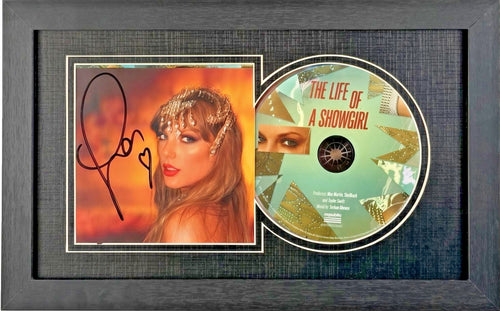
“Olivia Rodrigo autograph” is not a single standardized format. The signature may appear on a photograph, poster, insert, booklet, card, poster, ticket, guitar, book, or another item. Each substrate creates different questions. A glossy photo can reflect light and hide ink texture. A coated poster may show pressure or smearing differently from an uncoated paper insert. A card can be sold with a record or poster without having been signed at the same time as the record or poster. A framed item may hide edges, labels, or backing information.
Make an object record before looking at comparisons. Note the item type, title or release description, dimensions, material, signature location, ink color, inscription, frame or mount, included packaging, and every document. Photograph the full front and back, edges, corners, signature close-up, labels, and documents. If a seller cannot provide an image of the actual item, mark that as an evidence limitation. A stock image can show a product design; it cannot prove what a particular signature looks like on a particular object.
Separate three questions
Authentication discussions often fail because three different questions are blended together:
- What is the object? Is the item a retail poster, a promotional photo, a later reproduction, or another format?
- What happened to it? How did it move from the signing or retailer to the current seller?
- Who signed it? Does the available evidence support the attribution, and what remains uncertain?
A strong answer to one question does not answer the others. A real retail package can carry a questionable signature. A plausible signature can be attached to an unclear object. A receipt can show a purchase without proving the person who signed it. Keep the questions separate in your notes.
2. Build an evidence packet
Think of evidence as a packet with layers rather than a single “proof” item. Start with the seller’s acquisition record: date, venue, seller type, order or lot reference, and what was received. Add photographs taken before framing or shipping, correspondence that identifies the item, event or retailer information, and any prior listing or catalogue reference. Mark each item as original, copy, screenshot, or recollection. Redact private addresses and payment information before sharing copies.
The packet should identify the exact object. “Signed Olivia Rodrigo record or poster” is too broad if the receipt does not name the release, signed component, quantity, or seller. A certificate that gives a generic artist name but no date, item description, dimensions, or lot reference may be useful context but leaves an identification gap. If a document uses a different spelling, title, format, or size, ask for an explanation and preserve both versions rather than editing one to match the other.
Provenance timeline
Create a timeline with five columns: date, holder, event, supporting record, and confidence. Use “reported by seller” when the event comes from someone else. Use “documented” only when you have a record that actually supports the event. Use “unknown” when a period is not documented. A gap is not automatically evidence of fraud; it is a fact that affects confidence and price. The same language protects a buyer and gives an honest seller a fair way to describe limits.
The companion comparison signed Olivia Rodrigo photo versus signed poster shows how evidence questions change with the format. The companion care guide storing, displaying, insuring and gifting signed Olivia Rodrigo memorabilia explains why the evidence packet should include framing, storage, and handoff records once an item is owned.
3. Understand signing context
Signing context can explain why two genuine signatures look different, but context should be documented rather than invented. A signing session, retail release, fan encounter, charity event, tour stop, or pre-signed merchandise program may involve different surfaces, ink, pace, and personalization practices. A seller should be able to say what they know about the context and how they know it. “The retailer described this as signed” is different from “the seller witnessed it being signed,” and both are different from an official announcement naming a specific product.
Do not infer a complete signing context from a date printed on a record or poster or from a photo of a celebrity holding a pen. A date can identify a release, not the moment of signing. A staged image can show a product, not the individual item now offered. If the seller references a retailer or event, ask for the archived page, receipt, order confirmation, or other item-specific record where available. Current websites change, so save the version you relied on.
Personalization and inscriptions
An inscription can be meaningful evidence of context but is not a universal authenticity test. It may be a name, short phrase, date, or symbol. Record it exactly, including punctuation and placement. Ask whether the seller acquired the item with the inscription or whether it was added later. Avoid assuming that a signature without an inscription is less genuine or that a personal inscription is impossible. Those judgments require specialist knowledge and item-specific evidence.
4. Read the signature without overreaching
Visual review can identify questions; it rarely answers them alone. Compare high-resolution images at a consistent scale and lighting. Note baseline, relative size, spacing, pen pressure as it appears on the surface, overlaps with printed areas, and whether the ink appears to sit on or interact with the coating. These observations can help a specialist understand the item. They are not a do-it-yourself pass/fail test.
Avoid internet checklists that promise one decisive clue such as a particular loop, letter shape, stroke, or ink color. Genuine signatures can vary with surface, pen, position, speed, fatigue, and whether the person signed a stack of items. Images can also be distorted by perspective, glare, compression, or color correction. A red flag deserves a question, not a conclusion.
Photograph standards
Request the actual item in several views: straight-on full view, oblique light to show surface, close-up at the highest available resolution, and reverse/edge views. Ask that at least one image include a neutral scale reference. For a framed object, request an image outside the glazing if safe and available. If the seller cannot remove it, ask for lighting that controls reflection and a statement that the assessment was made while framed.
Look for inconsistent image histories. A signature close-up with a different background, crop, or color temperature from the full-item image may be harmless, but ask. Metadata can be useful but is not conclusive because files are routinely exported and compressed. Screenshots of a seller’s own image are weaker than original files, though no file format can authenticate an object by itself.
5. Evaluate certificates and provenance
A certificate of authenticity is a document making a claim; it is not automatically an independent examination. Read the issuer, date, item description, artist name, signature details, serial or lot number, and transfer terms. Check whether the certificate belongs to the exact format and whether the physical item has matching identifiers. Ask whether the certificate is original, a copy, or a printout. If the issuer is a marketplace seller, understand that the document may reflect the seller’s own representation rather than a separate expert opinion.
Provenance can be stronger when it is contemporaneous, specific, and independently supported. An order confirmation naming a signed insert and a matching quantity is more useful than a generic invoice for an unsigned poster. A dated photograph of the exact object may support continuity, but a celebrity image or promotional shot is not item-specific. A prior auction catalogue may identify a lot, but verify that the dimensions and images match the object now offered.
Contradictions to resolve
Write every contradiction as a question: the certificate says a different size; the listing says “signed jacket” but the image shows a card; the seller dates acquisition before the stated release; the package appears complete but the back photo is missing. Ask for a correction or explanation in writing. If the answer changes, preserve both versions. A willingness to clarify is a positive signal, but it is not a guarantee.
6. Recognize red flags and green flags
Red flags are patterns of avoidable uncertainty, pressure, or contradiction. They include a refusal to show the actual item, a description that changes when asked a simple question, stock images presented as item photos, a certificate that cannot identify the object, a price justified only by a future-value claim, pressure to pay outside the platform, or a return policy that is absent, vague, or inconsistent with the venue’s current rules. None is automatic proof of fraud; together they justify pausing.
Olivia Rodrigo flags are practical behaviors: the seller states what is included and excluded, supplies full-item and detail photos, identifies gaps, provides a dated acquisition record, explains the certificate’s scope, allows time to review terms, and uses a traceable payment and shipping process. A polished certificate, luxury framing, or famous marketplace badge is not a substitute for these behaviors.
Red-flag table
| Signal | What it may mean | Appropriate response |
|---|---|---|
| Only stock images | Exact object is not inspectable | Request actual-item photos or pause |
| “Guaranteed authentic” with no scope | Marketing language exceeds evidence | Ask who made the determination and how |
| Certificate lacks item details | Document may not identify the lot | Request matching records |
| Urgency or off-platform payment | Reduced protections and review time | Use current platform terms or walk away |
| Story changes after questions | Record is unstable | Preserve messages and stop until resolved |
| Price far below close comparables | Could be condition, urgency, or risk | Require evidence before treating as bargain |
7. Test the listing and transaction terms
Read the listing as a contract summary. What exact surface is signed? What is included? Are frame, media, insert, certificate, and receipt original or copied? Are all defects shown? Which countries can be shipped to? What are the current return, dispute, and chargeback rules? Do not rely on an old screenshot of a platform policy. Confirm the live terms at the time of purchase and save them.
Ask the seller to answer key questions in the platform message system. Keep the final description and photos in a dated file. If the listing changes after you pay, contact the platform before accepting a materially different item. If a return is agreed, photograph the package and condition at every handoff. Documentation protects an honest buyer and seller; it does not turn uncertainty into certainty.
8. Know when to pause or seek specialist review
Pause when the item is expensive relative to your budget, the evidence packet is incomplete, the signature is obscured, the object has complex restoration or framing, the seller will not state terms clearly, or the story depends on a claim you cannot verify. A cooling-off period is a practical tool, not an admission that the item is bad.
For significant purchases, consult a specialist who works with the relevant format and can describe the service. Ask whether the review is in-person or remote, what materials are examined, whether the opinion is conclusive or limited, what the report contains, and what happens if the object cannot be assessed. Avoid services that promise certainty from one photograph or that refuse to explain their method. A specialist report is still an opinion with a defined scope.
Weight evidence by independence and specificity
When several records exist, consider two qualities: specificity and independence. Specificity asks whether the record identifies the exact object rather than a generic product. Independence asks whether the record was created by someone other than the current seller for a purpose unrelated to the current sale. An order confirmation from a retailer may be specific to a release but not to the individual signature; a seller’s photograph may be specific to the object but not independent. A prior owner’s message may add continuity while still being a reported account. Write both qualities into your notes instead of assigning a mysterious confidence percentage.
Evidence can also conflict without anyone knowing why. A document may contain a typo, a package may have been swapped, or a prior description may have used shorthand. Preserve the conflict, request clarification, and avoid selecting the version that produces the most attractive price. If the contradiction cannot be resolved, treat the uncertainty as part of the purchase decision and value the object accordingly—or decide not to proceed. This approach is slower than a yes-or-no checklist, but it is much easier to explain to a future buyer or insurer.
Keep the original image files, not only marketplace crops. Record when each photograph was made, who made it, and whether the item was framed or handled afterward. If a buyer later asks about a mark, the sequence can show whether it was present before shipment. This record does not establish who signed the object, but it prevents a good-faith description from becoming vague after the transaction and gives a specialist better material to review.
The objective is a defensible decision, not perfect certainty. Keep that standard visible when excitement, scarcity, or a familiar signature makes a quick purchase feel easier than a careful one. A clear record is useful even when the final decision is to decline or wait for better evidence and a qualified review before any consequential purchase today.
Practical evidence checklist
| Evidence | Collected? | Limitation to note |
|---|---|---|
| Actual-item front and reverse photos | ||
| Signature close-up with scale | ||
| Edge, corner, and frame views | ||
| Receipt or order confirmation | ||
| Signing or retailer context | ||
| Certificate and issuer details | ||
| Provenance timeline | ||
| Current return and shipping terms | ||
| Specialist scope, if used |
A simple evidence packet you can hand to a specialist
When remote review is not enough, organize the material before contacting a specialist. Put the full-resolution front and back photographs first, followed by close-ups of the signature, the signed surface, labels, edition information, and any damage. Add a short timeline with dates, sellers, venues, transfers, and the point at which the current owner acquired the object. Attach the invoice, receipt, correspondence, certificate, event material, and prior listing only when each item can be connected to this exact object. Mark documents as originals, scans, screenshots, or seller-provided copies.
Write a neutral question for the reviewer. For example: “Can you assess whether the signature is consistent with the supplied comparison material, and can you identify the limits of this review?” That wording is better than asking for a guaranteed yes or no before the evidence is examined. Ask whether the reviewer is evaluating the signature only, the object and signature together, or the full provenance story. Ask what happens if the evidence is inconclusive, whether the result is written, and whether the reviewer has a conflict of interest in the transaction.
Keep your own conclusion modest. A packet can improve the quality of a decision without turning uncertainty into certainty. If the evidence remains incomplete, record “not established from the materials reviewed,” preserve the questions, and decide whether the price and return terms justify proceeding. That record will also help a future owner understand what was actually examined rather than repeating an unsupported seller phrase.
Related guides
- Draft: Signed Olivia Rodrigo photo versus signed poster —
https://gauntlet.gallery/blogs/editorial/signed-olivia-rodrigo-photo-vs-poster-comparison - Draft: Storing, displaying, insuring and gifting signed Olivia Rodrigo memorabilia —
https://gauntlet.gallery/blogs/editorial/store-display-insure-signed-olivia-rodrigo-memorabilia - Existing Gauntlet provenance guide —
{{URL: /blogs/editorial/provenance-more-than-hype}} - Planned Olivia Rodrigo CD evidence guide —
https://gauntlet.gallery/blogs/editorial/signed-olivia-rodrigo-cd-authentication-provenance - Planned Olivia Rodrigo vinyl condition guide —
https://gauntlet.gallery/blogs/editorial/signed-olivia-rodrigo-vinyl-record-condition-guide - Planned Olivia Rodrigo guitar chain-of-custody guide —
https://gauntlet.gallery/blogs/editorial/signed-olivia-rodrigo-guitar-authentication-chain-of-custody - Planned Olivia Rodrigo safe-buying guide —
https://gauntlet.gallery/blogs/editorial/buy-signed-olivia-rodrigo-memorabilia-safely - Planned Olivia Rodrigo resale workflow —
https://gauntlet.gallery/blogs/editorial/sell-signed-olivia-rodrigo-cd-vinyl-resale-workflow - Planned Olivia Rodrigo album-booklet care guide —
https://gauntlet.gallery/blogs/editorial/preserve-signed-olivia-rodrigo-album-booklet-condition - Planned Olivia Rodrigo collector-format guide —
https://gauntlet.gallery/blogs/editorial/best-signed-olivia-rodrigo-items-for-collectors
FAQs
Can I authenticate a Olivia Rodrigo signature by comparing it with an online example?
You can identify questions about spacing, scale, and placement, but online examples are often distorted or incomplete. Use comparisons as context and seek qualified review for consequential decisions.
Is a COA enough if the seller is reputable?
Reputation is context, not a substitute for item-specific evidence. Read who issued the COA, what it identifies, and whether the physical item matches it.
Does a low price prove the item is fake?
No. A low price can reflect urgency, condition, missing documents, seller knowledge, or risk. It is a reason to investigate, not a conclusion.
Should the seller show the receipt publicly?
Private information can be redacted. The important point is that the buyer can understand what the receipt identifies and whether it connects to the exact item.
What should I do if the seller will not answer questions?
Pause or walk away. You are not required to convert missing evidence into confidence because an item is scarce or desirable.
Source notes and limitations
This is a collector-education draft, not authentication, appraisal, conservation, legal, tax, insurance, or investment advice. Signature variation is complex, photographs are limited evidence, and marketplace or retailer policies change. Confirm current terms with the platform, seller, carrier, insurer, or qualified specialist. No certificate, provenance story, visual feature, price, or seller status guarantees authenticity or future value. This article intentionally uses “assess” and “evidence” rather than promising a universal home authentication test.